
Heavy Machinery Demand Rising Parts: 2026 Market Guide
Heavy machinery demand rising parts is reshaping global procurement. Explore 2026 market data, OEM vs aftermarket insights, and sourcing strategies.
Loading article…
Article Not Found
The article you're looking for doesn't exist or may have been removed.
Back to BlogKey Takeaways
- The global heavy equipment spare parts market is projected to reach USD 213.73 billion by 2035, growing at a CAGR of 5.37%.
- Construction equipment leads heavy machinery demand rising parts, driven by infrastructure projects and high machinery utilization rates.
- Aftermarket parts hold roughly 42% of market share due to cost efficiency and broad availability.
- Predictive maintenance, telematics, and digital inventory platforms are reshaping how procurement teams source replacement components.
- Quality assurance is non-negotiable: downtime from inferior parts can cost operations up to $260,000 per hour.
- Asia-Pacific holds 38% of global market share and remains the fastest-growing region for spare parts demand.
Heavy Machinery Demand Rising Parts: Understanding the 2026 Market Dynamics
Heavy machinery demand rising parts is the accelerating global need for replacement and maintenance components across construction, mining, and industrial equipment fleets. As of 2026, the global heavy equipment spare parts market is valued at approximately USD 133.43 billion and is projected to reach USD 213.73 billion by 2035.
Market Overview of Heavy Machinery Parts
The heavy machinery parts market covers every component essential for maintaining, repairing, and keeping equipment operational across construction, mining, agriculture, and industrial sectors. This includes genuine OEM parts, licensed OEM-equivalent components, and vetted aftermarket alternatives designed for excavators, loaders, bulldozers, dump trucks, and other heavy-duty machinery.
"Downtime due to low-quality or incompatible parts for heavy equipment can be staggering, with potential losses up to $260,000 an hour. Saving on upfront costs on components isn't worth a potential catastrophe." - McGill Industries, Heavy Equipment Parts Market Analysis, 2025
The scale of this market reflects a simple operational truth: more machines running harder for longer means more wear, more replacements, and more pressure on procurement teams to source the right parts fast.
Market Size and Forecast
According to market research data from multiple industry sources, the global heavy equipment spare parts market was valued at approximately USD 133.43 billion in 2026 and is projected to grow to USD 213.73 billion by 2035, at a CAGR of 5.37%. A separate analysis by Zion Market Research places the broader heavy equipment components and parts market at USD 190.04 billion in 2024, projected to reach USD 278.64 billion by 2034 at a CAGR of roughly 4.90%. Mordor Intelligence estimates the construction and mining equipment spare parts segment alone at USD 174.04 billion in 2025, reaching USD 264.12 billion by 2030 at a CAGR of 8.70%.
These figures vary by scope and methodology, but the directional signal is consistent: rising parts is a structural trend, not a short-term spike.
Primary growth drivers include:
- Increased demand for maintenance, repair, and replacement services across all sectors.
- Aging machinery fleets requiring more frequent part replacements.
- Growing infrastructure development projects worldwide, particularly in Asia-Pacific and developing economies.
Key Market Segments
The heavy machinery parts market breaks down across three primary dimensions:
- By Type: Genuine OEM parts, licensed OEM-equivalent parts, and aftermarket components.
- By Application: Construction (largest segment), mining, agriculture, and industrial sectors.
- By Region: Asia-Pacific (38% share, fastest-growing), North America, Europe, and the rest of the world.
According to market data from Competitor #1, construction equipment accounted for 48% of spare parts demand in 2025, driven by infrastructure development activities. Earth-moving equipment dominated the broader heavy equipment market with a 45.3% share in 2025, per Market Data Forecast.
Drivers of Heavy Machinery Demand Rising Parts
Several structural forces are pushing heavy machinery demand rising parts higher across every major region. Understanding these drivers helps procurement teams anticipate shortages, plan inventory, and negotiate better supplier terms.
Infrastructure Development
Infrastructure investment is the single largest demand driver for heavy equipment spare parts. Governments across Asia, the Middle East, and North America are funding large-scale road, bridge, port, and energy projects that keep construction fleets running at high utilization rates. According to Spherical Insights, government funding for infrastructure projects in developing countries, particularly India and China, has created substantial demand increases for replacement components.
The US construction equipment market alone is expanding toward an estimated USD 57.1 billion by 2029, according to McGill Industries. Every dollar of that growth translates directly into parts consumption.
Aging Machinery Fleets
Older equipment doesn't retire quietly. A 20-year-old excavator might still handle earthmoving, but its components endure significantly more stress than newer models due to cumulative wear. As machinery ages, the frequency of part replacements accelerates, and the cost per repair event rises.
This pattern is especially pronounced in construction and mining, where equipment operates in harsh conditions and replacement cycles are compressed. Procurement teams managing aging fleets need reliable access to both OEM and quality aftermarket parts to keep total maintenance costs under control.
Technological Advancements
Technology is reshaping both how machinery fails and how parts get sourced. Telematics systems now monitor equipment health in real time, flagging wear patterns before they become failures. Predictive maintenance platforms analyze sensor data to recommend part replacements at optimal intervals, reducing both emergency downtime and unnecessary preventive replacements.
Digital inventory systems give procurement managers real-time visibility into parts availability across global supplier networks. E-commerce platforms for spare parts ordering are becoming standard, compressing lead times and improving supply chain responsiveness. According to Spherical Insights, AI diagnostic systems and digital spare parts marketplaces represent the primary growth opportunities in the market through 2035.
Mining and Energy Sector Expansion
Mining activity is accelerating globally, driven by demand for critical minerals used in battery technology and energy infrastructure. The mining segment is expected to grow at a CAGR of 6.8% through 2033, per Market Data Forecast, making it one of the fastest-growing end-use sectors for heavy machinery demand rising parts. Energy sector equipment, including gas compressors and power generation machinery, follows a similar trajectory. The global gas compressors market, valued at USD 5.1 billion in 2024 and projected to reach USD 6.9 billion by 2033, drives relentless demand for valves, pistons, seals, and other critical components.
How Heavy Machinery Parts Demand Actually Works
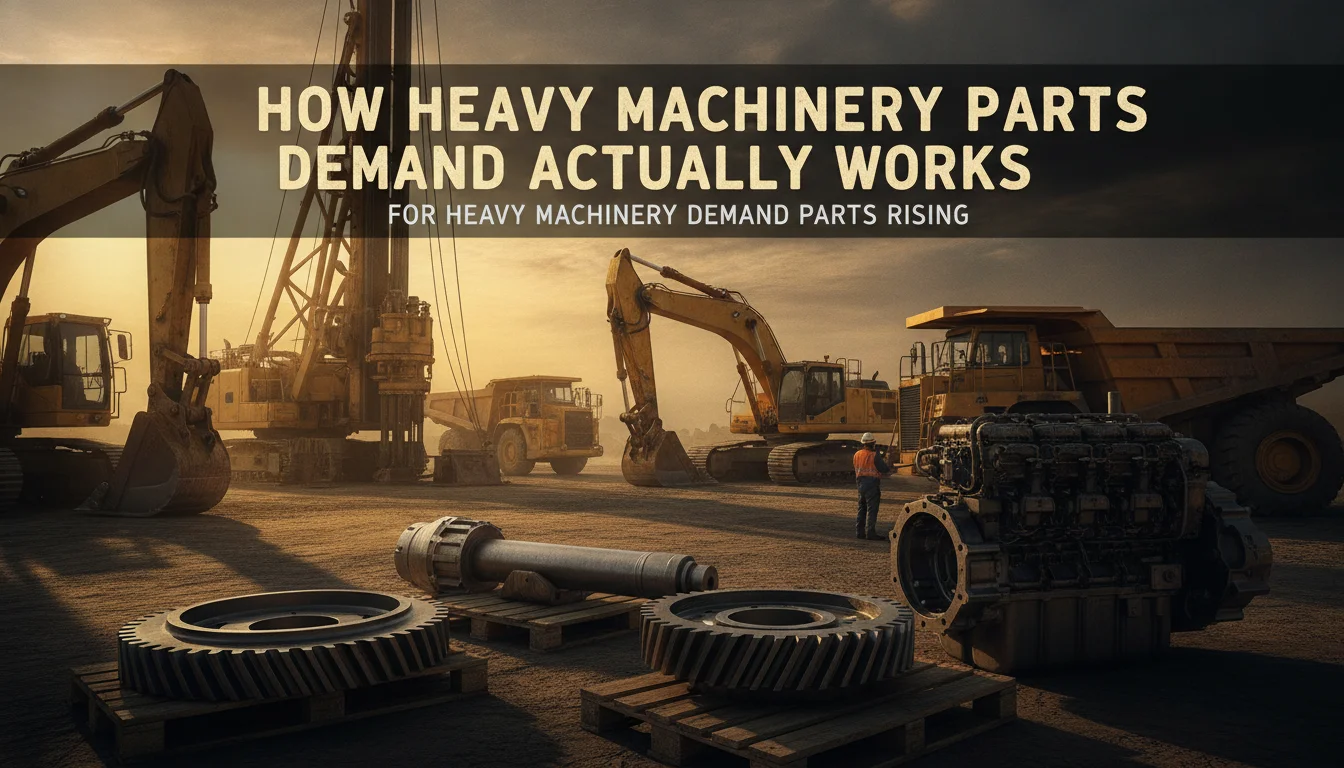
Heavy machinery demand rising parts follows a predictable mechanical and commercial logic. Understanding the underlying mechanics helps procurement teams make smarter sourcing decisions.
The Wear Cycle
Every heavy machine operates within a wear cycle. Components experience stress from load, vibration, heat, and contamination. Over time, tolerances degrade, seals fail, and metal surfaces wear beyond specification. The rate of wear depends on operating conditions, maintenance quality, and the original specification of the part.
OEM parts are engineered to precise tolerances for specific equipment models. When a Caterpillar 320 excavator hydraulic seal is specified to a particular durometer and temperature range, that specification exists because the engineering team tested it against real operating conditions. Substituting a lower-spec part might work for a few hundred hours, then fail catastrophically at the worst possible moment.
The Parts Ecosystem
Heavy machinery parts don't exist in isolation. Modern equipment integrates components from multiple suppliers: an OEM frame might house a third-party engine control system, a branded hydraulic pump, and aftermarket filters. According to McGill Industries, parts ecosystems are more interconnected than ever, with even major OEM equipment sometimes depending on specialized sub-suppliers. Woodward Inc., for example, has expanded its market share in engine control systems that integrate with major OEM equipment like Caterpillar.
For procurement teams, this interconnection means sourcing decisions for one component can affect the performance and warranty status of adjacent systems. Compatibility verification is not optional.
Supply Chain Mechanics
Parts move from manufacturer to end user through several channels: direct OEM distribution, authorized dealer networks, independent aftermarket distributors, and increasingly, digital marketplaces. Each channel offers different tradeoffs between price, lead time, availability, and quality assurance.
OEM channels typically offer the highest confidence in part authenticity and compatibility, but at premium pricing and sometimes longer lead times. Quality aftermarket distributors can match OEM specifications at lower cost, with faster availability for high-demand components. The key variable is supplier vetting: a reputable aftermarket supplier with batch-testing protocols and clear return policies is a fundamentally different proposition from a low-cost importer with no quality controls.
How to Apply This: A Practical Procurement Framework
Procurement managers navigating heavy machinery demand rising parts need a structured approach. Here are concrete steps that work in practice.
Step 1: Audit Your Fleet's Age and Wear Profile
Start with a complete inventory of your equipment fleet, including model, year, operating hours, and maintenance history. Flag any machines over 10 years old or with more than 10,000 operating hours as high-priority for proactive parts planning. These units will generate disproportionate parts demand and are most vulnerable to unplanned failures.
Step 2: Classify Parts by Criticality
Not all parts carry equal risk. Classify components into three tiers:
- Tier 1 (Critical): Parts whose failure causes immediate machine shutdown. Hydraulic seals, engine bearings, final drive components. Stock these locally or with a supplier who can deliver within 24-48 hours.
- Tier 2 (Important): Parts that degrade performance but allow limited continued operation. Filters, belts, minor electrical components. Maintain a buffer stock based on consumption history.
- Tier 3 (Routine): Wear items replaced on schedule. Bucket teeth, cutting edges, undercarriage wear parts. Plan these on a procurement calendar tied to operating hours.
Step 3: Qualify Multiple Suppliers for Each Tier
Single-source dependency is a procurement risk. For every Tier 1 and Tier 2 part category, qualify at least two suppliers: one OEM or authorized distributor, and one vetted aftermarket supplier. Evaluate suppliers on batch-testing protocols, return policies, lead time guarantees, and track record in your equipment brands.
Step 4: Implement Predictive Maintenance Data
If your equipment has telematics, use it. Connect machine health data to your parts procurement system so that wear alerts trigger purchase orders before failures occur. Even basic hour-meter tracking tied to manufacturer service intervals reduces emergency procurement events significantly.
Step 5: Negotiate Framework Agreements
For high-volume parts categories, negotiate annual framework agreements with your primary suppliers. These agreements lock in pricing, guarantee availability, and often include priority fulfillment during supply chain disruptions. For global operations, prioritize suppliers with regional distribution capabilities to minimize cross-border lead times.
Step 6: Track Total Cost of Ownership, Not Unit Price
A filter that costs 30 percent less but fails at half the service interval costs more in total. Build a simple total cost of ownership model for your highest-consumption parts categories, factoring in replacement frequency, installation labor, and downtime risk. This framework consistently justifies quality-first sourcing decisions.
OEM vs. Aftermarket vs. Genuine Parts: A Direct Comparison
Heavy machinery demand rising parts procurement requires a clear understanding of the three main part types. Each serves a different role in a well-structured maintenance strategy.
| Criteria | Genuine OEM Parts | OEM-Equivalent Parts | Aftermarket Parts |
|---|---|---|---|
| Manufacturer | Original equipment maker (e.g., Caterpillar, Komatsu) | Licensed third-party to OEM spec | Independent manufacturer |
| Compatibility | Guaranteed for specific model | High, when properly specified | Varies by supplier quality |
| Price | Highest | Moderate | Lowest to moderate |
| Availability | Through OEM dealer network | Broader distribution | Widest availability |
| Lead Time | Can be longer for specialty parts | Typically faster | Fastest for common parts |
| Quality Assurance | Highest, factory-tested | High, when supplier is vetted | Wide range: excellent to poor |
| Warranty Impact | No impact | Varies by OEM policy | May affect OEM warranty |
| Best Use Case | Critical systems, new equipment under warranty | Aging fleet maintenance, budget-conscious operations | High-consumption wear parts, budget-constrained fleets |
The right sourcing mix depends on your fleet age, operating environment, and risk tolerance. Most experienced procurement teams use genuine OEM parts for critical systems and vetted aftermarket components for high-consumption wear items.
Regional Market Analysis
Heavy machinery demand rising parts is not uniform across regions. Understanding regional dynamics helps global procurement teams anticipate availability constraints and pricing pressures.
Asia-Pacific: The Growth Engine
Asia-Pacific holds 38 percent of the global heavy equipment spare parts market share and is the fastest-growing region, according to market data from Competitor #1. Construction expansion in India and China, combined with growing mining activities and industrial development, is driving sustained demand. Government infrastructure funding in both countries has created a substantial and durable demand base for replacement components across all equipment categories.
North America: Mature but Active
The US market is driven by strong demand from construction, mining, agriculture, and industrial sectors. The country has a large installed base of heavy machinery requiring regular replacement components and maintenance services. Infrastructure modernization and commercial development activities keep construction equipment parts demand elevated. The market is also seeing increased adoption of predictive maintenance technologies and online spare parts platforms.
However, as Metal Center News reported in June 2025, the US heavy equipment market has experienced some softening following the post-pandemic demand surge of 2022 and 2023. Economic uncertainty and tariff policy questions have constrained equipment order velocity, particularly in North America. This near-term softening in new equipment sales actually supports parts demand: operators extend the life of existing machines rather than buying new ones, increasing maintenance and replacement part consumption.
Europe: Steady Demand, Regulatory Pressure
European markets show steady parts demand driven by infrastructure renewal and mining activity. Regulatory pressure around emissions and equipment efficiency is accelerating the adoption of newer machinery in some segments, which can temporarily reduce parts demand for older equipment while creating new demand for updated components.
Middle East and Africa: Project-Driven Demand
Large-scale energy and infrastructure projects across the Middle East and Africa create concentrated, project-driven demand for heavy machinery parts. Procurement in these regions often requires suppliers with strong global logistics capabilities and the ability to deliver to remote project sites on tight timelines.
Emerging Trends in the Heavy Machinery Parts Market
The heavy machinery parts market is evolving rapidly, and procurement teams that track these trends will be better positioned to manage costs and availability.
Growth of Aftermarket Parts
The aftermarket segment holds roughly 42 percent of market share, driven by cost efficiency and broad availability. This growth reflects a practical reality: as machinery ages and OEM parts become harder to source for older models, quality aftermarket alternatives fill a genuine supply gap. The key distinction is supplier quality. Reputable aftermarket suppliers offer components that match OEM specifications, with traceability and quality testing documentation. Low-cost importers with no quality controls represent a different and dangerous category entirely.
Digitalization and E-Commerce
E-commerce platforms for spare parts procurement are becoming standard across the industry. Businesses are turning to online platforms for faster access to parts, reduced lead times, and improved inventory management. According to Spherical Insights, digital spare parts marketplaces represent one of the primary growth opportunities in the market through 2035. Real-time inventory tracking, digital part number cross-referencing, and online ordering with global shipping integration are now baseline expectations for serious industrial suppliers.
Predictive Maintenance and IoT Integration
The integration of IoT sensors and telematics into heavy machinery is changing demand patterns for heavy machinery demand rising parts. Rather than replacing parts on fixed schedules or after failure, operators can now replace components based on actual wear data. This shift reduces both emergency procurement events and unnecessary preventive replacements, but it also requires procurement teams to respond faster when sensor data flags an imminent failure.
According to Spherical Insights, the implementation of predictive maintenance systems together with IoT monitoring technologies has brought about changes in how spare parts demand patterns develop across the industry.
Focus on Quality Assurance
With low-quality parts flooding the market, procurement teams are placing greater emphasis on supplier qualification and component traceability. The financial logic is straightforward: a failed part that causes machine downtime at $260,000 per hour makes any upfront cost savings irrelevant. Quality assurance now means more than checking a part number. It means verifying batch-testing protocols, reviewing supplier certifications, and confirming compatibility documentation before purchase.
"Reputable suppliers should offer a mix of high-quality components that are competitively priced: genuine brand-name parts that offer traceability, OEM components that provide identical quality without brand premiums, and properly vetted replacement parts that can match OEM specs." - McGill Industries, The Critical Demand for Heavy Equipment Parts, 2025
Key Players in the Heavy Machinery Parts Market
Several companies dominate the heavy machinery parts market through extensive portfolios, global distribution networks, and strong brand recognition among procurement teams.
Caterpillar Inc.
Caterpillar holds a dominant position in the heavy equipment market, with a 42.21 percent market share according to McGill Industries. When nearly half of job sites run Caterpillar equipment, procurement teams face a dual challenge: genuine parts ensure compatibility and performance, but OEM pricing can strain maintenance budgets. This tension drives demand for quality OEM-equivalent alternatives for non-critical components, while keeping genuine Cat parts in the mix for critical systems.
Komatsu Ltd.
Komatsu is a major player known for innovative solutions and a comprehensive parts portfolio. Their focus on technological integration, including telematics and connected equipment platforms, positions them well for the predictive maintenance era. Komatsu's global distribution network supports procurement teams in regions where local dealer coverage is limited.
Other Notable Companies
Volvo Construction Equipment, Hitachi Construction Machinery, and John Deere each contribute significantly to the market through distinct product lines and regional strengths. The broader ecosystem also includes specialized sub-suppliers like Woodward Inc. in engine control systems, whose components integrate with major OEM equipment and create their own parts demand streams.
Common Mistakes in Heavy Machinery Parts Procurement
Procurement teams managing heavy machinery demand rising parts consistently make the same avoidable errors. Recognizing these patterns is the first step to eliminating them.
Mistake 1: Prioritizing Unit Price Over Total Cost
Buying the cheapest available part is the most common and most costly mistake in heavy equipment procurement. A hydraulic seal that costs half the OEM price but fails in 500 hours instead of 2,000 hours costs four times as much in total, before accounting for the labor and downtime associated with the premature failure. Always calculate total cost of ownership, not just purchase price.
Mistake 2: Single-Source Dependency
Relying on a single supplier for critical parts creates catastrophic vulnerability during supply chain disruptions. The COVID-19 pandemic exposed this risk across every industry. Procurement teams that had qualified backup suppliers weathered the disruption far better than those who didn't. For every Tier 1 critical part, maintain at least two qualified sources.
Mistake 3: Skipping Supplier Qualification
Not all suppliers claiming to offer OEM-quality parts actually deliver them. Effective supplier qualification means asking specific questions: Do they batch-test components? What are their return and warranty policies? Can they provide traceability documentation? What's their track record with your specific equipment brands? Skipping this process is how low-quality parts enter your maintenance program.
Mistake 4: Reactive Rather Than Predictive Procurement
Waiting for a part to fail before ordering a replacement is the most expensive procurement strategy possible. Emergency sourcing costs more, takes longer, and often results in accepting whatever is available rather than what is optimal. Telematics data and manufacturer service intervals give procurement teams the information they need to stay ahead of failures. Use it.
Mistake 5: Ignoring Compatibility Verification
Part number matching is necessary but not sufficient. Heavy machinery parts ecosystems are interconnected, and a component that fits physically may not be compatible with adjacent systems. Always verify compatibility against the specific machine model, serial number range, and build date. This is especially critical for electrical components and hydraulic systems where specification mismatches can cause cascading failures.
A Realistic Procurement Scenario
Consider a mining operation running a fleet of 15 Komatsu PC490 excavators in a remote location. The fleet averages 4,500 operating hours per year per machine. Based on manufacturer service data, final drive components on these machines typically require inspection at 8,000 hours and replacement at 12,000-15,000 hours under normal conditions. In a high-abrasion environment, that interval compresses.
Without a proactive procurement strategy, the operation discovers a failing final drive during a routine inspection. Emergency sourcing from the nearest OEM dealer takes 10-14 days. The machine sits idle for two weeks, costing the operation in lost production and project delays.
With a structured approach: the procurement team has already identified final drive components as Tier 1 critical parts for this fleet. They've qualified two suppliers, one OEM dealer and one vetted aftermarket distributor with documented OEM-equivalent specifications. They maintain a small buffer stock of the highest-consumption components at the site. When the inspection flags early wear, a replacement is ordered and arrives within 5 days. The machine is back in service before failure occurs.
The difference between these two scenarios is not luck. It's procurement discipline applied to heavy machinery demand rising parts.
Challenges Facing the Heavy Machinery Parts Market
Despite strong growth prospects, the heavy machinery parts market faces real headwinds that procurement teams need to plan around.
Economic Uncertainty
Economic fluctuations affect heavy machinery sales and, consequently, parts demand. As Metal Center News reported in June 2025, the US heavy equipment market has softened following the post-pandemic surge, with tariff uncertainty and trade policy questions constraining order velocity. Caterpillar's CEO noted during Q1 2025 earnings that while results were better than expected, the situation remains fluid given tariff uncertainty. Deere & Co. similarly reported that uncertainty had constrained equipment order velocity in North America.
For parts procurement, near-term economic softening in new equipment sales can actually support parts demand, as operators extend existing fleet life rather than buying new machines.
Supply Chain Disruptions
Global supply chain disruptions have led to delays in parts availability across multiple categories. Companies must build supply chain resilience through supplier diversification, strategic buffer stocks, and framework agreements with suppliers who have regional distribution capabilities.
Quality Control Issues
The proliferation of low-quality parts is a genuine market risk. Procurement teams must implement stringent supplier qualification processes and insist on traceability documentation for all critical components. The short-term cost savings from inferior parts are never worth the downtime and reputational risk of a preventable failure.
Pros and Cons of the Current Heavy Machinery Parts Market
The current market environment for heavy machinery demand rising parts presents both real opportunities and genuine challenges for procurement teams.
Pros
- Expanding supply options: Growth in the aftermarket segment and digital marketplaces gives procurement teams more sourcing choices than ever before.
- Technology-driven efficiency: Predictive maintenance and digital inventory systems reduce emergency procurement events and improve planning accuracy.
- Competitive pricing: Increased competition among suppliers, particularly in the aftermarket segment, is keeping prices competitive for high-consumption wear parts.
- Faster global delivery: Improved logistics networks and regional distribution hubs are compressing lead times for international procurement.
- Better quality assurance tools: Digital traceability, batch-testing documentation, and supplier certification programs make it easier to verify part quality before purchase.
Cons
- Low-quality parts proliferation: The same market growth that creates more sourcing options also attracts low-quality suppliers. Supplier qualification is more important, and more time-consuming, than ever.
- Supply chain fragility: Global supply chains remain vulnerable to disruption from geopolitical events, tariff changes, and logistics bottlenecks.
- Price volatility: Raw material costs and logistics expenses create pricing uncertainty for both OEM and aftermarket components.
- Compatibility complexity: As machinery becomes more technologically integrated, compatibility verification becomes more complex and the cost of getting it wrong increases.
- Economic headwinds: Near-term uncertainty in new equipment markets can create demand volatility for certain parts categories.
Future Outlook for Heavy Machinery Parts
The future of heavy machinery demand rising parts looks structurally strong through 2035 and beyond. Infrastructure investment, mining expansion, and the global energy transition are all driving sustained demand for heavy equipment, which translates directly into parts consumption.
Technology will continue reshaping the market. AI diagnostic systems, digital spare parts marketplaces, and IoT-enabled predictive maintenance will change how and when parts are procured, but they won't reduce the fundamental need for quality components. If anything, they'll raise the bar on supplier responsiveness and part quality, as operators become better at detecting wear and less tolerant of supply delays.
As of 2026, the procurement teams best positioned for this environment are those that have already built diversified supplier networks, implemented data-driven maintenance planning, and established clear quality standards for every part category in their fleet. The market will reward preparation and punish reactive sourcing.
For global procurement teams, working with suppliers who combine OEM-quality standards with fast international delivery is the practical answer to heavy machinery demand rising parts challenges. That's exactly what we've built at 3GEN Export: a global parts supply operation covering 40+ equipment brands, with 5-day delivery to most destinations worldwide.
Explore our full range of OEM-quality spare parts for Caterpillar, Komatsu, Volvo, Atlas Copco, and 40+ brands at 3genexport.com. Fast global delivery, competitive pricing, and quality you can document.
Frequently Asked Questions
What heavy machinery is in demand for spare parts right now?
Construction equipment, particularly excavators and loaders, drives the largest share of heavy machinery demand rising parts globally. Mining equipment, including dump trucks and drilling machinery, is the fastest-growing category. According to market data, construction equipment accounted for 48 percent of spare parts demand in 2025, with excavators leading within that segment.
What factors are driving the demand for heavy machinery parts?
The demand for heavy machinery parts is driven by three primary forces: infrastructure development projects worldwide, aging machinery fleets requiring more frequent replacements, and technological advancements that enable predictive maintenance and faster procurement. Regional infrastructure investment, particularly in Asia-Pacific, is the single largest demand driver as of 2026.
Why are heavy equipment sales falling while parts demand stays strong?
New equipment sales and parts demand often move in opposite directions during economic uncertainty. When operators delay new machine purchases due to budget constraints or market uncertainty, they extend the life of existing equipment, which increases maintenance and replacement part consumption. This counter-cyclical dynamic means parts demand can remain strong even when new equipment order velocity slows.
Which segment holds the largest share in the heavy machinery parts market?
The construction equipment segment holds the largest share, accounting for 48 percent of spare parts demand driven by ongoing infrastructure projects and high machinery utilization rates. Within construction equipment, excavators represent the leading equipment type for parts consumption.
How significant is the aftermarket segment in the heavy machinery parts market?
The aftermarket segment holds roughly 42 percent of market share, making it the largest single part type category. This reflects the cost efficiency and broad availability of quality aftermarket components for aging fleets. The key distinction is supplier quality: vetted aftermarket parts from reputable distributors can match OEM specifications, while low-cost alternatives carry significant performance and downtime risk.
What is the projected growth rate of the heavy machinery parts market through 2035?
The global heavy equipment spare parts market is projected to grow at a CAGR of 5.37 percent, reaching USD 213.73 billion by 2035 from a 2026 base of approximately USD 133.43 billion. The construction and mining equipment spare parts segment shows a higher growth rate of 8.70 percent through 2030, per Mordor Intelligence, reflecting particularly strong demand in those sectors.