
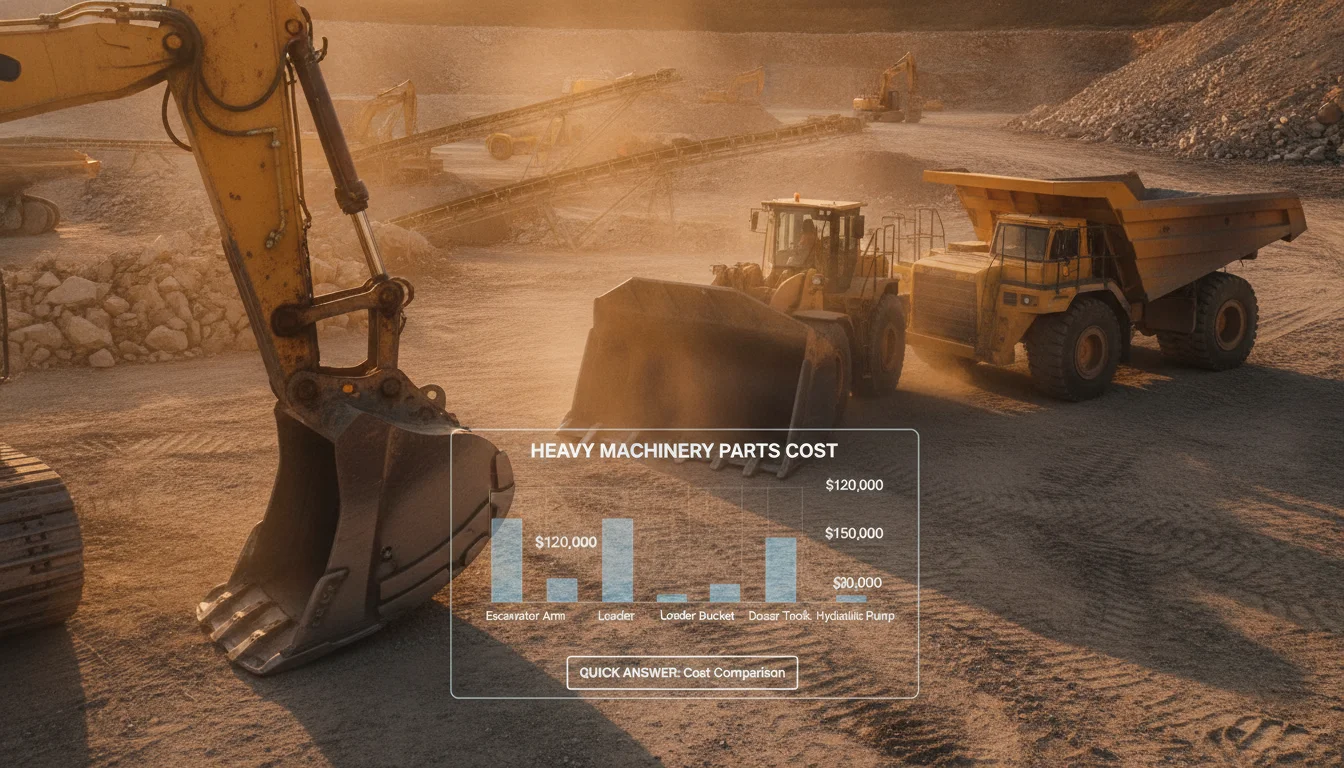
Heavy Machinery Parts Cost Comparison 2026
Heavy machinery parts cost comparison: OEM vs aftermarket pricing, TCO analysis, and buying tips for global procurement teams. Get OEM-quality parts fast.
Loading article…
Article Not Found
The article you're looking for doesn't exist or may have been removed.
Back to BlogQuick Answer
Heavy machinery parts cost comparison is the process of evaluating OEM parts against aftermarket alternatives across price, quality, warranty, and total lifecycle cost to find the best value for your fleet.
Key Takeaways
- OEM parts cost 20-50% more upfront than aftermarket alternatives, but often deliver lower total lifecycle costs.
- Aftermarket quality varies widely: top-tier suppliers can match OEM performance, while budget options may fail prematurely under heavy loads.
- Total Cost of Ownership (TCO) must include purchase price, installation, maintenance frequency, and downtime exposure.
- Knowing your machine's exact make, model, and serial number is the first step to avoiding costly compatibility errors.
- OEM parts typically carry comprehensive warranties; most aftermarket parts offer limited or no warranty coverage.
- As of 2026, global supply chain pressures are making strategic parts sourcing more critical than ever for fleet operators.
Understanding Heavy Machinery Parts
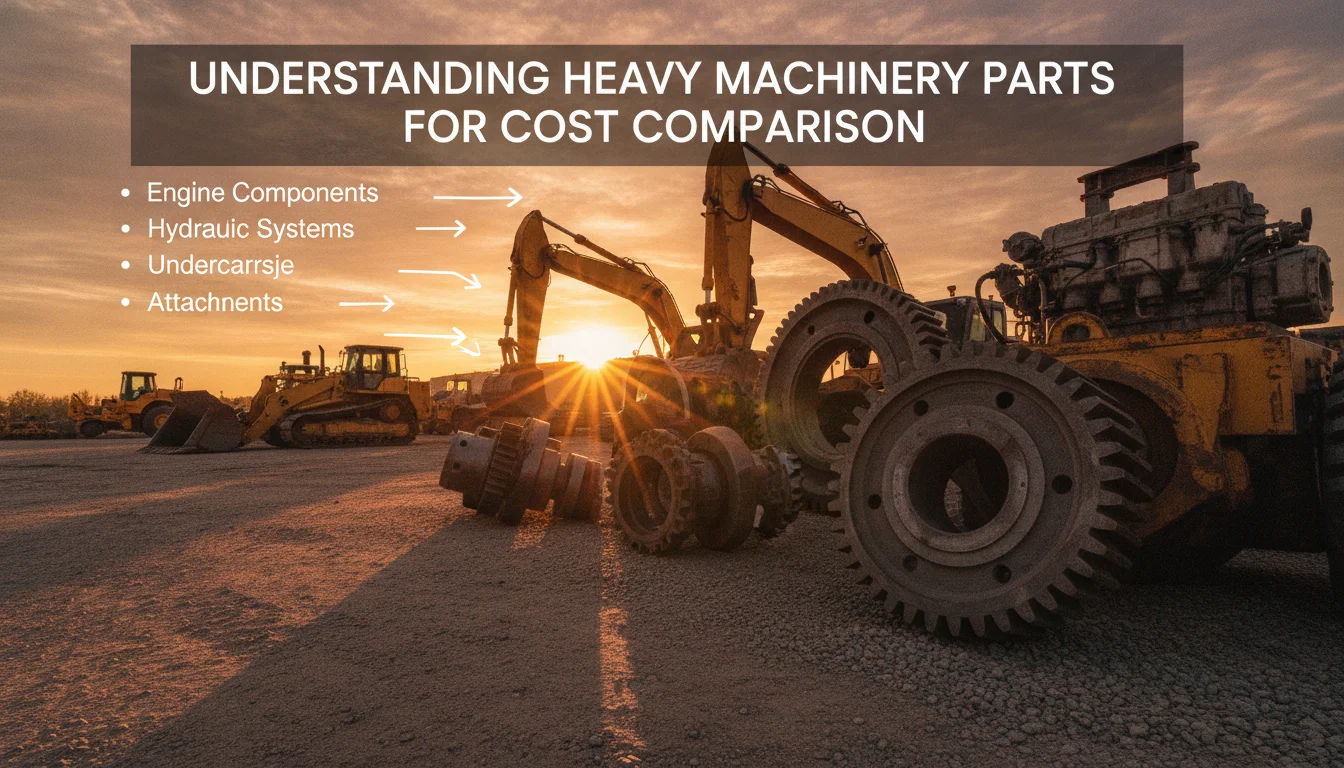
Heavy machinery parts are the essential components that keep construction, mining, and energy equipment running at full capacity. Any serious heavy machinery parts cost comparison starts here: understanding exactly what you're buying before you compare prices.
What Are OEM Parts?
OEM parts are manufactured by the original equipment maker, built to exact factory specifications for a specific machine. Caterpillar, Komatsu, Volvo, Hitachi, and John Deere all produce OEM components engineered to precise tolerances. This guarantees compatibility and performance, which is critical for maintaining structural integrity and warranty compliance.
Consider a concrete example: an OEM track link assembly for a John Deere 210G LC uses proprietary alloys engineered to resist wear in abrasive soils, matching the original blueprint to prevent vibrations or misalignments that accelerate failures. That level of precision is what you pay for with OEM.
What Are Aftermarket Parts?
Aftermarket parts come from third-party manufacturers not affiliated with the original equipment maker. They aim to replicate OEM specifications, but quality varies significantly across suppliers. Some aftermarket producers use reverse-engineered designs with high-grade steel and deliver performance close to OEM standards. Others cut corners on heat treatment and material quality, leading to premature wear.
The appeal is straightforward: lower upfront cost. But that cost advantage can disappear quickly if the part fails under load or requires replacement ahead of schedule.
Cost Analysis: OEM vs Aftermarket Parts
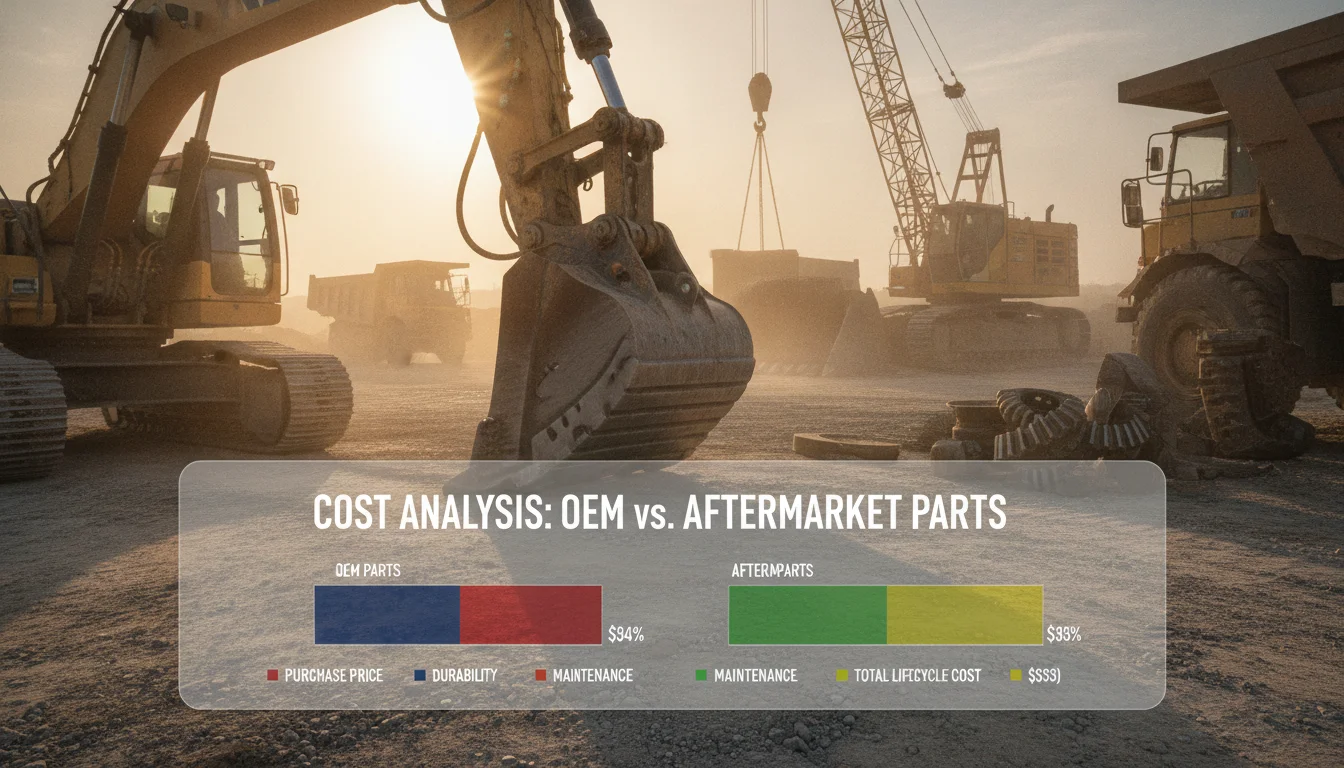
A thorough heavy machinery parts cost comparison must go beyond the sticker price. This section breaks down the real numbers across purchase price, quality, and warranty coverage.
Price Differences
OEM parts typically run 20-50% higher in cost than aftermarket equivalents, according to equipment lifecycle data from the excavator parts market. For example, a genuine Caterpillar hydraulic pump may cost $2,500, while a comparable aftermarket unit could be priced around $1,500. That $1,000 gap is real, and for fleets managing dozens of machines, it adds up fast.
Aftermarket sprockets for a Volvo EC210 might cost 25-40% less than OEM, freeing up capital for other operational needs. The question is always whether that savings holds over the full service life of the part.
Quality and Performance
OEM parts are designed to meet exact machinery specifications. Aftermarket parts can vary widely. High-quality aftermarket parts may perform comparably to OEM in light-duty or moderate-use scenarios. Under heavy loads, however, some aftermarket components show higher failure rates, per equipment maintenance data from the excavator parts industry. Budget options that skip proper heat treatment are the most common culprits.
The key is supplier selection. Not all aftermarket is equal. A reputable aftermarket supplier with documented quality controls is a very different proposition from an unknown low-cost importer.
Warranty and Support
OEM parts typically come with comprehensive warranties that guarantee performance and reliability. Aftermarket parts may carry limited warranties, or none at all. This matters enormously when a part fails at a critical point in a project. Without warranty coverage, the full cost of replacement and associated downtime falls entirely on the operator.
"For professionals running high-hour machines and adhering to tight deadlines, minimizing unexpected failures and costly downtime is paramount. OEM provides that unshakeable confidence for high-stakes jobs where a crack in a suspension component could halt a multimillion-dollar project." - Langley Excavator Parts, industry analysis
Comparison Table: OEM vs Aftermarket Parts
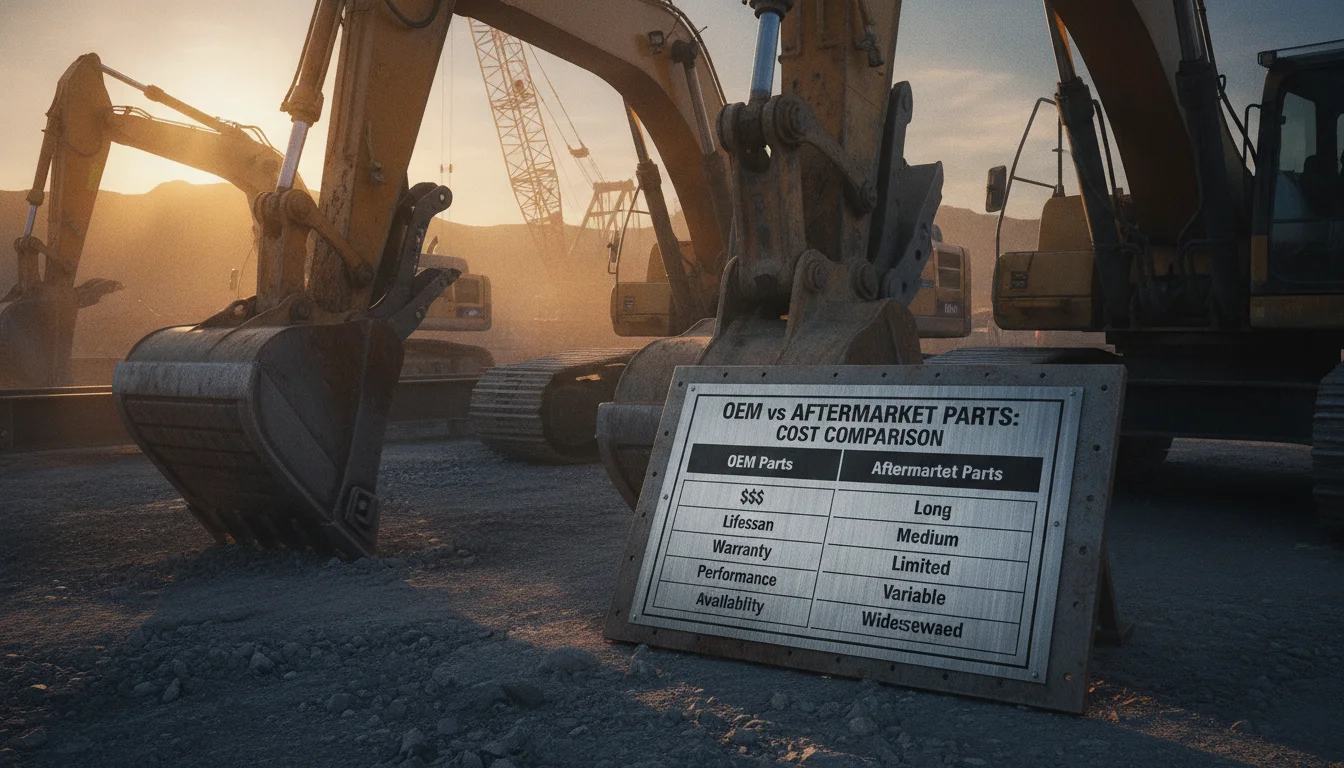
| Feature | OEM Parts | Aftermarket Parts |
|---|---|---|
| Cost | 20-50% higher upfront | Lower, but quality varies |
| Quality | High, meets factory specifications | Variable: some match OEM, some fall short |
| Warranty | Comprehensive manufacturer warranty | Limited or no warranty |
| Reliability | High, fewer unexpected failures | Variable, higher failure risk under heavy loads |
| Longevity | Longer service life | Shorter lifespan possible, more replacements |
| Compatibility | Guaranteed fit for specific machine | May require verification against serial number breaks |
| Resale Value Impact | Maintains machine value and warranty compliance | May affect resale value if non-OEM parts are documented |
Pros and Cons
Pros of OEM Parts
- Guaranteed compatibility with your specific machine model and serial number
- Comprehensive warranty coverage reduces financial risk on part failure
- Consistent quality and performance across every unit
- Maintains machine resale value and warranty compliance
- Engineered to exact tolerances, reducing wear on adjacent components
Cons of OEM Parts
- 20-50% higher upfront cost compared to aftermarket alternatives
- Longer lead times in some regions due to limited distribution networks
- Single-source supply can create procurement bottlenecks for global fleets
Evaluating Total Cost of Ownership (TCO)
Total Cost of Ownership is the only honest framework for a heavy machinery parts cost comparison. TCO captures not just the purchase price, but every dollar the part costs you over its full service life.
Initial Purchase Price
The purchase price is the most visible component of TCO. OEM parts cost more upfront. That's a fact. But longevity and reliability can offset that premium over a full maintenance cycle, particularly for high-wear components like undercarriage parts, hydraulic seals, and filters.
Maintenance and Repair Costs
Regular maintenance is the foundation of extending heavy machinery service life. OEM parts typically require less frequent replacement, which lowers cumulative maintenance costs. Cheaper aftermarket parts may need replacement sooner, and each replacement carries its own labor cost, parts cost, and scheduling disruption.
According to manufacturer service bulletins, using non-OEM components in critical systems can also accelerate wear on adjacent parts. A substandard hydraulic seal, for example, doesn't just fail on its own: it can damage the pump, the cylinder, and connected hoses, turning a $200 seal replacement into a $3,000 repair job.
Downtime Costs
Downtime is one of the most significant hidden costs in construction and mining operations. If a machine fails due to a faulty part, the resulting idle time translates directly into lost productivity and missed project milestones. Investing in reliable parts, whether OEM or verified high-quality aftermarket, minimizes this exposure.
As the equipment maintenance community consistently notes: if you can't afford the parts, you likely can't afford to own the machine. The two go together.
How the Cost Comparison Actually Works: The Mechanics Behind TCO
Understanding how to run a proper heavy machinery parts cost comparison requires more than a price list. Here's the underlying framework procurement teams use to make defensible decisions.
Equipment cost analysis, as documented in civil engineering practice literature, divides costs into two main categories: owning costs and operating costs. Owning costs include depreciation, cost of capital, insurance, taxes, and storage. Operating costs include fuel, filters, oil, grease, tires, and repair. Parts purchasing decisions sit squarely in the repair and maintenance column of operating costs, but they ripple into depreciation and resale value as well.
When you run a true TCO model, you're calculating the hourly cost of equipment ownership as accurately as possible. That means assigning a cost-per-hour figure to every major component based on its expected service life. A hydraulic pump rated for 8,000 hours at $2,500 OEM costs roughly $0.31 per operating hour. An aftermarket equivalent at $1,500 but rated for only 5,000 hours costs $0.30 per hour. The savings are minimal, and that calculation doesn't yet account for the warranty risk or the labor cost of an earlier replacement.
This cost-per-hour model is the standard approach for contractors preparing accurate bids and negotiating change orders, per established equipment costing methodology in the construction industry.
"Equipment cost analysis is important to all parties to the construction contract. Contractors need an accurate estimate of equipment costs to ensure that they are not losing money by using rented or owned equipment on various jobs." - Papathanasiou & Touran, Civil Engineering Practice
How to Apply This: A Step-by-Step Buying Process
Applying a rigorous heavy machinery parts cost comparison to your procurement process doesn't require a finance team. Follow these steps and you'll make better decisions consistently.
Step 1: Confirm Your Machine's Exact Specifications
Before you look at a single price, confirm your machine's make, model, and serial number. This is non-negotiable. Different production years of the same model may require different parts due to serial number breaks: design changes a manufacturer makes mid-production run. Two machines with identical model numbers but different serial numbers can require completely different components. Always verify against the serial number break before ordering.
Step 2: Identify the Part Category and Criticality
Not all parts carry the same risk profile. Categorize the part you need by criticality:
- Critical components (hydraulic pumps, track link assemblies, engine components): Failure causes immediate machine shutdown. OEM is strongly preferred.
- Wear parts (filters, seals, belts, hoses): Higher replacement frequency. Quality aftermarket from a verified supplier is often acceptable.
- Structural components (boom pins, bucket teeth, undercarriage frames): Failure creates safety risk. OEM or certified aftermarket only.
Step 3: Run the Cost-Per-Hour Calculation
Divide the part price by its expected service life in hours. Compare OEM and aftermarket on this basis, not on sticker price alone. Factor in the labor cost of installation, since a part you replace twice costs you two installation cycles, not one.
Step 4: Vet Your Supplier
Research suppliers before committing. Look for documented quality controls, warranty terms, and a track record with your specific brand. For OEM parts, verify the supplier is an authorized distributor. For aftermarket, ask for material certifications and quality documentation. A reputable supplier will provide both without hesitation.
Step 5: Factor in Lead Time and Logistics
As of 2026, global supply chain dynamics mean lead time is a real cost factor. An OEM part that takes three weeks to ship from a regional warehouse can cost you more in downtime than the price difference between OEM and aftermarket. Work with suppliers who offer fast global delivery and maintain stock of high-demand components for your equipment brands.
Step 6: Document and Review
Track every parts purchase against actual service life. Over time, this data becomes your most valuable procurement tool. You'll know which aftermarket suppliers consistently deliver on their specifications and which OEM parts are worth every dollar of the premium.
Common Mistakes to Watch Out For
Most procurement errors in heavy machinery parts buying follow predictable patterns. Here are the ones we see most often, and how to avoid them.
Buying on Price Alone
The lowest price on a hydraulic component is rarely the best value. A part that fails at 60% of its rated service life costs more per operating hour than an OEM unit that runs to full specification. Always calculate cost-per-hour, not just cost-per-unit.
Ignoring Serial Number Breaks
Ordering a part without verifying the serial number break is one of the most common and costly mistakes in parts procurement. You receive the wrong part, pay return shipping, wait for the correct one, and your machine sits idle the entire time. Confirm the serial number break before every order.
Skipping Supplier Vetting
Not all aftermarket suppliers operate to the same standard. Buying from an unverified source to save a few hundred dollars can result in a part that fails within weeks. Ask for quality documentation, warranty terms, and references before placing a first order with any new supplier.
Underestimating Downtime Costs
Procurement teams often focus on parts cost and overlook the cost of the machine sitting idle. In active construction or mining operations, every day of unplanned downtime has a direct financial impact. Build downtime risk into your parts cost comparison, not just the purchase price.
Treating All Aftermarket as Equal
There's a wide spectrum of aftermarket quality. A top-tier aftermarket supplier using certified materials and documented manufacturing processes is a fundamentally different proposition from a low-cost importer with no quality controls. Treat supplier quality as a variable in your cost comparison, not a constant.
Realistic Scenario: Undercarriage Replacement Decision
Here's how a real procurement decision plays out using the framework above.
A fleet manager at a mid-size civil contractor is running a Caterpillar 336 excavator with 6,200 hours on the undercarriage. The machine operates in abrasive sandy soil conditions, which accelerates track wear. The undercarriage needs full replacement: track chains, sprockets, and idlers.
The OEM Caterpillar undercarriage kit is quoted at $18,000 with a 12-month warranty and an expected service life of 4,000-5,000 hours under current conditions. A reputable aftermarket kit from a verified supplier is quoted at $11,500 with a 6-month warranty and an estimated service life of 3,000-3,500 hours based on the supplier's published specifications.
Running the cost-per-hour calculation:
- OEM: $18,000 divided by 4,500 hours (midpoint) = $4.00 per operating hour
- Aftermarket: $11,500 divided by 3,250 hours (midpoint) = $3.54 per operating hour
On paper, the aftermarket option is cheaper per hour. But the fleet manager also factors in two additional variables: the OEM kit carries a 12-month warranty versus 6 months for aftermarket, and the machine is scheduled for a major project starting in 90 days where any unplanned downtime would trigger penalty clauses in the contract.
The decision: OEM. The $6,500 price difference is real, but the warranty coverage and reduced failure risk during a critical project window justify the premium. After the project, the fleet manager plans to re-evaluate aftermarket options for the next undercarriage cycle on a lower-priority machine.
This is how experienced procurement teams approach heavy machinery parts cost comparison: not as a one-time price check, but as a risk-adjusted business decision.
Impact of Quality on Long-Term Costs
The quality of parts used in heavy machinery directly determines long-term operating costs. This isn't a theoretical claim: it shows up in maintenance records, downtime logs, and resale valuations.
Reliability of OEM Parts
OEM parts are engineered to fit precisely and function optimally within a specific machine. This reliability translates into fewer unplanned breakdowns and lower cumulative maintenance costs. Per equipment lifecycle data, OEM undercarriage components like sprockets can outlast generic alternatives by a significant margin in demanding operating conditions.
Variability in Aftermarket Parts
Aftermarket quality is not uniform. Some manufacturers produce components that rival OEM performance. Others reduce costs by skipping critical manufacturing steps like heat treatment, which directly affects wear resistance under load. This variability is the central challenge in any aftermarket parts evaluation: you need supplier-level due diligence, not just part-level price comparison.
Long-Term Investment Considerations
Choosing between OEM and aftermarket is a long-term investment decision, not a transactional one. Companies that track parts performance over full machine lifecycles consistently find that quality parts, whether OEM or verified high-grade aftermarket, deliver better returns than the cheapest available option. The math is straightforward: fewer replacements, less labor, less downtime.
Best Practices for Purchasing Heavy Machinery Parts
To get the best value from your heavy machinery parts cost comparison, follow these proven purchasing practices.
Know Your Equipment
Your machine's make, model, and serial number are the foundation of every parts order. This information ensures you order the correct part and eliminates compatibility risk. Keep it documented and accessible for everyone on your procurement team.
Research Suppliers
Not all suppliers operate to the same standard. Research suppliers, check references, and look for documented quality controls and warranty terms. For OEM parts, confirm authorized distributor status. For aftermarket, request material certifications. A reputable supplier will provide this documentation without hesitation.
Evaluate Total Costs
Before committing to any purchase, run the full TCO calculation: purchase price, installation labor, expected service life, warranty coverage, and downtime risk. This approach consistently produces better procurement decisions than price-only comparisons.
Consider Lead Time as a Cost
As of 2026, global logistics remain a variable that procurement teams can't ignore. A part that's 15% cheaper but takes three weeks longer to arrive may cost more in total when you account for machine idle time. Work with suppliers who maintain stock of high-demand components and offer reliable global delivery timelines.
2026 Outlook: What's Changing in Parts Procurement
This year, several trends are reshaping how fleet operators approach heavy machinery parts cost comparison and sourcing strategy.
Global supply chain normalization is improving availability of OEM parts in many markets, but regional shortages for specific brands and models remain a real operational risk. Procurement teams that rely on a single-source OEM supplier without a qualified aftermarket backup are exposed to extended lead times when OEM stock runs out.
At the same time, the aftermarket parts sector continues to mature. More suppliers are investing in quality certification and documented manufacturing standards, which is raising the floor on aftermarket quality. This makes supplier vetting more important than ever: the range from best to worst aftermarket has narrowed at the top but remains wide at the bottom.
For global fleets operating Caterpillar, Komatsu, Volvo, Atlas Copco, and other major brands, the most effective strategy in 2026 combines OEM parts for critical and high-risk components with verified high-quality aftermarket for wear parts and consumables. This hybrid approach optimizes cost without compromising reliability.
Frequently Asked Questions
What is the difference between OEM and aftermarket parts?
OEM parts are manufactured by the original equipment maker and built to exact factory specifications for a specific machine. Aftermarket parts are produced by third-party companies and aim to replicate OEM specs, but quality varies significantly across suppliers. The key difference is consistency: OEM delivers uniform quality, while aftermarket requires supplier-level vetting.
Are aftermarket parts reliable for heavy machinery?
Aftermarket parts can be reliable, but reliability depends entirely on the supplier and the application. Top-tier aftermarket manufacturers use certified materials and documented processes that deliver performance close to OEM standards. Budget aftermarket options, particularly those skipping heat treatment on wear components, carry a higher failure risk under heavy loads.
How much can I save by using aftermarket parts?
Aftermarket parts typically cost 20-50% less than OEM equivalents at the point of purchase, per equipment parts market data. However, actual savings depend on the specific part, the supplier's quality level, and the service life the part delivers. Running a cost-per-hour calculation gives a more accurate picture of real savings than comparing sticker prices alone.
Do OEM parts come with warranties?
Yes. OEM parts typically carry comprehensive manufacturer warranties that cover performance and reliability for a defined period. Aftermarket parts may offer limited warranties, or none at all. Warranty coverage is a significant factor in total cost of ownership, particularly for high-value components where a premature failure triggers substantial repair and downtime costs.
How do I choose the right parts for my machinery?
Start with your machine's exact make, model, and serial number, and verify against any serial number breaks before ordering. Categorize the part by criticality: use OEM for critical and structural components, and consider verified high-quality aftermarket for wear parts and consumables. Always evaluate total cost of ownership, not just purchase price, and vet your supplier's quality documentation before placing an order.
What is the most cost-effective approach for fleet operators in 2026?
As of 2026, the most cost-effective strategy for fleet operators combines OEM parts for critical components with verified high-quality aftermarket for wear parts and consumables. This hybrid approach reduces upfront parts spend without compromising reliability on high-risk components. Tracking actual parts performance over time gives your team the data to refine this balance for your specific equipment and operating conditions.
Can using aftermarket parts void my equipment warranty?
Using non-OEM parts can affect your equipment's manufacturer warranty, depending on the terms of your warranty agreement and the jurisdiction you operate in. For machines still under OEM warranty, consult your dealer before installing aftermarket components. Once the OEM warranty period has expired, aftermarket parts are generally a viable option provided you select a reputable supplier.
Ready to source OEM-quality spare parts with fast global delivery? Shop at 3genexport.com and get the components you need, shipped worldwide in as little as 5 days.