
Heavy Machinery Parts for Export: 2026 Buying Guide
Source heavy machinery parts for export with confidence. Compare OEM vs aftermarket, shipping methods, and top suppliers for fast global delivery in 2026.
Loading article…
Article Not Found
The article you're looking for doesn't exist or may have been removed.
Back to BlogHeavy Machinery Parts for Export: 2026 Buying Guide
Heavy machinery parts for export are OEM, aftermarket, rebuilt, or used components sourced internationally for construction, mining, and industrial equipment. Procurement managers across Africa, the Middle East, Latin America, and Asia rely on cross-border supply chains to keep fleets operational when local stock runs dry.
Key Takeaways
- OEM, aftermarket, rebuilt, and used parts each serve distinct budget and performance needs.
- Compatibility verification by model and serial number prevents costly returns and downtime.
- Caterpillar, Komatsu, Volvo, John Deere, and Hitachi parts drive the highest global export demand.
- Shipping method choice (RO/RO, container, flat rack) directly affects lead time and total landed cost.
- Supplier reputation, parts availability, and export documentation experience are the three non-negotiable selection criteria.
- As of 2026, demand for U.S.-sourced heavy equipment parts continues to grow across developing markets.
Understanding Heavy Machinery Parts
Heavy machinery parts are the components that keep construction, mining, agricultural, and industrial equipment running. Knowing the four main categories helps procurement teams match the right part to the right budget without sacrificing reliability.
- OEM Parts: Original Equipment Manufacturer parts are produced by the same manufacturer that built the machine. They carry the tightest tolerances and are the safest choice for warranty-sensitive or mission-critical applications.
- Aftermarket Parts: Third-party manufacturers produce these to OEM specifications, often at a lower price point. Quality varies widely, so supplier vetting matters here more than anywhere else.
- Rebuilt Parts: Used cores that have been disassembled, inspected, and restored to original performance specs. Hydraulic pumps, final drives, and swing drives are common candidates for rebuilding.
- Used Parts: Pre-owned components pulled from decommissioned machines. Best suited for older models where new parts are scarce or prohibitively expensive.
Types of Heavy Machinery Parts for Export
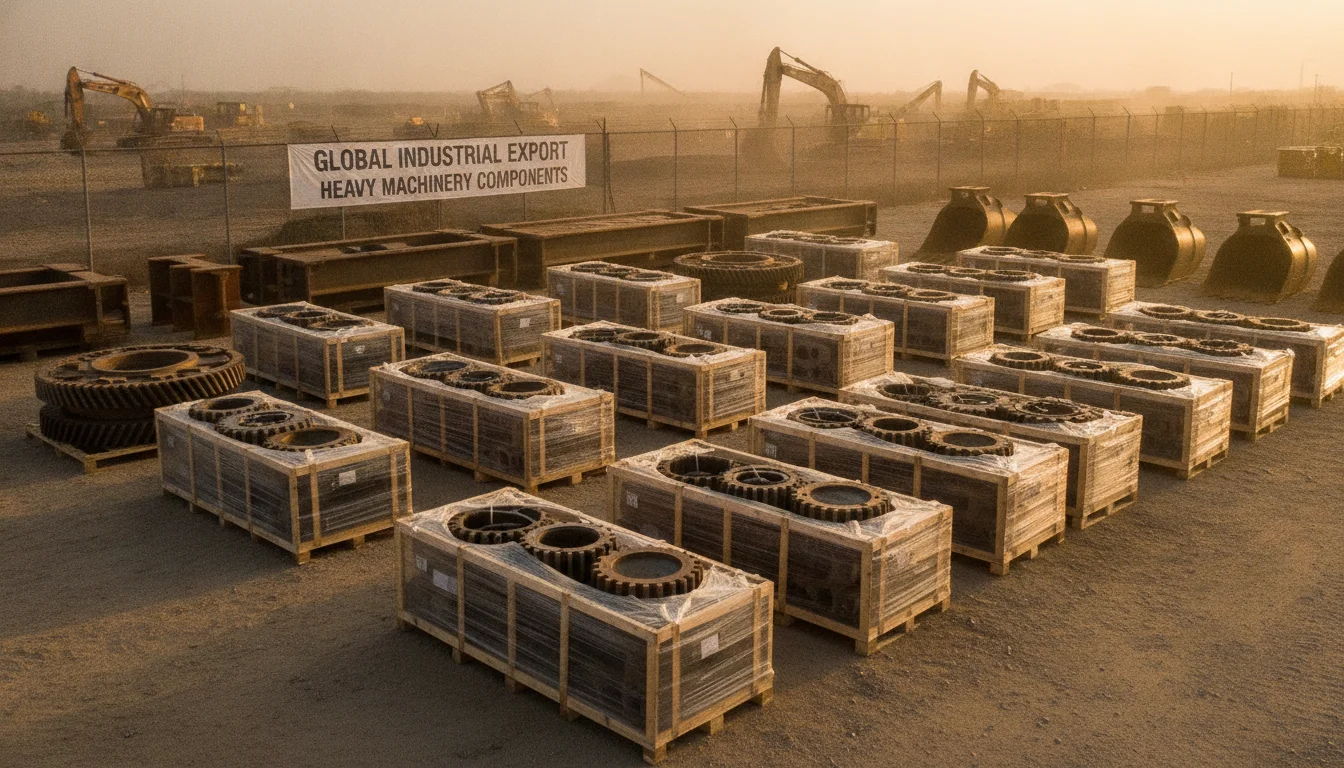
Different machine types require specific component categories. Here is a breakdown of the most commonly exported part families and the equipment they serve.
1. Engine Parts
Engine components are the highest-priority parts in any export order because engine failure stops the machine completely. Common export items include:
- Fuel injectors (Caterpillar C7, C15, C18; Komatsu SAA6D series)
- Oil filters and fuel filters
- Seals, gaskets, and o-rings
- Rebuild kits and overhaul kits
- Belts: serpentine and V-belts
- Sensors and electronic control modules
2. Hydraulic Parts
Hydraulic system failures are the leading cause of unplanned downtime on excavators and wheel loaders. Key export categories include:
- Hydraulic pumps and motors
- Hydraulic hoses and fittings
- Control valves and relief valves
- Hydraulic cylinders and seal kits
- Filters: hydraulic and return-line
3. Undercarriage Parts
Undercarriage wear is continuous on tracked machines operating in abrasive conditions. These parts are among the most frequently exported globally:
- Tracks and track shoes
- Sprockets and idlers
- Track rollers and carrier rollers
- Links, pins, and bushings
4. Electrical and Drivetrain Parts
Electrical faults and drivetrain wear are common in high-hour machines. Export demand covers:
- Alternators and starters
- Transmissions and torque converters
- Final drives and differentials
- Radiators and oil coolers
- Slewing rings and swing drives
What to Look For When Buying Heavy Machinery Parts for Export
Selecting the right parts for an international order requires more than finding the lowest price. These are the criteria that separate a successful procurement from an expensive mistake.
- Quality certification: Verify that parts meet ISO or ASTM standards. OEM parts carry manufacturer quality assurance by definition. For aftermarket, request test certificates or compliance documentation.
- Compatibility: Always confirm the machine model, serial number, and build year before ordering. A part number that fits a CAT 320D may not fit a 320D2. Cross-reference with the OEM parts manual or ask your supplier to verify.
- Supplier reputation: Look for suppliers with documented export experience, verifiable customer reviews, and a dedicated export team. According to MacAllister Machinery, their export staff is specifically trained in international shipping policies and export inspection processes.
- Parts availability: Suppliers located near major OEM distribution centers can dramatically reduce lead times. MacAllister Machinery, for example, is positioned between Caterpillar's two largest North American distribution centers and receives multiple parts deliveries each day.
- Shipping options: A supplier offering only one shipping method is a risk. You need flexibility between air freight, ocean container, and RO/RO depending on urgency and cargo type.
- Export documentation support: Customs declarations, commercial invoices, packing lists, and export certificates must be accurate. One documentation error can hold a shipment at port for days.
How to Choose the Right Parts: Use-Case Examples
The right part type depends on your machine's age, application, and how much downtime risk you can absorb. Here are three practical scenarios procurement teams face regularly.
Scenario 1: Active Fleet, Warranty Period
A mining company running a fleet of Komatsu PC360 excavators under manufacturer warranty should order genuine OEM parts only. Using non-OEM components can void warranty coverage. Lead time is acceptable because planned maintenance windows exist. Source directly from an authorized Komatsu dealer or a verified OEM export specialist.
Scenario 2: Aging Fleet, Cost Pressure
A construction contractor operating a 12-year-old CAT 320C in a market where dealer support is limited has different priorities. OEM parts may be discontinued or priced at a premium. Quality aftermarket parts from a reputable supplier, verified against OEM specifications, deliver the best value. Rebuilt hydraulic pumps and remanufactured final drives are strong options here.
Scenario 3: Emergency Breakdown, Remote Site
When a wheel loader goes down on a remote mining site, air freight of a critical engine seal kit or fuel injector set is justified. The cost of air shipping is almost always less than one day of lost production. Suppliers who can ship within 24 hours, like those with direct access to major OEM distribution networks, are the right call in this situation.
"Parts can be acquired from Caterpillar in as little as 1.5 hours. MacAllister Machinery can ship most Cat parts orders within 24 hours." - MacAllister Machinery Export Parts Division
Price Range Guidance: Budget, Mid-Range, and Premium
Price tiers for heavy machinery parts for export vary significantly by part type, brand, and quality grade. Understanding where each option sits helps procurement managers set realistic budgets and avoid false economies.
| Tier | Part Type | Best For | Trade-Off |
|---|---|---|---|
| Budget | Used / salvage parts | Older machines, discontinued models, low-hour applications | No warranty, condition varies; inspect before installing |
| Mid-Range | Quality aftermarket / rebuilt | Cost-sensitive fleets, aging equipment, high-wear items | Quality varies by supplier; always request specs |
| Premium | Genuine OEM parts | Warranty-active machines, mission-critical applications | Higher unit cost; lowest total cost of ownership over time |
For high-wear consumables like filters, seals, and belts, quality aftermarket parts often deliver strong value. For structural components like final drives, swing drives, and hydraulic pumps, the cost difference between OEM and a failed aftermarket part rarely justifies the risk.
Top Suppliers of Heavy Machinery Parts for Export
Several suppliers specialize in heavy machinery parts for export. Here is a comparison of notable options based on publicly available information.
| Supplier | Types of Parts Offered | Shipping Options | Location |
|---|---|---|---|
| 3GEN Export | OEM, Aftermarket, Rebuilt | Global 5-day delivery, air and ocean | USA, Turkey, UAE |
| Machinery Parts Warehouse | New, Used, Aftermarket, Rebuilt | Air, Ocean Freight | Peru, IL & Miami, FL, USA |
| MacAllister Machinery | OEM Cat, Used, Rebuilt | Export Air, Ocean Freight (24-hour ship) | Indianapolis, IN, USA |
| TVH | Aftermarket (8M+ references) | Fast worldwide delivery | Global |
| Ring Power | New, Used Cat equipment and parts | International export, multiple methods | Florida, USA |
"Over 8 million known references for all major makes and models on the market, with more arriving every day. Fast, worldwide delivery." - TVH Construction Equipment Parts
Shipping and Logistics for Exporting Heavy Machinery Parts
Getting parts from supplier to job site across international borders involves more moving pieces than a domestic order. Here is what experienced procurement managers plan for.
1. Documentation
Accurate export documentation is non-negotiable. A missing or incorrect document can hold your shipment at customs for days. Required paperwork typically includes:
- Commercial invoice with accurate part descriptions and values
- Packing list with weights and dimensions
- Customs declaration for the destination country
- Export certificates if required by the destination country
- Bill of lading or airway bill
2. Shipping Methods
Choose the right method based on cargo size, urgency, and destination port access. Per K International Transport, the three primary options for heavy equipment parts are:
- Roll-On/Roll-Off (RO/RO): Ideal for vehicles and machinery that can be driven or towed onto the vessel. Cost-effective for operational equipment.
- Container Shipping (FCL and LCL): Suitable for parts, boxed components, and non-operational machinery. Full Container Load (FCL) for large orders; Less than Container Load (LCL) for smaller shipments.
- Flat Rack Shipping: Used for oversized or non-standard items that cannot fit inside a standard container.
- Air Freight: The fastest option for urgent, high-value, or small parts. Lead times can be reduced to days rather than weeks.
3. Customs Clearance
Every destination country has its own import regulations, tariff classifications, and inspection requirements. Work with a supplier or freight forwarder who has direct experience shipping to your destination. K International Transport ships to major ports across Europe (Rotterdam, Hamburg, Bremerhaven), Africa (Mombasa, Lagos, Dakar), the Middle East (Jebel Ali, Jeddah), and Latin America (Cartagena, Colon).
4. Packaging for Export
Heavy parts require secure, export-grade packaging to survive ocean transit. Hydraulic components are particularly sensitive to contamination during shipping. Reputable suppliers use sealed packaging, rust inhibitors, and proper crating for oversized items. Always confirm packaging standards before placing a large order.
What to Expect: Maintenance and Lifecycle Planning
Sourcing parts internationally is only half the equation. Knowing when to order and how to manage part lifecycles keeps your fleet productive and your procurement costs predictable.
Plan Maintenance Windows Around Lead Times
Ocean freight from the U.S. to most global destinations takes several weeks depending on the route. Air freight compresses that to days. Build your planned maintenance schedule around realistic lead times. For scheduled services like filter changes, seal replacements, and belt inspections, order 4-6 weeks ahead when using ocean freight.
Keep Critical Spares On-Site
For remote operations in Africa, the Middle East, or Latin America, maintaining a small on-site inventory of high-wear items is standard practice. Fuel injectors, hydraulic seal kits, track rollers, and filters are the most common candidates. The cost of holding spare inventory is almost always less than the cost of emergency air freight or unplanned downtime.
Track Part Numbers by Serial Number
Heavy equipment manufacturers update part numbers across production runs. A CAT 320D and a CAT 320D2 may share a model name but use different components. Always record the machine serial number and cross-reference it against the OEM parts manual or your supplier's compatibility database before ordering. According to manufacturer specifications, using the serial number is the only reliable method for confirming exact part fitment.
Inspect Incoming Parts Before Installation
This applies especially to used and rebuilt components. Before installing any exported part, inspect it against the original specification: check dimensions, surface condition, and any included documentation. For hydraulic components, verify that ports are sealed and internal surfaces show no contamination. A brief incoming inspection prevents a warranty dispute later.
"Pro Tip: For high-wear undercarriage components on tracked excavators and dozers, industry maintenance data shows that proactive replacement at 70-80% wear extends final drive life and reduces total undercarriage cost over the machine's service life. Order replacement tracks, sprockets, and rollers before failure, not after."
Global Demand Outlook for 2026
As of 2026, demand for U.S.-sourced heavy machinery parts continues to grow across developing markets. According to K International Transport, buyers across Africa, Latin America, the Middle East, and Asia are actively seeking reliable pre-owned machinery and spare parts from the U.S., driven by the global reputation of American equipment for durability and parts availability.
Brands like Caterpillar, Komatsu, John Deere, Hitachi, and Kobelco remain the most sought-after in international markets. Excavators, bulldozers, wheel loaders, and dump trucks generate the highest parts export volume. This year, procurement teams sourcing from multiple global suppliers are finding that suppliers with offices or distribution points in multiple regions, such as the U.S., Turkey, and the UAE, offer faster response times and more flexible shipping options than single-location exporters.
For procurement managers evaluating their supply chain strategy, the 3GEN Export blog covers related topics including OEM heavy equipment parts sourcing, aftermarket market trends, and brand-specific buying guides for Caterpillar, Komatsu, Volvo, and Atlas Copco. These resources are updated regularly to reflect current pricing, availability, and logistics conditions.
Pros and Cons of Sourcing Heavy Machinery Parts for Export
Pros
- Access to wider inventory: International suppliers, particularly in the U.S., carry parts for 40+ brands that may be unavailable locally.
- Competitive pricing: Global competition among suppliers keeps prices lower than single-source domestic markets, especially for aftermarket and rebuilt components.
- OEM-quality assurance: Established export specialists offer genuine OEM parts with full traceability, reducing the risk of counterfeit components.
- Flexible shipping options: Air, ocean container, and RO/RO shipping give procurement teams control over cost versus speed trade-offs.
- Broader brand coverage: A single export supplier can often source parts for Caterpillar, Komatsu, Volvo, Hitachi, JCB, and dozens of other brands from one point of contact.
Cons
- Longer lead times: Ocean freight takes several weeks. Emergency situations require air freight, which increases cost significantly.
- Documentation complexity: Export paperwork, customs declarations, and import regulations vary by country and require expertise to manage correctly.
- Compatibility risk: Ordering the wrong part number across international borders creates return logistics challenges that are far more costly than a domestic return.
- Counterfeit risk: The global parts market includes low-quality counterfeit components. Vetting suppliers and requesting certificates of conformity is essential.
- Currency and payment complexity: International transactions involve currency exchange, wire transfers, and sometimes letters of credit, adding administrative overhead.
Frequently Asked Questions
What heavy machinery is in demand for export?
Excavators, bulldozers, wheel loaders, dump trucks, and cranes generate the highest global export demand. According to K International Transport, brands like Caterpillar, Komatsu, John Deere, Hitachi, and Kobelco are especially sought after in international markets across Africa, the Middle East, Latin America, and Asia.
What are examples of heavy machinery parts?
Common examples include engine components (fuel injectors, seals, gaskets, overhaul kits), hydraulic parts (pumps, hoses, valves, cylinders), undercarriage components (tracks, sprockets, idlers, rollers), and drivetrain parts (transmissions, final drives, differentials). Filters, belts, and sensors round out the most frequently ordered categories.
How do I ensure the quality of parts for export?
Source from suppliers with documented export experience and verifiable customer references. For OEM parts, confirm the supplier is an authorized dealer or has direct access to OEM distribution. For aftermarket parts, request ISO compliance documentation or test certificates. Always verify part numbers against the machine serial number before ordering.
What is the average shipping time for heavy machinery parts?
Shipping times depend on the method and destination. Air freight delivers most parts within a few days. Ocean freight typically takes several weeks depending on the origin port and destination. Suppliers located near major OEM distribution centers, like those in the U.S. Midwest, can often ship within 24 hours of order confirmation, reducing total lead time significantly.
Who is bigger, Caterpillar or Komatsu?
Caterpillar is the larger company by global revenue and market presence, making it the most widely exported brand in the heavy equipment parts market. Komatsu is the second-largest construction equipment manufacturer globally and holds strong demand particularly in Asia-Pacific markets. Both brands are top priorities for international parts exporters.
Can I return parts if they don't fit?
Return policies vary by supplier and are more complex for international orders than domestic ones. Return shipping, customs re-entry, and restocking fees can make a wrong-part order expensive. The best protection is thorough compatibility verification before ordering: confirm the machine model, serial number, and part number with your supplier in writing before payment.
How can I find the best value for heavy machinery parts?
Compare total landed cost, not just unit price. Factor in shipping method, customs duties, packaging quality, and supplier reliability. A slightly higher unit price from a supplier with 24-hour shipping and accurate documentation often delivers better value than a lower price with uncertain lead times and documentation risk. For high-wear consumables, quality aftermarket parts from vetted suppliers offer strong value. For structural components, OEM or rebuilt parts reduce total cost of ownership over the machine's service life.
Source Your Parts with Confidence
Sourcing heavy machinery parts for export requires careful selection of part type, supplier, and shipping method. The decisions you make at the procurement stage directly affect fleet uptime, project timelines, and total maintenance cost. Get the compatibility right, vet your supplier thoroughly, and plan your lead times before the machine needs the part, not after it breaks down.
At 3GEN Export, we supply OEM-quality spare parts for Caterpillar, Komatsu, Volvo, Atlas Copco, and 40+ brands with verified global delivery in 5 days. Our team handles export documentation, compatibility verification, and logistics coordination from our offices in the USA, Turkey, and Dubai. Shop our full parts catalog or contact our export team directly for a fast quote on your specific part number and machine model.