
Heavy Machinery Parts Inventory Management Guide 2026
Heavy machinery parts inventory management strategies that cut downtime and costs. OEM sourcing, software tips, and a practical 2026 action plan inside.
Loading article…
Article Not Found
The article you're looking for doesn't exist or may have been removed.
Back to BlogKey Takeaways
- Heavy machinery parts inventory management reduces downtime and cuts unnecessary carrying costs when done systematically.
- Classifying parts by criticality, not just dollar value, catches the cheap components that ground expensive machines.
- Software with real-time tracking and automated reorder alerts prevents both stockouts and overstocking.
- Regular cycle counts and audits keep recorded inventory aligned with what's actually on the shelf.
- Linking parts data to maintenance workflows is what actually moves the uptime needle, not the software alone.
- Global sourcing partners with fast lead times reduce the need to over-stock slow-moving SKUs.
"Proper inventory management is not just about having parts on hand; it's about having the right parts at the right time to minimize equipment downtime and maximize productivity." - Industry Expert
Understanding Heavy Machinery Parts Inventory Management
inventory management is the systematic process of ordering, storing, tracking, and deploying spare parts so equipment stays running instead of sitting idle. It's the discipline that separates fleets with predictable uptime from fleets that scramble every time a hose fails.
We've watched this play out across mining sites, construction yards, and energy projects for years. A fleet with a disciplined parts program rarely gets caught off guard. A fleet without one is always one failed seal away from a costly delay. The difference isn't luck. It's process.
What Is Inventory Management, Really?
At its core, inventory management is the ordering, storing, and using of a company's stock. Applied to heavy machinery, that means tracking every hydraulic hose, filter, bearing, and engine component your fleet might need, and knowing exactly where each one sits at any given moment. Without that visibility, technicians waste hours hunting for parts that may or may not exist in the yard.
Why Inventory Management Matters in Heavy Machinery
Efficient this type of management matters because downtime is expensive and largely preventable. According to data reported by Heavy Vehicle Inspection, a single day of equipment downtime can cost over $2,000, and a $40 hydraulic hose fitting can idle a $300,000 excavator for a week if it isn't in stock. That's not a rounding error. That's a project falling behind schedule over a part that costs less than a dinner for four.
The same source reports that roughly 82% of construction companies still rely on manual tracking methods for maintenance and parts, a gap that leaves plenty of room for the kind of stockouts that stall jobsites. Poor inventory practices also carry a hidden cost: carrying costs on excess stock run between 15-30% of total inventory value, according to industry data cited by McGill Industries. For a fleet holding a few million dollars in spare parts, that percentage adds up fast.
Best Practices for Heavy Machinery Parts Inventory Management
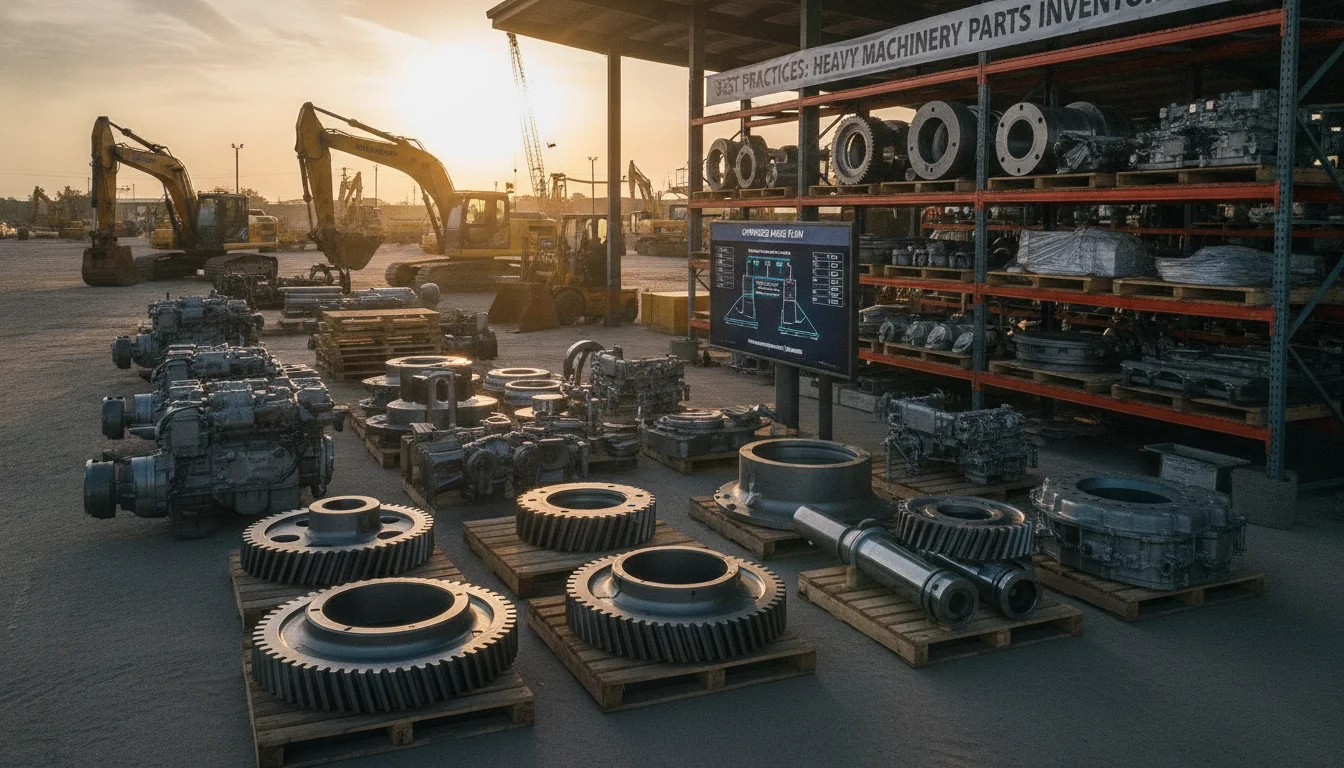
1. Classify Parts Based on Criticality
Not every part deserves the same shelf space or budget priority. Some components are essential to keep a machine running, while others barely register if they're delayed a week. A classification system helps prioritize what actually needs to sit on your shelf versus what can be ordered on demand:
- A-Class Parts: High-value items essential for operation (e.g., hydraulic pumps).
- B-Class Parts: Moderate value, less critical (e.g., filters).
- C-Class Parts: Low-value items that can be ordered as needed (e.g., bolts).
- Critical-Flag Parts: Low-cost items that can still ground a machine, like a seal or sensor, and deserve A-class treatment regardless of price.
That last category trips up a lot of procurement teams. A traditional ABC system ranks by dollar spend alone, which means a $50 seal that can stop a dragline in its tracks might get filed under low priority. Layering a criticality flag on top of ABC classification catches those blind spots before they cost you a week of downtime.
2. Leverage Technology for Real-Time Tracking
Inventory management software gives you visibility that spreadsheets and clipboards simply can't match. These systems track stock levels, usage history, and part locations in real time. Features worth prioritizing include:
- Automated alerts for low stock levels.
- Integration with maintenance management systems.
- Reporting tools for analyzing parts usage trends.
- Barcode or QR-code scanning for check-in and check-out accuracy.
3. Conduct Regular Audits and Cycle Counts
Regular audits and cycle counts are essential for maintaining accurate inventory records. Physical counts catch the discrepancies that build up between what's recorded and what's actually on the shelf, whether from miscounts, shrinkage, or parts pulled without logging. A rolling cycle count schedule, counting a portion of your inventory weekly rather than shutting down for one massive annual count, keeps accuracy high without disrupting daily operations.
How Heavy Machinery Parts Inventory Management Actually Works
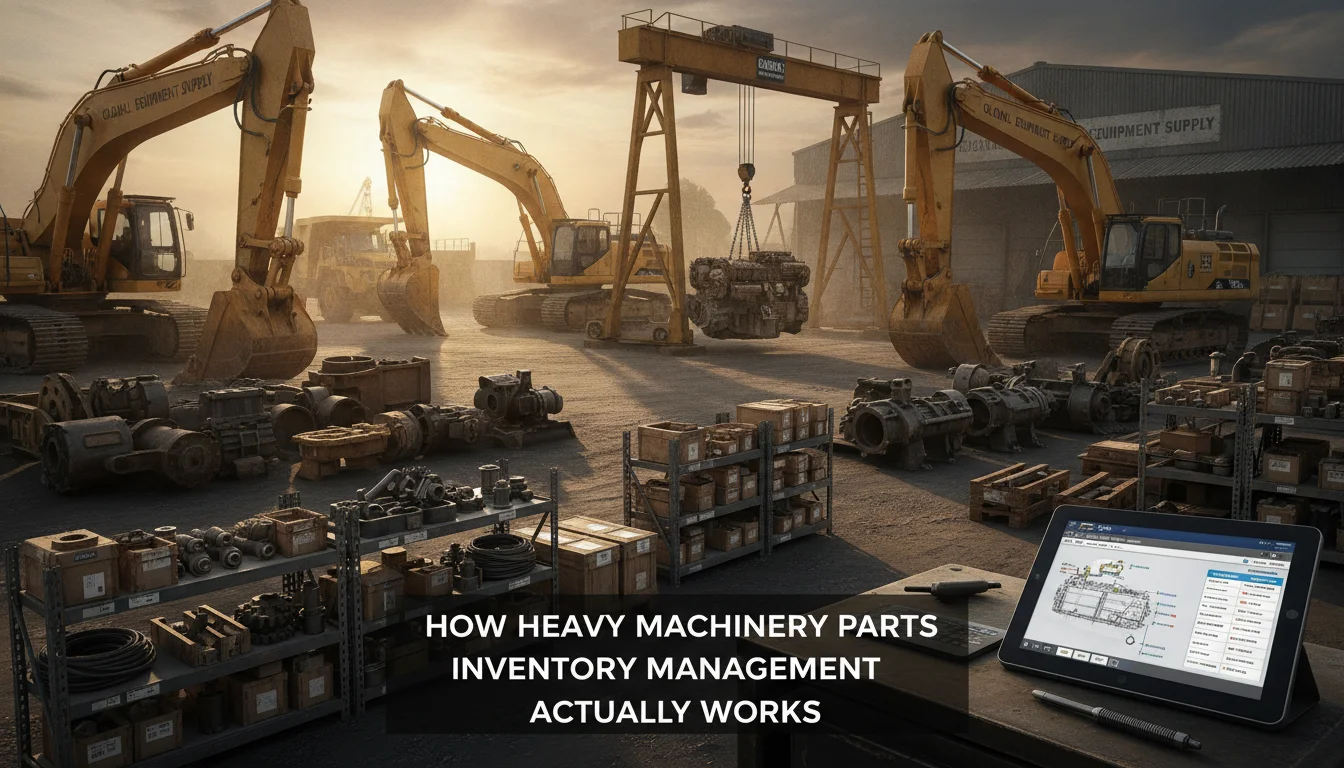
The mechanics behind a functioning parts program come down to three linked processes: demand forecasting, stock control, and replenishment triggers. Get any one of these wrong and the whole system drifts out of sync with reality.
Demand forecasting starts with your maintenance history. Every failure, every scheduled service interval, every wear pattern on a specific machine model feeds into how much of a given part you should keep on hand. A fleet running Caterpillar 320 excavators on rocky terrain will burn through undercarriage components faster than the same model on flat, soft ground. Your stocking levels should reflect that reality, not a generic manufacturer estimate.
Stock control is where min/max thresholds do the heavy lifting. You set a minimum quantity that triggers a reorder and a maximum that prevents overstocking. When usage pulls a part below the minimum, the system (ideally automated) generates a purchase order or replenishment request. This is the same logic classic Economic Order Quantity models rely on, though most maintenance teams temper the pure math with real-world constraints like freight minimums, hazmat shipping rules, and supplier lead times.
Replenishment triggers close the loop. Whether that trigger comes from a technician scanning a part during a work order or an automated alert from your software, the goal is the same: close the gap between "we used it" and "we ordered more" as fast as possible. The tighter that loop, the less safety stock you need to carry.
How to Apply This: A Practical Rollout Plan
Building or fixing a this kind of inventory management system doesn't require an overnight overhaul. Here's how we'd approach it in stages:
- Audit your current fleet and failure history. List every machine by model, age, and manufacturer, then pull maintenance logs to see which components fail most often.
- Classify every SKU. Run the ABC-plus-criticality method described above across your full parts catalog, not just your top sellers.
- Set min/max levels per part. Base these on actual usage data and realistic supplier lead times, not gut feel.
- Choose and implement software. Pick a platform that integrates with your existing maintenance workflow rather than running as a separate silo.
- Digitize the parts catalog. Assign barcodes or QR codes and link each part to the equipment models and maintenance types it serves.
- Schedule rolling cycle counts. Start with your A-class and critical-flag items, since discrepancies there carry the highest risk.
- Review analytics quarterly. Usage trends shift as your fleet ages or takes on new job types, so revisit your classifications and thresholds regularly.
As of 2026, most mid-size fleets we work with are running this process on a hybrid model: automated tracking for high-turnover consumables, and manual oversight for the small number of critical, low-volume spares that rarely move but can't ever be missing.
Comparing Inventory Management Approaches
There's no single right tool for every operation. The table below breaks down the main approaches fleets use for the machinery parts inventory management, based on the platforms and methods referenced across the industry.
| Approach | Best For | Strengths | Limitations |
|---|---|---|---|
| Manual tracking (spreadsheets/paper) | Very small fleets, single location | No software cost, simple to start | Error-prone, no real-time visibility, doesn't scale |
| Standalone inventory software | Shops focused purely on parts control | Barcode scanning, reporting, low learning curve | Lacks direct link to maintenance scheduling |
| Integrated fleet maintenance platforms (e.g., Tenna, HCSS Equipment360, Fullbay) | Multi-site fleets running frequent maintenance | Real-time alerts, ties parts to work orders and equipment health | Higher cost, requires onboarding and data migration |
| ABC + criticality classification | Any fleet setting stocking priorities | Prevents both overstocking and critical stockouts | Requires accurate failure history to be effective |
| Vendor-managed inventory (VMI) / consignment | Low-value, high-volume C-class parts | Reduces carrying cost and storage burden | Less control over exact stock timing |
Choosing the Right Inventory Management Software
The right software for heavy machinery parts inventory management is the platform that ties directly into your maintenance workflow, not just a standalone parts list. Here's what to look for.
1. Centralized Database
A centralized database consolidates all parts, supplies, and tools into a single system. This makes it far easier to track and manage inventory across multiple job sites and warehouse locations without juggling separate spreadsheets for each one.
2. Real-Time Monitoring and Alerts
Real-time monitoring lets managers track stock levels and get alerted when parts hit predefined thresholds. That proactive visibility is what prevents stockouts and keeps critical components available before a technician even needs to ask.
3. Integration with Maintenance Workflows
Software that integrates with existing maintenance workflows keeps parts inventory and maintenance schedules talking to each other. That means technicians see suggested parts for a work order automatically, instead of guessing what they'll need and making a second trip to the shop.
Common Mistakes to Watch Out For
Most heavy machinery parts inventory management failures trace back to a handful of repeatable mistakes. Watch for these:
- Treating all parts equally. Stocking a $5 bolt with the same rigor as a hydraulic pump wastes time and shelf space.
- Ignoring criticality in favor of pure dollar value. A cheap seal that grounds a dragline deserves A-class attention regardless of unit price.
- Skipping cycle counts because "the system already tracks it." Software only reflects reality if physical counts confirm it periodically.
- Running parts and maintenance as separate systems. When these two disconnect, technicians lose time chasing parts that maintenance scheduling should have already flagged.
- Over-relying on manual tracking at scale. Spreadsheets work for a handful of machines. They break down fast once you're running a multi-site fleet.
- Not accounting for supplier lead time in min/max calculations. A minimum threshold set without real freight and customs timelines invites stockouts.
A Practical Scenario: Avoiding a Week of Downtime
Picture a mid-size mining contractor running six CAT 320 excavators across two sites. One machine starts showing early signs of a hydraulic seal leak. Under a reactive parts model, the technician notices the leak, checks the shelf, finds nothing, and submits an order. The part ships, clears customs, and arrives a week later. The excavator sits idle that entire time, and the project timeline absorbs the hit.
Now run the same scenario through a properly managed inventory program. The seal kit is flagged as a critical-class part despite its relatively low cost, so it's already stocked at both sites based on failure history from the fleet's maintenance logs. The technician pulls the part, logs the usage in the system, and a replenishment alert automatically fires to the supplier once stock dips below the minimum threshold. Downtime shrinks from a week to a matter of hours.
That's the entire value proposition of heavy machinery parts inventory management in one comparison: the part itself rarely changes. What changes is whether it's on the shelf when you need it.
Common Challenges in Parts Inventory Management
1. Over-Stocking and Under-Stocking
The most persistent challenge in parts inventory management is balancing stock levels. Over-stocking ties up capital in carrying costs, while under-stocking risks the exact downtime this whole discipline exists to prevent. A min/max stocking strategy, calibrated against real usage and lead-time data, helps mitigate both risks at once.
2. Inefficient Tracking Methods
Manual tracking methods remain common, and they're a leading source of errors and inefficiency. Moving to a digital system doesn't just speed things up, it removes the human error that comes from handwritten logs and outdated spreadsheets.
3. Lack of Visibility Across Locations
Fleets running multiple job sites often lose track of what's actually available where. A centralized inventory management system provides real-time visibility into stock levels across every location, which means a part sitting unused at Site A can cover an urgent need at Site B instead of triggering a fresh order.
Integrating Parts Inventory Management with Maintenance Workflows
Integration between parts and maintenance is what turns inventory data into actual uptime. Here's how to connect the two effectively.
1. Link Inventory to Maintenance Records
Linking parts inventory to maintenance records ensures technicians have what they need for scheduled service and repairs without a separate search process. That link is what shortens the time between diagnosis and repair.
2. Automate Parts Requests
Automating parts requests removes a manual step that's easy to forget under deadline pressure. When a technician identifies a needed part during a work order, the system generates a replenishment request automatically, keeping stock levels where they need to be.
3. Utilize Analytics for Continuous Improvement
Analytics turn raw usage data into decisions. Reviewing parts usage trends regularly helps identify which classifications need adjusting, which suppliers are underperforming on lead time, and where carrying costs are creeping up.
"The machine is not down because something broke. It is down because the part to fix it is not on the shelf." - Heavy Vehicle Inspection, Heavy Equipment Parts & Inventory Management Guide 2026
Pros and Cons of Formal Parts Inventory Management Systems
Pros
- Reduces unplanned downtime by ensuring critical parts are on hand before failures happen.
- Cuts unnecessary carrying costs by right-sizing stock instead of over-ordering out of caution.
- Improves cross-site visibility, letting fleets share stock instead of duplicating orders.
- Creates a data trail that improves forecasting and vendor negotiations over time.
Cons
- Requires upfront investment in software, training, and data migration.
- Demands disciplined data entry. A system is only as accurate as the people logging usage.
- Can be overkill for very small fleets with only one or two machines.
- Ongoing cycle counts and audits require dedicated staff time that smaller teams may not have.
2026 Outlook for Heavy Machinery Parts Inventory Management
As of 2026, more fleets are shifting from reactive to predictive parts management, leaning on telematics and maintenance history to forecast failures before they happen rather than reacting once a machine is already down. This year's trend among mid-size and large fleets is tighter integration between inspection software, maintenance scheduling, and parts inventory, closing the gaps that used to exist between three separate systems.
Global sourcing is part of this shift too. Fleets that once over-stocked slow-moving SKUs out of fear of long lead times are increasingly leaning on suppliers who can deliver OEM-standard parts quickly across borders, which reduces the carrying-cost burden discussed earlier without increasing downtime risk.
Conclusion
Effective heavy machinery parts inventory management is what separates fleets that hit their project deadlines from fleets that bleed money waiting on parts. By classifying components by criticality, leveraging real-time tracking software, running regular cycle counts, and tying inventory directly to maintenance workflows, operations teams can meaningfully cut both downtime and carrying costs. As sourcing and software options keep evolving through 2026, staying current on both fronts will separate the fleets that lead from the ones that lag.
Need parts fast to fill a critical gap in your stocking plan? Shop OEM-quality spare parts with global 5-day delivery at 3genexport.com, covering Caterpillar, Komatsu, Volvo, Atlas Copco, and 40+ brands.
Frequently Asked Questions
What is heavy machinery parts inventory management?
Heavy machinery parts inventory management is the systematic approach to ordering, storing, and using spare parts for heavy equipment so essential components are available when needed. It combines classification, tracking software, and audits to minimize downtime and control costs.
How can I effectively organize my parts inventory?
Start by classifying parts based on criticality rather than price alone, then implement inventory management software for real-time tracking. Follow up with regular cycle counts to catch discrepancies before they turn into stockouts.
What is the best software for parts inventory management?
There isn't a single best option for every fleet. Platforms like Tenna, HCSS Equipment360, and Fullbay each offer real-time tracking and maintenance integration, so the right choice depends on your fleet size, budget, and existing maintenance software.
What are the 5 stages of the inventory management process?
The typical stages are planning, ordering, storing, tracking, and auditing inventory levels. Each stage feeds into the next, so a gap in one, like poor tracking, undermines the accuracy of every stage after it.
What are the best practices for inventory management?
Best practices include classifying parts by criticality, leveraging tracking technology, conducting regular audits, setting realistic min/max stock levels, and integrating inventory data directly with maintenance workflows.
How can technology improve parts inventory management?
Technology improves parts inventory management by providing real-time visibility into stock levels, automating reorder alerts, and connecting inventory data with maintenance work orders. This shortens the gap between identifying a need and getting the part in hand.