
Heavy Machinery Parts Procurement Guide 2026
Your heavy machinery parts procurement guide for 2026: OEM vs aftermarket, supplier selection, inventory management, and global sourcing with 5-day
Loading article…
Article Not Found
The article you're looking for doesn't exist or may have been removed.
Back to BlogA heavy machinery parts procurement guide is a structured framework for sourcing, evaluating, and purchasing components for construction, mining, and energy equipment. Get this process right and you protect uptime, control costs, and keep projects on schedule.
Key Takeaways
- Always confirm your machine's make, model, and serial number before ordering any part.
- OEM parts protect warranty coverage; aftermarket parts can cut costs when sourced from verified suppliers.
- According to industry maintenance data, a $50 filter left unchanged can trigger a $5,000 engine overhaul.
- 82% of construction companies still track parts manually, leading to 40% higher failure rates than digitally managed fleets.
- Proactive inventory management, not reactive ordering, is the single biggest driver of reduced equipment downtime.
- A reliable global supplier with fast shipping is as important as the part itself.
Understanding Heavy Machinery Parts
What Are Heavy Machinery Parts?
Heavy machinery parts are the individual components that make up construction, mining, and energy equipment: engines, hydraulic systems, undercarriage assemblies, filters, seals, and structural elements. These parts keep excavators digging, bulldozers grading, and cranes lifting. When one component fails, the entire machine stops, and on a busy site that means lost revenue every hour the machine sits idle.
Types of Heavy Machinery Parts
- OEM Parts: Original Equipment Manufacturer parts are produced by the brand that built the machine, for example Caterpillar, Komatsu, or Volvo. They are identical to the part installed on the assembly line and are designed to meet exact specifications.
- Aftermarket Parts: Produced by third-party manufacturers, aftermarket parts are often priced 20% to 40% below OEM equivalents. Quality varies by supplier and component category, so always request material certifications before ordering.
- Remanufactured Parts: Used cores rebuilt to OEM specifications. Remanufactured parts offer a middle ground between cost and reliability, and many are warranty-compliant when sourced through authorized channels.
- Salvage Parts: Pulled from decommissioned machines. Useful for older equipment where new parts are discontinued, but condition must be verified carefully.
Importance of Quality in Parts Procurement
Choosing high-quality parts is critical for maintaining the performance and longevity of heavy machinery. Poor-quality parts accelerate wear on adjacent components, raise maintenance costs, and create safety hazards on site. According to manufacturer specifications, a worn hydraulic pump can reduce lifting capacity by up to 30%, turning a productive machine into a liability.
"Every component in a heavy equipment machine is part of a finely tuned system. Using the wrong part not only accelerates wear on adjacent components but can also lead to cascading failures that are expensive to repair." - Henan Junton Vehicle Co., procurement engineering team, 2026
OEM vs. Aftermarket vs. Remanufactured: A Direct Comparison
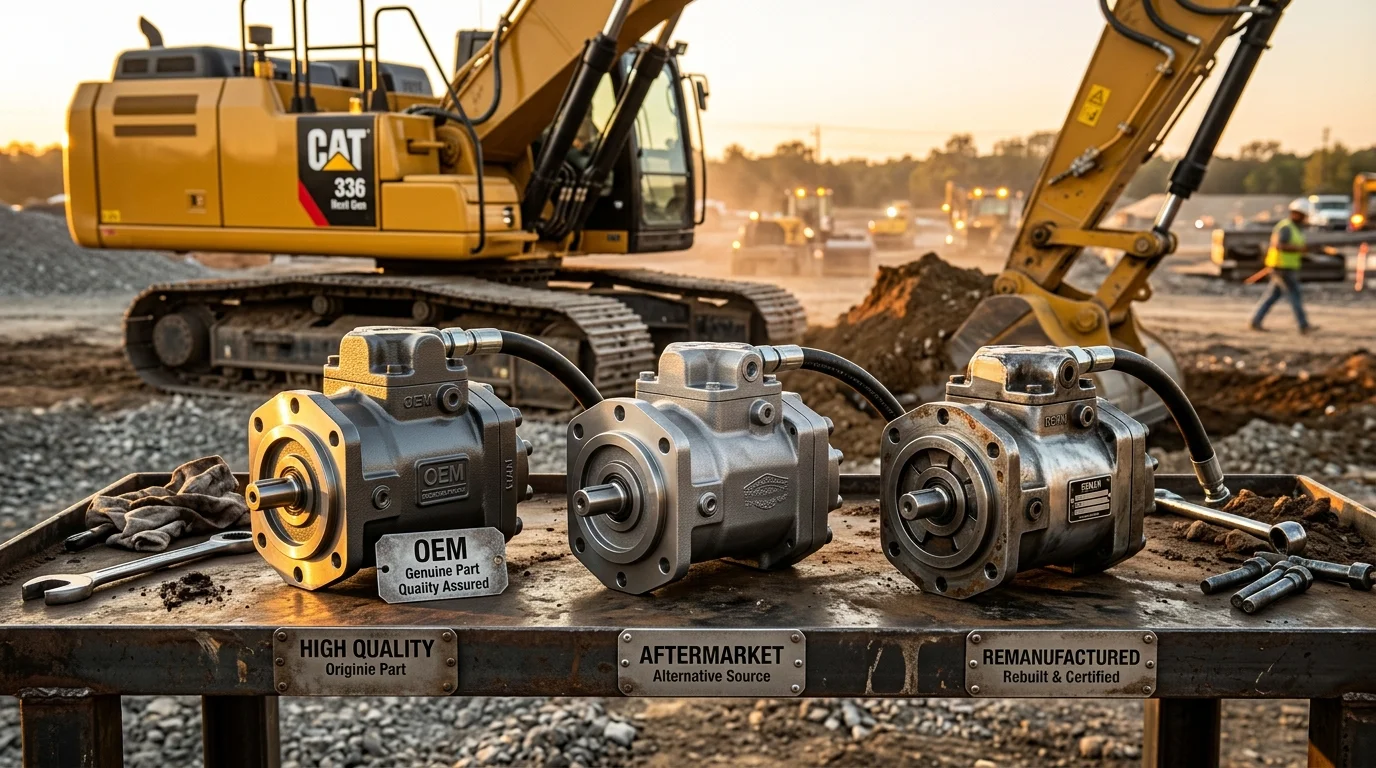
Choosing between part types is one of the most consequential decisions in any procurement workflow. The table below compares the three main options across the criteria that matter most to fleet managers and procurement supervisors.
| Criteria | OEM Parts | Aftermarket Parts | Remanufactured Parts |
|---|---|---|---|
| Price vs. OEM | Baseline | 20%–40% lower | Varies; often 25%–35% lower |
| Fit & Compatibility | Guaranteed | Varies by supplier | Rebuilt to OEM spec |
| Warranty Compliance | Always compliant | Case-by-case; may void warranty | Often compliant via authorized channels |
| Availability | Strong for current models | Wide, including older models | Dependent on core availability |
| Lead Time | Can be long for specialty parts | Often faster from local distributors | Moderate |
| Quality Consistency | High and predictable | Variable; request certifications | High when sourced from reputable rebuilders |
| Best Use Case | Warranty-active machines, critical systems | Older fleets, budget-constrained projects | High-cost components like pumps and motors |
Best Practices for Parts Procurement
Know Your Machinery
Before purchasing any part, confirm your machine's make, model, and serial number. This is non-negotiable. Different production years of the same model can require completely different components, and ordering the wrong part wastes time and money. Keep the data plate information accessible to everyone on your procurement team.
Understand Serial Number Breaks
Manufacturers often update designs during a production run, creating what the industry calls serial number breaks. A part that fits a machine built in 2020 may not be compatible with a 2022 model, even if they share the same model name. Always verify which serial number range your machine falls within before placing an order.
Evaluate Supplier Reliability
Working with a reputable supplier streamlines the entire procurement process. Look for suppliers that offer a wide range of parts, fast global shipping, clear return policies, and responsive technical support. Partnering with an authorized dealer or a verified global exporter gives you access to parts that meet OEM specifications and protects your machine's warranty.
How the Procurement Process Works: Step by Step
Understanding the mechanics of a well-run procurement cycle helps you avoid the reactive, crisis-driven ordering that costs fleets the most money. Here is how a professional procurement workflow operates from start to finish.
- Identify the need. A maintenance inspection or operator report flags a worn or failed component. Document the machine ID, hours, and failure mode before doing anything else.
- Pull the exact specification. Retrieve the OEM part number from the service manual or the machine's data plate. Confirm the serial number break range. Ambiguity here causes wrong-part orders.
- Evaluate part type options. Decide between OEM, aftermarket, or remanufactured based on warranty status, budget, and criticality of the component. Use the comparison table above as your starting framework.
- Source from verified suppliers. Request quotes from at least two suppliers. Ask for material certifications on aftermarket parts. Confirm lead time and shipping terms before committing.
- Place the order and confirm logistics. Verify the shipping address, customs documentation for international orders, and expected delivery date. For critical parts, consider air freight to minimize downtime.
- Receive and inspect. On arrival, check the part against the OEM part number, inspect packaging for damage, and confirm dimensions before installation. A five-minute check here prevents a costly reinstallation later.
- Log the transaction. Record the part number, supplier, cost, and installation date against the machine's maintenance record. This data feeds your future inventory planning.
How to Apply This in Practice: A Real-World Scenario
Consider a fleet supervisor managing eight Komatsu PC200 excavators on a road-building project in Southeast Asia. One machine develops a hydraulic leak mid-shift. The operator reports sluggish boom response and visible fluid loss at the cylinder rod seal.
The supervisor pulls the machine's serial number and identifies the correct seal kit using the OEM parts catalogue. Because the machine is still under warranty, she opts for OEM seals rather than aftermarket. She contacts 3GEN Export, confirms the part number, and selects express international shipping. The seal kit arrives within five days. The machine is back in service before the project's critical pour date.
The total cost: the seal kit plus shipping. The avoided cost: days of excavator downtime at $2,000 or more per day, plus potential hydraulic pump damage from running low on fluid. Proactive identification and fast sourcing made the difference.
"Spare parts delays are one of the biggest causes of heavy equipment downtime, and they are almost entirely preventable. A $40 hydraulic hose fitting can idle a $300,000 excavator for a week if it is not in stock." - HVI App, Heavy Equipment Parts and Inventory Management Guide, 2026
Cost Considerations in Parts Procurement
Evaluating OEM vs. Aftermarket Parts
The total cost of ownership (TCO) is the right metric for this decision, not the sticker price. Aftermarket parts priced 20% to 40 percent below OEM can look attractive on a purchase order. But if they fail early or damage adjacent components, the repair bill erases any savings quickly.
Long-Term Cost Implications
Investing in high-quality parts reduces long-term costs tied to repairs and downtime. Industry maintenance data confirms it clearly: a $50 filter left unchanged can lead to a $5,000 engine overhaul. The math is not complicated. Skipping routine consumables to save a few dollars is one of the most expensive decisions a fleet manager can make.
Equipment downtime costs $2,000 or more per day on active projects. A $300,000 excavator sitting idle while you wait for a part that should have been stocked is a procurement failure, not a mechanical one.
Warranty Considerations
Using OEM parts is often required to maintain warranty coverage. Many OEM warranties include stipulations that mandate approved or OEM-certified parts for specific components. In some cases, using unapproved aftermarket parts voids the warranty entirely, leaving you responsible for major repair costs. Review your warranty terms before making any substitution.
Pros and Cons of Different Procurement Approaches
Pros
- OEM parts guarantee fit, performance, and warranty compliance with no guesswork.
- Aftermarket parts from Tier-1 suppliers can deliver equivalent performance at 20 percent–40 percent lower cost, freeing budget for other fleet needs.
- Remanufactured parts extend the life of high-cost components like hydraulic pumps and motors at a fraction of new-part pricing.
- Proactive procurement eliminates the most expensive downtime scenarios by keeping critical spares on the shelf before failure occurs.
- Digital inventory management reduces failure rates by 40 percent compared to manual tracking, according to industry maintenance data.
Cons
- OEM parts carry higher upfront costs and can have long lead times for specialty or low-volume components.
- Aftermarket parts vary widely in quality. Off-brand or unverified suppliers may use cheaper alloys that fail under high thermal or mechanical stress.
- Remanufactured parts depend on core availability, which can be limited for older or less common machine models.
- Proactive stocking ties up working capital in inventory, requiring disciplined min/max management to avoid over-stocking slow-moving parts.
- Manual procurement processes create errors, duplicate orders, and blind spots that digital systems eliminate.
The Role of Regular Maintenance
Preventive Maintenance Strategies
Regular maintenance is the most cost-effective way to reduce parts replacement frequency. A structured preventive maintenance schedule catches potential issues before they become failures, keeping machines productive and procurement costs predictable.
Common Maintenance Tasks
- Replacing hydraulic, fuel, and air filters on schedule to prevent contaminants from damaging engines and hydraulic systems.
- Lubricating moving parts to reduce friction and slow wear on pins, bushings, and bearings.
- Conducting routine inspections to identify wear on undercarriage components, seals, and hoses before they fail in the field.
- Checking fluid levels and quality, including hydraulic oil, engine oil, and coolant, at every service interval.
Impact of Neglecting Maintenance
Neglecting regular maintenance compounds costs fast. A hydraulic pump that is not serviced can reduce lifting capacity by up to 30 percent, according to manufacturer specifications. A worn bearing ignored during inspection can seize an axle, turning a routine maintenance task into a project-stopping event that takes days to resolve.
Inventory Management for Parts Procurement
Why Manual Tracking Fails
Reactive ordering, which means ordering parts only after equipment fails, guarantees maximum downtime every time. Industry maintenance data shows that 82 percent of construction companies still rely on manual tracking for maintenance and parts, and those companies experience 40 percent higher failure rates compared to digitally managed fleets. Spreadsheets and filing cabinets are not inventory systems.
Establishing Min/Max Stock Levels
Setting minimum and maximum stock levels for critical parts prevents stockouts and keeps necessary components available when machines need them. Start with your highest-failure-rate components: filters, seals, belts, and hoses. These are low-cost, high-impact items that should never run to zero.
Utilizing Technology for Inventory Tracking
Digital inventory management systems give you real-time visibility into what is on the shelf, what is on order, and what is linked to which machine. Barcode and QR scanning eliminate ghost inventory. Automated reorder alerts at minimum stock thresholds prevent the scenario where the last hydraulic filter was used last week and nobody noticed. According to industry maintenance data, digital CMMS platforms can reduce downtime by 75 percent compared to reactive, manual approaches.
Proactive Parts Management
Order parts before you need them, not after the machine stops. For high-wear components with predictable replacement intervals, set calendar-based reorder triggers tied to machine hours. For critical spares with long lead times, maintain a buffer stock sized to cover your average sourcing window.
Common Mistakes to Avoid in Parts Procurement
Even experienced procurement teams make avoidable errors. These are the patterns we see most often, and the fixes that eliminate them.
- Ordering by model name alone. Two machines with the same model name but different serial numbers may require different parts. Always include the full serial number in every parts request.
- Choosing price over total cost. The cheapest part is rarely the lowest-cost option over a machine's service life. Factor in failure risk, replacement labor, and downtime exposure before selecting a supplier.
- Ignoring warranty terms. Using unapproved aftermarket parts on a warranty-active machine can void coverage entirely. Read the warranty documentation before substituting any OEM component.
- Reactive-only ordering. Ordering parts only after failure is the most expensive procurement strategy possible. A hydraulic pump takes 3 to 10 business days to arrive. During that time, a machine sits idle at $2,000 or more per day.
- No supplier performance tracking. If you are not measuring fill rate, lead time accuracy, and part quality by supplier, you cannot make informed sourcing decisions. Track every order.
- Skipping incoming inspection. Parts can be damaged in transit or mislabeled. A five-minute check on arrival prevents a costly reinstallation and warranty dispute later.
Supplier Selection Criteria
Evaluating Supplier Capabilities
When selecting a supplier, assess their parts range, delivery speed, technical support quality, and track record with your equipment brands. A supplier who stocks parts for Caterpillar, Komatsu, Volvo, and Atlas Copco from a single source saves you time and reduces coordination overhead across your fleet.
Building Long-Term Relationships
A long-term supplier relationship delivers better pricing, priority service during high-demand periods, and access to technical expertise that generic marketplaces cannot match. Communication and transparency are the foundation. Share your fleet composition and maintenance schedule with your key suppliers so they can anticipate your needs.
Assessing Supplier Performance
Review supplier performance quarterly. Track on-time delivery rate, fill rate (the percentage of ordered items shipped complete), and part quality (measured by return and warranty claim rates). Suppliers who consistently underperform on these metrics cost you more than their invoice price suggests.
Global Sourcing and Logistics Context for 2026
As of 2026, global supply chains for heavy equipment parts have stabilized after several years of disruption, but lead times for specialty components remain longer than pre-2020 norms. Procurement teams sourcing internationally need to account for customs documentation, import duties, and port handling times in their planning windows.
Working with an experienced global exporter simplifies this significantly. At 3GEN Export, we ship OEM-quality parts for Caterpillar, Komatsu, Volvo, Atlas Copco, and 40+ other brands to customers in over 60 countries. Our standard delivery window is five days for stocked items, with expedited options available for critical breakdowns. We handle export documentation, customs paperwork, and freight coordination so your team focuses on keeping machines running.
For procurement managers sourcing across multiple regions, consolidating orders through a single global supplier reduces administrative load, simplifies accounts payable, and often unlocks volume pricing that offsets freight costs.
Frequently Asked Questions
What is equipment procurement?
Equipment procurement is the process of acquiring machinery and parts necessary for operations, ensuring the right components are available when needed. It covers everything from identifying the correct part specification to managing supplier relationships, logistics, and inventory levels to minimize downtime.
What is spare parts procurement?
Spare parts procurement involves sourcing and purchasing replacement components for machinery to maintain operational efficiency and prevent unplanned downtime. Effective spare parts procurement combines proactive inventory management, verified supplier networks, and accurate parts identification to keep machines productive.
What is included in heavy equipment?
Heavy equipment includes large machines used in construction, mining, and energy sectors: excavators, bulldozers, wheel loaders, cranes, drilling rigs, and haul trucks. Each machine type requires specific parts for operation, and component compatibility varies by make, model, and serial number range.
What is parts sourcing?
Parts sourcing is the process of identifying and acquiring the necessary components for machinery, with focus on quality, compatibility, and cost-effectiveness. It includes evaluating OEM versus aftermarket options, qualifying suppliers, and managing lead times to ensure parts arrive before machines stop.
How can regular maintenance reduce parts procurement costs?
Regular maintenance reduces the frequency of unplanned parts replacement by catching wear before it becomes failure. A structured preventive maintenance schedule makes parts needs predictable, which allows proactive ordering at standard lead times rather than expensive emergency sourcing. Industry maintenance data confirms that neglecting a $50 filter can result in a $5,000 engine overhaul.
What factors should I consider when choosing between OEM and aftermarket parts?
Consider warranty status, component criticality, supplier verification, and total cost of ownership. OEM parts are the safest choice for warranty-active machines and safety-critical systems. Verified aftermarket parts from Tier-1 suppliers can deliver equivalent performance at lower cost for older machines or non-critical components. Always request material certifications and check the supplier's quality control process before ordering aftermarket parts for high-stress applications.