
How to Check if Caterpillar Parts Are Authentic
Learn how to check if Caterpillar parts are authentic: verify part numbers, inspect packaging, confirm warranty, and use the Cat Central app.
Loading article…
Article Not Found
The article you're looking for doesn't exist or may have been removed.
Back to BlogHow to check if Caterpillar parts are authentic is the process of verifying part numbers, inspecting packaging and workmanship, confirming warranty coverage, and sourcing from authorized Cat dealers or the Cat Central app.
Key Takeaways
- Part number verification is the most reliable first check for authenticity.
- Packaging quality matters: smudges, crooked labels, spelling errors, and plain boxes are strong counterfeit red flags.
- Warranty coverage only applies to genuine Cat and Cat Reman parts; counterfeit parts carry no Caterpillar warranty.
- Physical workmanship such as rough edges, poor finishes, or adhesive stickers instead of permanent engravings indicates a fake.
- Authorized Cat dealers can confirm authenticity using specialized tools and official databases.
- Digital tools including QR codes, barcodes, and the Cat Central app add an extra verification layer.
Understanding Counterfeit Caterpillar Parts
What Counterfeit Parts Are
Counterfeit parts are fakes or imitations, often offered at a lower price than genuine products. They are frequently made to look like OEM parts, with logos, labels, and part numbers copied from the originals. Because they are not produced or authorized by Caterpillar, they often do not meet the same quality, reliability, and safety standards. This distinction matters because a part that looks identical on the outside can differ internally in material composition, heat treatment, seal tolerance, or dimensional accuracy. Knowing are authentic starts with understanding what you are up against.
Why Counterfeit Parts Reach the Market
The global heavy equipment aftermarket is large, and counterfeiters exploit urgent maintenance schedules, price pressure, and long supply chains. According to Al Burhan, a UAE-based authorized Caterpillar parts supplier, the market for counterfeit Caterpillar parts has grown dramatically. Fake components are designed to look authentic, complete with copied logos, labels, and part numbers. Operators may not recognize a fake until downtime or failure occurs. The problem is especially acute for high-wear items such as filters, fuel system components, undercarriage parts, and engine gaskets, where replacement frequency is high and buyers may be tempted by lower upfront prices.
Genuine Cat Parts and Cat Reman Defined
Genuine Cat parts are components produced or authorized by Caterpillar to meet the manufacturer's engineering specifications. Cat Reman parts are remanufactured by Caterpillar to perform like new, offering fast, drop-in-ready solutions that cost a fraction of the price of new when you return a used part, known as a core. According to Caterpillar, Cat Reman parts are designed and remanufactured by Caterpillar and are built to meet the same rigorous standards as new genuine parts. The warranty and traceability attached to both genuine and Reman parts are central to this type of authentic.
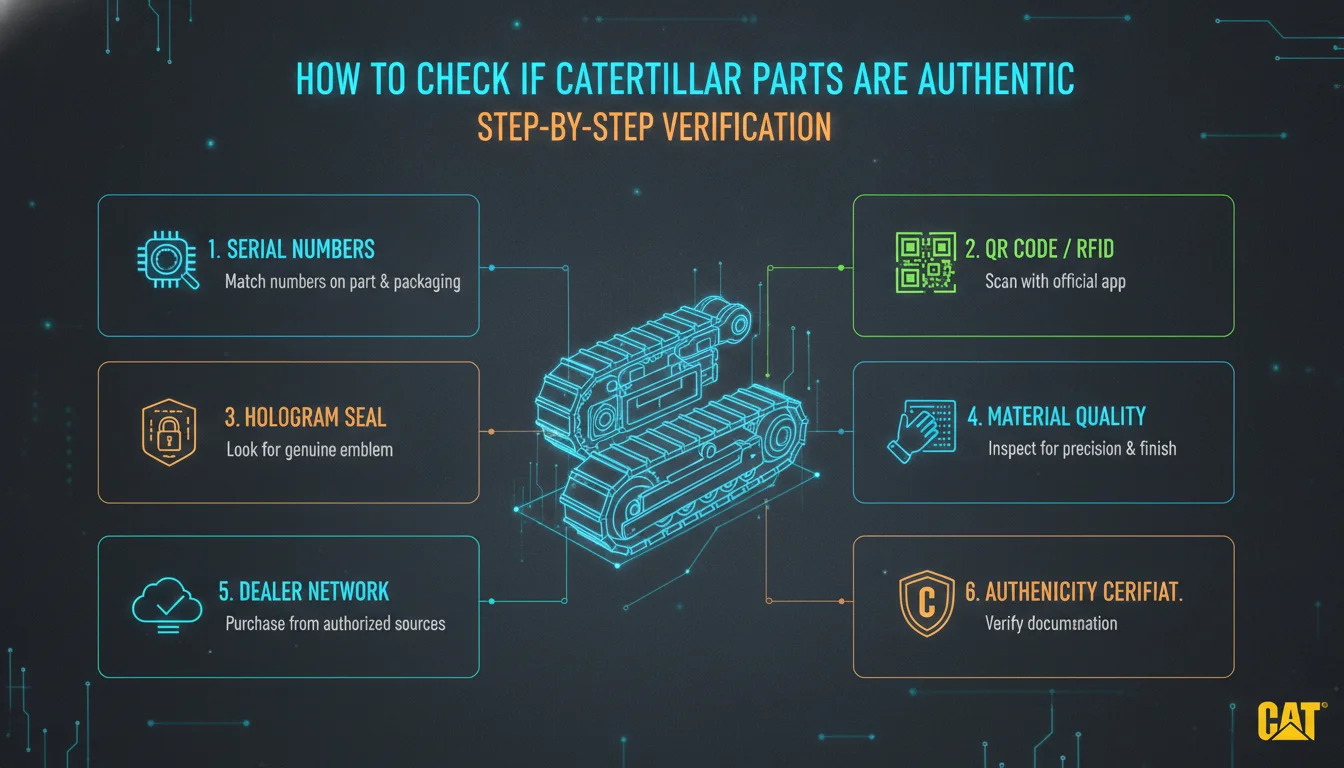
How to Check if Caterpillar Parts Are Authentic: Step-by-Step Verification
Step 1: Inspect Packaging and Labels
The first step in this kind of are authentic is a close inspection of packaging and labeling. Genuine Cat parts and Cat Reman parts come in high-quality packages. According to Caterpillar, smudges, smears, inconsistencies in the logo, and crooked labels are warning signs of fakes. Authentic parts often include difficult-to-replicate holograms or security seals. Al Burhan adds that counterfeit packaging often shows spelling errors, blurry printing, unusual fonts, or missing information. Genuine parts arrive in sturdy boxes with professional printing and clearly displayed company logo, part number, and product information. Do not assume a part is genuine just because the box has a yellow-and-black color scheme. Inspect print quality, label alignment, and security features carefully.
Step 2: Verify the Part Number and Serial Number
Part number verification is central to the to check if caterpillar parts are authentic. According to All Parts Machinery, Caterpillar uses unique and consistent numbering systems, and a genuine part will always have a clearly engraved or printed part number directly on the product or on its OEM label. Examples include 6Y7197, 8E5346, and 1R0749. Cross-check serial numbers, part numbers, or trim codes against official Cat records. If a serial number cannot be read or appears sandblasted or cleaned, that is a red flag. According to David Zalar, Lifecycle Manager for Caterpillar Fuel Systems, Caterpillar does not let such parts leave its facilities. A generic label or a part number that cannot be found in official manufacturer catalogs is another strong warning sign.
Step 3: Examine Physical Workmanship and Materials
Some differences in quality are visible to the naked eye. Counterfeit parts could use lower-grade materials and have poor finishes, rough edges, or mismatched components. All Parts Machinery notes that authentic parts feature precise and clean manufacturing details, with part numbers or logos permanently marked by laser or mold, not printed stickers. Compare weight, surface texture, machining marks, and fitment against a known genuine sample. If a part feels lighter, has porous castings, or shows uneven machining, treat it as suspect. Physical inspection is a practical answer to authentic without specialized database access.
"They certainly don't come with any Caterpillar warranty if they're not Cat parts." - David Zalar, Lifecycle Manager for Caterpillar Fuel Systems
Warranty, Documentation, and Dealer Verification
Step 4: Confirm Caterpillar Limited Warranty
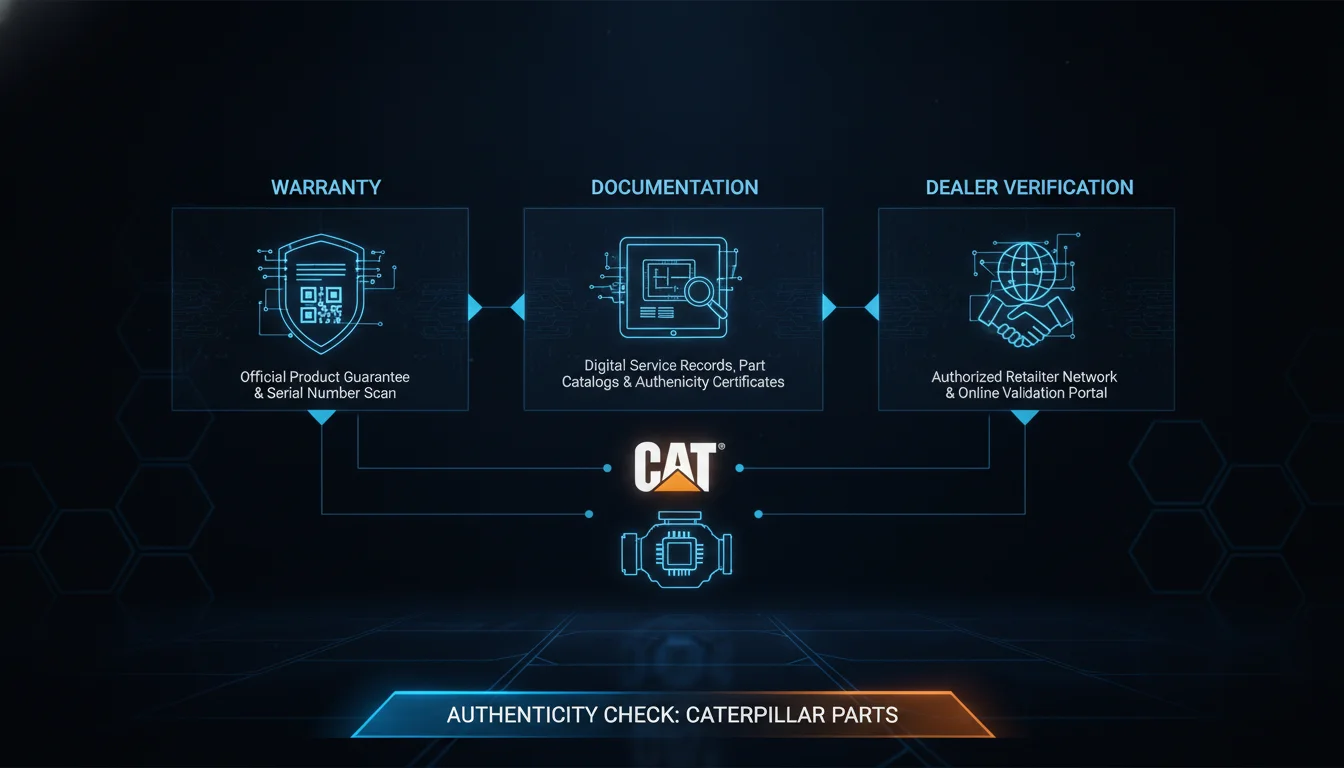
Genuine Cat parts and Cat Reman parts come with a Caterpillar Limited Warranty. An authorized Cat dealer can provide complete details about the applicable warranty. Counterfeit parts do not come with any Caterpillar warranty. This is one of the strongest verification signals because warranty registration requires traceability to Caterpillar inventory. If a seller cannot or will not provide warranty documentation, or if the warranty terms seem vague, the part may not be genuine. For Caterpillar warranty coverage to apply, there must be an identifiable defect in Caterpillar material and workmanship. Installing a counterfeit part can disqualify a machine from coverage that would otherwise protect a genuine part.
When to Visit an Authorized Cat Dealer
If any doubt remains after checking packaging, numbers, and workmanship, take the part to an authorized Cat dealer location. Technicians there can confirm authenticity using specialized tools and databases. This validation path is especially important for high-value or safety-critical components such as fuel systems, engine internals, and undercarriage parts. A dealer can cross-reference the part number and serial number against current Caterpillar records, inspect the physical component, and issue a definitive answer. For high-stakes repairs, dealer verification should always be part of how to.
Supplier Documentation and OEM References
A professional distributor should issue a sales invoice or certificate that includes the OEM reference or manufacturer's part number. Reliable suppliers clearly indicate whether the part is OEM, remanufactured, or aftermarket, along with serial or batch information. Keep original packaging for warranty or future verification. If a seller cannot provide a traceable invoice, is vague about source, or avoids questions about OEM references, treat that as a risk. Documentation alone does not prove authenticity, but the absence of documentation is a meaningful red flag.
"OEM parts are never shipped in plain boxes or without identifiable lot codes." - All Parts Machinery, industry parts identification guide, October 2025
Digital Verification: QR Codes and the Cat Central App
Scanning Barcodes and QR Codes
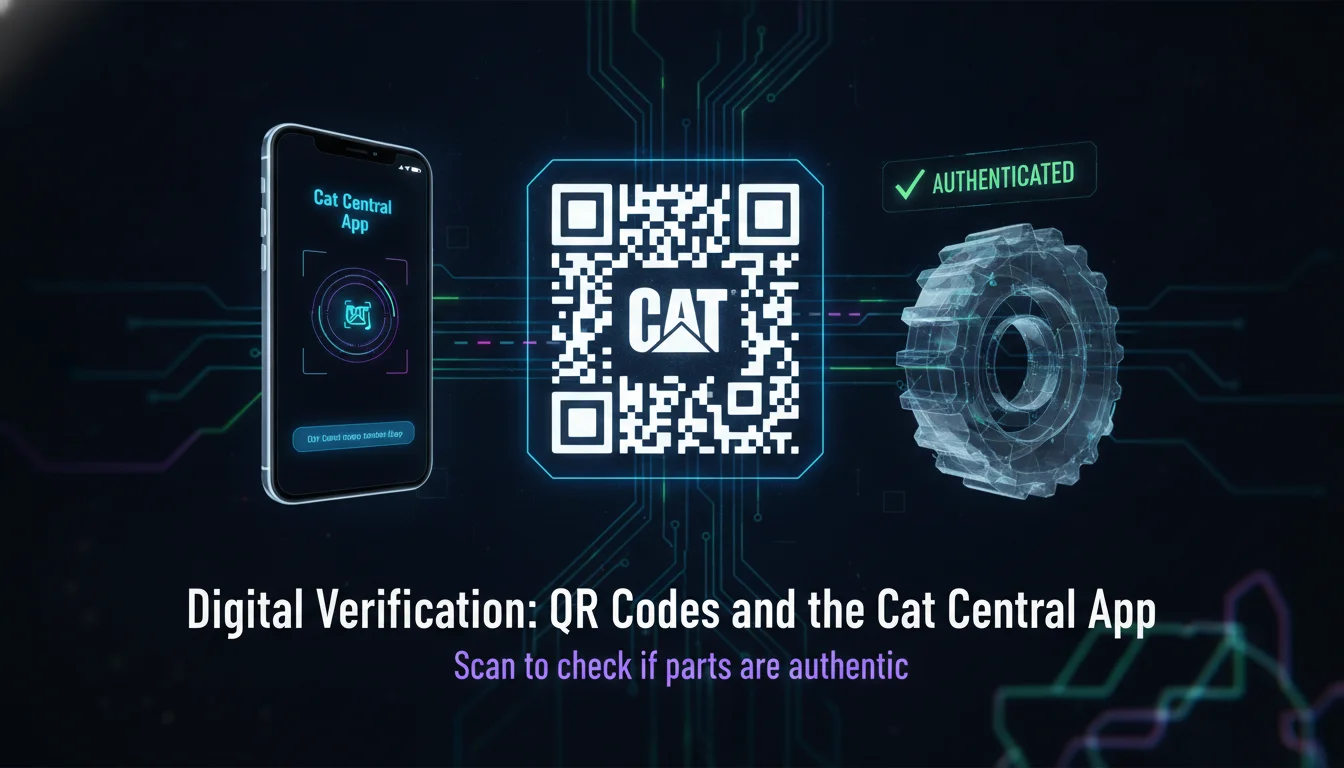
Scanning barcodes or QR codes through official Caterpillar platforms is a fast way to verify authenticity. This step ties physical markings to digital records. Genuine packaging includes unique barcodes and lot codes. A generic label with no scannable code is a red flag. Use the official app rather than a third-party scanner when possible, because official platforms cross-reference Caterpillar databases directly. If a scanned code does not return a valid result, or if the result does not match the part in hand, stop the purchase.
Using the Cat Central App
Caterpillar dealer GMMCO promotes a four-step process for authentic parts: search, select, purchase, and receive genuine Cat parts through the official platform. Users can scan a QR code to download the Cat Central app. The app provides a direct connection to Caterpillar parts catalogs and dealer inventory, reducing the chance of buying a counterfeit from an unauthorized source. The app approach turns are authentic into a traceable, purchasable workflow rather than a guessing exercise.
Cross-Referencing Official Parts Catalogs
After scanning or entering the part number, check the result against Caterpillar's online parts lookup. If the part number does not appear in official records, or if the application data does not match your machine serial number, the part may not be genuine. Online lookup tools provide machine-specific parts diagrams. A part number that appears only in an independent seller's listing but not in any official catalog should be treated with extreme caution.
How to Verify a Caterpillar Serial Number
Locating the Serial Number
Caterpillar machines and major components carry serial numbers on identification plates or stamped surfaces. For engines, the serial number may be on the cylinder block. For machines, look on the frame. The serial number is a manufacturer-assigned identifier tied to build records, not a random code. Knowing where to look is the first part of this type of authentic for whole components and Reman cores.
Reading the Serial Number Format
Caterpillar serial numbers typically follow a prefix-and-sequence format. The prefix identifies the product family or model, while the sequence number identifies the unit. To read a Caterpillar serial number, locate the factory code and compare it with dealer records. If characters are unevenly spaced, altered, or difficult to read, investigate further. According to David Zalar, a serial number that appears sandblasted or cleaned is a warning sign that Caterpillar would not allow from its own facilities.
Checking Serial Numbers Against Official Records
Cross-reference the serial number with an authorized Cat dealer. A dealer can confirm the machine or component build date, configuration, and parts applicability. Serial number verification is especially helpful when buying used parts or Reman cores, because cloned serial numbers may appear on counterfeit products. If the serial number does not match the machine or engine model, or if the dealer has no record, assume the part is not authentic until proven otherwise.
Physical Workmanship and Material Inspection in Detail
Visual Markings and Engraving
Original Cat parts use permanent marking methods such as laser etching or mold casting. Printed adhesive labels alone, especially on components that should be stamped, can indicate a fake. Check for sharp, clean characters on metal surfaces and consistently applied logo geometry. A part number printed on a sticker and not engraved may still be genuine for some smaller components, but verify it against official records. The combination of marking method and part number placement is a useful authenticity signal.
Material Quality and Fitment
Counterfeit parts often use lower-grade metals, polymers, or seals. A part that feels lighter, has porous castings, or shows poor machining tolerances is suspect. Compare with a known genuine sample or dealer reference. Fitment is another indicator: a part that requires excessive force, has gap issues, or does not align with mating surfaces may not be genuine. Because counterfeit parts are not manufactured to Caterpillar specifications, they may fit incorrectly and malfunction, causing internal damage to an engine or hydraulic system.
Packaging Condition and Security Features
Genuine Caterpillar boxes are yellow and black with the CAT logo and unique barcode, according to All Parts Machinery. Packaging is part of the manufacturer's quality control process. Plain boxes, missing lot codes, or absent security seals are red flags. Even with authentic packaging, inspect the part inside, because counterfeiters sometimes reuse genuine boxes. The condition of holographic stickers, security seals, and barcode placement can provide additional confirmation of authenticity.
Genuine vs. Counterfeit: Verification Methods Compared
No single method is perfect, so a layered approach is the most reliable answer to this kind of are authentic. The table below compares the main verification methods, what to inspect, and the red flags that indicate a fake.
| Verification Method | What to Check | Authentic Sign | Counterfeit Red Flag |
|---|---|---|---|
| Packaging and labels | Box quality, logo alignment, printing, security seals | High-quality print, clear CAT logo, holograms or security seals | Smudges, smears, spelling errors, crooked labels, plain boxes |
| Part number and serial number | Engraved or printed numbers, official catalog match | Clearly marked number found in Cat records | Generic label, unreadable or sandblasted number, no catalog match |
| Physical workmanship | Material finish, weight, machining, fitment | Clean edges, exact tolerances, permanent markings | Rough edges, porous castings, adhesive stickers instead of engraving |
| Warranty and documentation | Caterpillar Limited Warranty, OEM invoice | Traceable warranty through authorized dealer | No warranty, vague or missing documentation |
| Digital verification | QR codes, barcodes, Cat Central app, online lookup | Code returns valid part record matching the component | No scan result, mismatch with official database |
| Dealer validation | Authorized Cat dealer inspection | Technician confirms using specialized tools and databases | Seller discourages dealer inspection or cannot provide dealer reference |
The most reliable verification combines at least three methods. For critical repairs, use all six. Dealer validation is the strongest individual method because it uses Caterpillar's own systems. Packaging and digital scans are fast but can be spoofed, so they should never be the only check.
Genuine Parts vs. Aftermarket: What Procurement Managers Should Know
Procurement managers evaluating how to check if Caterpillar parts are authentic often face a related question: should they buy genuine OEM parts, Cat Reman parts, or third-party aftermarket components? The answer depends on application, risk tolerance, and total cost of ownership.
| Part Type | Source | Warranty | Best For | Key Risk |
|---|---|---|---|---|
| Genuine Cat (new) | Caterpillar or authorized dealer | Caterpillar Limited Warranty | Critical systems, new machines | Higher upfront cost |
| Cat Reman | Caterpillar remanufacturing | Caterpillar Limited Warranty | Cost-sensitive repairs with OEM quality | Core return required |
| Third-party aftermarket | Independent suppliers | Supplier warranty only | Non-critical wear parts | Variable quality, no Cat traceability |
| Counterfeit | Unauthorized sources | None | No legitimate use case | Equipment damage, voided warranty |
For fleet maintenance supervisors, the practical rule is straightforward: use genuine or Reman parts for fuel systems, engine internals, hydraulic components, and undercarriage. Third-party aftermarket parts from reputable suppliers may be acceptable for lower-risk consumables, but always verify OEM references and supplier credentials before ordering.
Risks of Installing Counterfeit Caterpillar Parts
Equipment Damage
Because counterfeit parts are not manufactured to Caterpillar specifications, they may fit incorrectly and malfunction, causing internal damage to your engine. A failed fuel injector, for example, can damage pistons and cylinders. A counterfeit filter may allow contamination into a hydraulic system. The small amount you might save buying a counterfeit part could quickly be offset by the costs of dealing with equipment damage. Knowing how to check if Caterpillar parts are authentic protects against these avoidable costs.
Reduced Performance and Increased Downtime
Fake parts are not designed to the same standards as genuine Cat parts. They could hurt your engine's efficiency, productivity, or fuel consumption. Counterfeit parts may wear out faster than genuine Cat parts or cause unexpected breakdowns, leading to repair delays and disrupting your operation. According to Caterpillar, the costs include downtime, the cost of parts, the cost of mechanic labor, and loss of production. These indirect costs routinely exceed any upfront savings on a fake part.
Warranty and Compliance Issues
For Caterpillar warranty coverage, there must be an identifiable defect in Caterpillar material and workmanship. By installing a counterfeit part, you become ineligible for a Caterpillar Limited Warranty that would otherwise cover a genuine Cat part. The use of fake parts may also cause your engine to exceed regional emissions or environmental standards. Compliance failures can lead to fines, site shutdowns, or failed inspections. How to check if Caterpillar parts are authentic is therefore not just a maintenance question. It is a risk management question.
How to Buy Authentic Caterpillar Parts in the USA and Globally
Authorized Dealers and Official Portals
Buying through authorized Cat dealers remains the most direct way to avoid counterfeits. In the USA, the official Caterpillar parts portal and McGill Industries are examples of sources that supply genuine Caterpillar parts. Authorized dealers can provide warranty and traceability. Even when buying from an authorized dealer, you still have the right to verify the part using the methods above. Traceability from dealer inventory to your worksite is a strong authenticity indicator.
Evaluating Independent Suppliers
Independent suppliers may be legitimate. Look for industrial parts suppliers that clearly state they sell new, genuine Caterpillar parts and can provide OEM references. Request part number verification, physical photos, and warranty details before payment. A supplier that refuses to provide an invoice with OEM references or that only offers a generic description should be avoided. Where you buy is as important as how to check if Caterpillar parts are authentic after purchase.
Global Purchasing and Import Considerations
In the UAE, Al Burhan is an authorized supplier of Caterpillar Genuine Parts. In India, GMMCO Cat promotes the Cat Central app and can be reached at 1800 425 2546. In Canada, Finning highlights the parts.cat.com feature for finding the right parts with confidence. For cross-border purchases, confirm that the part is permitted for import and is not subject to regional emissions or environmental standards. Ask the seller to declare whether the part is OEM, remanufactured, or aftermarket before shipment.
At 3GEN Export, we supply OEM-quality spare parts for Caterpillar, Komatsu, Volvo, and 40+ brands with global delivery. Every order includes full part number documentation and traceable sourcing, so you can apply the verification steps above with confidence. Browse our parts categories or explore our brand pages to find the components your fleet needs.
Pros and Cons of Buying Genuine Caterpillar Parts
Pros
- Full Caterpillar Limited Warranty: Genuine and Reman parts carry traceable warranty coverage that counterfeit parts cannot match.
- OEM-spec performance: Parts are manufactured or remanufactured to Caterpillar's engineering tolerances, protecting engine efficiency and fuel consumption.
- Compliance assurance: Genuine parts keep your equipment within regional emissions and environmental standards.
- Traceability: Part numbers, serial numbers, and lot codes are verifiable against official Caterpillar records at any point in the supply chain.
- Lower total cost of ownership: Avoiding equipment damage, unplanned downtime, and compliance fines typically outweighs the higher upfront price of genuine parts.
Cons
- Higher upfront cost: Genuine Cat parts carry a price premium over third-party aftermarket alternatives.
- Lead time variability: Depending on your region and the part category, authorized dealer stock may not always be immediately available.
- Core return requirement for Reman: Cat Reman pricing assumes you return a used core; failing to do so increases the net cost.
- Verification effort: Confirming authenticity through multiple methods takes time, especially for procurement teams managing large parts orders.
Final Word: How to Check if Caterpillar Parts Are Authentic in 2026
How to check if Caterpillar parts are authentic is a layered process. Start with packaging and labels, verify part numbers and serial numbers, inspect physical workmanship, confirm warranty coverage, and use digital tools where available. If any doubt remains, visit an authorized Cat dealer for a definitive inspection. The risk of counterfeit parts is not hypothetical. Fake components can damage equipment, reduce performance, increase downtime, and void warranty. By following a structured verification sequence and buying through traceable sources, you can protect your equipment and your business in 2026 and beyond.
Shop OEM-quality spare parts with global 5-day delivery at 3genexport.com.
Frequently Asked Questions
How do I check if a Caterpillar part is genuine?
Verify the part number against official Cat records, inspect packaging for clear branding and security seals, check workmanship quality, and confirm warranty with an authorized dealer. For the strongest confirmation, take the part to an authorized Cat dealer location where technicians can use specialized tools and databases.
How to check Caterpillar serial number?
Locate the serial number on the component or machine identification plate, then cross-reference it with an authorized Cat dealer against official build records. If the characters appear sandblasted, cleaned, or unevenly spaced, treat the part as suspect until verified.
Are Caterpillar parts made in China?
Caterpillar has global manufacturing and sourcing operations. Genuine Caterpillar parts are built to Caterpillar specifications regardless of production location. Authenticity depends on source, markings, and traceability, not country of origin.
How to know if car parts are genuine?
Check packaging quality, part number engraving, and warranty documentation, then buy from authorized dealers. For Caterpillar equipment specifically, use the Cat Central app and dealer verification as the two strongest confirmation methods.
How to read Caterpillar serial number?
Caterpillar serial numbers use a prefix that identifies the product family and a sequence that identifies the unit. Compare the full code with dealer records to confirm build details and parts applicability for your specific machine.
Can I verify Caterpillar parts without a dealer?
You can perform initial checks using packaging, part numbers, markings, and the official Cat Central app. However, a dealer inspection is the strongest confirmation for high-value or safety-critical components, and we recommend it whenever the stakes are high.