
How to Choose a Hydraulic Pump for Excavator
Learn how to choose hydraulic pump for excavator: pump types, key specs, common mistakes, and OEM-quality sourcing with global 5-day delivery.
Loading article…
Article Not Found
The article you're looking for doesn't exist or may have been removed.
Back to BlogKey Takeaways
- Axial piston pumps are the standard choice for main hydraulic circuits on mid-to-large excavators, operating at 280-350 bar working pressure.
- Three specifications drive every pump selection decision: maximum flow rate, maximum operating pressure, and displacement per revolution.
- A mid-size 20-ton excavator typically requires a main pump in the 200-250 L/min flow range. Match your machine's serial number, not just its model name.
- Replacement pump costs range from $3,000 to $6,000 depending on type and displacement. A more efficient pump pays back its premium through lower fuel and maintenance spend.
- Common selection mistakes include sizing by machine model alone, ignoring production-year spec changes, and skipping compatibility checks on the pilot circuit.
- As of 2026, OEM-equivalent axial piston pumps from Kawasaki, Rexroth, and Nachi are available with verified specs and global delivery in five business days.
Knowing how to choose hydraulic pump for excavator is the difference between a machine that performs at full capacity and one that bleeds money through slow cycle times, overheating fluid, and premature component wear. The hydraulic pump converts mechanical energy from the diesel engine into pressurized flow that drives every movement on the machine.
Understanding Hydraulic Pumps in Excavators
A hydraulic pump in an excavator is the component responsible for converting mechanical power into hydraulic energy. This pressurized fluid drives the boom, arm, bucket, swing motor, and travel circuits. The pump choice directly affects the excavator's digging force, cycle speed, fuel consumption, and long-term maintenance costs.
What is a Hydraulic Pump?
A hydraulic pump is a device that moves hydraulic fluid through a closed circuit, generating the pressure needed to operate hydraulic actuators. In excavators, the main pump powers primary functions such as digging, lifting, and rotating, while secondary pumps supply pilot pressure and auxiliary circuits.
Importance of Choosing the Right Pump
Choosing the correct hydraulic pump is critical for ensuring the excavator operates efficiently. A mismatched pump reduces digging force, increases fuel consumption, accelerates heat buildup, and raises maintenance costs. Getting the selection right from the start avoids all of those outcomes.
How a Hydraulic Pump Actually Works in an Excavator
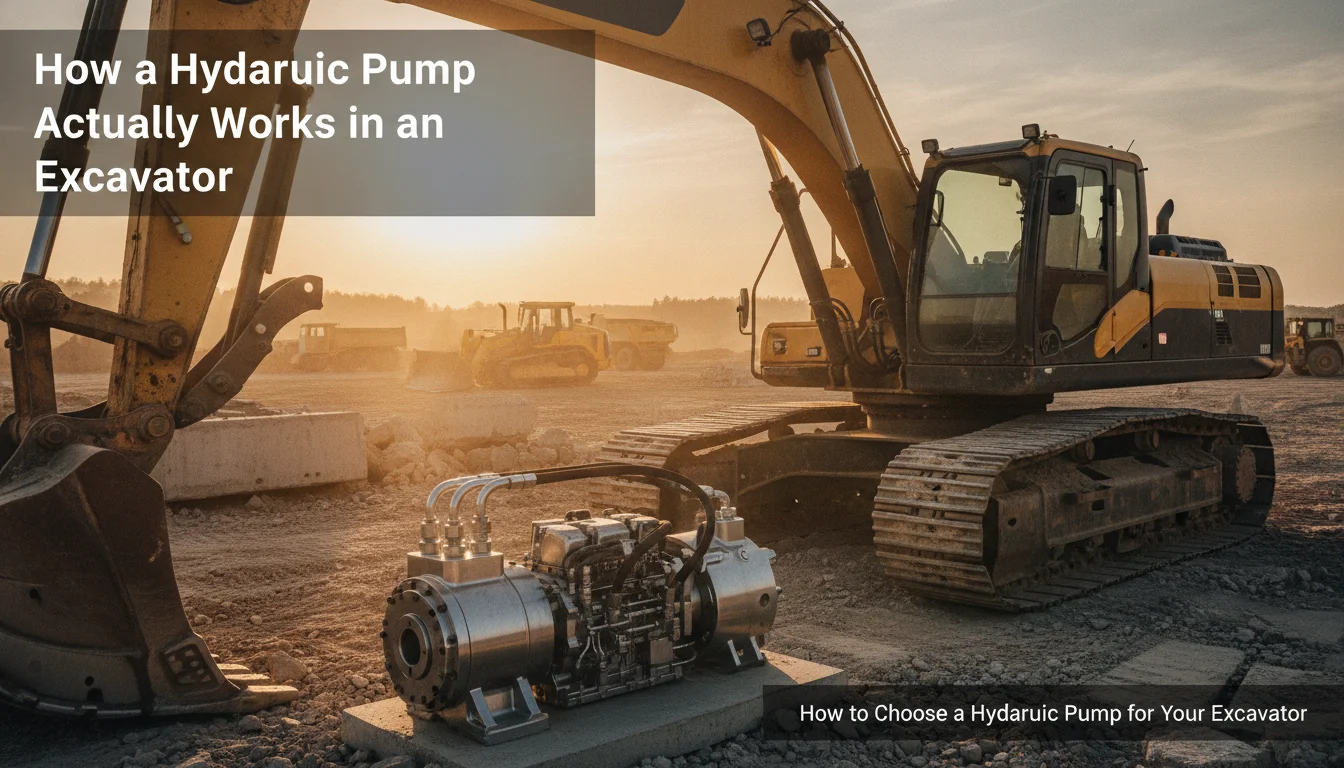
Understanding the internal mechanics helps you make a better selection decision and spot problems earlier. Here is the sequence of events every time an operator moves a control lever.
The diesel engine drives the pump through a direct coupling or PTO arrangement. As the pump shaft rotates, pistons (in an axial piston design) reciprocate inside a rotating cylinder block. The angle of the swashplate controls how far each piston travels on each stroke. A steeper swashplate angle means a longer piston stroke, which displaces more fluid per revolution. A shallower angle reduces displacement and flow.
That pressurized fluid travels through the main control valve, which directs flow to whichever actuator the operator is commanding. When no function is active, the pump destroke to minimum displacement, reducing fuel consumption. This is the core advantage of variable displacement: the pump only works as hard as the job demands.
Load-sensing systems take this further. A signal line communicates actual load pressure back to the pump regulator. The pump then adjusts its output to maintain a set differential above load pressure, rather than pumping at maximum capacity regardless of demand. According to manufacturer specifications from Kawasaki and Rexroth, load-sensing variable displacement pumps consistently deliver better fuel economy than fixed-displacement alternatives across typical excavator duty cycles.
"The pump type you choose influences performance, reliability, operating cost, fuel efficiency, and maintenance intervals. A mismatched or undersized pump can diminish digging force, slow cycle times, increase heat generation, and raise the overall cost of ownership." - Poocca Hydraulic, industry technical reference
Gear pumps work differently. Two interlocking gears create expanding and contracting chambers as they rotate, pushing fluid from inlet to outlet at a fixed volume per revolution. There is no swashplate, no variable displacement, and no load sensing. Flow is proportional to shaft speed only. This simplicity makes gear pumps reliable and inexpensive for low-pressure auxiliary circuits, but unsuitable as main pumps on anything larger than a compact excavator.
Types of Hydraulic Pumps Used in Excavators
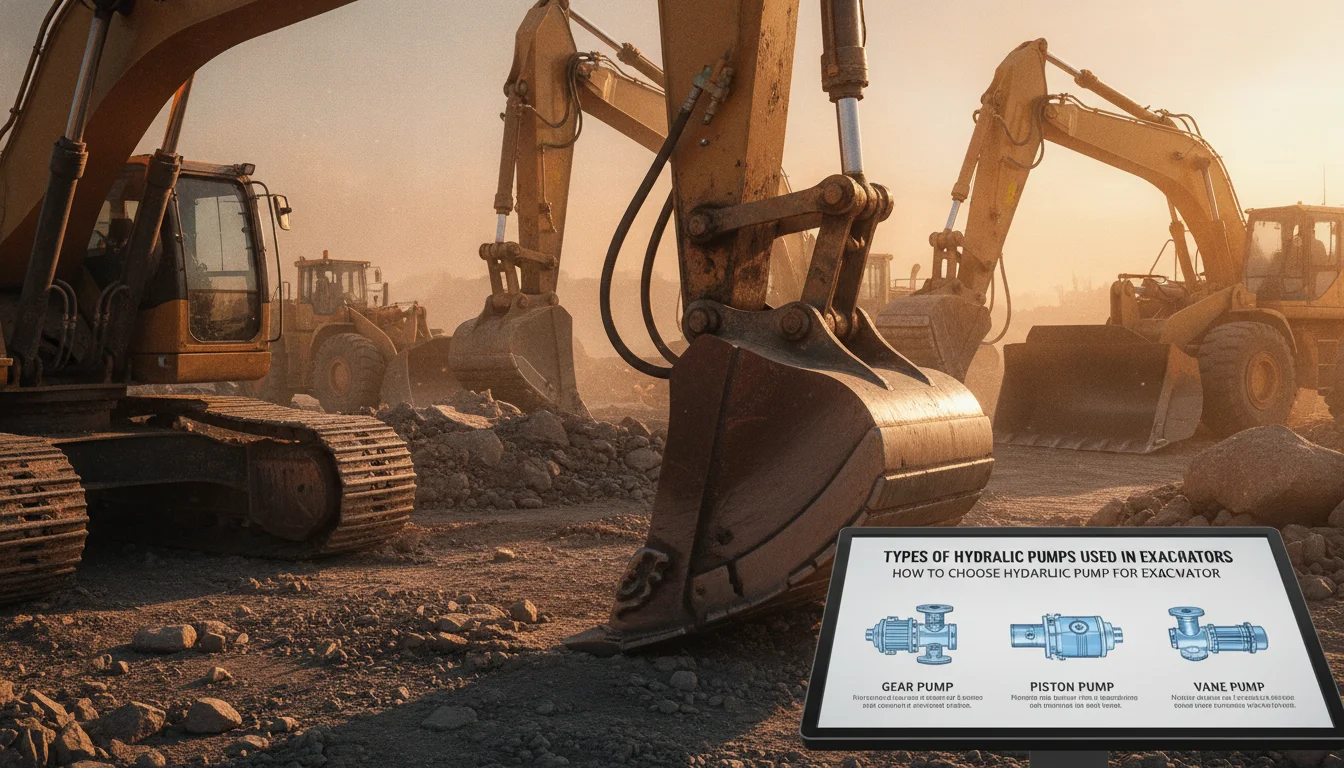
Three pump types appear across the excavator market, each suited to a different role and machine class. Understanding the differences is the first step in knowing how to choose hydraulic pump for excavator correctly.
Axial Piston Pumps
Axial piston pumps are the standard for main hydraulic circuits on modern excavators. They operate at working pressures of 280-350 bar, handle variable displacement through swashplate adjustment, and integrate with load-sensing control systems. The Kawasaki K3V and K5V series cover excavators from 10 tons up to the 50-ton class, with displacements ranging from 63 cc/rev to 280 cc/rev. The Rexroth-Uchida AP2D series is the dominant choice for mini and midi excavators, available in displacements from 10 cc/rev to 36 cc/rev. Per Fluid Power Journal, the AP2D achieves volumetric efficiency up to 98%, which translates directly to lower fuel consumption and reduced heat load on the hydraulic system.
Gear Pumps
Gear pumps are simpler and less expensive than piston pumps. They are typically used for auxiliary functions in excavators: pilot pressure supply, cooling circuits, and brake release systems. Fixed displacement means they cannot adapt output to load demand, which limits their efficiency in primary circuits. For auxiliary roles, that limitation is acceptable because the flow requirements are small and relatively constant.
Vane Pumps
Vane pumps use a rotor with sliding vanes inside an eccentric cavity. They offer smoother flow than gear pumps and can handle moderate pressure applications. In excavator hydraulics, vane pumps appear in medium-duty circuits where gear pump noise is a concern but the pressure demands do not justify the cost of a piston pump. They are less common than the other two types in heavy construction equipment.
Hydraulic Pump Types: Comparison Table

| Feature | Axial Piston Pump | Gear Pump | Vane Pump |
|---|---|---|---|
| Typical working pressure | 280-350 bar | Low to moderate | Moderate |
| Displacement type | Variable | Fixed | Fixed or variable |
| Primary excavator role | Main hydraulic circuit | Auxiliary / pilot circuit | Medium-duty circuits |
| Fuel efficiency | High (load sensing) | Low | Moderate |
| Purchase cost | $3,000-$6,000+ | Low | Moderate |
| Maintenance complexity | Moderate | Low | Low to moderate |
| Best machine class | 10-ton and above | All classes (auxiliary) | Medium excavators |
| Key brands | Kawasaki, Rexroth, Nachi | Multiple OEM suppliers | Multiple OEM suppliers |
Key Specifications to Consider
Three numbers from your service manual or the existing pump's data plate determine whether a replacement will perform correctly. Every other specification is secondary to these three.
Flow Rate
Flow rate, measured in liters per minute (L/min) or gallons per minute (GPM), determines how fast the excavator moves its attachments. A mid-size 20-ton excavator typically requires a main pump in the 200-250 L/min range, according to industry technical data. Going below that figure produces sluggish cycle times. Going above it pushes excess flow through relief valves, generating heat and wasting fuel.
Maximum Operating Pressure
Maximum operating pressure determines whether the pump can sustain the forces the machine demands. Most excavator main pumps are rated between 350 and 450 bar working pressure. Do not confuse working pressure with peak pressure: working pressure is the continuous rated load, peak pressure is the momentary maximum the pump can tolerate without damage. A mismatch on this specification is rarely safe or cost-effective.
Displacement
Displacement is the volume of fluid displaced per revolution of the drive shaft, expressed in cc/rev. On a variable pump, this figure represents maximum displacement when fully stroked. Matching displacement to the original pump specification is essential for preserving the performance characteristics the machine was designed around. Even within the same excavator model, displacement specs can differ between production years, so always verify against your machine's serial number before ordering.
How to Choose Hydraulic Pump for Excavator: Step-by-Step
Knowing how to choose hydraulic pump for excavator comes down to a repeatable process. Follow these steps in order and you will avoid the most expensive mistakes.
Step 1: Pull the Specifications from the Source
Consult the excavator's OEM service manual or read the data plate on the existing pump directly. Record the maximum flow rate, maximum operating pressure, and displacement per revolution. Also note the pump model number and the machine's serial number. Serial number matters because OEM specifications sometimes changed mid-production run without a model name change.
Step 2: Identify the Pump's Role in the Circuit
Determine whether you are replacing the main pump, the pilot pump, or an auxiliary pump. Each has different pressure and flow requirements. The main pump drives boom, arm, bucket, and travel. The pilot pump supplies low-pressure control signals to the main control valve. Mixing these up is a costly error.
Step 3: Evaluate Pump Types Against Your Application
Based on the specifications and circuit role, select the appropriate pump type:
- For main circuits on excavators 10 tons and above, axial piston pumps are the correct choice.
- For pilot and auxiliary circuits, gear pumps are appropriate and cost-effective.
- For medium-duty secondary circuits where smooth flow matters, consider vane pumps.
Step 4: Verify Brand and Model Compatibility
Cross-reference the pump model against the excavator's OEM parts list. Reputable pump manufacturers for excavator applications include Kawasaki (K3V, K5V series), Rexroth-Uchida (AP2D series), and Nachi (PVD, PHK series). Confirm that the replacement unit matches the mounting flange, shaft dimensions, port configuration, and control interface of the original.
Step 5: Confirm Lead Time and Source Quality
Verify that the supplier can provide documentation confirming OEM-equivalent specifications. Ask for the pump's test report or spec sheet. Confirm delivery lead time against your maintenance window. At 3GEN Export, we ship OEM-quality hydraulic pumps globally with a five-business-day delivery commitment, so downtime stays predictable.
Pros and Cons of Axial Piston Pumps for Excavators
Axial piston pumps dominate excavator main circuits for good reasons, but they are not without trade-offs. Here is an honest assessment.
Pros
- High working pressure capability (280-350 bar) suits heavy digging and lifting demands.
- Variable displacement reduces fuel consumption during light-load and idle conditions.
- Load-sensing integration enables smooth multi-function operation.
- Long service life when maintained correctly, with major OEM brands offering proven field reliability across thousands of operating hours.
- Wide availability of OEM-equivalent replacements from Kawasaki, Rexroth, and Nachi.
Cons
- Higher purchase cost than gear or vane pumps, with replacement units typically ranging from $3,000 to $6,000.
- More sensitive to hydraulic fluid contamination than gear pumps. Tight internal clearances mean that dirty oil accelerates wear significantly faster.
- Greater maintenance complexity. Rebuilding a piston pump requires specialized tooling and training.
- Longer lead times for some displacement variants if sourced through slow supply chains.
Common Mistakes to Avoid
Most pump selection errors fall into a small number of categories. Recognizing them in advance saves significant money and downtime.
Choosing the Wrong Size
Selecting a pump that is either too large or too small for the excavator's hydraulic circuit is the most expensive mistake. A pump that is too large pushes excess flow through relief valves, generating heat and accelerating fluid degradation. A pump that is too small produces sluggish operation, slow cycle times, and reduced digging force. Size to the machine's specification, not to a general category.
Ignoring Compatibility
Ensure the replacement pump is compatible with the existing hydraulic system in every dimension: mounting flange, shaft size, port locations, control type, and displacement. A pump that is close but not exact will create integration problems that cost more to fix than the original pump replacement.
Overlooking Maintenance Requirements
Different pump types have different maintenance intervals and failure modes. Axial piston pumps require clean hydraulic fluid above all else. Contamination is the leading cause of premature piston pump failure, according to OEM service bulletins from major excavator manufacturers. Factor maintenance requirements into your selection, not just purchase price.
Skipping the Serial Number Check
Ordering by model name alone is a common shortcut that leads to wrong parts. Excavator manufacturers sometimes updated pump specifications mid-production without changing the model designation. Always verify against the machine's serial number and the existing pump's part number before placing an order.
Ignoring the Pilot Circuit
The pilot pump is a separate, smaller pump that supplies low-pressure control oil to the main control valve. It is often overlooked during main pump replacement. If the pilot pump is also worn, replacing only the main pump will not restore full machine performance. Inspect both simultaneously.
Real-World Scenario: Replacing the Main Pump on a 20-Ton Excavator
Here is a realistic example of how the selection process plays out in practice.
A fleet maintenance supervisor at a civil construction company notices that one of their 20-ton excavators has developed a half-second lag on boom raise and the bucket feels slower than the other machines on site. The operator confirms the issue has been building over two to three weeks. The supervisor pulls the service manual and reads the data plate on the existing pump: a Kawasaki K3V112DT, maximum displacement 112 cc/rev, rated flow approximately 220 L/min at operating speed, maximum working pressure 350 bar.
Rather than ordering by model name alone, the supervisor cross-references the machine's serial number against the OEM parts list and confirms the K3V112DT is the correct variant for that production year. He contacts 3GEN Export, provides the pump model number and machine serial number, and receives a verified OEM-equivalent unit with a matching spec sheet. The pump ships within two business days and arrives on site within five. The machine returns to full cycle speed after installation and a proper hydraulic flush.
The total downtime: six days. Without a reliable supplier and a clear selection process, that figure easily doubles.
"Piston pumps are known for their high-pressure capabilities, high efficiency, and durability. They handle a wide range of viscosities better than their counterparts, making them the preferred choice for excavator hydraulic systems." - Ikrom Kurbanov, General Manager, Hydraulic America, writing in Fluid Power Journal
Cost Considerations
Hydraulic pump costs vary based on type, displacement, and brand. Understanding the full cost picture helps you budget accurately and avoid false economies.
Initial Purchase Cost
Replacement hydraulic pumps for excavators typically range from $3,000 to $6,000 for axial piston main pumps, depending on displacement and brand. Gear pumps for auxiliary circuits cost significantly less. Axial piston pumps sit at the higher end of the range because of their internal complexity and precision manufacturing tolerances.
Long-Term Operational Costs
A more efficient pump with proper variable displacement and load sensing will reduce fuel consumption over its service life. Factor in fluid costs, filter replacement intervals, and the cost of unplanned downtime when evaluating total cost of ownership. A pump that fails prematurely because it was undersized or poorly matched costs far more than the price difference between a budget unit and an OEM-equivalent replacement.
Warranty and Support
When purchasing a hydraulic pump, confirm the warranty terms and the supplier's ability to provide technical support. A solid warranty protects your investment. More importantly, a supplier who can answer technical questions about compatibility and specifications before the sale prevents costly mistakes after it.
2026 Outlook: What's Changing in Excavator Hydraulic Pump Supply
As of 2026, the global supply of OEM-equivalent axial piston pumps has improved significantly compared to the disruptions of recent years. Lead times from major manufacturers including Kawasaki and Rexroth have stabilized, and the availability of verified aftermarket equivalents has expanded across the 10-ton to 50-ton excavator class.
Procurement teams are increasingly prioritizing suppliers who can provide spec documentation alongside the part, not just a catalog number. This year, we are seeing more fleet managers request pump test reports and volumetric efficiency data as standard purchase requirements. That is a positive shift. A pump that arrives with verified specifications is a pump you can install with confidence.
The move toward electrified and hybrid excavators is also beginning to affect pump design, with some manufacturers developing electrically driven variable displacement pumps for hybrid powertrains. For the vast majority of the global fleet operating conventional diesel excavators, however, the axial piston pump remains the correct answer for the foreseeable future.
Frequently Asked Questions
How do I determine what size hydraulic pump I need?
To determine the correct size, consult your excavator's OEM service manual or read the data plate on the existing pump. Record the maximum flow rate (L/min or GPM), maximum operating pressure (bar or PSI), and displacement per revolution (cc/rev). Match all three specifications to the replacement unit, and always verify against your machine's serial number rather than model name alone.
What type of hydraulic pump do excavators use?
Most excavators use a variable displacement axial piston pump as their main hydraulic pump. These pumps handle the high working pressures (280-350 bar) required for digging, lifting, and travel. Gear pumps are used for auxiliary and pilot circuits where lower pressure and fixed flow are acceptable.
How do I select the right hydraulic pump for my excavator?
Knowing how to choose hydraulic pump for excavator starts with pulling three numbers from your service manual: flow rate, operating pressure, and displacement. Then match the pump type to the circuit role (axial piston for main circuits, gear pump for auxiliary), verify brand and model compatibility against your serial number, and confirm the supplier can provide spec documentation before you order.
What happens if your hydraulic pump is too big?
An oversized pump pushes more flow than the system is designed to handle. The excess flow bypasses through relief valves, converting hydraulic energy into heat. That heat degrades fluid faster, accelerates seal wear, and can damage other components in the circuit. Oversizing is not a safety margin. It is a source of ongoing damage.
Can I replace a hydraulic pump myself?
Replacement is possible for experienced maintenance technicians with the correct tools and a clean working environment. The critical steps are: depressurize the system fully before disconnecting any lines, cap all ports immediately to prevent contamination, flush the hydraulic circuit before starting the new pump, and fill the pump case with clean hydraulic fluid before initial startup. If you are not confident in any of those steps, engage a qualified hydraulic technician.
How often should I maintain my hydraulic pump?
Follow the OEM maintenance schedule for your specific pump and application. Industry maintenance data shows that hydraulic fluid and filter changes are typically required every 1,000 to 1,500 hours of operation under normal conditions, with more frequent intervals in dusty or high-temperature environments. Contamination is the primary cause of premature piston pump failure, so fluid cleanliness is the single most important maintenance factor.
Shop OEM-quality hydraulic pumps for Caterpillar, Komatsu, Volvo, and 40+ other brands with verified specifications and global five-day delivery at 3genexport.com. Our procurement team is available to cross-reference your pump model and serial number before you order.