
How to Extend Equipment Parts Life: 2026 Guide
Learn how to extend equipment parts life with proven maintenance strategies for heavy machinery. OEM parts, lubrication, and inspection tips inside.
Loading article…
Article Not Found
The article you're looking for doesn't exist or may have been removed.
Back to BlogKey Takeaways
- Regular inspections catch wear early and prevent costly breakdowns on Caterpillar, Komatsu, Volvo, and other heavy equipment fleets.
- Proper lubrication is the single most effective daily habit for reducing friction and extending component life.
- Operator training turns your crew into the first line of defense against mechanical failure.
- OEM-quality parts outperform cheap aftermarket alternatives in both durability and long-term cost.
- Documented maintenance records let you spot trends, plan replacements, and avoid reactive break-fix cycles.
- As of 2026, organizations using structured asset management consistently extend equipment lifespan by 30-40% compared to reactive maintenance approaches, according to industry data.
How to extend equipment parts life is the practice of applying systematic maintenance, correct lubrication, quality replacement components, and operator discipline to maximize the usable service life of heavy machinery parts before replacement is needed.
Understanding Equipment Lifespan
Equipment lifespan refers to the total operating hours a machine or its components can deliver before performance drops below acceptable thresholds. Factors influencing lifespan include usage patterns, environmental conditions, and maintenance practices. The gap between a part's design life and its actual service life is almost always a maintenance gap, not a manufacturing defect.
"The average maintainable asset in commercial and industrial facilities operates at 55-65% of its design lifespan - replaced not because it wore out, but because reactive maintenance let cumulative neglect make replacement cheaper than continued repair." - Oxmaint Asset Management Report, March 2026
That figure should alarm any fleet manager. A machine designed to run for 25,000 hours that fails at 14,000 hours didn't have a parts problem. It had a process problem. Understanding this distinction is the first step toward building a maintenance culture that actually works.
Factors Affecting Equipment Lifespan
- Usage Patterns: The frequency and intensity of use directly impact wear and tear. A CAT 320 excavator running three shifts per day degrades far faster than one running a single eight-hour shift.
- Environmental Conditions: Harsh conditions - extreme heat, dust, moisture, corrosive chemicals - accelerate degradation and demand more frequent maintenance intervals.
- Maintenance Regularity: Consistent maintenance practices are the single most controllable variable. Miss a few PM cycles and cumulative neglect compounds quickly.
Importance of Maintenance
Proper maintenance is critical for extending equipment lifespan. It prevents breakdowns, ensures reliability, and eliminates unexpected failures that derail project timelines. A robust maintenance plan significantly improves equipment performance and reduces total cost of ownership across your fleet.
How Preventive Maintenance Actually Works
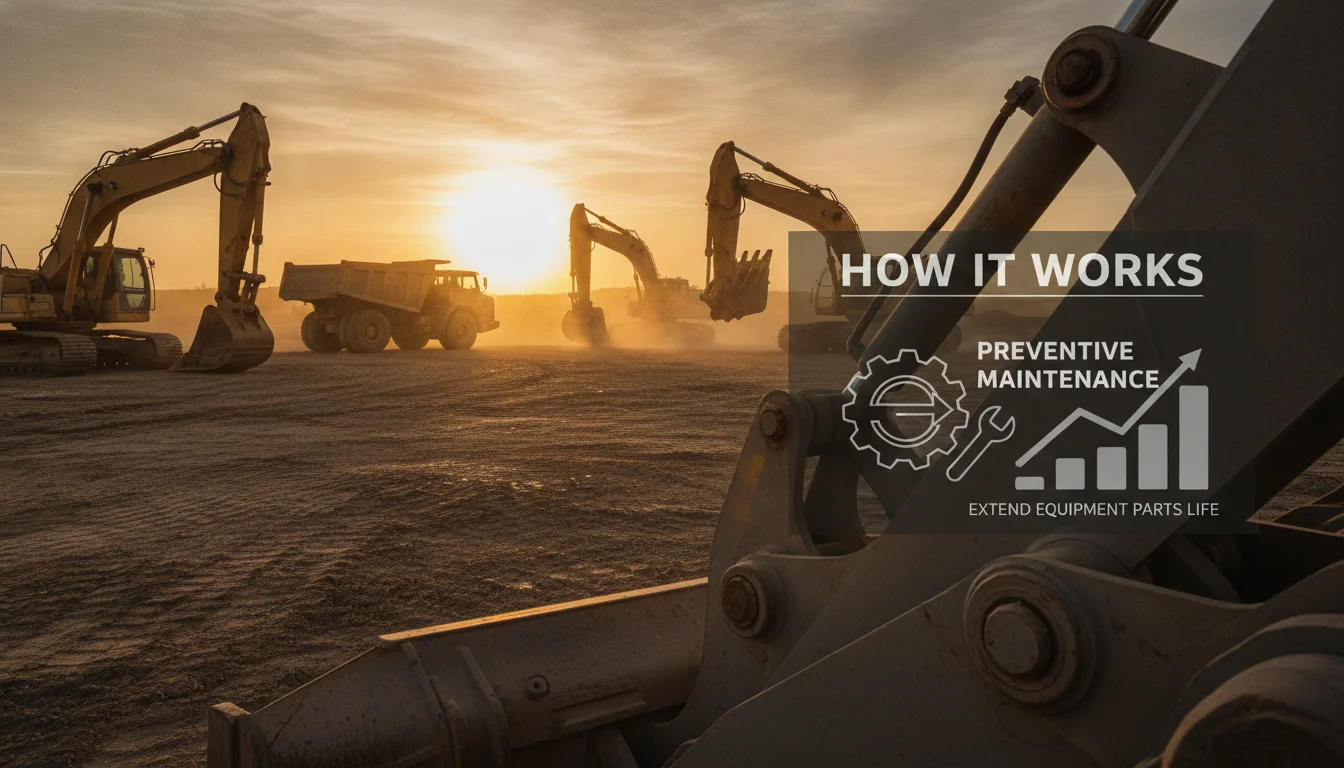
Preventive maintenance works by intervening before wear reaches the failure threshold, keeping components operating within their design limits rather than pushing them past the point of no return.
Here's the underlying mechanics. Every moving part in a heavy machine - whether it's a Komatsu PC200 swing bearing or a Volvo EC300 hydraulic cylinder - experiences three phases of wear: break-in, normal operation, and accelerated degradation. The goal of preventive maintenance is to keep components in the normal operation phase as long as possible.
Friction is the primary enemy. Metal-on-metal contact generates heat, and heat accelerates molecular breakdown in both the metal and any surrounding seals. Lubrication creates a film barrier that prevents direct contact. When that film breaks down - because the lubricant is old, contaminated, or simply absent - wear rates increase sharply. According to manufacturer service bulletins from Caterpillar and Komatsu, most premature component failures trace back to lubrication failures or contaminated fluids, not manufacturing defects.
Contamination is the second major failure driver. Dust, water, and debris entering hydraulic systems or gearboxes act as abrasives. A hydraulic system running contaminated fluid will destroy pump internals and valve spools far ahead of their rated service life. This is why filter changes are not optional - they're the primary contamination control mechanism in any heavy equipment system.
Fatigue cracking is the third mechanism. Structural components - frames, booms, bucket linkages - accumulate stress cycles. Catching hairline cracks during inspection before they propagate is the difference between a weld repair and a catastrophic structural failure. Regular visual inspection, particularly at high-stress weld joints, is the only reliable way to catch fatigue damage early.
"Preventive maintenance is a strategy of carrying out regular maintenance activities - inspection, lubrication, cleaning, and adjustment - in advance of failure. Instead of waiting until something fails, PM is intended to avert failures by getting ahead of wear and imminent degradation." - Automate.org, October 2025
Step-by-Step: How to Extend Equipment Parts Life in Practice
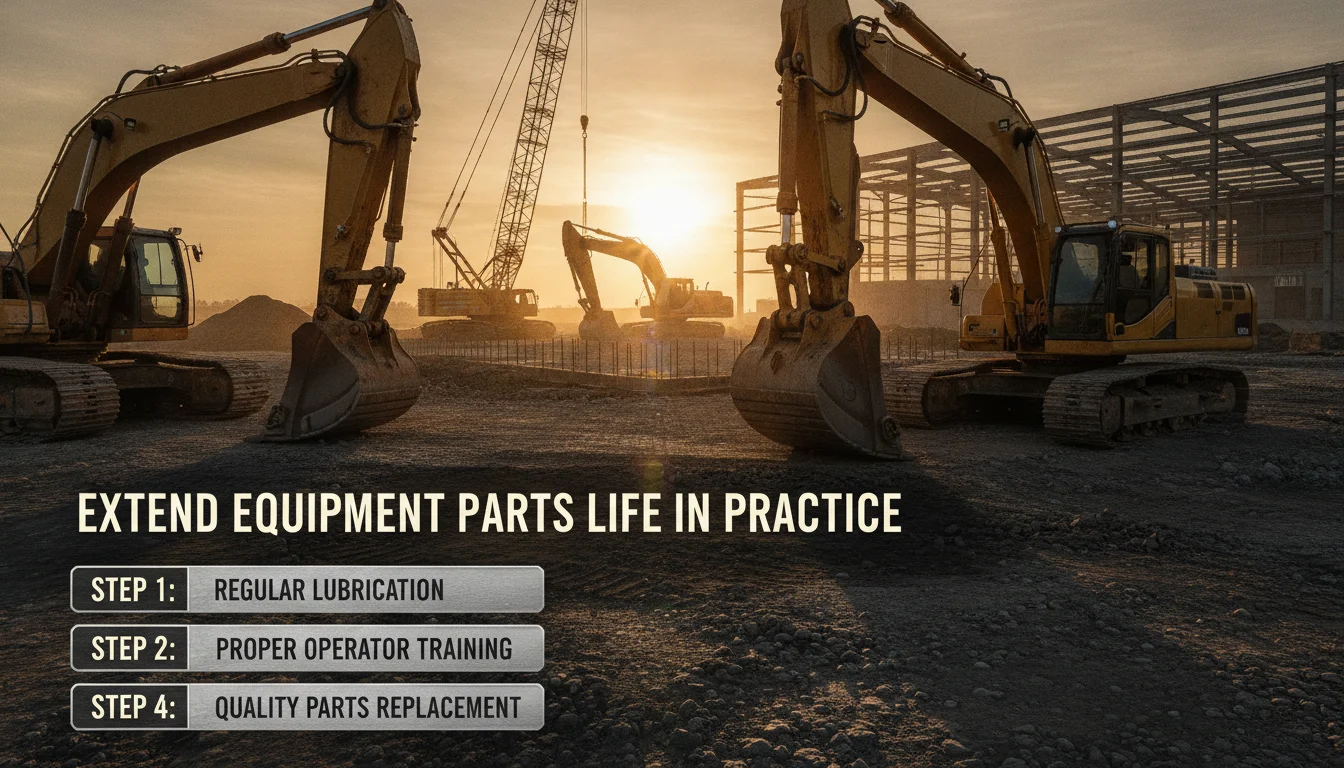
Knowing how to extend equipment parts life requires more than good intentions. It requires a repeatable system that your team executes consistently, regardless of production pressure.
Step 1: Build a Usage-Based Maintenance Schedule
Time-based schedules are a starting point, but usage-based scheduling is more accurate. If a machine runs eight hours per day, a six-month service interval may be appropriate. If that same machine runs three shifts, the interval should compress to three months or less, per OEM service manual guidance. Tie every maintenance task to operating hours logged, not calendar dates alone.
Step 2: Conduct Systematic Pre- and Post-Shift Inspections
Train operators to inspect before and after every shift. The Canadian Centre for Occupational Health and Safety (CCOHS) identifies regular inspections as one of the key methods for mitigating workplace hazards on heavy equipment. Each inspection should cover:
- Rust, cracks, dents, or warping on structural components and metal fixtures
- Tire tread wear, punctures, and inflation pressure
- Hydraulic fluid levels and hose fittings for leaks
- Fraying wiring or loose electrical connections
- Chain and belt tension
- All safety mechanisms and controls
Step 3: Apply Lubrication Correctly and Consistently
Follow the OEM lubrication schedule exactly. Use the specified lubricant type for each component - different parts require different formulations. Clean grease fittings before applying new grease to avoid pushing contamination into the joint. Check for grease buildup on pistons and signs of excess oil around seals. Avoid over-lubrication: too much grease damages seals and attracts abrasive dirt.
Step 4: Clean Equipment After Every Use
A clean machine is an inspectable machine. Dirt and debris hide oil leaks, hairline cracks, and worn components. Use pressure washers for caked-on grime on undercarriages and structural surfaces. Use brushes and cloths for delicate areas around electrical components and control panels. Select cleaning agents appropriate for the material - check the OEM manual for any restrictions before applying chemicals.
Step 5: Replace Filters and Fluids on Schedule
Filters are the contamination control system for your hydraulic circuits, engine oil, and fuel systems. A clogged or bypassing filter allows abrasive particles to circulate through precision-clearance components. Change filters at or before the OEM-specified interval, and always change them when you change fluids. Never extend filter intervals to save money - the downstream repair cost will be multiples of the filter price.
Step 6: Use OEM-Quality Replacement Parts
When a component needs replacement, the part you install determines how long the repair lasts. OEM parts are engineered to exact tolerances for your specific machine. Cheap aftermarket alternatives may fit physically but often lack the material specifications, heat treatment, or surface finish that the OEM part delivers. As one industry principle states: a $20 fix done wrong becomes a $2,000 repair.
Step 7: Document Everything
Record every inspection finding, fluid change, part replacement, and repair. Maintenance records let you identify patterns - a bearing that fails every 800 hours signals a lubrication or alignment issue, not just bad luck. Documentation also supports warranty claims and resale value. Use a CMMS (Computerized Maintenance Management System) or even a structured spreadsheet if budget is limited.
Regular Inspections
Conducting regular inspections is the foundation of any strategy to extend equipment parts life. Inspections should be systematic, documented, and assigned to specific personnel to ensure consistency across shifts and crew changes.
What to Inspect
- Visual Checks: Look for signs of wear, rust, or damage on all structural and mechanical components.
- Functional Tests: Verify all controls, safety mechanisms, and warning systems are operational.
- Fluid Levels: Check hydraulic fluid, engine oil, coolant, and lubricant levels at every inspection to prevent overheating and friction damage.
Frequency of Inspections
Establish a routine inspection schedule based on equipment usage. Equipment used daily typically requires weekly detailed inspections, while machines used less frequently can be checked monthly. High-stress applications - quarry work, deep mining, demolition - may warrant daily documented checks.
Scheduled Maintenance
Implementing a scheduled maintenance program keeps equipment in optimal condition and is central to any plan for how to extend equipment parts life across a mixed fleet.
Types of Maintenance
- Routine Maintenance: Fixed-schedule checks and adjustments - fluid top-ups, filter changes, belt tension checks, lubrication of grease points.
- Preventive Maintenance: Condition-based maintenance that uses historical data and OEM service bulletins to anticipate and address potential failures before they occur.
Documenting Maintenance Activities
Keeping detailed records of maintenance activities helps track equipment condition over time. This information is invaluable for identifying wear trends, planning part replacements proactively, and demonstrating compliance with OEM warranty requirements.
Cleaning Practices
Regular cleaning is a direct maintenance action that extends equipment parts life by making wear visible and preventing contamination-driven damage.
Cleaning Techniques
- Pressure Washing: Use pressure washers for stubborn dirt and grime on undercarriages, frames, and structural surfaces.
- Hand Cleaning: Use brushes and cloths for delicate areas around sensors, electrical connectors, and control panels.
- Appropriate Cleaning Agents: Select cleaning agents based on the equipment type and materials involved. Always check the OEM manual first.
Benefits of Cleaning
A clean machine is easier to inspect, enabling early detection of wear and damage. Regular cleaning also improves operator safety, reduces fire risk from accumulated grease, and makes fluid leaks immediately visible.
Lubrication Practices
Proper lubrication is the most cost-effective single action you can take to extend equipment parts life. It reduces friction and wear on every moving surface, preventing premature failure of components that are expensive to replace.
Lubrication Guidelines
- Follow Manufacturer Recommendations: Use the exact lubricant type and quantity specified for each component in the OEM service manual.
- Regular Checks: Monitor lubricant levels at every inspection and check for contamination - milky oil indicates water ingress, dark gritty grease indicates abrasive contamination.
- Avoid Over-Lubrication: Excess lubricant damages seals and attracts dirt, creating an abrasive paste that accelerates wear rather than preventing it.
Importance of Lubrication
Regular lubrication not only extends the life of equipment parts but also improves operational efficiency, reduces operating temperatures, and lowers noise levels - all indicators of a healthy drivetrain.
Operator Training
Well-trained operators are essential for any program designed to extend equipment parts life. They are the eyes and ears of your maintenance system, detecting problems hours or days before they appear on a scheduled inspection.
Training Programs
- Initial Training: Provide comprehensive onboarding for new operators covering equipment operation, pre-shift inspection procedures, and how to report abnormalities.
- Ongoing Training: Update training materials regularly as equipment is upgraded or new models are added to the fleet. Technology evolves - training must keep pace.
- Encouraging Communication: Build a culture where operators feel comfortable reporting unusual noises, smells, vibrations, or control behavior without fear of slowing production.
Benefits of Training
Trained operators prevent costly mistakes and ensure machinery is operated within its rated parameters. An operator who recognizes that a hydraulic system is running hotter than normal can trigger a service check before a seal fails - saving hours of downtime and hundreds of dollars in parts.
Using Quality Parts
Investing in high-quality parts is non-negotiable for any serious effort to extend equipment parts life. The component you install today determines how long your next service interval will be.
OEM vs. Aftermarket: A Direct Comparison
| Factor | OEM Parts | Low-Cost Aftermarket | OEM-Quality Aftermarket (e.g., 3GEN Export) |
|---|---|---|---|
| Dimensional Accuracy | Exact to spec | Variable - may require shimming | Manufactured to OEM tolerances |
| Material Specification | OEM-certified alloys and compounds | Often unspecified or inferior grades | Matched to OEM material standards |
| Heat Treatment | Full OEM process | Frequently skipped to reduce cost | Applied per OEM specification |
| Warranty | Full OEM warranty | Limited or none | Quality guarantee included |
| Lead Time (global) | Can be 2-6 weeks from OEM dealer | Variable | 5-day global delivery available |
| Long-Term Cost | Higher upfront, lower total cost | Low upfront, high total cost | Competitive upfront, low total cost |
Choosing the Right Parts
- OEM vs. Aftermarket: OEM parts are engineered specifically for your machine model. Aftermarket quality varies widely - always verify the supplier's quality assurance process before purchasing.
- Compatibility: Confirm part numbers against your machine's serial number and model specification. A part that almost fits will fail faster than the original.
- Quality Assurance: Source parts from suppliers who provide warranties, traceable manufacturing documentation, and brand-specific compatibility verification.
Long-Term Cost Savings
Quality parts carry a higher upfront cost. They also deliver lower maintenance frequency, longer intervals between replacements, and fewer secondary failures caused by a bad part damaging adjacent components. Over the life of a fleet, the total cost difference is substantial.
Monitoring Operating Conditions
Understanding operating conditions is a critical input for any plan to extend equipment parts life. The same machine in a temperate climate and a desert mine site has very different maintenance requirements.
Key Operating Conditions to Monitor
- Temperature: Extreme heat causes thermal expansion that tightens clearances and degrades lubricants faster. Extreme cold increases viscosity and can cause cold-start damage if warm-up procedures are skipped.
- Load Levels: Operating equipment beyond its rated capacity accelerates wear on structural components, drivetrains, and hydraulic systems. Overloading is one of the fastest ways to shorten part life.
- Environmental Factors: Dust, moisture, salt air, and chemical exposure each attack different materials. Coastal or marine environments demand more frequent corrosion inspections. Dusty quarry environments require more frequent air filter and hydraulic filter changes.
Adjusting Maintenance Based on Conditions
By monitoring these conditions, you can adjust maintenance schedules and inspection focus areas to match actual operating stress. A machine working in a quarry at high altitude in summer heat needs a different PM interval than the same model working in a temperate warehouse environment.
Common Mistakes That Shorten Equipment Parts Life
Knowing how to extend equipment parts life also means knowing what not to do. These are the most common errors we see across construction, mining, and energy fleets worldwide.
1. Using Quick Fixes Instead of Proper Repairs
Taping a leaking hydraulic hose or running a machine with a known bearing noise to meet a deadline is a false economy. Minor issues compound quickly. A small hydraulic leak that costs $40 to fix properly can escalate to a full cylinder rebuild costing many times more if left unaddressed. Always fix the root cause, not the symptom.
2. Skipping Filter Changes to Save Money
Filters are the cheapest insurance policy in your maintenance budget. A bypassing oil filter allows abrasive particles to circulate through engine bearings and precision hydraulic components. The repair cost for contamination damage is always a multiple of the filter cost. Never extend filter intervals beyond OEM specifications.
3. Over-Lubricating Grease Points
More grease is not better. Excess grease pressurizes and damages lip seals, allowing contamination to enter the joint. It also attracts dirt, creating an abrasive compound that accelerates wear. Apply the quantity specified in the OEM service manual - no more.
4. Ignoring Operator Feedback
Operators notice changes in machine behavior before any sensor does. A machine that "feels different" or "sounds off" is communicating a developing problem. Maintenance teams that dismiss operator feedback consistently face avoidable breakdowns. Build a formal reporting channel and act on it.
5. Installing Incompatible or Low-Quality Replacement Parts
A part that almost fits will fail faster than the original and may damage adjacent components in the process. Always verify part numbers against your machine's serial number. Source from suppliers who can confirm OEM-level quality standards and provide traceability documentation.
6. Neglecting Storage and Idle Equipment
How you store equipment during idle periods directly affects its condition when it returns to service. Stored machines should have fuel systems stabilized, hydraulic cylinders retracted to protect chrome rod surfaces, batteries maintained on trickle charge, and covers fitted to protect air intakes and exhaust ports from moisture and pest ingress.
Realistic Scenario: Fleet Maintenance on a Mining Site
Consider a mid-size mining operation running six Komatsu PC360 excavators and four CAT 773 haul trucks in a high-dust, high-temperature environment. The site previously operated on a reactive maintenance model: fix it when it breaks. Machine availability averaged around 70%, and unplanned downtime was a recurring problem.
The maintenance manager implemented a structured PM program based on operating hours rather than calendar dates. Every 250 hours, all machines received a full fluid and filter service, lubrication of all grease points, and a documented visual inspection. Every 1,000 hours, hydraulic systems were sampled for contamination analysis and wear metals. Operators received formal training on pre-shift inspection procedures and a direct reporting line to the maintenance supervisor.
Within two service cycles, the team identified a pattern: two of the PC360 excavators were consuming hydraulic fluid faster than the others. Investigation revealed worn cylinder rod seals - a $300 repair per machine. Caught early, the fix was straightforward. Left undetected, the same leak would have introduced air into the hydraulic circuit, causing pump cavitation and a repair bill many times larger.
The site also switched from low-cost aftermarket filters to OEM-specification filters sourced through a verified supplier. Hydraulic fluid contamination levels, measured by particle count analysis, dropped significantly within three service cycles. Machine availability improved as unplanned breakdowns decreased.
This scenario reflects the pattern we see consistently across the fleets we supply: structured maintenance combined with quality parts delivers measurable improvements in uptime and total cost of ownership.
Maintenance Approach Comparison Table
| Maintenance Approach | Description | Best For | Risk Level | Cost Profile |
|---|---|---|---|---|
| Reactive (Break-Fix) | Repair only when failure occurs | Non-critical, easily replaced assets | High | Low upfront, very high long-term |
| Routine/Time-Based PM | Fixed-interval service regardless of condition | Standard fleet operations | Medium | Predictable, moderate total cost |
| Usage-Based PM | Service intervals tied to operating hours | Variable-use equipment fleets | Low-Medium | Efficient - avoids over-servicing |
| Condition-Based PM | Maintenance triggered by actual condition data (fluid analysis, vibration) | High-value, critical assets | Low | Higher setup cost, lowest long-term cost |
| Predictive Maintenance | AI and sensor data predict failure before it occurs | Large fleets with telematics | Very Low | High investment, maximum life extension |
Pros and Cons of a Structured Equipment Parts Life Extension Program
Pros
- Reduced unplanned downtime: Consistent PM catches developing failures before they stop production.
- Lower total maintenance cost: Preventing failures is cheaper than repairing them. Industry data from structured asset management programs shows maintenance cost reductions of 25-35% compared to reactive approaches.
- Extended component life: Parts operating within design parameters last significantly longer than those running in neglected systems.
- Improved operator safety: Well-maintained equipment is safer to operate and reduces incident risk.
- Better resale value: Documented maintenance history supports higher resale prices for used equipment.
- Warranty compliance: Following OEM maintenance schedules keeps manufacturer warranties valid.
Cons
- Upfront time and resource investment: Building a PM program requires initial effort to document schedules, train staff, and set up tracking systems.
- Higher parts and lubricant costs initially: OEM-quality parts and specified lubricants cost more than the cheapest alternatives available.
- Requires organizational discipline: PM programs fail when production pressure consistently overrides scheduled maintenance. Management commitment is essential.
- Over-maintenance risk: Poorly calibrated time-based schedules can result in replacing components that still have significant service life remaining.
2026 Outlook: Where Equipment Maintenance Is Heading
As of 2026, the approach to how to extend equipment parts life is evolving beyond manual inspection and scheduled service. Several trends are reshaping maintenance practice across construction, mining, and energy sectors.
Telematics integration is now standard on most new Caterpillar, Komatsu, and Volvo machines. Real-time data on engine hours, hydraulic pressure, fuel consumption, and fault codes allows maintenance teams to respond to developing issues before they cause failures. Older machines can be retrofitted with aftermarket telematics units at relatively low cost.
Fluid analysis programs - sending oil and hydraulic fluid samples to a laboratory for wear metal and contamination analysis - are becoming more accessible to smaller fleets. This is one of the most cost-effective condition monitoring tools available, providing early warning of bearing wear, seal failures, and coolant contamination weeks before a failure would otherwise occur.
Supply chain resilience has also become a priority this year. Procurement managers are increasingly sourcing critical spare parts from verified global suppliers rather than relying solely on local OEM dealer networks, which can have extended lead times for less common components. Fast global delivery - parts arriving within five days regardless of location - is now a realistic expectation from quality international suppliers.
The combination of better monitoring tools and more reliable parts supply chains means that the barriers to running a world-class maintenance program are lower in 2026 than they've ever been. The fundamentals, however, remain unchanged: inspect regularly, lubricate correctly, use quality parts, train your operators, and document everything.
Frequently Asked Questions
What is the best way to extend equipment parts life?
The best way to extend equipment parts life is through a structured preventive maintenance program that combines regular inspections, correct lubrication, timely filter and fluid changes, operator training, and the use of OEM-quality replacement parts. No single action delivers results in isolation - the combination of all these practices is what produces measurable life extension.
How often should heavy equipment be inspected?
Inspection frequency should match usage intensity. Equipment running daily in demanding conditions - quarrying, mining, demolition - typically requires pre- and post-shift operator checks plus a detailed weekly inspection. Machines used less frequently can be inspected monthly. Always follow OEM service manual guidance as the baseline, then adjust upward for harsh operating environments.
Why is lubrication important for equipment longevity?
Lubrication creates a protective film between metal surfaces, preventing direct contact and the heat and wear that result from friction. Without adequate lubrication, components degrade rapidly and fail well before their design life. According to manufacturer service guidelines, most premature component failures in heavy equipment trace back to lubrication failures or contaminated fluids rather than manufacturing defects.
What role does operator training play in equipment maintenance?
Operators are the first line of defense against mechanical failure. A trained operator recognizes when a machine sounds, feels, or responds differently than normal - and reports it before a developing problem becomes a breakdown. Ongoing training ensures operators stay current with new equipment models and updated inspection procedures, directly contributing to longer part life across the fleet.
Are OEM parts worth the investment for extending equipment life?
Yes. OEM and OEM-quality parts are engineered to exact dimensional tolerances, material specifications, and heat treatment standards for your specific machine. Low-cost aftermarket alternatives may fit physically but often lack the material quality that determines how long the part lasts under load. The higher upfront cost of quality parts is consistently offset by longer service intervals and fewer secondary failures caused by a substandard component damaging adjacent parts.
How can monitoring operating conditions help extend equipment parts life?
Operating conditions directly determine how fast components wear. Extreme temperatures, overloading, high dust, and moisture each accelerate specific failure modes. By monitoring these conditions and adjusting maintenance intervals accordingly - more frequent filter changes in dusty environments, shorter lubrication intervals in extreme heat - you keep parts operating within their design parameters rather than pushing them past their limits.
Where can I source OEM-quality spare parts with fast global delivery?
3GEN Export supplies OEM-standard spare parts for Caterpillar, Komatsu, Volvo, Atlas Copco, and 40+ other heavy equipment brands, with global delivery in as little as five days. Our parts are verified for compatibility against machine serial numbers and model specifications, and every order is backed by a quality guarantee. Visit our parts categories or browse by brand to find the components your fleet needs.
Shop OEM-quality spare parts with global 5-day delivery at 3genexport.com.