
How to Identify Genuine Cat Parts: 2026 Guide
Learn how to identify genuine Cat parts using serial numbers, packaging checks, and supplier verification. Protect your fleet with OEM-quality components.
Loading article…
Article Not Found
The article you're looking for doesn't exist or may have been removed.
Back to BlogKey Takeaways
- Knowing how to identify genuine Cat parts protects your equipment investment and keeps operators safe.
- Verify authenticity through part numbers, OEM packaging, documentation, and supplier credentials.
- Counterfeit parts can trigger unplanned downtime costing between $125,000 and $2.3 million per hour, according to industry data.
- Caterpillar's official tools, including Parts.Cat.Com and the Cat Central app, make part verification straightforward.
- Genuine Cat parts carry a 12-month warranty covering labor if installed by an authorized dealer.
- Sourcing from authorized dealers or verified global suppliers is the most reliable protection against counterfeits.
How to identify genuine Cat parts is the process of verifying that Caterpillar components meet OEM specifications through part number checks, physical inspection, and supplier authentication. Skipping this process puts your machinery, your crew, and your budget at serious risk.
Why Genuine Cat Parts Matter
Genuine Cat parts matter because they are engineered as a complete system, built and tested to match your machine's exact specifications, per Caterpillar's own product documentation. That precision has direct consequences for uptime, safety, and total cost of ownership.
Performance and Reliability
Genuine Cat parts are engineered to exact specifications, ensuring compatibility and reliability. Caterpillar designs each component to work as part of a complete system, using materials specifically selected for the application. In extreme operating environments, including high-dust mining sites and high-temperature construction zones, that material precision is what separates a part that lasts a full service interval from one that fails mid-shift.
"They certainly don't come with any Caterpillar warranty if they're not Cat parts." - David Zalar, Lifecycle Manager for Caterpillar Fuel Systems, Cat Reman Blog (March 2025)
Financial Impact
Investing in genuine parts reduces total cost of ownership. Counterfeit parts may appear cheaper at the point of purchase, but the downstream costs are severe. According to industry research cited by Triune ME, unplanned downtime in heavy equipment operations can cost facilities between $125,000 and $2.3 million per hour, depending on the sector. In oil and gas specifically, facilities report an average of 32 hours of unplanned downtime monthly at costs reaching $220,000 per hour.
A counterfeit fuel filter that saves roughly 40% on purchase price can destroy an injection system worth tens of thousands of dollars. Add emergency labor, expedited shipping for genuine replacements, and lost production, and that initial saving becomes a significant loss. Installing non-genuine parts also typically voids manufacturer warranties, leaving your operation fully exposed to repair costs.
Safety and Compliance
Using genuine parts ensures compliance with safety standards. Counterfeit components, particularly brake systems, hydraulic filters, and structural parts, can jeopardize operator safety and expose your company to legal liability. Regulatory bodies in most jurisdictions require equipment to maintain manufacturer specifications for safe operation. A counterfeit part that fails under load is not just a maintenance problem. It is a safety incident.
Understanding Cat Part Numbers
Understanding Cat part numbers is the first practical step in how to identify genuine Cat parts, because every authentic Caterpillar component carries a unique numeric identifier that links it to a specific machine, application, and specification set.
Decoding the Part Number
Cat part numbers typically consist of a series of digits and letters indicating the part type, its specifications, and its compatibility with specific machinery. The structure is consistent across product lines, which means a trained procurement manager can cross-reference any number against official Caterpillar resources before placing an order. Familiarizing your team with this numbering system is one of the lowest-cost authenticity controls available.
Common Part Categories
Parts fall into categories including engine components, hydraulic systems, filters and fluids, undercarriage, ground engaging tools, electrical and electronics, and drivetrain assemblies. Each category has specific numbering conventions. Knowing which category a part belongs to helps you spot numbering anomalies that often indicate a counterfeit.
Importance of Accurate Part Numbers
Using the correct part number is non-negotiable for compatibility and performance. Always cross-reference part numbers with official Caterpillar resources, specifically Parts.Cat.Com, before approving a purchase order. A number that does not appear in the official catalog is a hard stop.
How to Identify Genuine Cat Parts: Step-by-Step Verification
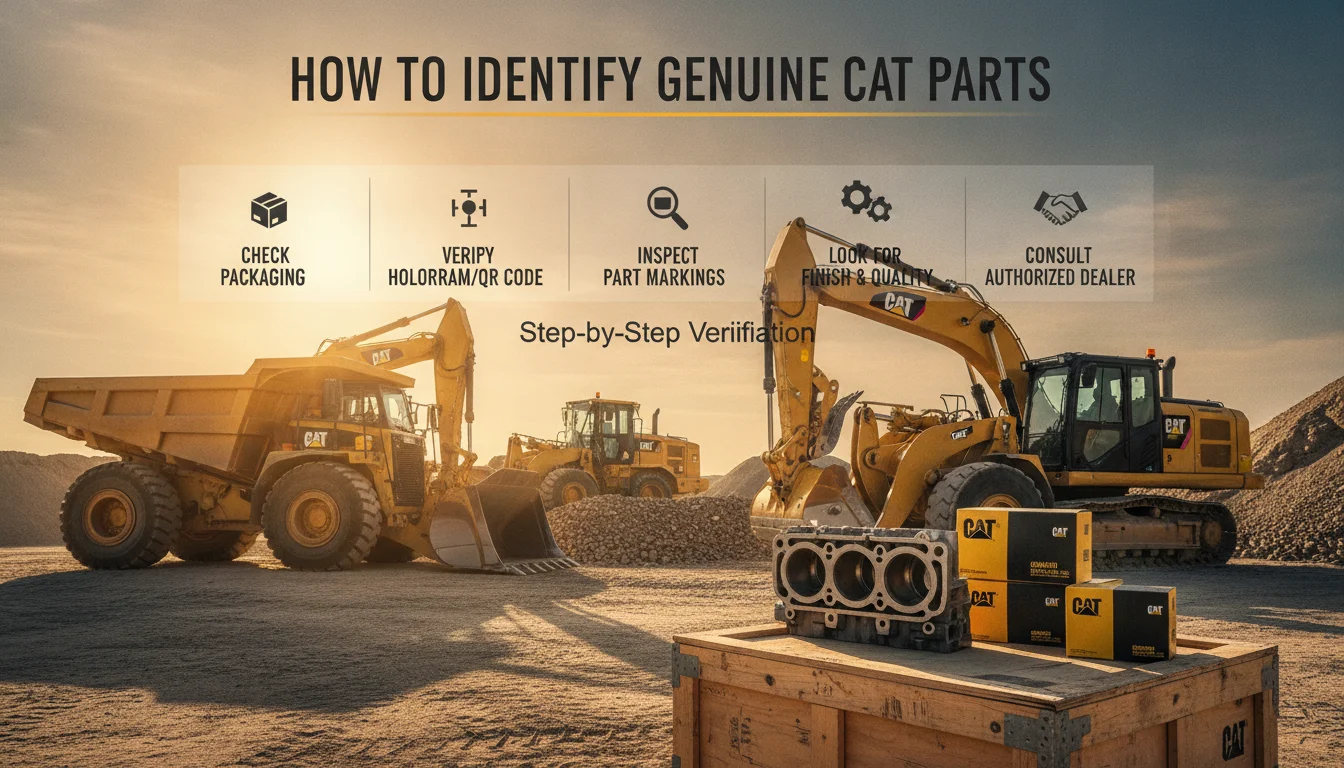
The most reliable approach to how to identify genuine Cat parts combines pre-purchase digital checks with a structured physical inspection on receipt. Follow these steps in order.
Step 1: Verify the Part Number Before Purchase
Enter the part number into Parts.Cat.Com or the Cat Central app before committing to any purchase. The official catalog covers over 1.4 million genuine Cat parts. If the number returns no result, or if the listed price differs dramatically from the supplier's quote, treat it as a red flag and request documentation from the seller.
Step 2: Evaluate the Supplier's Credentials
Confirm whether the supplier is an authorized Caterpillar dealer or a verified OEM-quality distributor. Check for dealer authorization certificates, business registration, and customer references. Authorized dealers are listed directly on the Caterpillar website. For international procurement, verify that the supplier has a documented track record of supplying genuine components to industrial buyers in your region.
Step 3: Inspect Packaging on Receipt
Genuine Cat parts arrive in high-quality packaging bearing the Caterpillar logo, part number, and full manufacturer details. The print quality is sharp and consistent. Blurred logos, inconsistent fonts, or generic plain-box packaging without brand markings are immediate warning signs. Check that the part number on the box matches the number on your purchase order exactly, including every digit and letter.
Step 4: Conduct a Physical Inspection of the Part
Examine the part itself. Genuine components have consistent surface finishes, precise dimensions, and correct markings. Look for casting marks, heat treatment indicators, and OEM stamps where applicable. Uneven surfaces, rough casting edges, incorrect color coding, or missing stamps suggest a counterfeit. For critical components like hydraulic seals, filters, and fuel system parts, any visual anomaly should trigger a hold on installation.
Step 5: Check Documentation and Warranty
Genuine Cat parts ship with documentation that includes warranty terms. Per Caterpillar's official product information, genuine parts carry a 12-month warranty, which covers labor costs if the part was originally installed by a Cat dealer. No documentation, no warranty card, or a warranty period shorter than 12 months is a strong indicator that the part is not genuine.
Step 6: Use Digital Authentication Tools
Some genuine Cat parts and packaging include QR codes or barcodes that link directly to Caterpillar's authentication system. Scan these codes using the Cat Central app to confirm authenticity in real time. The Cat SIS2GO app also provides step-by-step repair instructions and parts verification, removing guesswork from the process entirely.
Physical Inspection Protocol
A thorough physical inspection is a core element of how to identify genuine Cat parts, and it should be a standard receiving procedure for every parts delivery your operation accepts.
Packaging and Labeling
Genuine Cat parts come with high-quality packaging that includes clear labeling. Look for the Caterpillar logo, part number, and manufacturer details on the packaging. The label stock, adhesive quality, and print resolution on genuine packaging are noticeably superior to counterfeit alternatives.
Visual Inspection of the Part
Inspect the part itself for any signs of poor craftsmanship, such as uneven surfaces, incorrect markings, or inferior materials. Genuine parts have a consistent finish and precise dimensions. For machined components, check that mating surfaces are smooth and within tolerance. For rubber or polymer parts, check for uniform color and texture without bubbling or cracking.
Documentation and Warranty
Genuine parts should come with documentation, including a warranty. Caterpillar offers a 12-month warranty on genuine parts, which is not available for counterfeit alternatives. Keep all documentation on file. Warranty records also support equipment resale value, which suffers significantly when maintenance records show non-genuine components.
Genuine vs. Counterfeit Cat Parts: Comparison
The table below summarizes the key differences between genuine Cat parts, Cat Reman components, and counterfeit alternatives across the criteria that matter most to procurement managers.
| Criteria | Genuine Cat Parts | Cat Reman Parts | Counterfeit Parts |
|---|---|---|---|
| Engineering standard | OEM specification, full system design | Remanufactured to OEM spec by Caterpillar | Unknown, often substandard |
| Warranty | 12-month, includes labor (dealer-installed) | 12-month Caterpillar Limited Warranty | None |
| Part number traceability | Fully traceable via Parts.Cat.Com | Fully traceable via Parts.Cat.Com | Often copied or fabricated |
| Packaging quality | High-quality, branded, labeled | High-quality, branded, labeled | Poor print, generic or copied branding |
| Price point | OEM pricing | Lower than new, core return required | Significantly below market |
| Safety compliance | Meets all manufacturer safety specs | Meets all manufacturer safety specs | Not guaranteed, often non-compliant |
| Downtime risk | Low | Low | High |
Pros and Cons of Genuine Cat Parts
Procurement decisions always involve trade-offs. Here is an honest assessment of genuine Cat parts versus the alternatives.
Pros
- Guaranteed fit and compatibility: Genuine Cat parts are designed specifically for Cat machines, eliminating compatibility guesswork.
- 12-month warranty with labor coverage: No aftermarket or counterfeit supplier matches this protection level.
- Full parts traceability: Every genuine part is traceable through official Caterpillar systems, supporting compliance and audit trails.
- Lower total cost of ownership: Longer service life and fewer failures reduce overall maintenance spend.
- Protects equipment resale value: Maintenance records showing genuine parts support higher resale prices.
- Access to Cat digital tools: Genuine parts integrate with Cat Central, SIS2GO, and Cat Integrated Procurement systems.
Cons
- Higher upfront cost: Genuine parts carry OEM pricing, which is higher than aftermarket or counterfeit alternatives at the point of purchase.
- Lead time variability: Depending on your location and the part category, genuine parts may require longer lead times than locally available aftermarket options.
- Availability gaps for older machines: Some legacy Cat models may have limited genuine parts availability, requiring Cat Reman or approved alternatives.
Advanced Verification Techniques
Beyond physical inspection, advanced verification techniques give procurement teams a second layer of confidence when learning how to identify genuine Cat parts from less reliable sources.
Online Verification Tools
Caterpillar provides online tools to verify part numbers and check for authenticity. Use Parts.Cat.Com to look up any part number before purchase. The platform covers the full Caterpillar parts catalog and flags discontinued or superseded numbers, which counterfeiters often exploit.
Supplier Evaluation
Choosing the right supplier is as important as inspecting the part itself. Verify that your supplier is an authorized Caterpillar dealer or a documented OEM-quality distributor. Request references from other industrial buyers in your sector. Check for business registration, export licenses for international orders, and a clear returns policy. A supplier unwilling to provide documentation is a supplier worth avoiding.
Utilizing Technology
Some suppliers offer QR codes or barcodes on packaging that link to Caterpillar's authentication database. Scan these using the Cat Central app whenever available. The Cat SIS2GO app adds another layer by providing fault code lookup and step-by-step repair guidance, helping technicians confirm they have the right part before installation begins.
"Genuine Cat parts are engineered as a complete system, built and tested to match your machine's exact specs. That means better fit, longer life, and fewer surprises down the road." - Hawthorne Cat, authorized Caterpillar dealer
Common Mistakes to Avoid When Identifying Cat Parts
Even experienced procurement managers make errors that expose their operations to counterfeit risk. These are the most common mistakes we see, and how to avoid them.
Relying on Price Alone
Price is a useful signal, but it is not a verification method. Counterfeit parts are frequently priced at roughly 40% below genuine OEM pricing, which makes them attractive under budget pressure. The correct approach is to treat any price significantly below the Parts.Cat.Com reference price as a trigger for additional verification, not as a reason to proceed.
Skipping the Packaging Check
Many buyers inspect the part but not the packaging. Counterfeiters invest in copying part markings, but packaging quality is harder to replicate at scale. Blurred logos, inconsistent label fonts, missing lot numbers, or generic boxes without Caterpillar branding are often the clearest indicators of a fake. Build packaging inspection into your standard receiving checklist.
Purchasing from Unverified Online Sellers
Online marketplaces offer convenience, but they also host unauthorized sellers. Before purchasing from any online source, confirm the seller's authorization status on the Caterpillar dealer locator. If the seller cannot provide an authorization certificate or refuses to share business registration details, do not proceed.
Ignoring Serial Number Verification
Every Cat machine has a unique serial number that links to a specific parts compatibility list. Buyers who skip serial number verification risk ordering parts that are genuine but incompatible with their specific machine configuration. Use the serial number lookup function on Parts.Cat.Com to confirm compatibility before every order.
Failing to Document Purchases
Procurement teams that do not retain purchase documentation, including invoices, warranty cards, and supplier certificates, have no recourse if a counterfeit part causes equipment damage. Maintain a complete paper trail for every parts purchase. This documentation also supports warranty claims and regulatory compliance audits.
A Realistic Procurement Scenario
Consider a fleet maintenance supervisor at a mid-size mining operation running a mixed fleet of Cat 320 excavators and Cat 740 articulated trucks. The operation sources parts from multiple suppliers to manage lead times across remote sites.
During a routine filter replacement, a technician notices that a hydraulic filter received from a new supplier has slightly blurred Caterpillar branding on the box and no warranty documentation inside. The part number matches the catalog, but the packaging quality is noticeably below standard compared to previous orders.
The supervisor runs the part number through Parts.Cat.Com and confirms the number is valid. However, the supplier cannot provide an authorization certificate or a traceable invoice from an authorized distributor. The supervisor places the shipment on hold, contacts the supplier for documentation, and sources a verified replacement from an authorized dealer.
Two weeks later, the original supplier's parts are tested by a third-party lab and confirmed as counterfeit. The filter media does not meet Caterpillar's filtration specifications. Had those filters been installed, contamination of the hydraulic system would have been likely, with repair costs running into tens of thousands of dollars per machine.
This scenario plays out across mining and construction operations globally. The verification steps that prevented the problem took less than 30 minutes. The cost of skipping them could have been catastrophic.
How to Identify Genuine Cat Parts by Serial Number
Serial number verification is one of the most reliable methods for confirming both part authenticity and machine compatibility. Every Caterpillar machine carries a unique serial number, typically stamped on a metal plate on the machine frame or engine block.
To use serial number verification: locate the serial number on your machine, enter it into the Parts.Cat.Com serial number lookup tool, and review the parts compatibility list generated for your specific unit. Any part offered by a supplier that does not appear on that compatibility list for your serial number should be questioned before purchase.
The Cat Central app also supports serial number lookup, allowing field technicians to verify parts on-site without needing desktop access. As of 2026, Caterpillar continues to expand the digital tools available for serial number-based parts verification, making this process faster and more accessible for global buyers.
Common Red Flags to Avoid
Being aware of warning signs is a core part of how to identify genuine Cat parts in the field. These red flags apply whether you are buying locally or sourcing internationally.
Unusually Low Prices
If a deal seems too good to be true, it almost certainly is. Counterfeit parts are frequently sold at prices well below the OEM reference price. Use Parts.Cat.Com as your price benchmark. Any supplier quoting significantly below that level without a clear explanation, such as Cat Reman pricing or an authorized clearance sale, warrants scrutiny.
Poor Packaging
Genuine parts come in high-quality packaging. Damaged boxes, blurred printing, missing lot numbers, or packaging without full Caterpillar branding are all warning signs. Do not assume poor packaging is just a shipping issue. Inspect every shipment on receipt.
Missing Documentation
Genuine parts always ship with documentation, including warranty information and traceability records. If documentation is missing, request it from the supplier before installing the part. A supplier that cannot provide documentation is not a supplier you should be using for critical components.
Finding Reliable Suppliers
Identifying trustworthy suppliers is a critical part of how to identify genuine Cat parts at the procurement stage, before a single component reaches your site.
Official Caterpillar Dealers
Always consider purchasing from authorized Caterpillar dealers. They provide a guarantee of authenticity and quality, and their parts are covered by the full Caterpillar warranty. The dealer network is listed on cat.com and searchable by region.
Reputable Online Marketplaces
When buying online, use platforms with a documented track record of supplying genuine OEM parts to industrial buyers. Verify return policies, warranty terms, and customer service responsiveness before placing large orders. For global procurement, confirm that the supplier has export experience and can provide full shipping documentation.
Verified Global Distributors
For operations outside North America, authorized local dealers may not always stock the full range of parts needed for fast turnaround. Verified global distributors with OEM-quality supply chains fill this gap. At 3GEN Export, we supply OEM-standard Cat parts to mining, construction, and energy operations across more than 40 countries, with a documented 5-day global delivery capability. Every shipment includes full traceability documentation.
2026 Outlook: Counterfeit Parts and Global Supply Chains
As of 2026, the counterfeit parts problem in the heavy equipment sector continues to grow alongside the expansion of global e-commerce and cross-border procurement. The GCC region, Southeast Asia, and parts of Sub-Saharan Africa have seen particularly significant increases in counterfeit part distribution, according to regional industry reports.
Caterpillar has responded by expanding its digital verification tools, including the Cat Central app and Parts.Cat.Com, and by increasing support for authorized dealer networks in high-risk markets. For procurement managers, the practical implication is clear: digital verification tools are no longer optional. They are a standard part of responsible parts procurement in 2026.
The Cat Reman program also continues to expand as a cost-effective alternative to new genuine parts for operations managing tight budgets. Cat Reman components are remanufactured by Caterpillar to perform like new and carry the same 12-month warranty as new genuine parts, making them a fully legitimate option for fleet maintenance programs.
Frequently Asked Questions
Where can I find a genuine Caterpillar parts supplier?
You can find genuine Caterpillar parts suppliers through authorized dealers listed on the official Caterpillar website or by visiting Parts.Cat.Com. For international procurement, verified global distributors with documented OEM supply chains are a reliable alternative when local dealer stock is limited.
How do I identify genuine Cat parts by serial number?
Locate your machine's serial number on the frame or engine block, then enter it into the Parts.Cat.Com serial number lookup tool. The system generates a compatibility list for your specific unit, allowing you to confirm that any part you are considering is correct for your machine. The Cat Central app supports the same lookup from a mobile device.
How can I check a Caterpillar serial number?
To check a Caterpillar serial number, refer to the equipment's documentation or enter the number directly into the Parts.Cat.Com lookup tool. The Cat Central app also provides serial number verification with real-time access to operation and maintenance manuals for your specific machine configuration.
Are Caterpillar parts made in China?
Some Caterpillar components are manufactured in China, but they are produced under Caterpillar's strict quality control standards and specifications. The country of manufacture is less important than whether the part is produced or authorized by Caterpillar. Always verify through official channels rather than relying on country of origin as an authenticity indicator.
What are the signs of counterfeit Cat parts?
Key signs include unusually low pricing compared to Parts.Cat.Com reference prices, poor packaging quality with blurred logos or missing lot numbers, absent or incomplete warranty documentation, and part numbers that do not appear in the official Caterpillar catalog. Physical inspection often reveals uneven surface finishes, incorrect markings, or inferior materials on counterfeit components.
Can I return a part if I suspect it is counterfeit?
Most reputable suppliers maintain a return policy for parts that fail authenticity verification. If you suspect a part is counterfeit, place it on hold immediately, document the issue with photographs, and contact the supplier in writing. You can also report suspected counterfeits directly to Caterpillar, which actively investigates counterfeit supply chain issues.
What should I do if I receive a counterfeit part?
Do not install the part. Document everything, including packaging, part markings, and purchase records, and contact the supplier immediately to initiate a return. Report the incident to Caterpillar for further investigation. Maintaining complete purchase documentation from the outset is the most effective way to support any claim or legal action that follows.
At 3GEN Export, we supply OEM-quality Cat parts with full traceability documentation to industrial buyers across more than 40 countries. Every order ships with warranty coverage and complete authenticity records. Shop OEM-quality spare parts with global 5-day delivery at 3genexport.com and keep your fleet running without compromise.