
How to Identify Hydraulic Pump Failure: 8-Step Guide
How to identify hydraulic pump failure using noise, pressure, and flow tests. Diagnose symptoms fast and avoid costly downtime.
Loading article…
Article Not Found
The article you're looking for doesn't exist or may have been removed.
Back to BlogHow to identify hydraulic pump failure is the process of recognizing grouped symptoms, such as unusual noise, overheating, leaks, and slow actuation, then confirming the cause through fluid inspection, pressure and flow testing, and component checks before replacing the pump.
Key Takeaways
- Group symptoms, don't isolate them. Unusual noise, overheating, leaks, and slow movement rarely occur alone. Investigate combinations before assuming pump failure.
- Diagnose the circuit first. Restricted suction, contaminated oil, valve faults, and cylinder bypass can all mimic pump failure, according to Completely Hydraulic.
- Confirm with measurements. Use a pressure gauge, flow meter, and infrared thermometer to verify pump output before ordering a rebuild or replacement.
- Temperature thresholds matter. Hydraulic fluid begins losing viscosity at 180°F or higher, accelerating pump damage and seal wear.
- Maintenance beats repair. Many experts recommend a service check after every 10,000 hours of operation to catch wear before it becomes failure.
- Isolation testing prevents unnecessary pump replacement. Block downstream circuits and re-test output before condemning the pump.
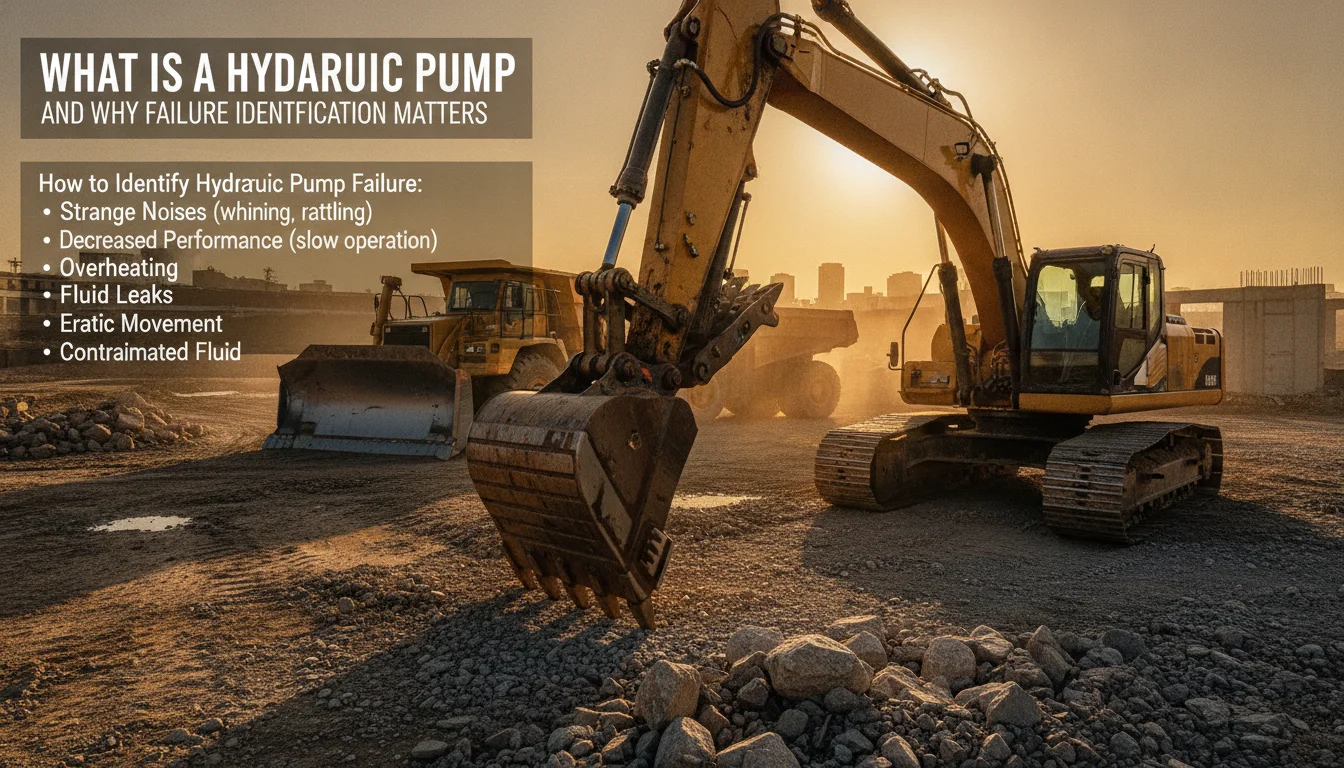
What Is a Hydraulic Pump and Why Failure Identification Matters
A hydraulic pump converts mechanical energy into hydraulic energy in the form of flow and pressure. In construction equipment, commercial trucks, farm machinery, and industrial systems, the pump acts as the system's heart. According to Tim Halpin, the three main pump types encountered in commercial upfitting are gear pumps, which are rugged and simple; vane pumps, known for quieter operation; and piston pumps, which handle high-pressure applications. Each type can produce similar failure symptoms, so the identification process must focus on how the system behaves rather than on pump design alone.
Why Early Detection Prevents Cascading Damage
Hydraulic failures rarely appear as a single isolated symptom. A pump that begins to whine may soon overheat, and overheating thins the fluid, which increases internal wear and leads to leaks. Hyspeco's diagnostic guide notes that catching these signs early can save significant time and money by preventing missed deadlines, costly downtime, and expensive repairs. Early detection also prevents safety hazards, because a failing pump can cause erratic actuator movements or sudden loss of lifting capacity.
System-Wide vs. Pump-Specific Failures
The most important diagnostic discipline is to treat the pump as part of a circuit. As Completely Hydraulic states, restricted suction lines, contaminated oil, incorrect fluid viscosity, aeration, cavitation, valve faults, and internal cylinder leakage can all produce symptoms that appear to be pump-related. A slow cylinder, for example, may be caused by reduced pump flow, a restricted filter or hose, a valve problem, or cylinder bypass. This system-first perspective defines pump failure accurately: confirm the pump's actual output before condemning it.
How to Identify Hydraulic Pump Failure: The Core Symptom Set
Operators learning this type of failure should group symptoms rather than isolate one indicator. The most common warning signs across sources are unusual noise, reduced performance, overheating, leaks, and erratic or slow operation.
Auditory Warning Signs
Whining, grinding, knocking, or banging sounds are red flags. These sounds often suggest air contamination, cavitation, or internal component wear. Cavitation is the formation of vapor cavities in hydraulic fluid when pressure falls below the liquid's vapor pressure. Those cavities implode during compression and produce a knocking sound along with metal erosion on pump components. Aeration is the contamination of hydraulic fluid by air from leaks in seals or fittings, and it creates a high-pitched whine or banging as bubbles destabilize normal fluid cycling. A change in sound from normal operation is one of the earliest and most noticeable clues.
Performance and Speed Changes
Slow hydraulic movement, longer cycle times, and weak performance under load are common indicators. When a pump's internal components wear or internal leakage increases, the system struggles to lift loads it previously handled easily. Sluggish operation can also result from low pressure, external leaks, high temperatures, or degraded fluid viscosity. Operators often notice they must increase engine RPM or wait longer for actuators to complete a cycle. That's a signal to measure output, not to assume the pump is the only problem.
Thermal and Leak Indicators
Overheating is both a symptom and a cause of further damage. Hydraulic fluid begins to lose viscosity at 180°F or higher, reducing its lubricating film and shortening component life. External leaks may appear as pools or puddles under the machine or as a spray from a pressurized line. Internal leaks are harder to see and usually show up as low system pressure, increased fluid demand, or slow performance. Together, heat and leaks point to either pump degradation or circuit conditions that need correction.
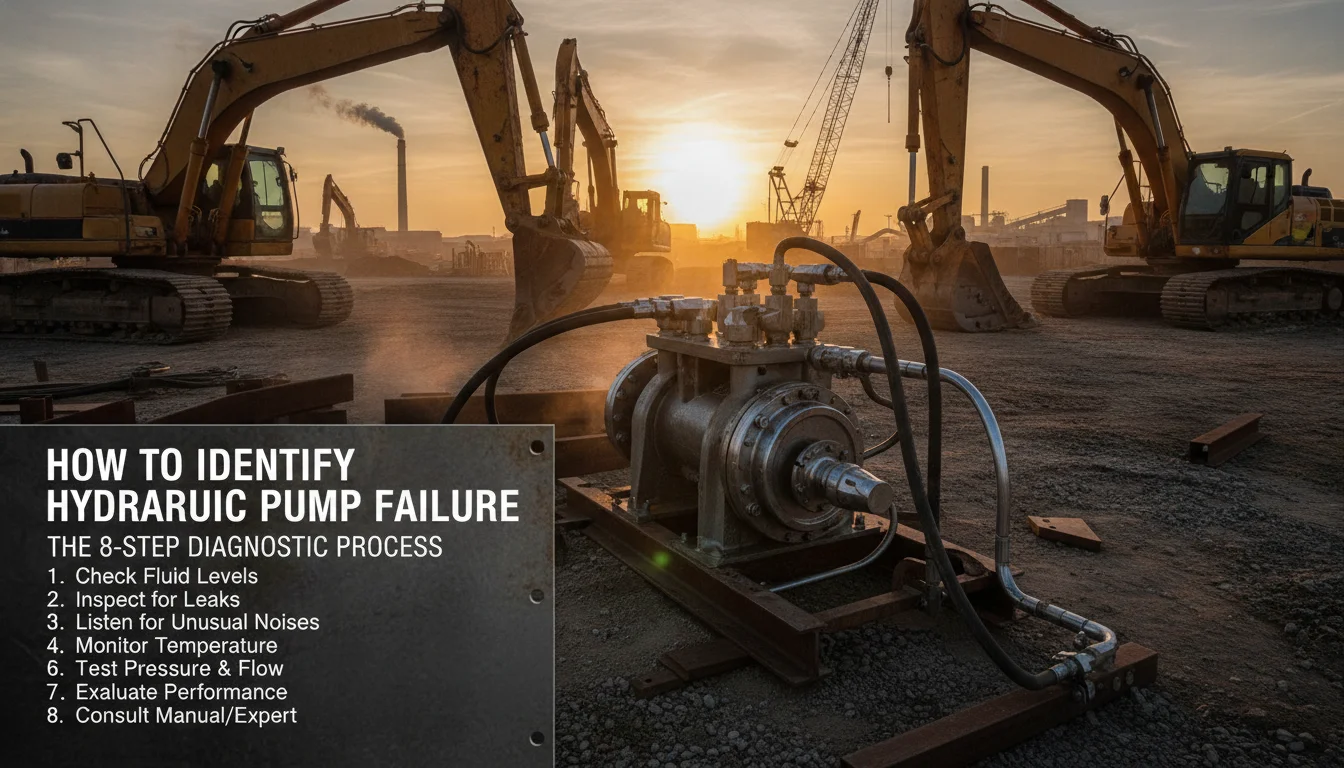
How to Identify Hydraulic Pump Failure: The 8-Step Diagnostic Process
The most reliable way to confirm this kind of pump failure is to follow a structured sequence. Hyspeco's diagnostic guide outlines an eight-step process that moves from environmental checks to internal inspection.
Steps 1 Through 4: Confirm Baseline Conditions
- Verify the operating environment. Confirm the hydraulic fluid is clean, the area is reasonably dust-free, and temperature and pressure levels are within normal range.
- Inspect the hydraulic fluid. Check for discoloration, foam, or particulate matter. Milky fluid indicates water contamination, while metallic particles suggest internal wear.
- Listen for abnormal sounds. Operate the system and note any whining, knocking, or banging. Cavitation sounds may signal air entering through loose fittings or a clogged inlet.
- Check system pressure. Use a gauge to measure the pump's delivered pressure. A drop from expected pressure could indicate worn pump components or system blockages.
Steps 5 Through 8: Output Tests and Internal Inspection
- Inspect external components. Check hoses, seals, connections, and the pump housing for physical damage, cracks, or leaks that allow fluid or air to compromise operation.
- Perform a flow test. Use a flow meter to assess pump output. Reduced flow rate may point to internal wear or obstructions in the pump.
- Check for overheating. Use an infrared thermometer to pinpoint hot spots. Overheating often highlights low fluid levels, dirty filters, or poor lubrication.
- Inspect internal components. If external checks do not reveal the cause, open the pump when feasible and inspect pistons, vanes, and gears for wear, scoring, or deformation.
Tools You Need for Field Diagnosis
A basic diagnostic kit includes a pressure gauge, flow meter, infrared thermometer, and a clean container for fluid sampling. These tools allow a technician to measure performance instead of relying on sound and feel alone. Pressure confirms whether the pump generates force. Flow confirms whether it delivers volume. When both are tested, the diagnosis becomes far more reliable.
"A hydraulic symptom does not identify the failed component by itself. A slow cylinder, for example, could be caused by reduced pump flow, a restricted filter or hose, a valve problem, internal cylinder leakage or another circuit fault. Diagnose the circuit before condemning the pump." - Completely Hydraulic, Engineering Point
Common Causes Behind the Symptoms
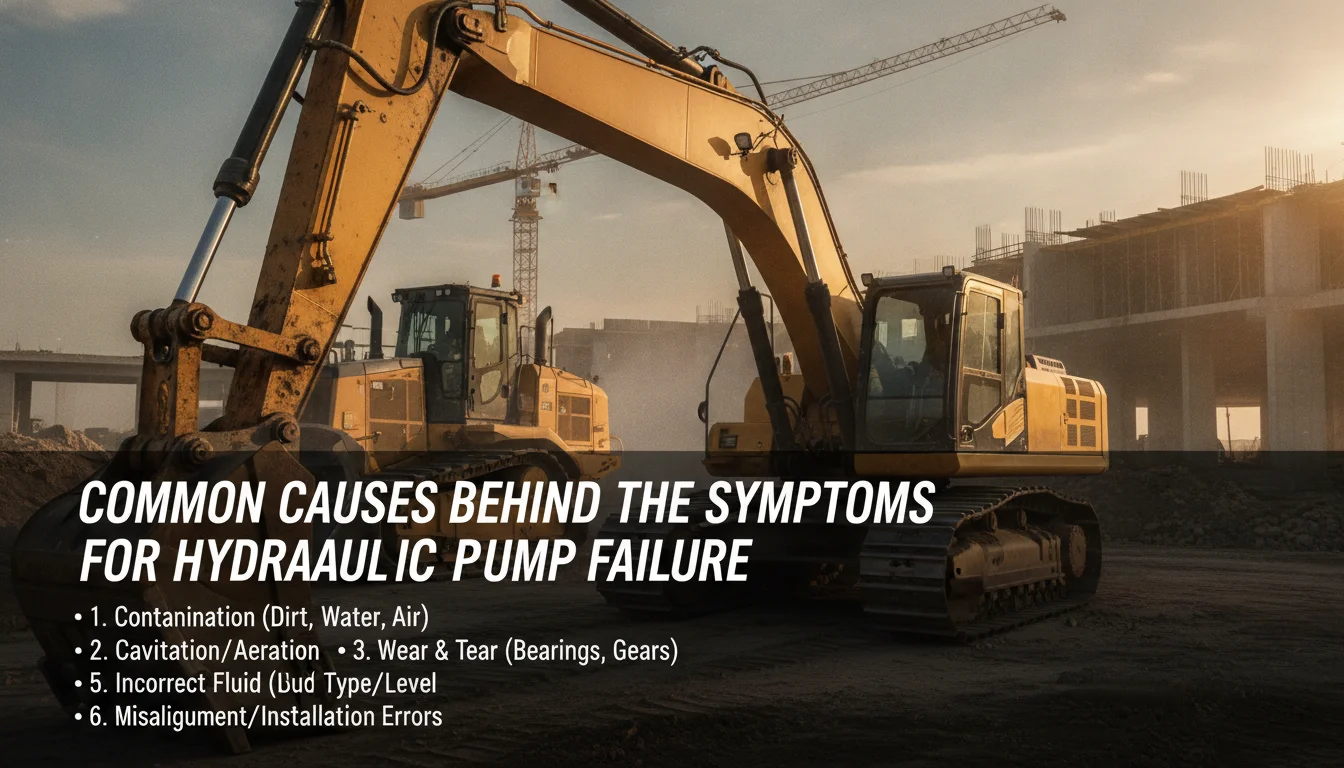
The warning signs listed above often share the same underlying causes. Knowing these causes makes the to identify hydraulic pump failure less about guessing and more about tracing evidence through the circuit.
Contamination: Water, Particulate, and Air
Contaminated hydraulic fluid is one of the most common culprits behind pump failure. Water contamination turns fluid milky and reduces lubrication. Particulate matter, including metal shavings and chips from internal wear, can clog valves and fluid pathways, increasing heat and degrading pump components. Air contamination causes aeration, which leads to foaming and erratic actuator movements, degrading the fluid and causing component damage from overheating and loss of lubrication.
Cavitation and Aeration Explained
Cavitation occurs when fluid volume demand exceeds supply, causing a pressure drop below the liquid's vapor pressure. Vapor cavities form and then implode during compression, producing a knocking sound and metal erosion on pump components. Aeration occurs when outside air enters the system through leaks, or when irregular pressure and speed cause air pockets to form naturally. Both conditions generate noise, generate heat, and degrade fluid quality over time.
Overheating, Viscosity Loss, and Internal Wear
At 180°F or higher, hydraulic fluid begins to lose viscosity, reducing its ability to lubricate and seal. As Servo Kinetics notes, over-pressurization overworks the fluid and increases friction and wear on the system. As fluid thins, internal leakage increases, which in turn generates more heat. This cycle of heat, thinning, leakage, and more heat accelerates pump failure if not interrupted early.
| Symptom | Possible Cause | What to Investigate First |
|---|---|---|
| Whining or knocking | Cavitation, aeration, restricted suction, low oil level | Oil level, suction path, inlet condition |
| Slow hydraulic movement | Reduced pump flow, valve fault, internal leakage | Pump output and circuit restrictions |
| Excessive heat | Internal leakage, restricted flow, cooling problem | Pump, valves, cooler, oil condition |
| External oil leak | Seal, connection, housing, or shaft-area problem | Identify the exact leak source safely |
| Weak performance under load | Pump wear, pressure-control issue, cylinder bypass | Pressure, flow, and component leakage |
Pressure and Flow Testing: Turning Guesswork into Measurement
Pressure and flow testing turns how to identify hydraulic pump failure from guesswork into measurement. Flow rate is the volume of hydraulic fluid delivered by the pump per unit of time, typically measured in gallons per minute. Pressure is the force the pump generates against resistance. Both must be evaluated against manufacturer specifications.
Pressure Testing Procedure
Install a pressure gauge at the pump outlet or a specified test port. With the system warm and operating, record the pressure at idle and under load. Compare the reading to the equipment manufacturer's specification. A pressure drop can indicate worn pump components, internal leakage, or a blockage. If pressure is low but flow is normal, the cause may be a relief valve setting or a valve leak rather than the pump itself.
Flow Meter Evaluation and Expected Output
A flow meter measures the pump's actual output under controlled conditions. Reduced flow rate points to internal wear, obstructions, or suction restrictions. Because flow and pressure are related but distinct, a pump can produce normal pressure while flow remains low if internal clearances have opened. For reliable identification, test both values and compare them to the pump's rated curve.
Interpreting Test Results Against Circuit Causes
Pressure and flow test results should be interpreted as part of the entire hydraulic circuit. If both pressure and flow are significantly low, the pump itself is a likely suspect. If pressure is low but flow is near normal, investigate the relief valve, directional valve, or cylinder bypass. If flow is low but pressure is normal, check for suction-line restrictions, clogged filters, or fluid viscosity issues before opening the pump.
Pros and Cons of DIY Field Diagnosis vs. Professional Testing
Understanding the trade-offs helps procurement managers and maintenance supervisors allocate resources correctly when hydraulic pump failure symptoms appear.
Pros
- Faster initial response. Field technicians can run Steps 1 through 7 of the diagnostic process without sending the machine to a shop, reducing initial downtime.
- Lower immediate cost. A pressure gauge and infrared thermometer cost far less than a full shop teardown, and they often reveal circuit-level causes that don't require pump replacement at all.
- Prevents unnecessary part replacement. Structured field diagnosis, as outlined by Hyspeco and Completely Hydraulic, stops technicians from condemning a pump that is actually performing within spec.
- Builds baseline data. Routine field measurements of pressure, flow, and temperature create a performance record that makes future deviations easy to spot.
Cons
- Limited internal visibility. Field diagnosis cannot replace a bench teardown when internal scoring, deformation, or bearing failure is suspected. Step 8 requires opening the pump.
- Tool dependency. Accurate diagnosis requires a calibrated pressure gauge and flow meter. Relying on sound and feel alone increases the risk of misdiagnosis.
- Risk of misinterpreting results. Without experience reading pump curves and manufacturer specs, a technician may confuse a valve fault or suction restriction for a failed pump.
- Safety exposure. Pressurized hydraulic lines must be depressurized before any fitting or hose is touched. Skipping this step creates serious injury risk.
Hydraulic Pump Failure in Different Applications
Application context changes how to identify hydraulic pump failure because duty cycles, operating environments, and failure consequences vary widely across equipment types.
Commercial Trucks and Mobile Equipment
In commercial trucks, hydraulic pumps power liftgates, wreckers, and dump bodies. According to Tim Halpin, in 2026, over 14% of commercial vehicles inspected during safety sweeps were pulled off the road immediately due to system failures. A sluggish liftgate or a wrecker bed that moves slower than normal may be the first field signal of pump trouble. Mobile equipment also endures vibration, road debris, and temperature swings, which can loosen fittings and accelerate seal wear.
Industrial Machinery and Stationary Systems
Industrial hydraulic systems, such as those in presses, injection molding machines, and manufacturing lines, often run continuously. In stationary applications, slow cylinder movement, pressure fluctuations, and elevated reservoir temperatures may be more visible because production rates and part quality are directly affected. The same diagnostic principles apply, but internal leakage in pumps, valves, and cylinders can be isolated more easily with planned shutdowns.
Climate and Operating Environment Factors
Ambient heat, humidity, and airborne debris influence failure rates. In high-humidity environments, water contamination is more common. In hot climates, heat exchangers and vents may be overwhelmed, reducing the pump's ability to dissipate heat. Hyspeco recommends verifying that the system is running under normal operating conditions, including a dust-free environment and correct temperature and pressure, before deeper diagnosis. A hot or dirty environment changes how to identify hydraulic pump failure because it can create symptoms that mimic mechanical wear.
Diagnosing Internal vs. External Leaks
Leak diagnosis clarifies how to identify hydraulic pump failure when internal and external losses produce similar symptoms. External leaks are visible. Internal leaks are inferred from performance data.
Identifying External Leak Sources Safely
External leaks appear as pools or puddles under the machine, drips from fittings, or a spray from pressurized lines. Common sources include torn hoses, loose connections, damaged seals, and cracked housings. Always depressurize the system before touching fittings or lines. Identify the exact leak point before replacing parts, because a leak at a cylinder or valve connection may be mistaken for a pump housing leak.
Recognizing Internal Leakage Indicators
Internal leakage is the bypass of hydraulic fluid within a pump, valve, or cylinder from a high-pressure area to a low-pressure area. It usually shows up as low system pressure, slow actuator movement, increased fluid demand, or unexplained heat. Internal leaks are harder to diagnose and often require monitoring fluid levels in different parts of the system or testing by a trained technician. A pump with worn internal clearances may still run without external drips, making output testing essential.
When to Isolate Pump vs. Cylinder vs. Valve Leakage
Because internal leakage in a cylinder or valve can mimic pump failure, isolation testing is the best approach. Block or cap downstream circuits where safe, then measure pump pressure and flow. If output returns to normal when the downstream circuit is isolated, the leak is likely in the cylinder or valve. If output remains low, the pump is the more probable source. This isolation step prevents unnecessary pump replacement and is a critical part of how to identify hydraulic pump failure correctly.
"Contaminated hydraulic fluid is one of the most common culprits behind pump failure. Milky fluid indicates water contamination, while metallic particles suggest internal wear." - Hyspeco, A Guide to Diagnosing Hydraulic Pump Failures
Repair vs. Replacement Decision Guide
Once a pump is confirmed as the source of failure, the next decision is repair or replacement. This choice depends on the extent of damage, the cost of new parts, and the expected remaining life of the equipment.
Factors That Favor Repair or Rebuild
A pump may be a good rebuild candidate when damage is limited to wear items such as pistons, vanes, gears, seals, bearings, or shaft seals. If the housing is intact and the failure is isolated to scoring or deformation of internal parts, rebuilding can restore performance at a lower cost than replacement. Many hydraulic repair providers, such as Servo Kinetics in Ann Arbor, offer reliability-centered maintenance checks and rebuilding services for industrial pumps and motors.
Factors That Favor Replacement
Replacement is often the better choice when the pump housing is cracked, multiple internal components have failed, or the pump has been repeatedly repaired. If the original pump is obsolete or a new unit offers better efficiency and warranty coverage, the decision becomes easier. In some cases, a new pump may be the only route to meet updated safety or performance standards.
Life Expectancy and Service Intervals
There is no universal lifespan for every hydraulic pump, but many experts recommend a service check after every 10,000 hours of operation. Regular service checks can catch wear before it becomes failure, regardless of whether the pump is rebuilt or replaced. The actual life depends on fluid cleanliness, operating temperature, pressure cycles, and the type of application.
Preventative Maintenance to Avoid Future Failures
Preventative maintenance reduces how often you need to apply how to identify hydraulic pump failure diagnostics, because the goal is to catch the cause before the symptom appears.
Fluid Management and Cleanliness
Hydraulic fluid degrades over time due to heat, contamination, and oxidation. Follow the manufacturer's recommended schedule for fluid changes. Keep reservoirs clean, replace filters on schedule, and inspect breathers and seals to prevent contaminants from entering. A clean system reduces wear from particulate matter and water, the two most common fluid-borne failure causes.
Temperature and Filtration Monitoring
Monitor reservoir and case temperatures regularly. If the system approaches 180°F, check heat exchangers, vents, and cooling airflow. Avoid over-pressurization, because it adds heat and friction to the system. Filtration monitoring helps detect rising contamination levels before they cause scoring or clogged valves. Infrared thermometers make this a routine field task rather than a reactive one.
Inspection Cadence and Documentation
Establish a repeatable inspection routine. Hyspeco recommends regular fluid changes, cleaning reservoirs, replacing filters, and inspecting vents as core maintenance tasks. Document pressure, flow, and temperature readings over time so shifts from baseline are evident before a failure occurs. As of 2026, the most effective maintenance programs treat these records as operational data, not just paperwork.
Frequently Asked Questions
What is the most common cause of hydraulic pump failure?
Contaminated hydraulic fluid is the most common culprit. Water, particulate matter, and air can cause erosion, overheating, and internal wear that lead to pump failure. Keeping fluid clean and filters replaced on schedule is the single most effective preventive measure.
What is the average lifespan of a hydraulic pump?
There is no universal average lifespan because duty cycle, fluid cleanliness, and operating temperature vary widely. Many experts recommend a service check after every 10,000 hours of operation to detect wear before it becomes failure.
How do I test a hydraulic pump?
Use a pressure gauge to measure output pressure and a flow meter to measure flow rate. Compare both readings to manufacturer specifications while the system is warm and under load. Testing both values together gives a far more reliable diagnosis than pressure alone.
Can a hydraulic pump be fixed?
Yes, many pumps can be rebuilt if damage is limited to internal wear parts like pistons, vanes, gears, or seals. A cracked housing or catastrophic internal damage usually requires full replacement rather than a rebuild.
What temperature is too hot for hydraulic fluid?
At 180°F or higher, hydraulic fluid begins to lose viscosity and its lubricating film, accelerating seal and component damage. Higher temperatures also increase internal leakage and shorten the fluid's service life.
What does cavitation sound like?
Cavitation typically produces a knocking or banging sound as vapor cavities implode under pressure. It may also include a high-pitched whine, especially when combined with aeration from air entering through loose fittings or seals.
Building a Reliable Identification Routine
Knowing how to identify hydraulic pump failure is built on grouped symptom recognition, circuit-level diagnosis, and measured verification. Unusual noise, slow movement, heat, and leaks point toward possible pump failure, but they are not proof by themselves. A structured eight-step process, combined with pressure and flow testing, isolates the pump from the rest of the circuit and prevents costly misdiagnosis.
Summary of Identification Priorities
Prioritize oil inspection, noise characterization, pressure and flow measurement, and leak isolation before opening the pump. Treat high heat as both a symptom and an accelerator of failure. Document baseline readings so future deviations are easy to spot before they become emergencies.
Integrating Diagnostics into Maintenance Workflows
Make diagnostics part of scheduled maintenance, not just emergency response. When technicians routinely record pressure, flow, and temperature, the question of how to identify hydraulic pump failure becomes a comparison against known performance rather than a search for catastrophic signs. That approach minimizes downtime, controls repair costs, and extends the life of the entire hydraulic system. Shop OEM-quality hydraulic pump components and spare parts with global 5-day delivery at 3genexport.com.