
How to Source Heavy Equipment Parts in 2026
Learn how to source heavy equipment parts with confidence: OEM vs aftermarket, supplier vetting, cost control, and global delivery tips for 2026.
Loading article…
Article Not Found
The article you're looking for doesn't exist or may have been removed.
Back to BlogHow to source heavy equipment parts is the process of identifying, evaluating, and procuring the correct replacement components for construction, mining, and energy machinery from verified suppliers. Get it wrong and you're looking at costly downtime, compatibility failures, and warranty headaches.
Key Takeaways
- Always start with your equipment's serial number and model year before contacting any supplier.
- OEM parts guarantee fit and performance; aftermarket parts can deliver strong value when sourced from verified manufacturers.
- Cross-reference part numbers across at least two sources before placing any order.
- Supplier reputation, inventory depth, and warranty terms matter as much as unit price.
- Building long-term supplier relationships reduces lead times and unlocks better pricing.
- As of 2026, global sourcing platforms have made OEM-quality parts accessible to buyers in virtually every market.
Understanding Heavy Equipment Parts
Heavy equipment parts are the mechanical, hydraulic, and structural components that keep construction, mining, and energy machinery running at full capacity. Understanding the differences between part types is the foundation of any effective sourcing strategy.
Types of Heavy Equipment Parts
- OEM Parts: Produced by the original equipment manufacturer or their certified supply chain. These components meet the exact engineering specifications of the machine and typically carry full factory warranty coverage.
- Aftermarket Parts: Manufactured by third-party suppliers to match or exceed OEM specifications. Quality varies significantly by manufacturer. Reputable aftermarket suppliers engineer their parts to the same production standards as OEM facilities, but without the brand markup.
- Remanufactured Parts: Used cores that have been fully disassembled, inspected, machined back to original tolerances, and reassembled with new wear components. According to manufacturer specifications, remanufactured parts must meet the same performance standards as new OEM components.
- Used/Salvage Parts: Sourced from decommissioned or damaged equipment. These carry the lowest upfront cost but require thorough inspection and carry higher replacement risk.
"OEM components are usually made by the same production facilities that supply name-brand quality heavy equipment parts, but don't carry the brand's name." - McGill Industries, Heavy Equipment Parts Guide, 2025
Importance of Quality Parts
Using substandard parts creates a compounding cost problem. Inferior components fail faster, trigger secondary damage to adjacent systems, and can create OSHA-reportable safety incidents. The upfront savings on a cheap seal kit or hydraulic pump can easily be erased by a single unplanned shutdown on a live job site.
How to Identify the Right Parts
Identifying the right parts before you contact a supplier is the single most important step in learning how to source heavy equipment parts without costly errors.
Gathering Equipment Information
Pull this information from the machine's data plate before you call anyone:
- Serial Number: This unique identifier allows suppliers to pinpoint the exact production variant of your machine. Two machines of the same model can have different internal configurations depending on build date.
- Model Year: Manufacturers frequently update component specs mid-production run. The model year narrows down which revision of a part applies to your machine.
- Manufacturer: Caterpillar, Komatsu, Volvo, Atlas Copco, and other OEMs each maintain separate part numbering systems. Confirming the manufacturer upfront eliminates cross-brand confusion.
- Hours and Operating Conditions: High-hour machines or those operating in extreme environments (mining dust, arctic temperatures, saltwater exposure) may require upgraded specifications rather than standard replacements.
Cross-Referencing Part Numbers
Always cross-reference part numbers across at least two sources before ordering. OEM part numbers change when manufacturers issue supersession updates. A reputable supplier will flag these changes automatically. As industry forum members consistently note, cross-checking part numbers before ordering is the single most reliable way to avoid costly mistakes.
Reading the Machine's Service Manual
OEM service manuals list every serviceable component by part number, torque specification, and replacement interval. If you don't have the physical manual, most manufacturers provide digital versions through their dealer networks. For Caterpillar equipment, the SIS (Service Information System) is the authoritative reference. For Komatsu, the equivalent is the Komatsu Parts Book system.
Where to Source Heavy Equipment Parts
Knowing where to source heavy equipment parts is as important as knowing what to order. Each channel has distinct trade-offs in price, speed, and risk.
Authorized Dealers
Authorized dealers provide direct access to genuine OEM parts with full factory warranty backing. If your machine is still under warranty, this is the only channel that preserves your coverage. The trade-off is price: dealer pricing for OEM parts typically carries a significant premium over aftermarket alternatives, and availability for older or discontinued models can be limited.
Aftermarket Suppliers
Reputable aftermarket suppliers engineer their components to match OEM performance at a lower price point. According to industry maintenance data, buyers working with established aftermarket suppliers for non-critical wear parts can achieve meaningful cost reductions compared to OEM dealer pricing. The key word is reputable. Verify that the supplier has documented quality control processes, traceable manufacturing origins, and a clear return policy before placing an order.
Global Export Suppliers
As of 2026, global B2B suppliers like 3GEN Export have made OEM-quality spare parts accessible to procurement teams in markets where local dealer networks are thin or lead times are prohibitive. These suppliers stock parts for 40+ brands including Caterpillar, Komatsu, Volvo, and Atlas Copco, and can ship globally with 5-day delivery windows. For fleet operators in regions with limited dealer coverage, this channel is often the most practical way to source heavy equipment parts without extended downtime.
Online Marketplaces
Platforms like eBay and Machinery Parts Warehouse provide access to new, used, and aftermarket parts from multiple sellers. Customer reviews and seller ratings help gauge reliability, but these platforms require more due diligence on part authenticity and seller accountability than working with a dedicated industrial supplier.
Local Salvage and Rebuild Yards
For older machines where OEM parts are discontinued, salvage yards can be a practical source for used components. Suppliers like H&R Construction Equipment Parts operate yards across multiple locations and can locate specific components quickly. Always request inspection photos and ask about any available warranty or return window before purchasing used parts through this channel.
How the Sourcing Process Works: Step by Step
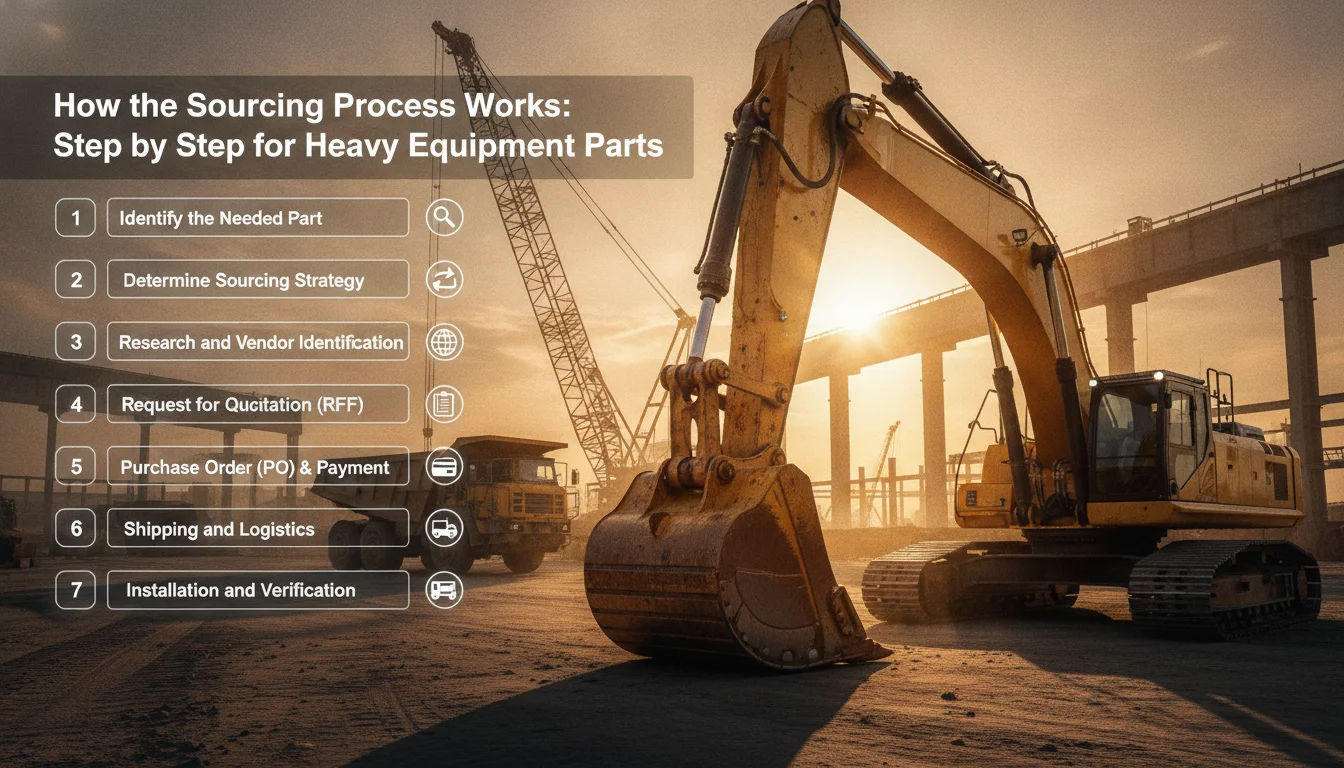
Understanding how to source heavy equipment parts at a process level helps procurement managers build repeatable workflows that reduce errors and compress lead times.
- Document the failure or maintenance need. Record the machine serial number, model, operating hours, and a clear description of the failed component or scheduled replacement item. Include photos where possible.
- Pull the OEM part number. Reference the service manual or contact your dealer's parts desk. Note any supersession numbers that may apply.
- Identify your sourcing channel. Decide whether OEM, aftermarket, or remanufactured is appropriate based on the component's criticality, your budget, and your lead time requirement.
- Contact at least two suppliers. Request a quote that includes unit price, shipping cost, estimated delivery date, and warranty terms. Do not evaluate price in isolation.
- Verify compatibility before payment. Provide the supplier with your serial number and part number. A reliable supplier will confirm compatibility in writing before processing the order.
- Place the order and confirm logistics. For international orders, confirm Incoterms, customs documentation requirements, and tracking arrangements upfront.
- Inspect on receipt. Check packaging integrity, part number markings, and physical condition before installation. Document any discrepancies immediately.
- Record the transaction. Log the part number, supplier, price, delivery date, and installation date. This record supports future sourcing decisions and warranty claims.
OEM vs. Aftermarket vs. Remanufactured: Full Comparison
Choosing between part types is one of the most consequential decisions in how to source heavy equipment parts. This table summarizes the key trade-offs.
| Factor | OEM Parts | Aftermarket Parts | Remanufactured Parts | Used/Salvage Parts |
|---|---|---|---|---|
| Fit & Compatibility | Guaranteed exact fit | Varies by manufacturer | Restored to OEM spec | Variable - inspect carefully |
| Price Point | Highest | Lower than OEM | Mid-range | Lowest upfront cost |
| Warranty Coverage | Full factory warranty | Supplier warranty (varies) | Typically 1-year minimum | Usually none or limited |
| Availability (Older Models) | Limited for discontinued | Often broader availability | Depends on core availability | Best option for obsolete parts |
| Lead Time | Can be long for specialty items | Often faster | Moderate | Depends on yard inventory |
| Risk Level | Lowest | Low to medium | Low | Medium to high |
| Best Use Case | Warranty machines, critical systems | Wear parts, high-volume fleets | Major assemblies (engines, pumps) | Obsolete models, budget constraints |
Pros and Cons of Each Sourcing Approach
Every sourcing channel has genuine strengths and real limitations. Here's an honest assessment.
Pros
- OEM sourcing through authorized dealers eliminates compatibility risk and preserves warranty coverage on newer machines.
- Aftermarket sourcing from verified suppliers delivers cost savings on wear parts without sacrificing performance when the supplier has documented quality controls.
- Global export suppliers provide access to OEM-quality parts in markets where local dealer networks are limited, often with faster delivery than waiting for regional stock replenishment.
- Remanufactured parts offer a cost-effective path for major assemblies like final drives, hydraulic pumps, and transmissions, with performance restored to original specifications.
- Salvage yards are often the only viable source for parts on discontinued or obsolete equipment models.
Cons
- OEM dealer pricing carries a significant premium that can strain maintenance budgets on high-hour fleets with frequent part turnover.
- Aftermarket quality is inconsistent across the market. Low-cost suppliers with no traceable manufacturing standards can produce parts that fail prematurely and cause secondary damage.
- Global sourcing introduces customs, import duty, and logistics complexity that requires experienced handling to avoid delays.
- Used parts carry inherent uncertainty about remaining service life, and most carry no warranty protection.
- Online marketplaces require significant buyer due diligence to distinguish reliable sellers from those offering counterfeit or misrepresented components.
Evaluating Suppliers
Supplier evaluation is where most procurement errors occur. Price is visible; quality and reliability are not.
Reputation and Reliability
Research suppliers through customer reviews, industry forum discussions, and direct references from other fleet operators. Industry forums like Boom and Bucket show real operators consistently recommending suppliers who can locate and ship parts quickly, with one operator noting a trusted supplier had parts located and shipped within an hour of contact. That kind of responsiveness is a meaningful signal of inventory depth and operational competence.
Inventory and Availability
A supplier with deep inventory across multiple brands can fulfill orders faster and is more likely to stock the specific variant you need. Suppliers covering 40+ brands, including Caterpillar, Komatsu, Volvo, John Deere, Hitachi, and Atlas Copco, give procurement managers a single point of contact for mixed fleets.
Pricing and Warranty
Compare total landed cost, not just unit price. Factor in shipping, customs duties for international orders, and the value of warranty coverage. A part with a 12-month warranty at a slightly higher price is often a better total value than a cheaper part with no recourse if it fails at 90 days.
Quality Control Documentation
Ask suppliers directly: what quality control processes do they apply? Reputable suppliers can describe their inspection protocols, manufacturing traceability, and testing procedures. If a supplier cannot answer these questions clearly, that is a red flag regardless of price.
"Choosing the right supplier can make all the difference in the performance and longevity of your equipment." - Machinery Parts Warehouse, 2026
Cost Considerations
Cost management in parts sourcing requires thinking beyond the invoice price of a single component.
Budgeting for Parts
Establish a maintenance budget based on your fleet size, machine hours, and the manufacturer's recommended service intervals. Prioritize budget allocation toward high-wear components: undercarriage parts, hydraulic seals, filters, and ground-engaging tools typically account for the largest share of routine parts spend on construction and mining equipment.
Long-Term Savings
Investing in quality parts reduces the frequency of repeat failures. A hydraulic pump that lasts through its full rated service life costs less per operating hour than a cheaper alternative that requires replacement at half the interval. Factor total cost of ownership into every sourcing decision, not just the purchase price.
Volume Pricing and Supplier Agreements
Fleet operators managing multiple machines benefit from negotiating volume pricing agreements with their primary suppliers. Committing to a preferred supplier for a defined category of parts, such as all undercarriage components or all hydraulic consumables, typically unlocks better unit pricing and priority fulfillment during high-demand periods.
Common Mistakes to Avoid When Sourcing Parts
Even experienced procurement managers make avoidable errors. These are the most common mistakes we see when teams are learning how to source heavy equipment parts at scale.
- Ordering by description instead of part number. Generic descriptions like "hydraulic pump" or "track roller" are not sufficient for accurate sourcing. Always use the OEM part number as the primary identifier.
- Ignoring supersession updates. OEM part numbers are updated when manufacturers improve or consolidate components. Ordering an obsolete number can result in receiving an incompatible part or a long delay while the supplier investigates.
- Evaluating price without considering total landed cost. A part priced 20% lower than the competition may cost more overall once you factor in shipping, duties, and a shorter warranty period.
- Purchasing from unverified online sellers. The market for counterfeit heavy equipment parts is real. Fake hours on used equipment and counterfeit components are documented problems in the industry. Buyer beware applies strongly to unverified online sellers.
- Skipping incoming inspection. Parts can be damaged in transit or incorrectly labeled. Inspecting every delivery before installation protects your warranty claim rights and prevents installing a defective component.
- Waiting until failure to order. Reactive sourcing is the most expensive sourcing model. Operators who push through early warning signs, whether a hydraulic leak, unusual vibration, or elevated operating temperatures, consistently face larger repair bills and longer downtime than those who act on the first signal.
- Not documenting purchases. Without records of part numbers, suppliers, prices, and installation dates, you cannot track component life cycles, negotiate volume pricing, or support warranty claims effectively.
Worked Example: Sourcing a Final Drive for a Komatsu PC200
Here's how a realistic sourcing scenario plays out when you apply a structured process.
A fleet supervisor at a road construction company notices that the left final drive on a Komatsu PC200-8 excavator is leaking oil and showing increased noise during travel. The machine has 8,400 hours on it, and the project it's assigned to has four weeks remaining.
Step 1: Document the need. The supervisor pulls the machine's serial number from the data plate and records the model designation: PC200-8. He notes the operating hours and photographs the leak point.
Step 2: Pull the part number. Using the Komatsu Parts Book, he identifies the final drive assembly part number for this serial number range. He also notes the supersession history to confirm the current active part number.
Step 3: Evaluate sourcing options. The machine is out of warranty. The local Komatsu dealer quotes a new OEM final drive with a 6-week lead time. A remanufactured unit from a verified supplier is available with a 10-day lead time and a 12-month warranty. A global export supplier quotes an OEM-quality unit with 5-day international shipping.
Step 4: Verify compatibility. The supervisor provides the serial number and part number to both alternative suppliers. Both confirm compatibility in writing.
Step 5: Evaluate total cost. The remanufactured unit and the export supplier unit are both priced well below the OEM dealer quote. The export supplier's 5-day delivery fits the project timeline. The supervisor selects the export supplier option, confirms Incoterms and customs documentation, and places the order.
Step 6: Inspect and install. The unit arrives on day 5. The supervisor inspects packaging and part number markings before signing off on receipt. Installation is completed the same day, and the machine returns to service within the project window.
This scenario illustrates why knowing how to source heavy equipment parts through multiple channels, and evaluating them systematically, directly protects project timelines and maintenance budgets.
Best Practices for Purchasing Parts
Implementing consistent purchasing practices is what separates reactive maintenance teams from those that run efficient, low-downtime operations.
Regular Maintenance Checks
Conduct scheduled inspections at manufacturer-recommended intervals. Proactive identification of wear allows you to source replacement parts before failure, giving you time to compare suppliers and select the best option rather than accepting whatever is available fastest under emergency conditions.
Building Relationships with Suppliers
Long-term supplier relationships deliver compounding benefits: better pricing, faster response times, priority access to limited stock, and a supplier who understands your fleet's specific configuration. Treat your key suppliers as operational partners, not just transaction vendors.
Documenting Purchases
Maintain a parts log that records part numbers, supplier names, purchase prices, delivery dates, and installation dates for every component. This data supports warranty claims, informs future sourcing decisions, and provides the evidence base for negotiating volume pricing agreements.
Stocking Critical Spares
For high-wear components with predictable replacement intervals, consider maintaining a small on-site inventory of critical spares. Filters, seals, belts, and ground-engaging tools are good candidates. This eliminates lead time entirely for the most common maintenance needs and reduces the risk of unplanned downtime on remote job sites.
2026 Outlook: How the Parts Sourcing Market Is Evolving
As of 2026, the global heavy equipment parts market is shifting in ways that directly affect how procurement teams operate.
Global supply chain disruptions over the past several years have pushed more fleet operators to diversify their sourcing channels rather than relying on a single dealer or supplier. This year, we're seeing increased adoption of global export suppliers by procurement teams in Africa, Southeast Asia, the Middle East, and Latin America, where local dealer networks have historically been thin and lead times long.
Digital parts catalogs and online compatibility tools have made it faster to identify correct part numbers without calling a dealer. OEM manufacturers including Caterpillar and Komatsu have expanded their digital parts lookup systems, reducing the friction of the identification step.
The remanufactured parts segment continues to grow as fleet operators look for ways to manage costs without compromising performance on major assemblies. According to manufacturer specifications, remanufactured components from certified programs must meet the same performance standards as new parts, making them a credible option for high-value assemblies like engines, transmissions, and hydraulic pumps.
For procurement managers building their sourcing strategy this year, the practical takeaway is straightforward: diversify your supplier base, invest in documentation and process, and evaluate total cost of ownership rather than unit price alone.
Frequently Asked Questions
What is the best way to find heavy equipment parts?
Start with your equipment's serial number and model year, then pull the OEM part number from the service manual or dealer parts system. Contact at least two suppliers, including an authorized dealer and a verified aftermarket or global export supplier, to compare price, availability, and lead time. Always confirm compatibility in writing before placing an order.
Are aftermarket parts reliable for heavy equipment?
Aftermarket parts can be highly reliable when sourced from manufacturers with documented quality control processes and traceable manufacturing origins. Quality varies significantly across the aftermarket supply base. Research the supplier's reputation, ask about their QC protocols, and check for warranty coverage before purchasing. Reputable aftermarket suppliers engineer their parts to match OEM performance specifications.
How can I ensure I get the right part?
Always use the OEM part number as your primary identifier, not a generic description. Provide your machine's serial number to the supplier and ask them to confirm compatibility in writing. Cross-reference the part number against at least two sources and check for any supersession updates that may have changed the active part number since your service manual was printed.
What should I consider when purchasing used parts?
Request inspection photos and ask about the source machine's operating hours and condition. Inquire about any warranty or return policy the supplier offers. Used parts carry inherent uncertainty about remaining service life, so they are best suited for lower-criticality applications or situations where OEM and aftermarket options are unavailable or cost-prohibitive.
How often should I replace heavy equipment parts?
Replace parts according to the manufacturer's recommended service intervals, not just when they fail. OEM service manuals specify replacement intervals for wear components based on operating hours and conditions. Proactive replacement of high-wear items like filters, seals, and undercarriage components prevents unplanned failures and extends the overall service life of the machine.
Where can I find OEM parts for older or discontinued equipment models?
For older models where OEM parts are no longer in production, your best options are remanufactured components, reputable aftermarket suppliers with broad catalog coverage, and salvage yards that specialize in heavy equipment. Global export suppliers often maintain inventory for older model lines that local dealers have discontinued. Suppliers covering 40+ brands, like 3GEN Export, are a practical starting point for hard-to-find components.
What are the three types of spare parts used in heavy equipment?
The three primary categories are consumable parts (filters, seals, belts, fluids replaced at regular intervals), wear parts (undercarriage components, ground-engaging tools, cutting edges that wear progressively with use), and capital spare parts (major assemblies like engines, transmissions, and hydraulic pumps replaced infrequently but at high cost). Understanding which category a component falls into helps you prioritize sourcing strategy and budget allocation.
Need OEM-quality spare parts for your fleet? Shop parts for Caterpillar, Komatsu, Volvo, Atlas Copco, and 40+ brands with global 5-day delivery at 3genexport.com.