
How to Source Heavy Machinery Parts in 2026
Learn how to source heavy machinery parts with confidence: OEM vs aftermarket, supplier vetting, global shipping, and cost-saving tips for B2B buyers.
Loading article…
Article Not Found
The article you're looking for doesn't exist or may have been removed.
Back to BlogKey Takeaways
- Knowing your machine's make, model, and serial number is the first step to sourcing the right part every time.
- OEM parts guarantee compatibility and warranty compliance; aftermarket parts can cut costs when sourced from vetted suppliers.
- Serial number breaks mean two machines with identical model numbers may need different components - always verify before ordering.
- Supplier reliability matters as much as part quality: check shipping speed, return policies, and inventory depth.
- Regular maintenance reduces emergency sourcing pressure and extends equipment life significantly.
- As of 2026, global B2B platforms have made how to source heavy machinery parts faster and more transparent than ever before.
How to Source Heavy Machinery Parts in 2026
How to source heavy machinery parts is the process of identifying, evaluating, and procuring the correct replacement components for construction, mining, and energy equipment from reliable global or local suppliers.
Understanding Heavy Machinery Parts
Heavy machinery parts are components specifically designed to replace worn, damaged, or failed parts in heavy equipment. They play a critical role in maintaining the functionality and efficiency of machinery. When one component degrades, the ripple effect across interconnected systems can be severe. A failing hydraulic hose on an excavator, for example, doesn't just affect fluid flow - it can reduce hydraulic pressure across the entire circuit, damage the pump, and bring the machine to a full stop. According to manufacturer specifications and industry maintenance data, catching component wear early is the most cost-effective approach available to fleet operators.
Types of Heavy Machinery Parts
- OEM Parts: Original Equipment Manufacturer parts are made by the original manufacturer and designed to fit and function exactly as the original components. They're the safest choice for machines still under warranty.
- Aftermarket Parts: Produced by third-party manufacturers, these can be more affordable than OEM parts. Quality varies widely, so choosing a supplier with a proven track record is essential. Some aftermarket suppliers engineer their parts to meet or exceed OEM tolerances.
- Rebuilt/Remanufactured Parts: Used parts refurbished to meet original specifications. A cost-effective alternative to new parts, particularly for older machines where new OEM stock is discontinued or scarce.
Importance of Quality Parts
Using high-quality parts is essential for the longevity and performance of heavy machinery. Poor-quality parts accelerate wear across adjacent components, increase breakdown frequency, and drive up total operational costs. The savings from a cheap part disappear fast when it triggers a secondary failure in a hydraulic pump or final drive assembly.
"Every component in your machine has a purpose - and when one part begins to wear down or fails, it can cause a ripple effect across the entire system. Costly repairs and extended downtime follow." - EquipmentShare, Guide to Buying Heavy Equipment Parts, 2024
Pros and Cons of the Main Sourcing Approaches
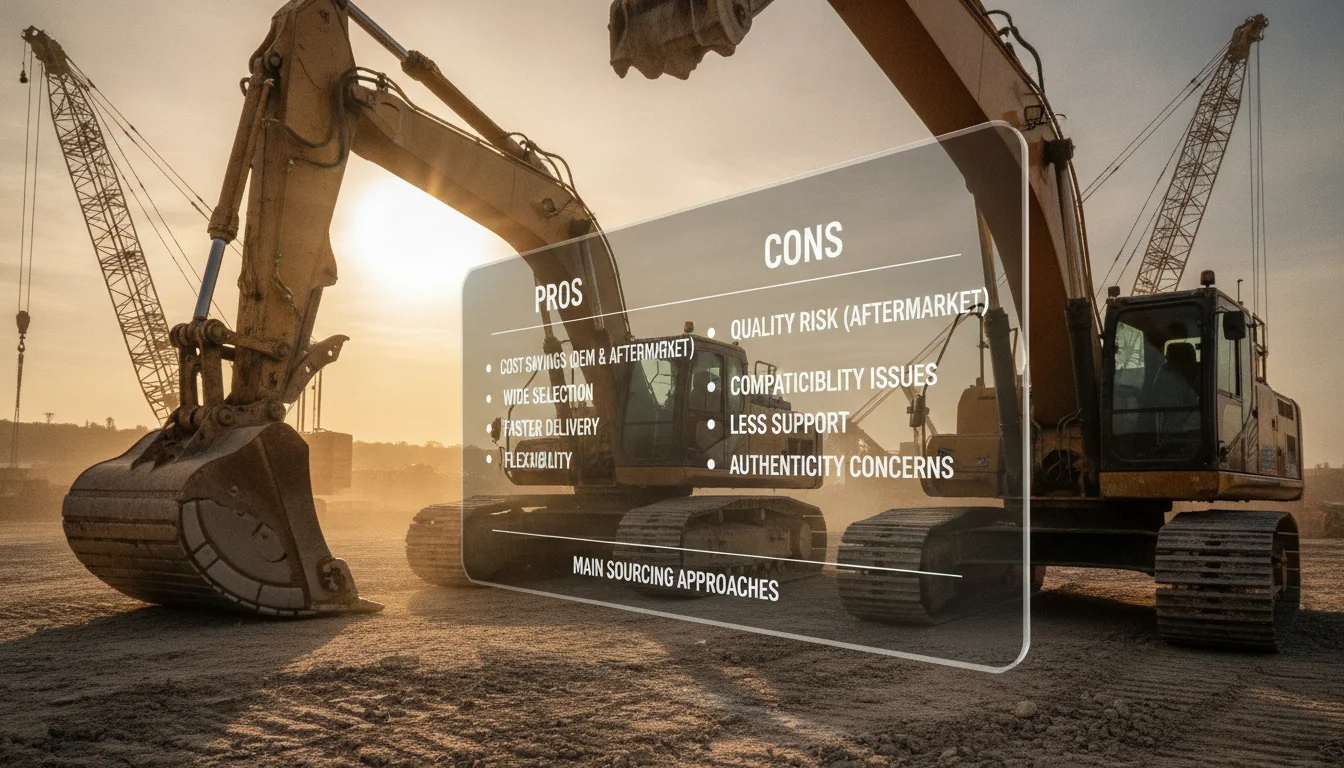
Understanding the trade-offs between sourcing channels helps procurement managers make faster, better-informed decisions. No single channel is right for every situation.
Pros
- OEM from authorized dealers: Guaranteed compatibility, warranty protection, and factory-backed technical support.
- Aftermarket from vetted global suppliers: Significant cost savings, broader availability for older models, and faster lead times when OEM stock is depleted.
- Rebuilt/remanufactured parts: Lower cost than new, environmentally responsible, and often the only option for legacy equipment.
- Global B2B platforms (like 3genexport.com): Access to OEM-quality stock across 40+ brands, consolidated ordering, and reliable international shipping.
Cons
- OEM from authorized dealers: Higher prices, longer lead times for non-stocked items, and geographic availability gaps in remote regions.
- Aftermarket from unvetted sources: Inconsistent quality, potential compatibility issues, and risk of voiding equipment warranties.
- Rebuilt parts: Variable refurbishment standards, limited warranty coverage, and uncertainty about remaining service life.
- Salvage yards: Unpredictable inventory, no quality guarantees, and often no return policy on electrical or hydraulic components.
Best Practices for Sourcing Heavy Machinery Parts
When you need to source heavy machinery parts, following proven best practices saves time and money while ensuring you get the right components for your equipment. Skipping any of these steps is where most procurement errors originate.
1. Know Your Machine's Make, Model, and Serial Number
Before sourcing parts, collect your machinery's exact make, model, and serial number from the data plate. Different models and production years require different parts, and suppliers will ask for these details upfront. For fleet operations, maintain a centralized list of serial numbers so any team member can place an accurate order without delay.
2. Understand Serial Number Breaks
Serial number breaks occur when manufacturers update a machine's design during a production run. Two machines with the same model number but different serial numbers may require entirely different parts. Understanding these breaks ensures you order the correct component and eliminates the cost and delay of returns. This is one of the most common causes of wrong-part orders in the industry.
3. Compare OEM and Aftermarket Parts
Deciding between OEM and aftermarket parts is a critical step when you source heavy machinery parts. OEM parts provide guaranteed reliability and are required for machines under warranty. Per manufacturer warranty terms, using non-OEM parts may void coverage - always review your warranty documentation before making a substitution. Aftermarket parts from reputable suppliers can deliver equivalent performance at lower cost, but verify that the supplier meets recognized industry quality standards before committing.
4. Verify Supplier Credentials
A reliable parts supplier offers more than just inventory. Look for fast shipping commitments, clear return policies, responsive customer service, and documented quality assurance processes. Suppliers who can provide traceability documentation - confirming part origin and manufacturing standards - are significantly lower risk than those who cannot.
"For new, refurbished, or surplus parts, suppliers mentioned often for quick shipping and broad inventory include those with yards across multiple regions who can locate and ship parts within hours of an order." - Meta AI Summary of Heavy Machinery Parts Sourcing Tips, Facebook, 2024
How the Sourcing Process Actually Works
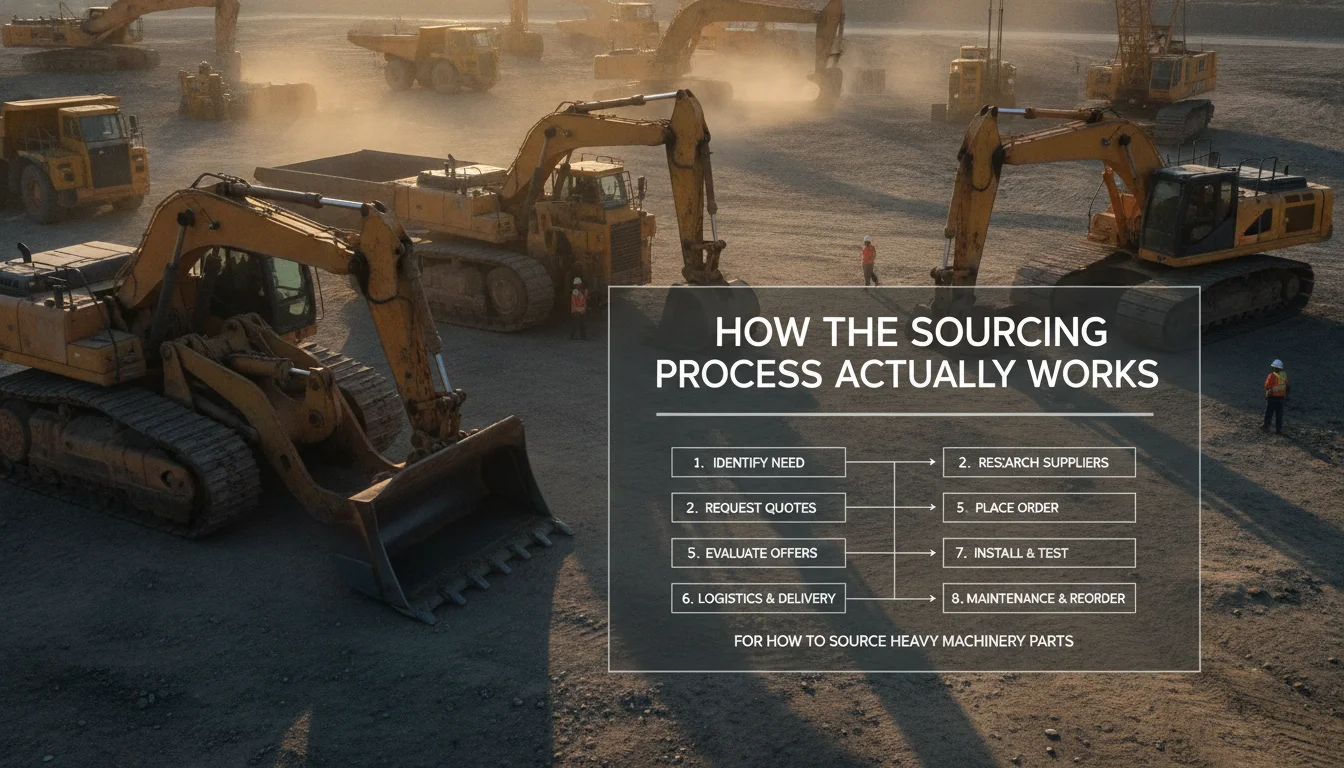
How to source heavy machinery parts effectively requires understanding what happens between identifying a failed component and receiving a verified replacement. The process involves more than a simple online search - it's a structured procurement workflow with several decision points.
When a component fails or shows wear, the clock starts immediately. Every hour of machine downtime on a construction or mining site has a direct cost. The sourcing process must be fast and accurate simultaneously. Here's how it works in practice:
Step 1: Failure identification. The operator or maintenance technician identifies the failed or degrading component. This may come from a scheduled inspection, a performance anomaly, or a visible failure. The part number is pulled from the machine's service manual or OEM parts catalog.
Step 2: Specification confirmation. The procurement team confirms the exact part number, cross-referencing the machine's serial number against the manufacturer's parts book to account for any serial number breaks. This step prevents the most common sourcing error in the industry.
Step 3: Supplier identification. The team contacts authorized dealers, global B2B suppliers, and aftermarket specialists simultaneously. Running parallel inquiries compresses lead time significantly compared to sequential sourcing.
Step 4: Quote comparison. Quotes are evaluated not just on price but on shipping speed, warranty terms, and supplier reliability history. The cheapest quote with a three-week lead time may cost more in downtime than a slightly higher-priced part that ships within five days.
Step 5: Order placement and tracking. The order is placed with a confirmed delivery timeline. Reputable suppliers provide tracking information and proactive communication if any delays arise.
Step 6: Receiving inspection. Upon delivery, the part is inspected against the order specification before installation. Checking part numbers, condition, and packaging integrity at this stage prevents installation of incorrect or damaged components.
Step-by-Step Process for Sourcing Parts
Follow this structured process to source heavy machinery parts efficiently and accurately every time:
- Identify the Part Needed: Use your machine's service manual to determine the specific OEM part number required. Do not rely on visual identification alone for complex hydraulic or electrical components.
- Gather Machine Information: Collect the make, model, serial number, and production year. Pull this from the data plate, not from memory or documentation that may be outdated.
- Research Suppliers: Contact authorized dealers, global B2B suppliers, and reputable aftermarket specialists. Cast a wide net initially to understand availability and lead times across the market.
- Compare Prices and Lead Times: Get quotes from multiple suppliers. Factor in shipping speed alongside unit cost - a part that arrives in five days at a modest premium often delivers better total value than a cheaper part with a three-week lead time.
- Check Reviews and Credentials: Verify supplier reputation through customer reviews, industry references, and quality certifications. For international suppliers, confirm export experience and customs documentation capability.
- Place Your Order: Confirm all order details in writing, including part number, quantity, shipping method, and expected delivery date. Obtain tracking information immediately.
- Inspect on Receipt: Check the delivered part against your order specification before installation. Contact the supplier immediately if there is any discrepancy.
Where to Source Heavy Machinery Parts
There are multiple channels for sourcing heavy machinery parts, each with distinct advantages depending on your urgency, budget, and equipment type.
1. Authorized Dealers
Starting with authorized dealers is the most reliable route for OEM parts. They provide genuine components, can assist with warranty claims, and have direct access to manufacturer technical support. Prices are typically higher, and availability for non-stocked items can mean extended lead times - particularly for older or less common machine models.
2. Global B2B Suppliers
Specialized global suppliers like 3GEN Export stock OEM-quality parts for Caterpillar, Komatsu, Volvo, Atlas Copco, and 40+ additional brands. These suppliers combine broad inventory depth with international shipping capability, making them particularly valuable for operations in regions where local dealer networks are thin. As of 2026, the best global B2B platforms offer 5-day delivery to most major markets worldwide.
3. Online Marketplaces
Platforms like eBay and specialized heavy equipment parts marketplaces offer wide selection, including new, used, and aftermarket components. Always verify seller ratings, return policies, and part condition descriptions carefully. The risk of receiving incorrect or misrepresented parts is higher on general marketplaces than with dedicated industrial suppliers.
4. Local Suppliers and Salvage Yards
Local suppliers provide fast access to common wear parts, and salvage yards can source used components at a fraction of new-part cost. This channel is particularly useful for older machinery where OEM new-stock availability is limited. Inspect used parts carefully and confirm any available warranty terms before purchasing.
Comparison of Sourcing Options
Use this table to quickly evaluate which sourcing channel fits your specific situation when you need to source heavy machinery parts under time and budget pressure.
| Source Type | Part Quality | Typical Lead Time | Price Level | Best For |
|---|---|---|---|---|
| Authorized Dealers | OEM guaranteed | 1-14 days (varies by stock) | High | Warranty-active machines, critical components |
| Global B2B Suppliers (e.g., 3GEN Export) | OEM-quality, verified | 5 days globally | Competitive | International fleets, broad brand coverage |
| Online Marketplaces | Variable | 3-21 days | Low to medium | Non-critical parts, price-sensitive procurement |
| Local Suppliers | Variable | Same day to 3 days | Medium | Urgent needs, common wear parts |
| Salvage Yards | Used, unverified | 1-5 days | Low | Legacy machines, discontinued OEM parts |
Common Mistakes to Avoid When Sourcing Parts
Even experienced procurement teams make avoidable errors when sourcing heavy machinery parts under pressure. Knowing where the process typically breaks down helps you build safeguards before you need them.
Ordering by Model Number Alone
This is the most frequent and costly mistake. Two machines with identical model designations can require completely different parts if they fall on opposite sides of a serial number break. Always cross-reference the serial number against the manufacturer's parts catalog before placing any order.
Choosing Price Over Lead Time
A part that saves money on paper but adds two weeks to your machine's downtime is not a bargain. Calculate the total cost of the sourcing decision, including lost productivity, before selecting the lowest-price option.
Skipping Supplier Verification
Not all suppliers who claim to stock OEM or OEM-quality parts actually deliver on that claim. Request documentation, check references, and review return policies before placing a first order with any new supplier. This is especially important for international procurement where recourse options are more limited.
Ignoring Warranty Implications
Using aftermarket parts on a machine still under manufacturer warranty can void coverage. Per standard OEM warranty terms, always confirm whether a substitution is permitted before proceeding. In most cases, OEM parts are required for warranty-active equipment, though some manufacturers handle exceptions on a case-by-case basis.
Failing to Inspect on Receipt
Installing a part without first verifying it against the order specification is a risk that experienced technicians avoid. Wrong parts, shipping damage, and counterfeit components are all caught at the receiving inspection stage - not after installation.
Neglecting to Document Part History
Fleet operations that don't track which parts were installed, when, and from which supplier lose the ability to identify patterns of premature failure. Good documentation supports warranty claims, identifies underperforming suppliers, and improves future sourcing decisions.
A Realistic Sourcing Scenario
Here's how the sourcing process plays out in a real-world fleet maintenance context.
A mining operation running a fleet of Komatsu PC390 excavators notices hydraulic drift on one unit during a morning pre-shift inspection. The maintenance supervisor pulls the machine's service manual and identifies the likely cause: worn hydraulic cylinder seals. The part number is confirmed against the machine's serial number - and the serial number falls after a known design update, meaning the seal kit required is a later-specification part, not the one listed for earlier units of the same model.
The supervisor contacts three sources simultaneously: the local Komatsu dealer, a global B2B supplier with verified Komatsu inventory, and a regional aftermarket specialist. The dealer quotes a 10-day lead time for the correct kit. The global B2B supplier has the part in stock and confirms 5-day international delivery. The aftermarket specialist offers a lower price but cannot confirm the seal material specification meets Komatsu's hydraulic system requirements.
The procurement team selects the global B2B supplier. The part arrives on day five, passes receiving inspection, and the machine is back in service by end of the following day. Total downtime: six days. Had the team ordered by model number alone and received the wrong seal kit, the process would have restarted from scratch, adding at minimum another week of downtime.
This scenario illustrates why knowing how to source heavy machinery parts correctly - with serial number verification, parallel supplier outreach, and lead time as a primary evaluation criterion - directly affects operational productivity.
The Role of Regular Maintenance
Regular maintenance is the most effective way to reduce emergency sourcing pressure. By staying ahead of routine tasks, you identify potential failures before they escalate into unplanned downtime events that require urgent, often expensive, parts procurement.
Common Maintenance Tasks
- Replacing Filters: Regularly replace hydraulic, fuel, and air filters to prevent contaminants from damaging engine and hydraulic system components. Filter replacement intervals are specified in OEM service bulletins and should be followed precisely.
- Lubricating Components: Ensure all moving parts receive the correct lubricant at the correct interval. Under-lubrication accelerates wear on pins, bushings, and bearing surfaces - components that are expensive and time-consuming to replace.
- Inspecting for Wear: Scheduled visual and measurement-based inspections of undercarriage components, cutting edges, bucket teeth, and hydraulic hoses allow you to plan part replacements proactively rather than reactively.
- Fluid Analysis: Regular oil and hydraulic fluid sampling provides early warning of internal component wear before visible symptoms appear. Many OEM service programs include fluid analysis as a standard maintenance tool.
2026 Outlook: How the Parts Sourcing Market Is Evolving
As of 2026, the global heavy equipment parts market continues to shift toward digital procurement channels. B2B buyers now expect the same transparency and speed from industrial parts suppliers that they experience in consumer e-commerce. This year, the most competitive suppliers are investing in real-time inventory visibility, digital part number cross-referencing tools, and streamlined international logistics networks.
Supply chain disruptions from recent years have pushed many fleet operators to diversify their sourcing strategies, reducing dependence on single-source suppliers and building relationships with multiple vetted partners across different regions. This approach to how to source heavy machinery parts - with redundancy built in - has become standard practice for operations that cannot afford extended downtime.
Aftermarket quality has also improved significantly. Leading aftermarket suppliers now publish detailed specification sheets and material certifications, making it easier for procurement teams to verify compliance before ordering. The gap between premium aftermarket and OEM parts has narrowed for many standard wear components, though critical hydraulic, electrical, and engine components still warrant OEM sourcing wherever possible.
For global operations, the ability to consolidate parts procurement across multiple brands through a single international supplier has become a meaningful efficiency gain. Rather than managing separate dealer relationships for Caterpillar, Komatsu, Volvo, and Atlas Copco equipment, procurement teams can source across all brands through one platform with unified shipping, documentation, and account management.
Frequently Asked Questions
What is the difference between OEM and aftermarket parts?
OEM parts are manufactured by the original equipment maker and guarantee compatibility, quality, and warranty compliance. Aftermarket parts are produced by third-party companies and vary in quality and price. For warranty-active machines, OEM parts are typically required. For out-of-warranty equipment, high-quality aftermarket parts from vetted suppliers can deliver equivalent performance at lower cost.
How can I ensure I get the right part for my machinery?
Always have your machine's make, model, and serial number ready before contacting any supplier. Cross-reference the serial number against the manufacturer's parts catalog to account for serial number breaks - design updates that mean two machines with the same model number may need different components. Never order by model number alone.
Where can I find reliable suppliers for heavy machinery parts?
Reliable suppliers include authorized OEM dealers, specialized global B2B platforms like 3GEN Export, regional aftermarket specialists, and local heavy equipment parts distributors. Always verify supplier credentials, check customer reviews, confirm return policies, and ask about shipping lead times before placing a first order. For international procurement, confirm the supplier's export documentation capability.
How often should I perform maintenance on my heavy machinery?
Maintenance intervals vary by machine type, operating conditions, and OEM specifications. Follow the service schedule in your machine's operator manual as the baseline. High-intensity applications - such as mining or demolition - typically require shorter intervals than the standard schedule. Fluid analysis programs can help calibrate maintenance timing based on actual component wear data rather than fixed intervals alone.
What should I do if I receive the wrong part?
Contact the supplier immediately with your order confirmation and the part number discrepancy clearly documented. Do not install the part. Reputable suppliers will arrange a return or exchange promptly. This is why reviewing a supplier's return policy before ordering matters: a clear, no-hassle return process is a strong indicator of overall supplier quality.
Can I use aftermarket parts without voiding my warranty?
Using aftermarket parts may void your warranty, depending on the manufacturer's terms. Most OEM warranties require OEM parts for covered repairs, though some manufacturers handle exceptions on a case-by-case basis. Always review your warranty documentation before substituting aftermarket components. When in doubt, contact the authorized dealer or manufacturer directly for written confirmation before proceeding.
Where can I buy real OEM parts for Caterpillar, Komatsu, or Volvo equipment?
Genuine OEM parts for Caterpillar, Komatsu, Volvo, and other major brands are available through authorized dealer networks and verified global B2B suppliers. When purchasing from non-dealer sources, request documentation confirming part origin and manufacturing standards. Suppliers like 3GEN Export stock OEM-quality parts for 40+ brands with verified sourcing and global delivery capability.
Ready to source heavy machinery parts with confidence? Shop OEM-quality spare parts with global 5-day delivery at 3genexport.com. Our team of procurement specialists is ready to help you find the right component for your Caterpillar, Komatsu, Volvo, Atlas Copco, or any other major brand equipment - fast.