
Komatsu Parts by Serial Number: 2026 Guide
Komatsu parts by serial number lookup made simple. Learn how to find, identify, and order the right components fast with our 2026 procurement guide.
Loading article…
Article Not Found
The article you're looking for doesn't exist or may have been removed.
Back to BlogKey Takeaways
- Using komatsu parts by serial number ensures accurate ordering and eliminates costly compatibility errors.
- Understanding the difference between part numbers and serial numbers is essential for effective parts identification.
- Serial number breaks mean a single model like the PC200 can require entirely different components across production runs.
- Online catalogs, the My Komatsu portal, and authorized dealers each offer distinct advantages depending on your situation.
- Remanufactured components are a legitimate, warranty-backed option for cost-conscious procurement teams.
- Always confirm your serial number falls within the specified range before placing any order.
Finding Komatsu Parts by Serial Number: The 2026 Procurement Guide
Komatsu parts by serial number is the method of using a machine's unique production identifier to pinpoint exactly which components fit a specific unit, eliminating guesswork and costly mis-orders across Komatsu's full equipment range.
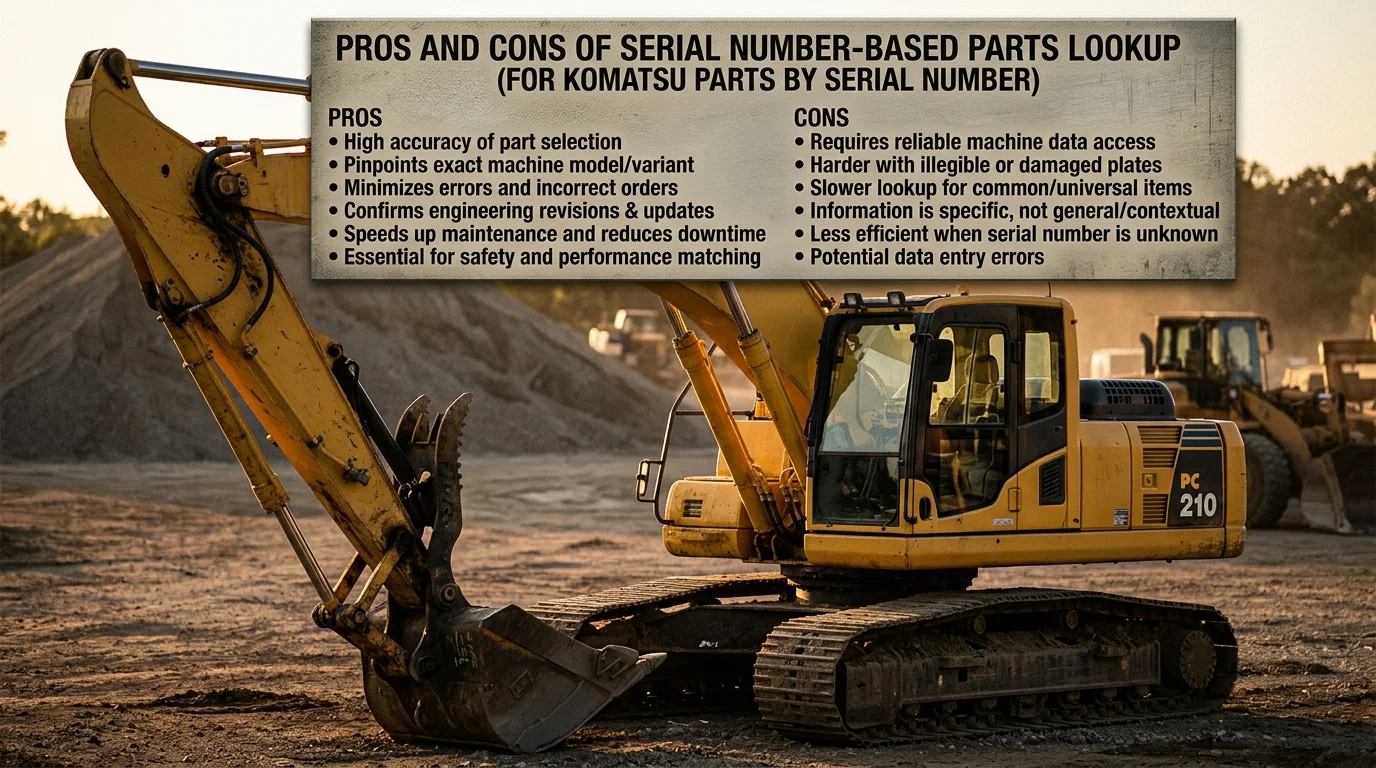
Pros and Cons of Serial Number-Based Parts Lookup
Pros
- Precision ordering: Serial numbers tie your request to a specific production range, so you receive the exact revision of a component your machine requires.
- Reduced downtime: Correct parts arrive ready to install. No waiting for return shipments or re-orders caused by wrong-fit components.
- Compatibility confidence: Serial number breaks are documented in OEM catalogs, so you can verify fit before committing to a purchase.
- Access to full parts history: Catalogs indexed by serial range show every revision a component has gone through, useful for older machines still in active service.
Cons
- Data plate wear: On older or heavily used machines, the data plate can accumulate grease, become illegible, or detach entirely, making serial number retrieval difficult.
- Catalog access costs: Full interactive access to some online parts catalogs requires a subscription. As of 2026, one major catalog platform charges USD 99 per month for complete access.
- Serial range complexity: A single model family can span dozens of serial ranges with different part revisions, which takes time to cross-reference correctly.
Understanding Komatsu Parts Identification
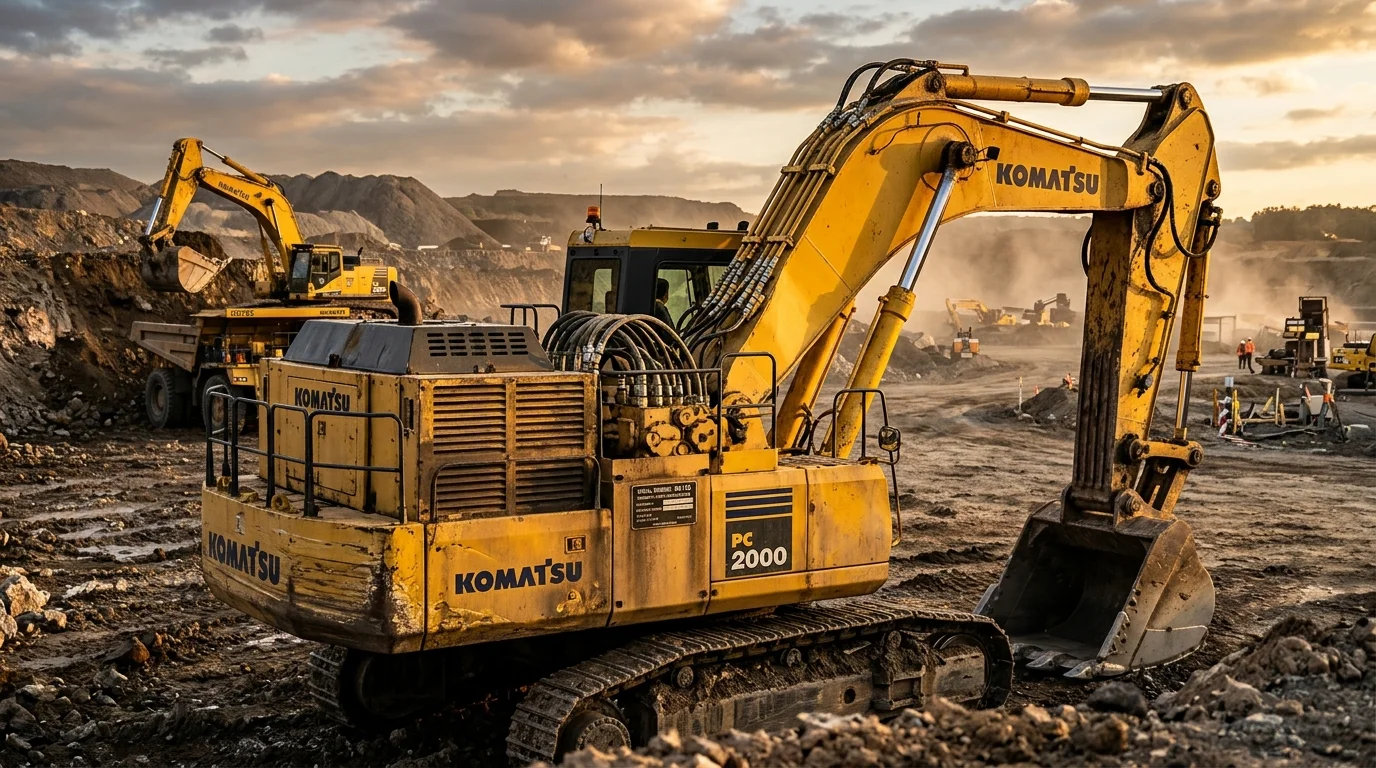
Identifying the right parts for your Komatsu machinery involves understanding two key identifiers: the part number and the serial number. Get either one wrong and you risk ordering a component that looks correct but won't fit your specific machine configuration.
What is a Part Number?
A part number is a unique identifier assigned to each component of a machine. It specifies the exact design and specifications of the part. If you need a hydraulic pump for a Komatsu PC200, for example, you use the specific part number associated with that pump revision, not a generic description.
What is a Serial Number?
A serial number identifies the specific machine model and its production details. It tells you which version of the machine you have, which matters because different production runs carry variations in parts. A Komatsu PC200-8 uses different pumps, sensors, wiring harnesses, and valves than a PC200-6 or PC200-7. The dash number alone signals a generational change in hydraulics, electronics, cab design, emissions configuration, and parts design.
Why Both Numbers Matter
Using both the part number and the serial number when ordering parts minimizes the risk of errors. As confirmed by technical parts identification guidance, many components look identical but carry different specifications depending on the machine's serial number range. Komatsu catalogs frequently contain serial number breaks: Part A fits machines up to a certain serial number, Part B fits machines from that point onward. Some parts also vary by options such as boom length, valve arrangement, emissions version, or region.
A part number identifies the part. A serial number identifies the machine configuration the part must fit. Provide both to your supplier simultaneously and you eliminate the most common source of procurement delays.
How the Serial Number System Works
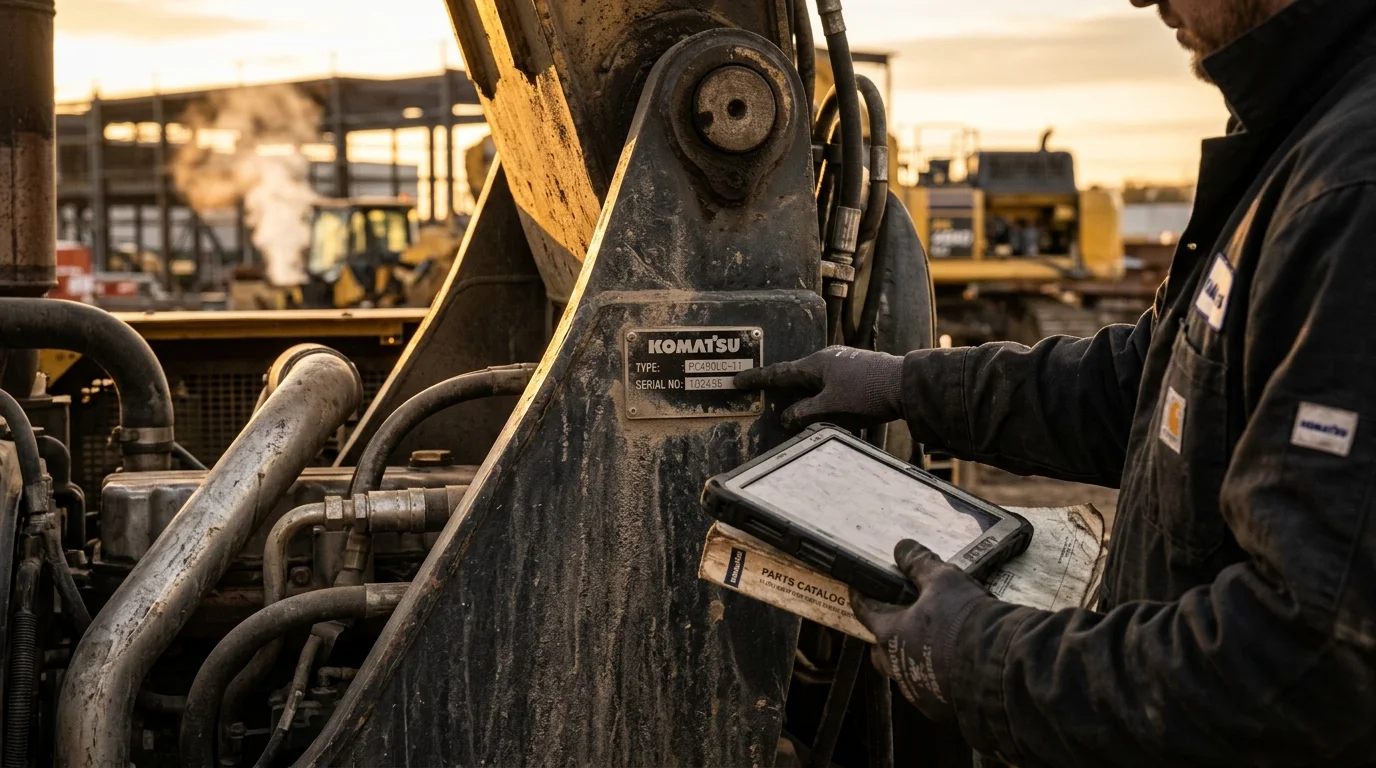
The serial number system is a structured production code that encodes machine type, model family, and build sequence into a single string. Understanding its structure helps you read catalog data faster and catch errors before they become expensive.
Take the Komatsu PC200-8 as a reference point. The model code itself carries meaningful data:
- PC: Komatsu's prefix for crawler hydraulic excavators. PW denotes wheeled excavators, WA covers wheel loaders, D indicates dozers.
- 200: The size and class indicator. In this case, the 20-ton operating class.
- -8: The series generation. A higher dash number means newer updates across hydraulics, electronics, cab design, emissions, and parts.
The serial number itself follows the model designation and typically includes a prefix tied to the production facility or machine type, followed by a sequential build number. When you open a parts catalog and select a model, you'll be asked to choose a serial range. That range corresponds to a specific production window. Parts sourced outside that window may share the same visual profile but differ in thread pitch, port sizing, seal groove dimensions, or material specification.
This is why procurement teams that rely on model name alone consistently run into fitment problems. The serial number is the only reliable anchor for parts compatibility across Komatsu's full lineup, which spans excavators, bulldozers, wheel loaders, motor graders, dump trucks, forklifts, and mining equipment.
Serial number breaks are a documented feature of Komatsu's parts catalog structure. Always confirm your machine's serial number falls within the range specified for any component before placing an order.
How to Locate Komatsu Parts by Serial Number: Step-by-Step
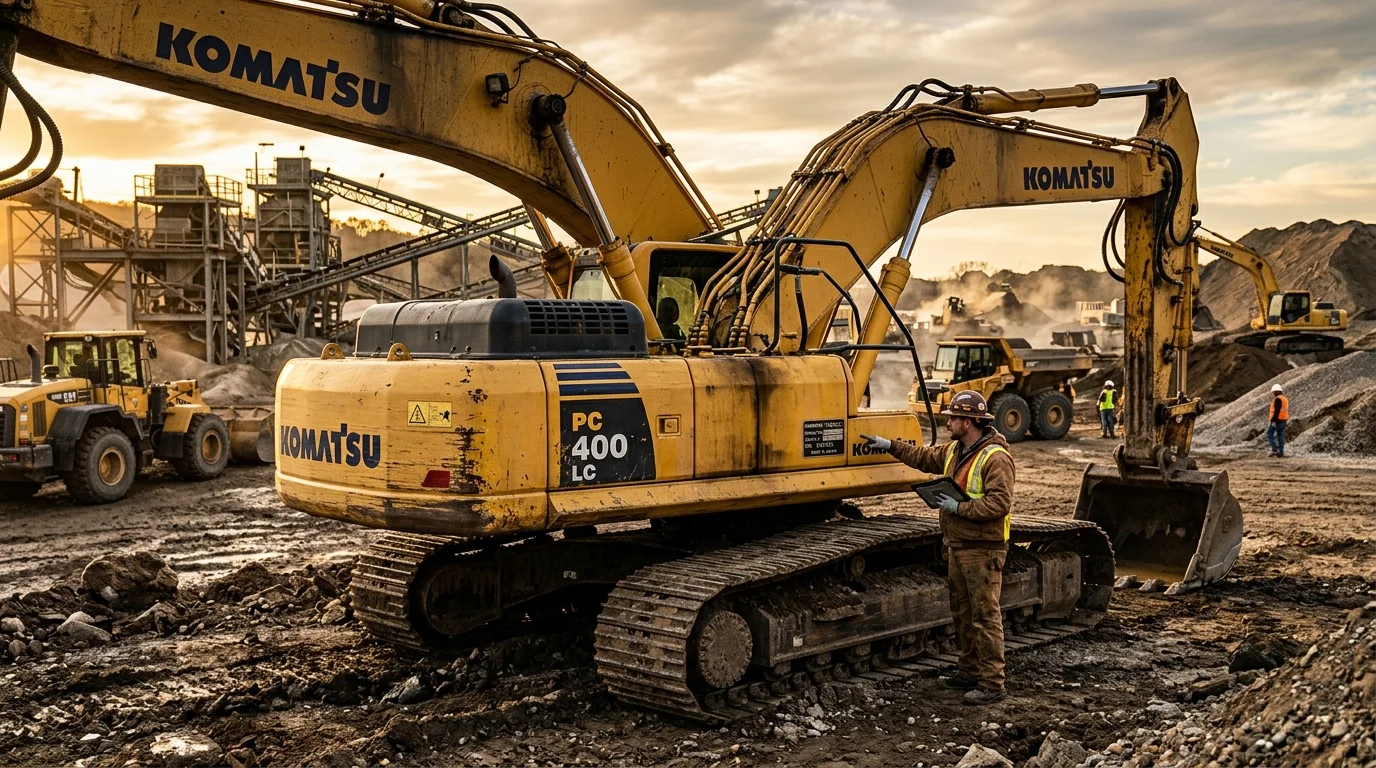
Finding the right parts for your Komatsu equipment is straightforward when you follow a systematic approach. Here are the steps procurement teams and maintenance supervisors use in practice.
Step 1: Identify Your Machine's Serial Number
Locate the serial number on your Komatsu machine. According to Komatsu engine identification guidance, the serial number is found on a data plate attached to the frame or near the engine, with location varying by machine type:
- Excavators (Crawler): On the cab, outside, on the right, as seen in the direction of travel.
- Excavators (Mini and Compact): On the base of the hydraulic arm or boom arm.
- Excavators (Wheeled): On the chassis at the front, on the right, as seen in the direction of travel.
- Bulldozers: On the frame, on the left, as seen in the direction of travel. Also stamped onto the frame at the rear, on the left, above the tow coupling.
- Crawler Dozers: At the entry to the driver's cab, on the inside, on the left, as seen in the direction of travel.
- Wheel Loaders: On the front frame on the right, as seen in the direction of travel, behind the front wheel.
- Skid Steer Loaders: Riveted onto the rear hydraulic column, on the right, as seen in the direction of travel.
- Forklifts: On the chassis or near the engine.
If the data plate is missing or illegible due to accumulated grease or physical damage, check the engine block directly. The engine serial number is typically inscribed on the left side of the engine block or on a metal data plate affixed to it. Note that the engine serial number differs from the machine PIN (Product Identification Number) or ESN (Equipment Serial Number), so confirm which identifier your catalog requires before searching.
Step 2: Decode the Model and Generation
Before opening a catalog, confirm the full model designation including the dash number. A PC200-6, PC200-7, and PC200-8 are distinct machines with different parts books. Ordering from the wrong generation's catalog is one of the most common procurement errors we see. Write down the complete model code and serial number together before you begin any search.
Step 3: Access the Parts Catalog
With the serial number confirmed, access a Komatsu parts catalog. Your main options in 2026 are:
- Online interactive catalogs: Platforms organized by machine model and serial range allow you to browse parts books, view exploded diagrams, and search by part number or English part name. Full interactive access may require an account and an active subscription.
- My Komatsu portal: The My Komatsu platform provides 24/7 access to machine telematics data, parts manuals, service manuals, software, and parts ordering from a single location. You can search by part number, upload a parts list, or browse by machine details including model name and serial number.
- PDF parts books: For teams that work in remote locations without reliable internet, PDF parts books are available for purchase and can be used offline. These are particularly useful for older machine models where interactive catalog coverage may be limited.
Step 4: Search Within the Correct Serial Range
Once inside the catalog, select the exact model and serial range that matches your machine. Do not approximate. If your serial number sits at the boundary between two ranges, contact the supplier or dealer to confirm which range applies. Filtering by the correct serial range surfaces only the parts compatible with your specific build, which dramatically reduces the chance of ordering an incorrect revision.
Step 5: Record Part Numbers Before Ordering
Note the full part number for each component you need, including any suffix or revision code. Cross-reference the exploded diagram to confirm the part's position in the assembly. This step is especially important for hydraulic components, engine parts, and undercarriage items where revision changes are common across serial ranges.
Ordering Komatsu Parts: Practical Guidance
After identifying the correct parts, placing the order efficiently is the next priority. Delays at this stage translate directly into machine downtime and project cost overruns.
Using Online Platforms
The My Komatsu portal offers a streamlined ordering process for genuine parts. You can search by part number, upload a full parts list for bulk orders, and select delivery options including pickup at your local dealer or direct shipping. This is the fastest route for procurement teams managing multiple machines.
Contacting Your Local Dealer
For complex orders or older machines where catalog coverage is limited, your local Komatsu dealer remains a reliable resource. Provide the full serial number and part numbers, and the dealer's parts team can confirm availability, check for superseded part numbers, and advise on lead times. This is particularly valuable when sourcing components for machines outside standard serial ranges.
Sourcing from Specialist Suppliers
For procurement teams managing global fleets, specialist heavy equipment parts suppliers can offer competitive pricing, faster delivery to remote locations, and OEM-quality components across Komatsu's full model range. At 3GEN Export, we supply OEM-standard parts for Komatsu excavators, bulldozers, wheel loaders, dump trucks, and more, with global delivery typically within five days. If you need a component urgently and your local dealer has it on backorder, a specialist supplier is often the fastest path to getting your machine back in service.
Considerations for Ordering
Keep these factors in mind before confirming any order:
- Lead times: Specialized components for older or less common models may carry extended lead times. Confirm before committing to a project timeline.
- Warranty coverage: Genuine and remanufactured parts from authorized sources typically include warranty coverage. Komatsu's remanufactured components program offers rebuilt parts that meet the same performance standards as new, at a lower cost.
- Superseded part numbers: Komatsu periodically updates part numbers when a component is revised. Always ask whether the part number you've identified has been superseded before ordering.
- Returns policy: Understand the supplier's returns process before ordering, particularly for high-value components. Most reputable suppliers accept returns on unused, correctly identified parts.
Comparison of Parts Ordering Methods
| Method | Best For | Advantages | Disadvantages |
|---|---|---|---|
| Online Interactive Catalog | Self-sufficient procurement teams | 24/7 access, exploded diagrams, serial range filtering | Full access may require a paid subscription |
| My Komatsu Portal | Fleet managers with multiple machines | Integrated telematics, parts ordering, and manuals in one place | Requires registration; learning curve for new users |
| Local Dealer | Complex orders, older machines | Personal assistance, superseded part number checks, local knowledge | Limited hours, potentially higher prices, stock constraints |
| PDF Parts Book | Remote sites, offline environments | No internet required, permanent reference copy | Not searchable interactively; may not reflect latest revisions |
| Specialist Global Supplier | Urgent orders, global fleet operations | Competitive pricing, fast global delivery, broad model coverage | Requires clear part number and serial data from buyer |
Common Mistakes to Avoid When Ordering by Serial Number
Even experienced procurement teams make avoidable errors. These are the mistakes we see most often, and how to prevent them.
Relying on Model Name Alone
Ordering parts based on model name without specifying the serial range is the single most common cause of wrong-part deliveries. A Komatsu PC200 has been produced across multiple generations, each with distinct component specifications. Always include the full model code and serial number in every parts request.
Ignoring Serial Number Breaks
Some parts only fit machines within a specific serial range. If your machine's serial number sits at the boundary of a documented break, the wrong revision can arrive and appear to fit during initial installation but fail prematurely. Confirm the exact range before ordering, and flag boundary cases to your supplier.
Overlooking Superseded Part Numbers
Komatsu updates part numbers when components are revised. If you order using an outdated number from an old parts book, you may receive a back-order notification or, worse, an obsolete part. Always verify whether the number you have is current, especially for machines more than five years old.
Skipping the Exploded Diagram Check
Part numbers alone don't tell the full story. Reviewing the exploded diagram confirms the part's exact position in the assembly, its relationship to adjacent components, and whether you need additional hardware, seals, or gaskets to complete the repair. Skipping this step often results in a second order and additional downtime.
Not Recording the Data Plate Before It Deteriorates
Data plates on working machines accumulate grease, suffer physical damage, and can detach over time. Photograph and record every machine's serial number, model code, and engine number when the equipment enters your fleet. Store this data in your maintenance management system. Recovering a serial number from a worn or missing plate is time-consuming and sometimes impossible without contacting the manufacturer directly.
A Realistic Procurement Scenario
Consider a fleet maintenance supervisor managing a mixed fleet at a road construction project. One of the Komatsu PC238USLC-11 excavators develops a hydraulic issue mid-project. The supervisor needs to identify and order the correct hydraulic component fast.
First, the team locates the serial number on the cab exterior, right side. They record the full model code and serial number. Next, they access the My Komatsu portal, select the PC238USLC-11, enter the serial number, and navigate to the hydraulics section of the parts book. The exploded diagram confirms the exact component and its part number, including the revision suffix that applies to their serial range.
They note that the part number has been superseded once since the machine was built. The current replacement number is confirmed in the catalog. They place the order through the portal for direct delivery to site. Because they had the serial number recorded in their maintenance system, the entire identification process takes under 20 minutes. The part arrives within the delivery window and the machine is back in service without a second order.
This scenario plays out differently when teams skip the serial number step. Without it, the wrong hydraulic revision ships, the machine stays down longer, and the project absorbs the cost of both the delay and the return freight.
Parts Categories Available Across Komatsu's Range
Komatsu's parts catalog covers the full machine lifecycle, from routine consumables to major structural components. Understanding which categories are available helps procurement teams plan maintenance schedules and budget accurately. Key categories include:
- Filters (engine, hydraulic, fuel, air)
- Engine components and power modules
- Hydraulics (pumps, motors, cylinders, valves, hoses, fittings)
- Undercarriage (track chains, rollers, idlers, sprockets, track shoes)
- Electrical and cab components
- Work equipment (buckets, blades, cutting edges)
- Fluids and chemicals
- Remanufactured components (engines, transmissions, hydraulic pumps)
- Attachments
For mining-specific equipment, Komatsu maintains a dedicated mining parts category covering large excavators, electric rope shovels, blasthole drills, and ultra-class haul trucks. Serial number-based lookup is especially critical in this segment, where component revisions are frequent and the cost of a wrong-fit part is substantial.
2026 Outlook: Digital Catalog Access and Global Procurement
As of 2026, the shift toward digital parts management is accelerating across the heavy equipment sector. The My Komatsu platform continues to expand its capabilities, integrating machine telematics data with parts ordering so that maintenance teams can identify wear patterns and order components proactively rather than reactively.
For global procurement teams, this means faster identification cycles and shorter lead times on routine components. The challenge remains for older machines and specialized mining equipment, where catalog coverage can be thinner and serial number data harder to retrieve. In these cases, working with a specialist supplier that maintains deep inventory across Komatsu's full model history is the most reliable approach.
PDF parts books remain a practical tool for remote operations where internet connectivity is unreliable. These can be purchased separately from interactive catalog subscriptions and used offline across the fleet.
Frequently Asked Questions
How do I find my Komatsu machine's serial number?
The serial number is on a data plate whose location varies by machine type. On crawler excavators, it's on the outside of the cab on the right side. On bulldozers, it's on the left side of the frame. On wheel loaders, it's on the front frame on the right, behind the front wheel. If the data plate is worn or missing, the serial number is typically inscribed directly on the engine block on the left side.
How do I check a Komatsu serial number to confirm my machine's specifications?
Enter the serial number into the My Komatsu portal or an online parts catalog, select your model, and choose the matching serial range. The catalog will display the parts book and exploded diagrams specific to your machine's production configuration. For older machines, your local dealer can cross-reference the serial number against Komatsu's production records.
Can I order Komatsu parts online?
Yes. The My Komatsu portal allows registered users to search by part number, upload a parts list, and select delivery to a local dealer or direct to site. Specialist global suppliers also accept online orders for OEM-quality components with international shipping.
What should I do if I ordered the wrong part?
Contact the supplier immediately with your order details, the correct serial number, and the part number you actually need. Most reputable suppliers have a returns process for unused, incorrectly ordered parts. To avoid this situation, always confirm the serial range before placing the order and review the exploded diagram to verify the part's position in the assembly.
Are remanufactured Komatsu parts a reliable option?
Remanufactured components are a cost-effective and reliable option for many applications. Komatsu's own remanufactured components program rebuilds parts to OEM performance standards and includes warranty coverage. They're particularly well-suited for high-cost items like engines, transmissions, and hydraulic pumps where the price difference between new and reman is significant.
Where can I find Komatsu parts catalogs for older machines?
Online interactive catalogs organized by model and serial range cover a wide span of Komatsu's production history. For machines where interactive coverage is limited, PDF parts books are available for purchase and can be used offline. Your local dealer can also access Komatsu's internal parts database for older serial ranges not covered by public-facing catalogs.
Shop OEM-quality Komatsu spare parts with global 5-day delivery at 3genexport.com. Provide your serial number and model code and our team will confirm compatibility before your order ships.