
Mining Conveyor Belt Rollers: Buyer's Selection Guide
Compare mining conveyor belt rollers by CEMA class, seal design, and material. Get practical specs, cost tiers, and maintenance tips from 3GEN Export.
Loading article…
Article Not Found
The article you're looking for doesn't exist or may have been removed.
Back to BlogMining conveyor belt rollers are heavy-duty cylindrical components that support and guide conveyor belts carrying ore, coal, and aggregate. Selecting them correctly means matching load rating, seal design, material, and CEMA class to your application.
Key Takeaways
- belt rollers must be selected by CEMA load class, belt width, material, seal design, and operating environment, not price alone.
- Steel rollers remain the mining standard for heavy loads; HDPE and composite rollers increasingly win in wet, corrosive, or high-impact zones.
- According to Flexco, roughly 43% of bearing failures trace back to moisture and contaminants, making seal quality a first-tier purchasing criterion.
- A single 1800mm steel roller can weigh up to 45kg; polymer alternatives can weigh up to 40% less, reducing injury risk during changeouts.
- Match roller type to conveyor zone: carrying rollers for the loaded belt, return rollers below, impact rollers at loading points.
- Always verify Total Indicated Runout (TIR), bearing specification, and CEMA class before final quote approval.
What Are Mining Conveyor Belt Rollers?
this type of rollers are cylindrical components that support and guide conveyor belts transporting bulk minerals such as coal, iron ore, copper concentrate, sand, and gravel. In most mining contexts, these rollers are also called idlers or carrier rollers, and the terms get used interchangeably on quote sheets and drawings.
According to West River Conveyors, bearing integrity, can durability, low shaft run-out, and effective seals are the four components any good roller and idler should deliver. West River offers CEMA B, C, D, E, and F idlers for belt widths ranging from 24 to 72 inches, with additional sizes available on request.
CEMA Class and Load Ratings
CEMA class is a load-rating standard published by the Conveyor Equipment Manufacturers Association. Higher CEMA classes (D, E, F) support larger lump sizes, faster belt speeds, and heavier material burdens. Matching this kind of belt rollers to the correct CEMA class prevents premature bearing failure, shell deflection, and unplanned downtime.
Common Mining Conveyor Terms
Total Indicated Runout (TIR) measures shaft straightness and concentricity; low TIR reduces belt mistracking and vibration. A multi-labyrinth seal is an engineered barrier that blocks dust, water, and fines from entering the bearing housing. A centrifugal flinger seal uses rotation to spin contaminants away before they reach the bearing.
Types of Mining Conveyor Belt Rollers
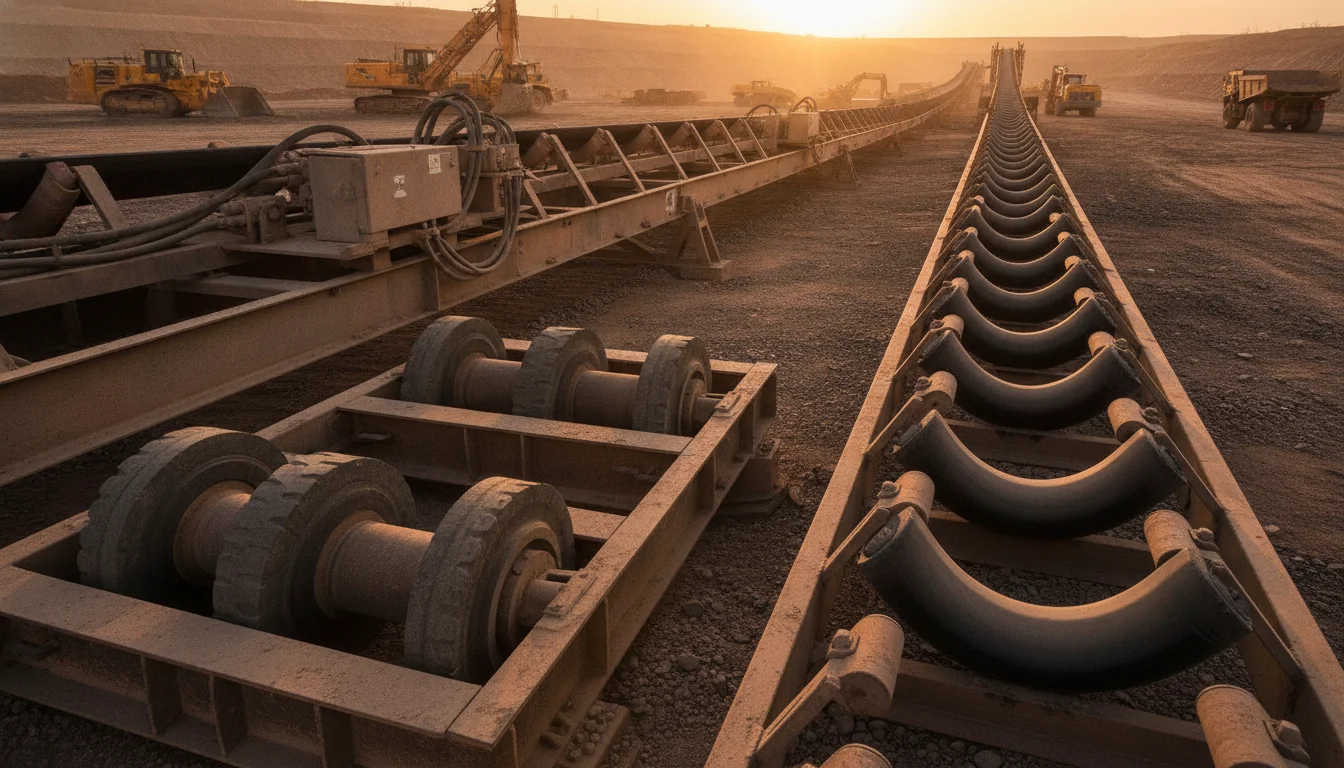
the conveyor belt rollers are not one-size-fits-all: different types solve different problems along the conveyor path. The main categories include carrying rollers, return rollers, impact rollers, guide rollers, training rollers, and specialty rollers such as spiral and disc designs.
| Roller Type | Primary Function | Common Materials | Pros | Cons / Considerations |
|---|---|---|---|---|
| Carrying / Trough | Support loaded belt and material | Steel, HDPE | High load capacity, CEMA class matched | Weight; may corrode if steel in wet service |
| Return | Support empty return belt | Steel, rubber disc, spiral | Reduces sag, self-cleaning options | Sticky material can build up if not disc/spiral |
| Impact | Absorb shock at loading points | Steel core with rubber/polyurethane discs | Protects belt and structure from impact | Higher cost; disc wear over time |
| Guide / Training | Keep belt centered | Steel, HDPE | Prevents edge damage and spillage | Requires proper alignment to be effective |
| Spiral / Self-Cleaning | Remove sticky carryback on return side | Steel spiral | Reduces material buildup | Not for extremely abrasive loads |
Carrying and Return Rollers
Carrying rollers support the belt and material on the loaded side; return rollers support the empty belt on its way back. In aggregate and hard-rock mines, carrying rollers are typically arranged in troughing sets of three or five rolls to form a deep trough. Return rollers are usually flat or crowned.
Impact, Guide, and Training Rollers
Impact rollers use multiple rubber discs mounted on a heavy-duty steel tube to dampen impact loading, as highlighted by PROK. Guide and training rollers automatically correct belt alignment to prevent spillage and edge wear. On long overland conveyors, training rollers are essential for stable tracking.
Specialty Rollers: Spiral, Polyurethane Disc, and Tapered
Spiral return rollers, also called self-cleaning rollers, clean sticky materials off the belt's return side. Polyurethane disc rollers reduce material buildup on the roller surface itself. Tapered rollers facilitate directional changes and are used in curved conveyor sections. These specialty designs cost more upfront but can cut downtime in sticky or high-wear applications.
The cheapest roller is rarely the least expensive option over a five-year lifecycle. If a seal fails early, the bearing follows, and that single failed roller can shut down an entire conveyor system. Spend on sealing and material compatibility first; recover the cost in avoided downtime.
Material Selection: Steel vs. HDPE vs. Composite
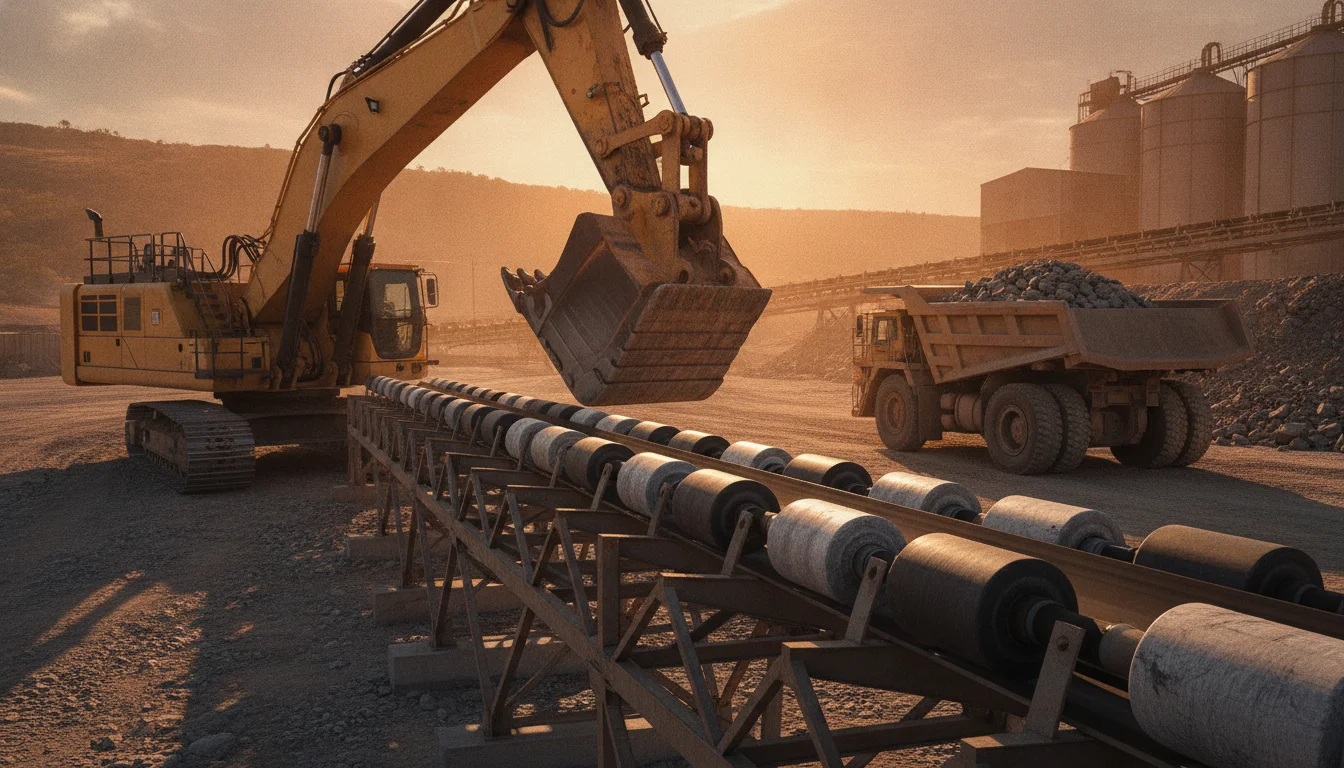
Material choice drives corrosion resistance, weight, noise, and service life for rollers. Each material has a defined operating envelope, and picking outside it shortens service life fast.
Steel Rollers: The Heavyweight Standard
Steel tube rollers remain the most common idlers found on mining conveyors because they're built for heavyweight applications, according to West River Conveyors. Steel offers high stiffness and predictable load capacity, but it's heavy: a single 1800mm roller can weigh up to 45 kilograms, making installation a two-person or mechanical-lift task.
HDPE and Composite Rollers: Lighter and Corrosion-Resistant
HDPE rollers are gaining ground in harsh, high-moisture environments because of their corrosion resistance. A polymer-based roller can weigh up to 40% less than steel, according to Flexco. That weight reduction lowers back-injury risk during changeouts, which matters most in underground mines where manual handling is routine.
Hybrid and Polyurethane Options
PROK's Hybrid Steel roller uses an electroplated galvanised steel tube paired with an advanced thermoset non-metallic bearing housing, machined to ISO 1940 G16. This hybrid build resists corrosion while maintaining bearing fit. Polyurethane disc rollers offer abrasion-resistant, hydrolytically stable discs, well suited to wet, acidic, or high-wear conditions.
What to Look For When Buying Mining Conveyor Belt Rollers
Buying the right mining conveyor means running a structured four-step check before you sign off on any quote. Skipping a step is how mismatched rollers end up on the frame.
- Step 1: Confirm CEMA class and belt width. Check the conveyor's CEMA load classification and belt width. West River Conveyors lists CEMA B through F for belt widths from 24 to 72 inches. Don't undersize a roller; an overloaded bearing is the fastest path to failure.
- Step 2: Evaluate seal and bearing quality. Flexco estimates that roughly 43% of bearing failures come from moisture and other contaminants. Look for multi-labyrinth seals, centrifugal flinger seals, and quality grease or oil cartridges. In tropical climates, a grease-type mechanism is usually preferred; in arctic climates, an oil-type mechanism often performs better.
- Step 3: Assess roller weight and handling. Compare total installed weight. Lighter HDPE or composite rollers cut manual handling injuries and speed up maintenance. A steel 1800mm roller at 45kg often needs mechanical lifting; a polymer roller at up to 40% less weight is still heavy but easier on crews.
- Step 4: Match roller type to conveyor zone. Specify carrying rollers for loaded spans, impact rollers at transfer points, return rollers below, and training rollers wherever tracking is critical. Self-cleaning options reduce carryback, spillage, and downtime.
Seal and Bearing Checklist
Before approving a quote, ask the supplier for bearing type and tolerance, seal type and IP rating, grease specification, TIR value, and a CEMA test report. Reputable manufacturers such as West River Conveyors, PROK, and Flexco publish these details. If a supplier can't provide TIR or seal test data, treat that roller as unverified.
Dimension and Shaft Matching
Roller diameter, shaft diameter, shell thickness, and bracket spacing must match the existing conveyor frame. Custom rollers are common in mining, but using offshore or generic dimensions can cause misalignment, increased vibration, and premature frame wear. Always send the conveyor serial number, existing roller drawings, or a physical sample when ordering replacements. For frame-matched components, check our parts categories before finalizing dimensions.
Matching Rollers to Your Conveyor Application and Lifecycle Costs
Price expectations for belt rollers vary widely by material, bearing class, seal design, and diameter. Suppliers generally don't publish fixed pricing because each roller gets quoted against duty cycle, length, and quantity. Use these qualitative tiers to set your budget.
Budget Tier: Standard Steel Carrying and Return Rollers
Standard steel CEMA C or D carrying and return rollers are the most economical route for dry, non-corrosive, moderate-load applications. They're widely available and easiest to source from regional distributors. This tier suits temporary conveyors, dry aggregate handling, and low-tonnage pilot plants.
Mid-Range Tier: HDPE, Composite, and Impact Rollers
HDPE and composite rollers command a moderate price premium over standard steel but reduce corrosion downtime and manual handling injuries. Impact rollers with rubber or polyurethane discs also sit in the mid-range. This tier fits wet processing, salt-laden air, underground coal, and loading zones handling lump material.
Premium Tier: Custom Engineered and Hybrid Rollers
Premium options include hybrid steel-composite rollers with ISO 1940 G16 balancing, heavy-duty CEMA E/F rollers with multi-labyrinth seals, and large-diameter polyurethane disc rollers for extreme impact. These are custom-built solutions for high-capacity overland conveyors, iron ore and copper concentrators, and sites where unscheduled downtime costs thousands per hour.
Application Scenarios
For a coal mine with high humidity and frequent washdown, HDPE return rollers with labyrinth seals and stainless steel shafts are common. For an iron ore loading point, impact rollers with polyurethane discs absorb the drop energy. For a 72-inch overland conveyor hauling copper ore, CEMA E steel carrying rollers with low TIR and centrifugal seals are standard. Match the material and roller type to the zone and the material being conveyed, not just to the initial quote.
Care and Maintenance of Mining Conveyor Belt Rollers
Mining conveyor belt rollers require more frequent maintenance than rollers in lighter industries because the weight, volume, and dust load are much higher. Regular inspection prevents catastrophic failures and extends roller life, and it's far cheaper than an unplanned belt stoppage.
Inspection Triggers
Inspect rollers immediately when you notice abnormal noise, loose conveyor rollers, running deviation, or hot bearing housings. Also check for material buildup on the shell, damaged seals, and visible shaft runout. Replace any roller that fails the spin test or shows rough rotation.
Cleaning and Lubrication
Clean rollers with dry compressed air or a stiff brush; don't pressure-wash directly into bearing housings unless the roller is IP-rated for washdown. Follow the manufacturer's lubrication schedule. In tropical climates, use a grease-type mechanism; in arctic conditions, an oil-type mechanism often performs better, as noted by TX Roller. Never mix incompatible greases.
Industry maintenance data shows that seal failure, not bearing defect, is the leading root cause behind premature roller replacement in mining service. Treat the seal as the primary wear item, and the bearing usually takes care of itself.
Storage and Handling
Store rollers horizontally on racks, off the ground, and away from direct sunlight or temperature swings. Protect machined shafts from impact. Use lifting slings or two-person lifts for heavy steel rollers. Composite rollers are lighter but still need careful handling to avoid shell damage.
Pros and Cons
Pros
- Correctly specified mining conveyor belt rollers reduce unplanned downtime and extend belt life.
- Material options (steel, HDPE, hybrid, polyurethane) let buyers match rollers precisely to environment and load.
- Standardized CEMA classes make cross-brand comparison and replacement sourcing straightforward.
- Lighter polymer options reduce manual handling injury risk during maintenance.
Cons
- Premium sealed and hybrid rollers carry a real cost premium over standard steel.
- Custom dimensions common in mining mean longer lead times if drawings aren't on hand.
- Undersizing or misapplying roller type to the wrong conveyor zone accelerates failure.
- Suppliers without published TIR or seal test data introduce quality risk into the purchase.
Frequently Asked Questions
What is a conveyor belt with rollers called?
A conveyor belt supported by rollers is typically called a belt conveyor or roller conveyor. The rollers themselves are called idlers or conveyor rollers, and the loaded-side sets are often referred to as troughing idlers.
What are mining conveyor belt rollers used for?
They support and guide the conveyor belt while it transports bulk materials such as coal, ore, sand, and gravel. Mining conveyor belt rollers minimize friction, maintain belt tracking, and absorb impact at loading points.
How many types of conveyor rollers are there?
Common mining roller types include carrying/trough, return, impact, guide, training, spiral, polyurethane disc, and tapered rollers. Each type solves a specific tracking, impact, or material buildup problem.
What is the difference between steel and HDPE rollers?
Steel rollers offer high stiffness and remain the standard for heavy loads. HDPE rollers are lighter, corrosion-resistant, and quieter, though they may have lower shell strength in extreme impact zones unless glass-reinforced.
How often should mining conveyor belt rollers be replaced?
Replacement intervals depend on load, speed, seal quality, and environment. Inspect monthly in severe service and replace any roller with rough rotation, excessive runout, damaged seals, or material buildup that can't be cleaned.
Can I use polymer rollers on an existing steel conveyor frame?
Yes, if the roller dimensions, shaft diameter, and bracket spacing match the existing frame. Many polymer rollers are drop-in replacements for steel CEMA B, C, D, or E idlers.
Choosing the right mining conveyor belt rollers comes down to seal quality, material compatibility, CEMA class, and application zone. As of 2026, buyers increasingly weigh lifecycle cost over sticker price, and that shift is pushing more mines toward HDPE and hybrid options in wet or corrosive zones. By matching roller type to each conveyor section and prioritizing life-of-system cost over initial price, mining operations reduce downtime, prevent injuries, and keep material moving. Shop OEM-quality spare parts with global 5-day delivery at 3genexport.com.