
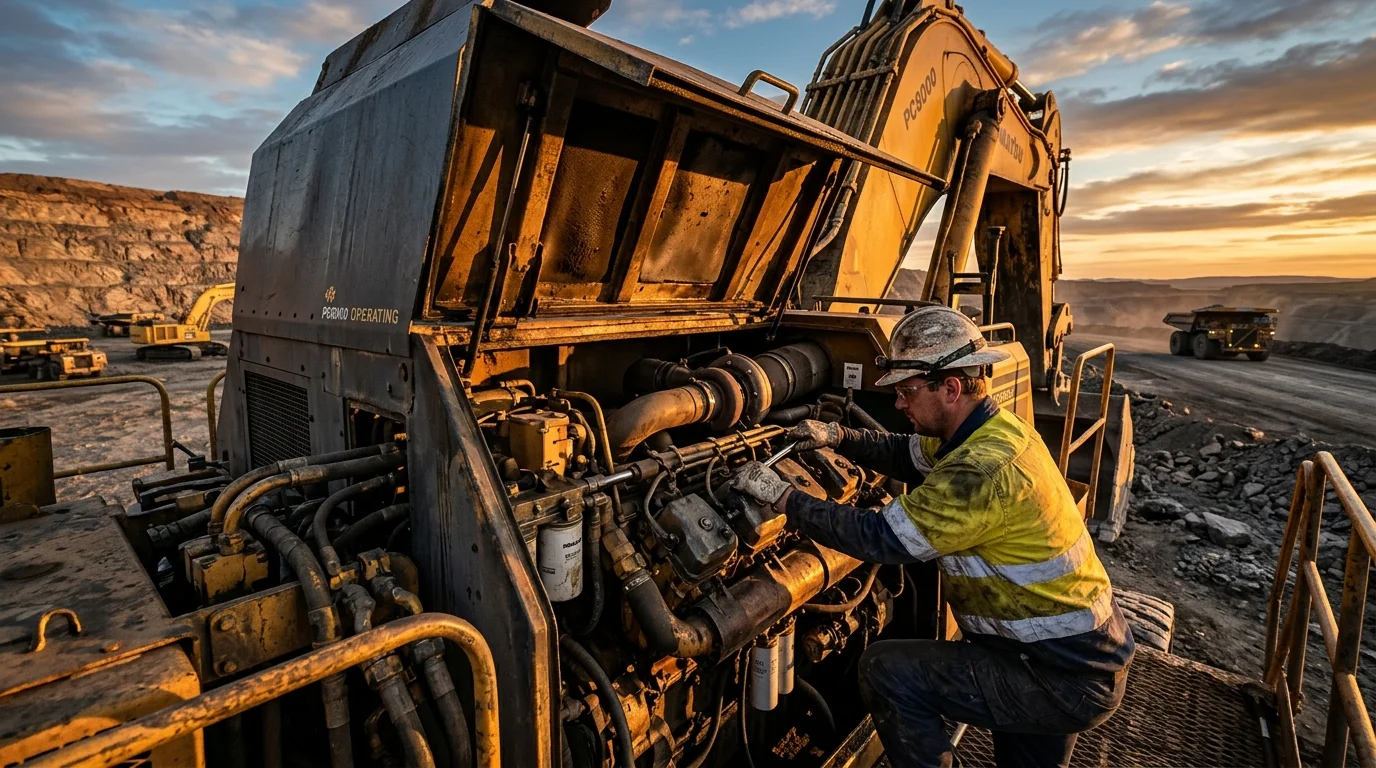
Mining Equipment Engine Parts: OEM vs Aftermarket Guide
Mining equipment engine parts replacement done right: OEM vs aftermarket, supplier selection, and maintenance tips for maximum uptime.
Loading article…
Article Not Found
The article you're looking for doesn't exist or may have been removed.
Back to BlogMining equipment engine parts replacement is the process of sourcing and installing critical engine components, including filters, injectors, gaskets, and bearings, to restore or maintain the performance of heavy mining machinery operating under extreme conditions.
Key Takeaways
- Correct part identification, including machine make, model, and serial number, prevents costly specification errors and installation delays.
- OEM, aftermarket, and rebuilt parts each serve distinct roles. Matching the right option to the application controls both cost and risk.
- Aftermarket engine parts can start around $800, while OEM equivalents often exceed $2,500. The price gap is real, but so is the performance difference on critical systems.
- Proactive maintenance, including routine inspections and documented replacement schedules, reduces unplanned shutdowns and extends equipment life.
- Supplier logistics capability, especially for remote and international sites, is as important as part quality when production is stopped.
- KMP Brand, with over 30 years of industry experience, supplies aftermarket engine components compatible with Cummins, Perkins, Caterpillar, Detroit Diesel, and Komatsu engines used across mining fleets.
Understanding Mining Equipment Engine Parts
Mining equipment engine parts are the components that keep diesel powertrains running through continuous heavy loads, abrasive dust, high heat, and relentless vibration. When one fails, the cost is rarely limited to the part itself. Downtime interrupts production, affects other machines in the fleet, and creates operational losses that dwarf the price of any single component.
Types of Engine Parts
Mining powertrains, whether in 400-ton haul trucks, hydraulic shovels, or underground loaders, share a common set of critical component categories. Each must be sourced to the correct specification for the engine series in use.
- Filters: Oil, fuel, and air filters protect critical engine internals from contamination. Correct micron rating and flow capacity matter as much as physical fit.
- Gaskets and Seals: Cylinder head gaskets, valve cover gaskets, and seal kits maintain compression and prevent fluid leaks under sustained thermal cycling.
- Fuel Injectors: Precision-crafted injectors deliver fuel efficiently into the combustion chamber. Worn injectors increase fuel consumption and emissions.
- Bearings: Crankshaft and camshaft bearings support rotating assemblies and reduce friction. Bearing failure is one of the fastest paths to catastrophic engine damage.
- Pistons and Rings: Piston kits, including rings and pin assemblies, directly affect compression, oil consumption, and power output.
- Cooling Components: Water pumps, oil coolers, and aftercoolers maintain operating temperature under continuous heavy load. Caterpillar 3500 Series engines, for example, rely on robust cooling circuits to sustain output in high-ambient mining environments.
- Turbochargers: Turbos boost power density in diesel engines. A failed turbo on a haul truck engine can take the entire machine offline within hours.
- Valvetrain Components: Camshafts, valves, and rocker assemblies control gas exchange. Worn valvetrain parts reduce efficiency and increase fuel burn.
Importance of Quality Parts
Low-quality or incorrectly specified parts create repeat failures, not one-time fixes. According to KMP Brand's engineering documentation, parts manufactured to meet or exceed OEM specifications undergo chemical analysis, mechanical analysis, and dimensional accuracy checks before release. That level of verification matters when an engine is running 20-hour shifts in a remote open-cut mine.
Using substandard components leads to:
- Increased unplanned shutdowns from premature part failure.
- Higher total maintenance costs over the equipment lifecycle.
- Safety risks for operators when critical systems fail unexpectedly.
- Warranty complications on newer equipment.
"In mining, the lowest price is not always the lowest cost. Reliable parts help protect both production and equipment life." - Millennium Machinery, Mining Replacement Parts Guide
What to Look For When Buying Mining Equipment Parts
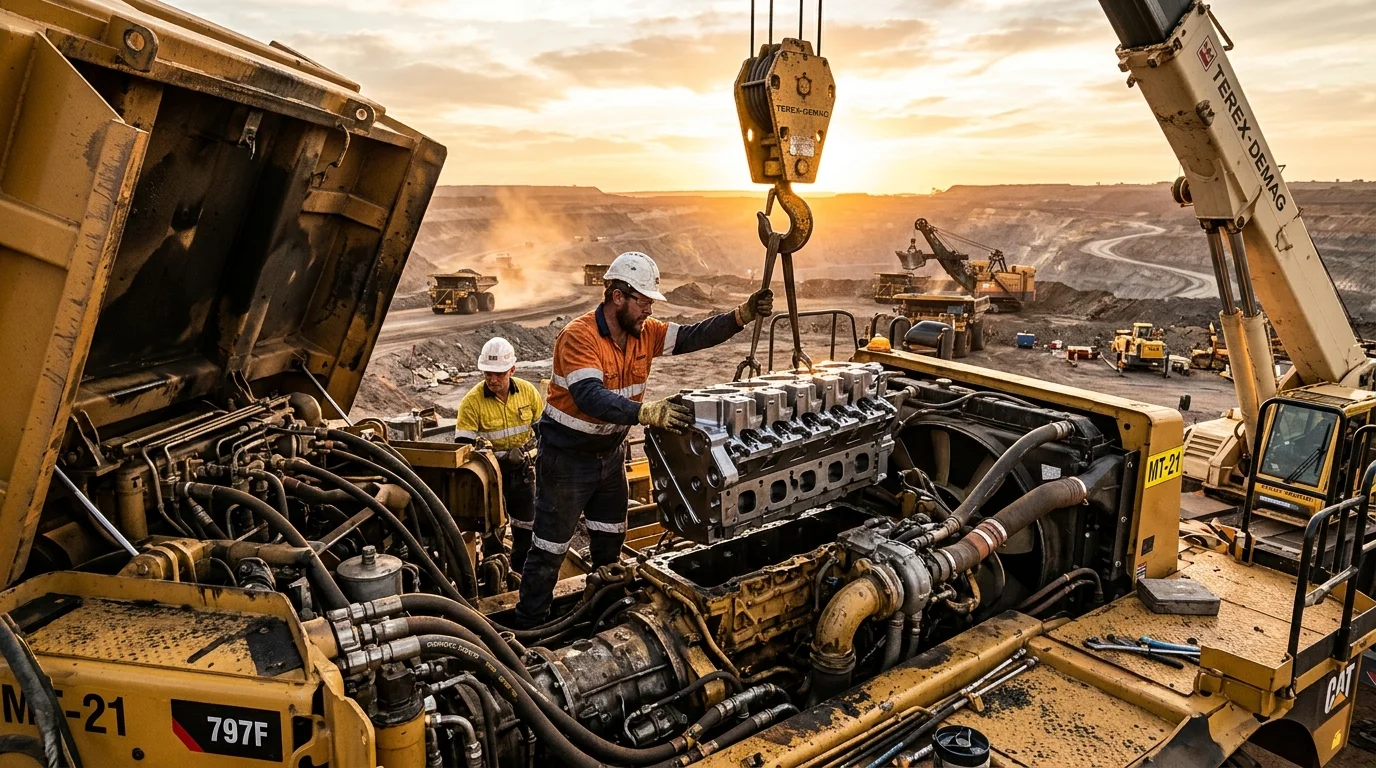
Sourcing the right part starts with the right information, not the right price. Every specification error adds delay, and delay costs production.
Correct Fit and Compatibility
Before requesting a quote, confirm the following for every order:
- Machine make and model
- Equipment serial number
- Existing part number or OEM reference
- Engine series (for example, Caterpillar C15, Cummins QSX, or Komatsu SAA6D engine families)
- Application and duty cycle, including any previous modifications
Even small specification errors can create major delays. As Millennium Machinery notes in their procurement guidance, a single wrong digit in a part number can result in the wrong component arriving at a remote site, adding days to an already costly shutdown.
Material and Durability
Mining equipment operates in conditions that destroy standard industrial components quickly. Parts must be built for:
- Sustained high temperatures in enclosed engine bays.
- Abrasive dust and particulate ingestion.
- Continuous vibration and impact loading.
- Long operating hours between scheduled service intervals.
Supplier Reliability and Logistics
A capable supplier does more than ship boxes. For remote and international mining operations, logistics support is as critical as part quality. Look for suppliers that offer:
- Fast quotations with clear lead times.
- Stocked inventory for urgent needs, not just sourcing on demand.
- Technical support for part identification and cross-referencing.
- Export documentation, consolidated shipments, and customs preparation for multi-country deliveries.
OEM vs Aftermarket vs Rebuilt Parts
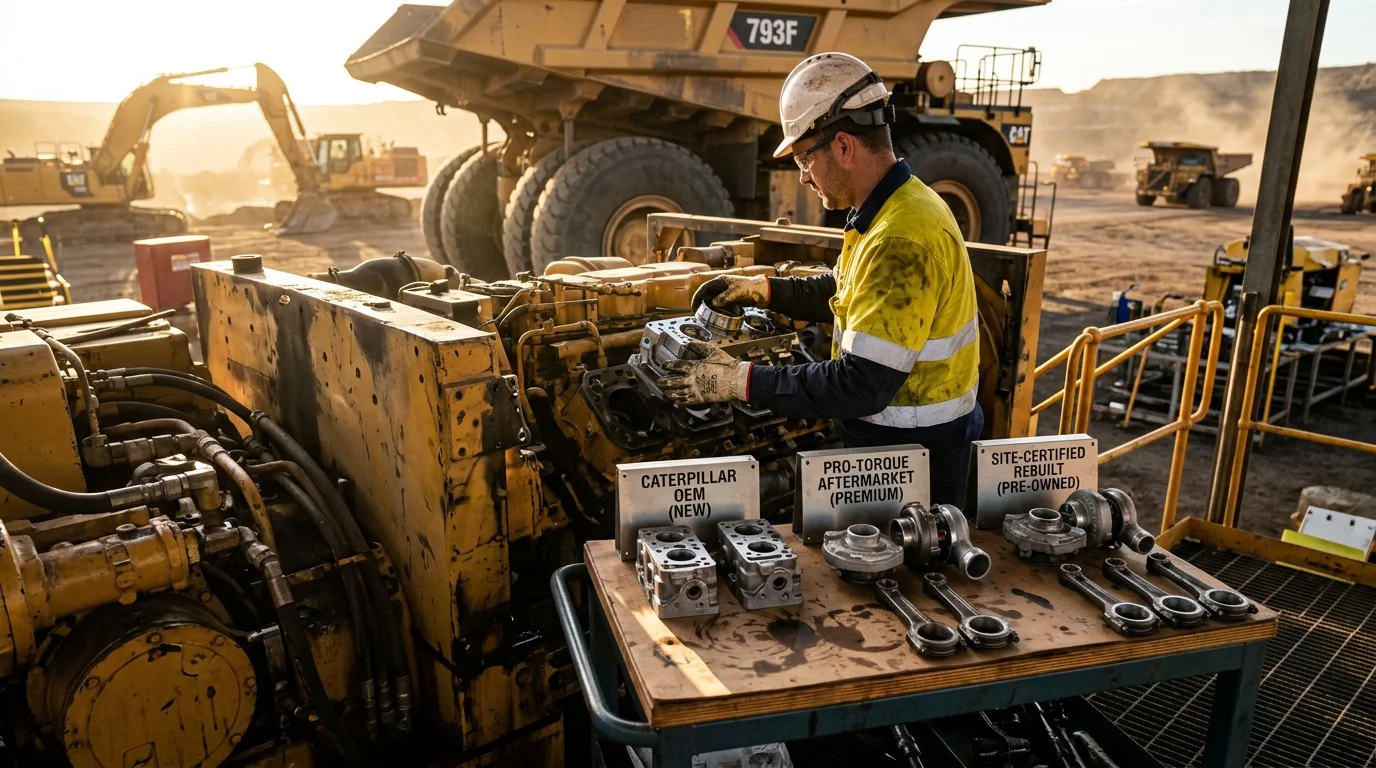
Choosing between OEM, aftermarket, and rebuilt components is a procurement decision that affects both budget and risk. Each option has a defined role in a well-managed maintenance program.
OEM Parts
OEM (Original Equipment Manufacturer) parts are produced by or to the exact specification of the equipment manufacturer. They are the right choice for:
- Critical systems where exact fit and tolerances are non-negotiable.
- Equipment still under manufacturer warranty.
- High-value machines where a second failure would be catastrophic.
OEM parts typically carry a higher price point. Based on competitor market data, OEM engine components often exceed $2,500 per unit for major assemblies.
Aftermarket Parts
Aftermarket parts are produced by third-party manufacturers to meet or exceed OEM specifications. Suppliers like KMP Brand, with over 30 years of experience, use ISO-certified quality control, including dimensional accuracy checks and materials testing, to validate their components against OEM standards.
Aftermarket parts are well-suited for:
- Common wear items such as filters, belts, seals, and bearings.
- Non-critical systems where cost control matters.
- Situations requiring fast availability when OEM lead times are too long.
Aftermarket engine parts can start around $800, making them a practical option for high-volume wear items across large fleets.
Rebuilt Components
Rebuilt or remanufactured parts are refurbished to original specifications. They are best applied to:
- Major assemblies with significant rebuild value, such as cylinder heads, turbochargers, and fuel injection pumps.
- Budget-constrained operations where new unit costs are prohibitive.
- Sustainable maintenance programs focused on reducing waste and extending component life.
Pros and Cons of Aftermarket Mining Engine Parts
Aftermarket parts dominate procurement decisions for most mining fleets. Understanding the trade-offs helps procurement managers make the right call for each application.
Pros
- Lower unit cost: Aftermarket engine parts typically start around $800, compared to OEM equivalents that often exceed $2,500 for major components.
- Faster availability: Aftermarket suppliers often carry broader stocked inventory, reducing lead times for common wear items.
- Wide brand compatibility: Quality aftermarket suppliers cover Caterpillar, Komatsu, Cummins, Perkins, and Detroit Diesel engines from a single source.
- OEM-equivalent quality: ISO-certified manufacturers like KMP Brand apply chemical, mechanical, and dimensional analysis to validate parts against OEM standards.
- Flexibility for older equipment: OEM parts for older engine series can be discontinued. Aftermarket suppliers often continue to stock these components.
Cons
- Variable quality across suppliers: Not all aftermarket manufacturers apply the same testing standards. Sourcing from unverified suppliers carries real risk.
- Warranty implications: Using non-OEM parts on equipment still under manufacturer warranty can complicate or void coverage.
- Fit tolerance variation: On precision-critical systems, aftermarket tolerances may not match OEM specifications exactly, particularly on older or less common engine families.
- Requires supplier vetting: Procurement teams must verify certifications, cross-references, and field performance data before committing to a new aftermarket source.
Care and Maintenance of Mining Equipment Parts
Proactive maintenance is the most cost-effective strategy for managing mining engine components. Reactive replacement, waiting until something fails, consistently costs more in both parts and lost production.
Routine Inspections
Conduct scheduled inspections of engine components to catch wear before it becomes failure. Per manufacturer service bulletins and industry maintenance practice, inspections should cover:
- Oil and coolant levels, including contamination checks.
- Filter condition and replacement intervals.
- Gasket and seal integrity, particularly around cylinder heads and oil pans.
- Turbocharger shaft play and bearing condition.
Timely Replacement
Replace worn or degraded parts before they cause secondary damage. The components most commonly driving unplanned shutdowns in mining engines include:
- Fuel and oil filters (high replacement frequency, low unit cost, high consequence if neglected).
- Belts, hoses, and tensioners.
- Bearings and crankshaft seals.
- Injector tips and fuel system components.
Documentation and Compliance
Maintain complete records of all maintenance activities, part numbers used, and replacement dates. Mining operations are subject to strict safety and environmental regulations, and documented maintenance histories support both compliance audits and warranty claims. They also give maintenance supervisors the data needed to identify recurring failure patterns before they escalate.
Brand Compatibility: Which Engines Do These Parts Fit?
Brand compatibility is the first filter in any parts procurement decision. The major engine families powering mining equipment globally include Caterpillar, Cummins, Komatsu, Perkins, Detroit Diesel, and Volvo Penta. Each has distinct part numbering systems and specification requirements.
For Caterpillar engines specifically, the C-Series (C6.4 through C32) and the legacy 3000, 3100, 3200, 3300, 3400, and 3500 Series cover the majority of the active mining fleet. IPD Parts, for example, stocks cylinder kits, engine bearings, gasket sets, valvetrain components, and oil pump assemblies across this full range, including the Caterpillar 3500 Series and C27 engines commonly found in large haul trucks and shovels.
For Cummins-powered equipment, the QSX and K Series engines are the most common in heavy mining applications. Komatsu SAA-series engines power much of the Komatsu haul truck and excavator fleet. Confirming the exact engine serial number before ordering is the only reliable way to ensure correct fitment across these families.
"KMP Brand supplies high-performance aftermarket engine components compatible with Cummins, Perkins, Caterpillar, Detroit Diesel and Komatsu engines, manufactured to meet or exceed OEM specifications and rigorously tested to perform in some of the toughest environments on earth." - KMP Brand, Mining Machinery Engine Parts
Comparison of Top Mining Equipment Engine Parts Suppliers
Selecting the right supplier depends on your fleet's engine brands, geographic location, and urgency requirements. The table below compares the key characteristics of suppliers active in this market.
| Supplier | Part Types Offered | Engine Brand Coverage | Delivery Capability | Support Services |
|---|---|---|---|---|
| KMP Brand | Aftermarket engine parts (OEM-spec) | Caterpillar, Cummins, Perkins, Komatsu, Detroit Diesel | Global distribution hubs in Europe, USA, and Far East | Technical support, part identification, cross-referencing |
| DMC Wear Parts | Aftermarket wear and undercarriage parts | Multiple brands including Sandvik-compatible GET | Standard and urgent shipping options | Wear parts specialists, expert consultation |
| Millennium Machinery | OEM, aftermarket, and rebuilt components | Mining, quarrying, and heavy industrial equipment | Export documentation and multi-country logistics | Technical assistance, troubleshooting, installation guidance |
| IPD Parts | Cylinder kits, gasket sets, bearings, valvetrain, oil pumps | Caterpillar (C-Series and 3000-3500 Series), Cummins | Ready-to-ship stocked inventory | Part number cross-referencing, application support |
| 3GEN Export | OEM-quality engine and powertrain parts | Caterpillar, Komatsu, Volvo, Atlas Copco, and 40+ brands | Global 5-day delivery | B2B procurement support, fast quotation, technical verification |
Frequently Asked Questions
Where can I buy mining equipment engine parts online?
You can source mining engine components from OEM distributors, ISO-certified aftermarket suppliers, and specialized B2B exporters like 3GEN Export. Always confirm the machine make, model, serial number, and engine series before ordering. A reputable supplier will cross-reference your part number and confirm compatibility before shipment.
What are the benefits of using OEM parts for mining equipment?
OEM parts are manufactured to the exact tolerances specified for your engine, ensuring correct fit and maintaining manufacturer warranty coverage. They are the preferred choice for critical systems and high-value equipment where a second failure would cause significant production loss.
How do I verify that an aftermarket part meets OEM standards?
Look for suppliers that apply ISO-certified quality control, including dimensional accuracy checks, chemical analysis, and mechanical testing. KMP Brand, for example, uses strict reverse engineering methods and technical laboratory analysis to validate components against OEM specifications. Ask for test documentation before committing to a new supplier.
What should I do if my mining equipment engine is down?
Contact a trusted supplier immediately with the machine make, model, serial number, and engine series ready. A capable supplier will provide a fast quotation, confirm part availability, and arrange urgent shipping. For international and remote sites, confirm that the supplier can handle export documentation and customs preparation.
How can I extend the service life of mining engine components?
Follow manufacturer-recommended service intervals, use parts that meet OEM specifications, and maintain complete maintenance records. Routine inspections of filters, seals, bearings, and cooling components catch wear early, before minor degradation becomes a catastrophic failure. Documented maintenance histories also support compliance with mining safety regulations.
What is the cost difference between OEM and aftermarket mining engine parts?
Based on market data, aftermarket engine parts can start around $800 for common wear components, while OEM equivalents for major assemblies often exceed $2,500. The right choice depends on the criticality of the system, the equipment's warranty status, and the availability of verified aftermarket alternatives for your specific engine family.