

Mining Equipment Maintenance Parts Checklist 2026
Your mining equipment maintenance parts checklist for 2026: filters, hoses, wear parts, and compliance tips to cut downtime and protect your fleet.
Loading article…
Article Not Found
The article you're looking for doesn't exist or may have been removed.
Back to BlogMining equipment maintenance parts checklist is a structured inventory of components, including filters, hoses, wear items, and fluids, that require scheduled inspection and replacement. It enables mining operations to preempt failures, manage spare parts efficiently, and maintain safety compliance.
Key Takeaways
- A parts-focused checklist connects daily inspections to spare parts inventory, reducing unplanned downtime.
- Regular use of a parts checklist extends equipment life and supports adherence to MSHA and ISO 55001 standards.
- Digital checklist platforms like Limble, Alpha Software, and MapTrack automate data capture and parts reordering.
- Tailoring checklists to machine-specific wear patterns and site conditions maximizes effectiveness.
- Fire suppression and brake checks carry the highest weight in any mining inspection because the consequences of failure in a pit are severe.
- Linking each checklist item to an OEM part number and current stock level closes the loop between maintenance execution and procurement.
The Critical Role of a Mining Equipment Maintenance Parts Checklist
A well-structured this type of checklist is the operational bridge between preventive maintenance strategy and on-the-ground execution. It itemizes the specific components that must be checked, replaced, or serviced at defined intervals, giving maintenance teams a repeatable, auditable process rather than a set of informal habits.
Why Parts-Focused Checklists Prevent Downtime
According to the maintenance experts at Limble, mining equipment operates in harsh, hazardous environments that accelerate wear and tear, leading to sudden breakdowns if components are not monitored. A parts checklist helps maintenance teams systematically inspect drill bits, hydraulic hoses, and conveyor belts: components prone to gradual degradation. By catching wear early, operators can schedule replacements during planned downtime rather than reacting to catastrophic failures. This proactive approach reduces overall maintenance costs and keeps production targets on track.
A parts checklist also enables better inventory control. When a checklist specifies a part number and replacement interval, the warehouse can stock the exact spares needed, avoiding both overstocking and stockouts. This integration of maintenance tasks with parts management is the foundation of modern mining reliability.
Connecting Maintenance to Spare Parts Management
The relationship between maintenance checklists and parts inventory is direct and practical. A detailed this kind of parts checklist includes not only what to inspect but also which replacement parts are required. For instance, when a monthly inspection calls for changing hydraulic filters, the checklist can reference the OEM part number and the current stock level. This approach, supported by platforms like the HVI App, ensures that the right parts are available when needed, minimizing equipment downtime.
Industrial fabrication services, as noted by MM Fabrications, also play a role when standard parts need reinforcement or customization. Including notes on custom fabrications in the checklist ensures that any modifications are tracked and replicated accurately during rebuilds.
Compliance and Safety Standards
Mining operations are subject to stringent safety regulations. The Mine Safety and Health Administration (MSHA) and international standards like ISO 55001 mandate documented maintenance processes. A parts checklist provides a clear audit trail, demonstrating that critical components such as fire suppression systems, ROPS (Roll-Over Protective Structures), and braking systems are regularly inspected. As MapTrack's updated June 2026 template notes, fire suppression and brake checks are weighted heavily because the consequences of failure in a pit are severe. A dated inspection trail is evidence of a controlled process for mining regulation, WHS, and ISO 55001 compliance.
Key Equipment Categories and Their Parts Checklist
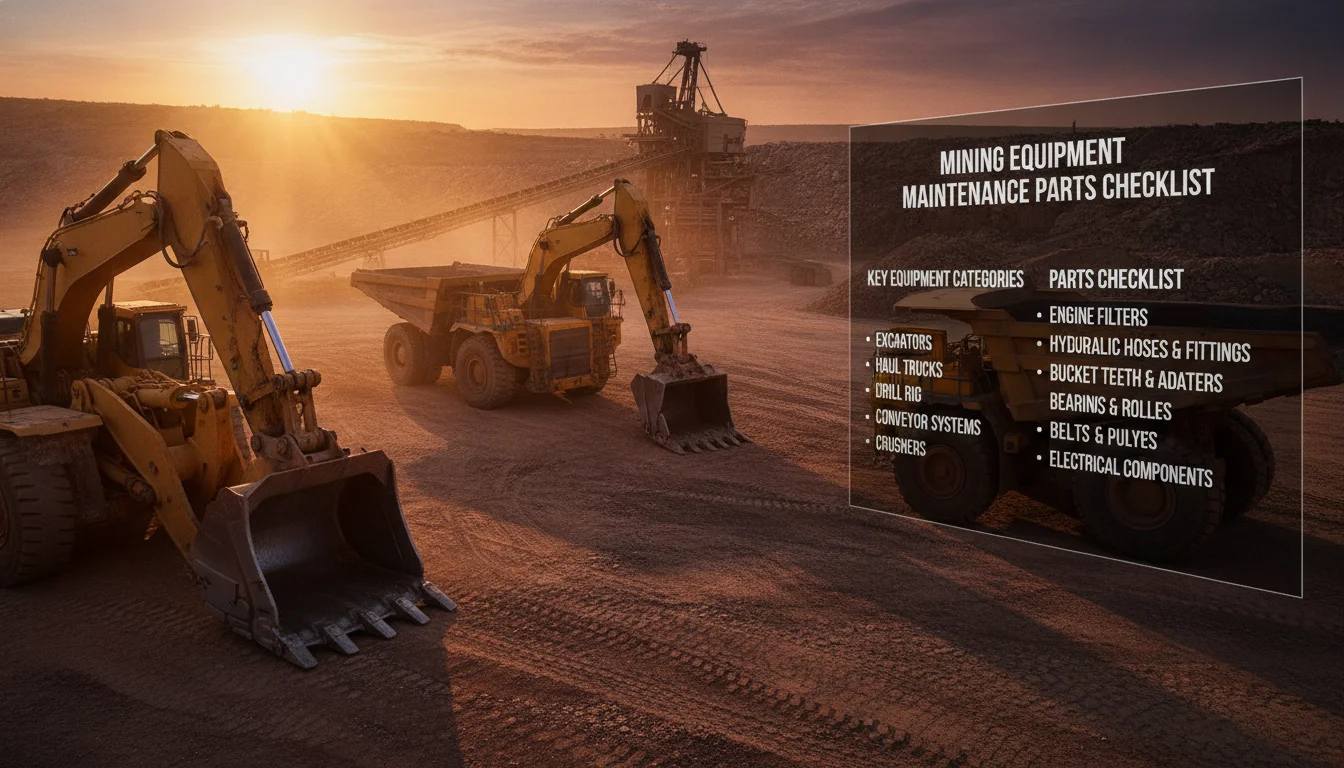
Mining fleets are diverse, and each machine type has unique parts that demand attention. A generic checklist is insufficient. Tailored lists must address the specific wear patterns and failure modes of each equipment category.
Excavators: Hydraulics, Undercarriage, and Attachments
Excavators are workhorses in mining, and their hydraulic systems are particularly vulnerable. The parts checklist for excavators should include:
- Hydraulic oil and filter inspection, checking for contamination and viscosity breakdown.
- Hoses and fittings for leaks, cracks, or bulges, with a focus on high-pressure lines.
- Boom, arm, and bucket pins and bushings for wear.
- Undercarriage components: track tension, roller wear, and idler condition.
- Electrical connections to control modules and sensors.
According to Limble's equipment guide, boom and arm inspections for cracks and weld integrity are essential, along with electrical system testing for battery and control panel functionality. By integrating these checkpoints with part numbers, maintenance planners can ensure that replacement hoses and seals are always on hand.
Haul Trucks: Tires, Brakes, and Engine Components
Haul trucks carry immense loads over rough terrain, making tires and brakes critical safety items. The parts checklist for haul trucks should cover:
- Tire tread depth and inflation, with triggers for retreading or replacement.
- Engine oil and filters, including air and fuel filters, per the service schedule.
- Brake pads, discs, and hydraulic fluid levels; brake testing should be documented.
- Suspension components, including shock absorbers and struts.
- Fuel and coolant levels, battery condition and charging systems, hour meter and service interval tracking, and exhaust system integrity, as recommended by Alpha Software's checklist template.
Alpha Software's guide highlights that a complete haul truck checklist creates a comprehensive view of vehicle health across every shift, not just at scheduled service intervals.
Drilling Rigs and Crushers: Wear Parts and Precision Components
Drilling rigs and crushers endure extreme mechanical stress, and their parts wear out rapidly. The the equipment maintenance parts checklist for these machines emphasizes:
- Drill bits and cutting teeth for abrasion and breakage.
- Hydraulic fluids and filters, with fluid analysis to predict pump failure.
- Crusher jaws, cones, and mantles for wear and alignment.
- Drive belts and gears, checking for cracking or slippage.
- Bearings and seals, lubricated to prevent contamination ingress.
Komplet America's crusher maintenance guide underscores the importance of jaw and cone inspections for wear and alignment, as well as drive system checks for belts and gears. Meanwhile, the CDC's Maintainability Design Checklist offers a framework for ensuring that parts are easily accessible for replacement, reducing labor hours. The CDC document specifically notes that operators can insert performance criteria for replacement tasks, for example setting a target that hydraulic lines on shuttle cars should be replaceable within 15 to 25 minutes, and embedding those targets directly in the checklist.
Conveyor Systems: Belts, Rollers, and Bearings
Conveyor systems are often overlooked in parts checklists, yet a single failed belt or seized roller can halt an entire processing circuit. Per Limble's equipment guide, conveyor maintenance should include:
- Belt inspections for wear, alignment, and proper tension.
- Roller and pulley checks for smooth operation.
- Electrical system evaluations for motor and drive functionality.
- Bearing checks for cracks and adequate lubrication.
Including conveyor components in your checklist closes a gap that many operations leave open until a costly stoppage forces the issue.
Building Your Mining Equipment Maintenance Parts Checklist: A Step-by-Step Guide
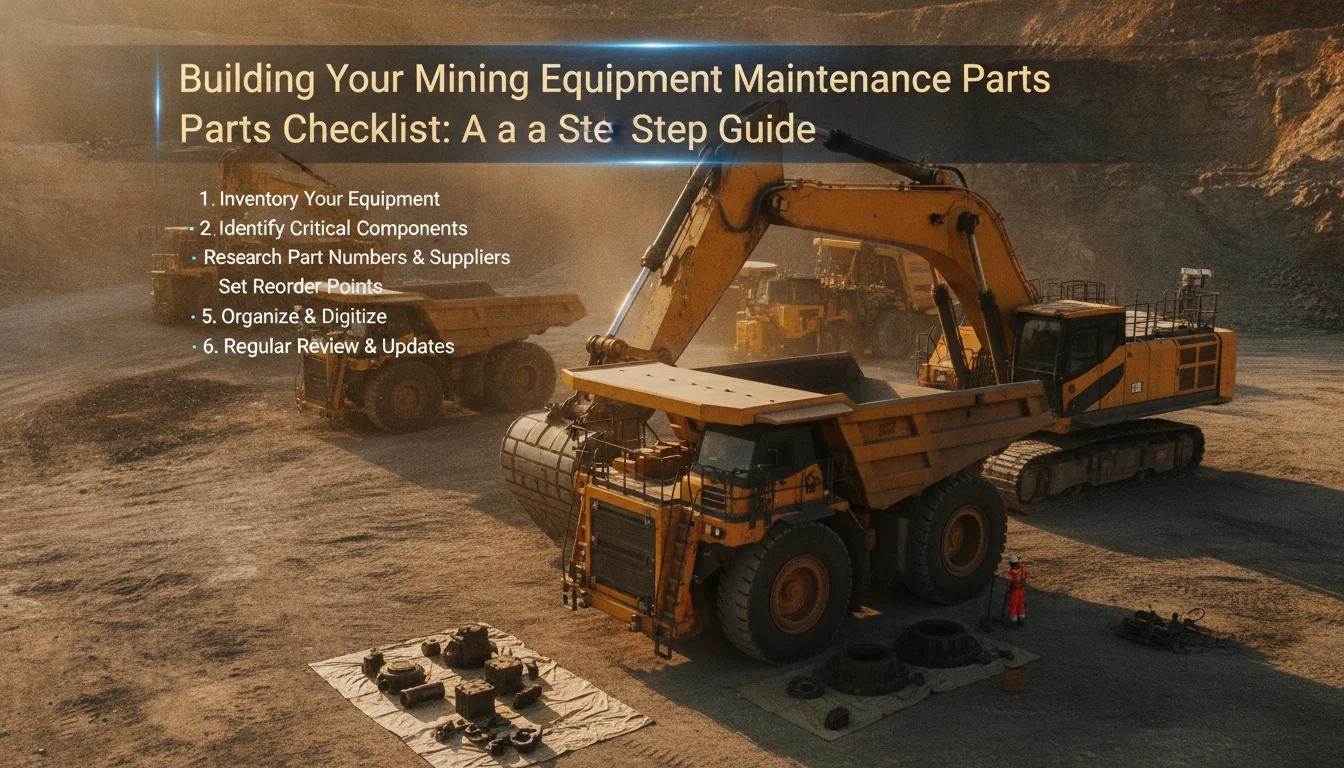
Creating an effective mining equipment is not a one-time task. It requires iteration and data-driven refinement. Following a structured process ensures the checklist is comprehensive, practical, and aligned with operational goals.
Step 1: Identify Critical Equipment and Failure Modes
Begin by cataloguing all major asset classes: excavators, haul trucks, drills, crushers, conveyors. Document their known failure modes using OEM manuals, historical maintenance data, and operator feedback. The CDC's Maintainability Design Checklist suggests categorizing maintenance points into primary, secondary, and tertiary zones based on accessibility, which directly influences inspection frequency and method. Understanding how each component fails, whether through hose abrasion, bearing seizure, or seal degradation, lets you list the specific parts that need monitoring.
Step 2: List Parts by Maintenance Interval (Daily to Annual)
Structure the checklist around inspection and replacement intervals. As outlined by MM Fabrications, a layered approach works well:
- Daily: Visible checks for leaks, tire condition, fluid levels, brake function.
- Weekly: Air filter cleaning, emergency system tests, lubrication of moving parts.
- Monthly: Engine diagnostics, hydraulic fluid sampling, replacement of worn hoses and belts.
- Quarterly: Structural inspections, electrical system tests, custom fabrication integrity.
- Annual: Complete teardown, rebuild, and parts upgrades per the latest standards.
For each interval, list the exact parts to inspect or replace, along with their OEM part numbers. This mining equipment maintenance parts checklist becomes a dynamic document that evolves with machine usage and site conditions.
Step 3: Integrate Inventory Levels and Supplier Data
Link each part on the checklist to your inventory management software. When a technician checks off a part that needs replacement, the system can trigger a purchase order if stock is low. Platforms like MapTrack and Limble offer CMMS capabilities that automate this process, ensuring critical spares are always available. Include supplier contact information and lead times in the checklist notes to streamline procurement, particularly for parts sourced internationally.
"Without proper mining asset maintenance, complex and costly critical assets like drills, excavators, crushers, and haul trucks may be prone to frequent breakdowns, heightened safety risks, prolonged downtime, wasted resources, and shorter lifespans." - Limble CMMS, Mining Equipment Maintenance Guide, March 2026
Comparison Table: Top Mining Equipment Maintenance Checklist Providers
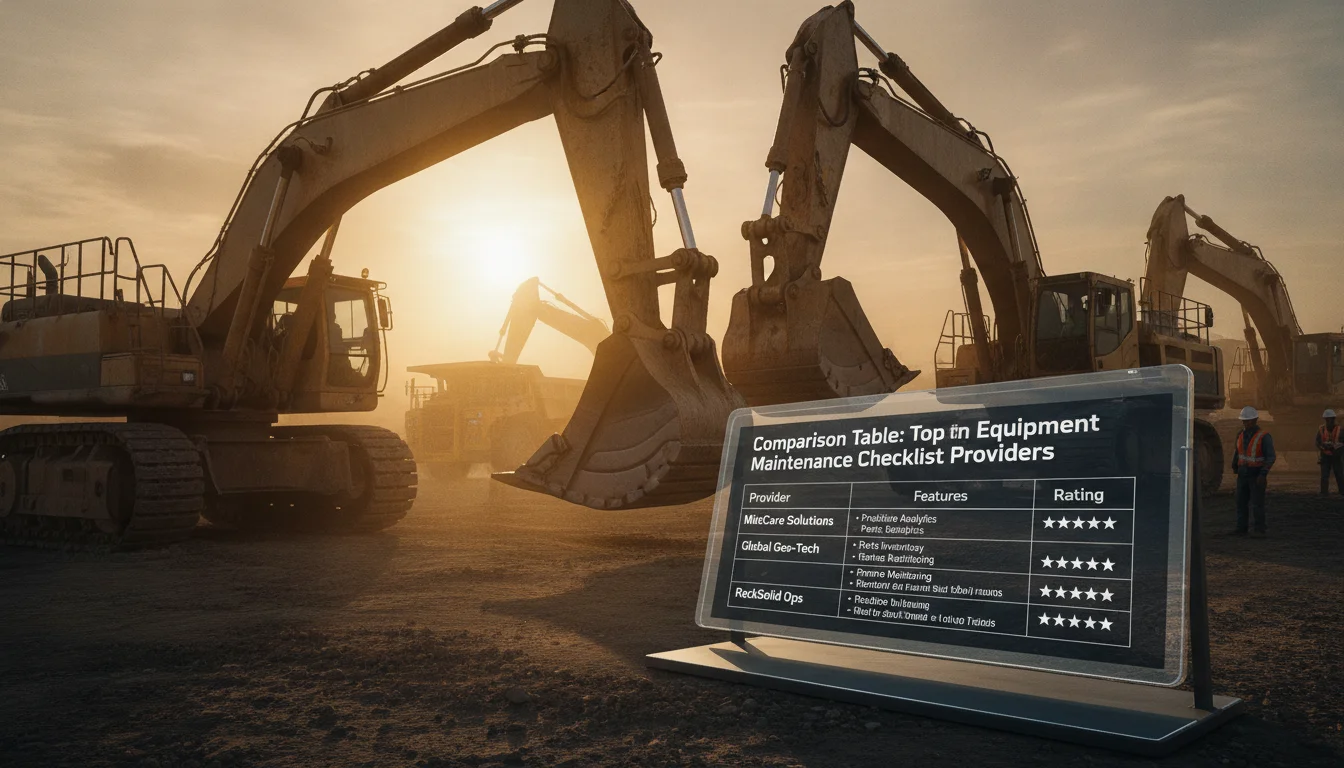
Several software platforms and template providers have emerged to digitize and simplify the mining equipment maintenance parts checklist process. The table below compares key options based on template availability, digital features, and suitability for mining operations.
| Provider | Checklist Format | Key Features | Best For |
|---|---|---|---|
| Limble CMMS | Customizable digital checklists | Mobile inspections, work order linking, inventory tracking, compliance reporting | Mines needing full CMMS integration |
| Alpha TransForm | Free PDF templates + mobile app | Digital form builder, offline data capture, photo attachments, automated alerts | Operations seeking template-based digitization |
| MapTrack | Ready-to-use PDF and mobile checklist | ROPS/FOPS checks, fire suppression, GET monitoring, audit trail generation | Mines prioritizing compliance and heavy plant inspections |
| HVI App | Comprehensive inspection checklists | Preventive maintenance scheduling, parts inventory control, cost analysis, telematics integration | Fleets focused on preventive and predictive maintenance |
Each platform offers distinct benefits. Selecting one depends on the mine's size, existing IT infrastructure, and specific compliance requirements. The common thread is the ability to convert a static parts checklist into a dynamic tool that feeds real-time data into maintenance management.
Pros and Cons of Using a Formal Mining Equipment Maintenance Parts Checklist
Pros
- Reduces unplanned downtime by catching wear before it becomes failure.
- Creates a dated audit trail that satisfies MSHA, ISO 55001, and WHS requirements.
- Connects maintenance tasks directly to parts inventory, eliminating stockouts on critical spares.
- Standardizes inspection quality across shifts and technicians, reducing human error.
- Supports parts kitting and pre-planned service events, cutting labor hours per repair.
Cons
- A poorly designed checklist can become a box-ticking exercise rather than a genuine reliability tool.
- Initial setup requires significant time investment to map OEM part numbers to each inspection point.
- Digital platforms require operator training and reliable connectivity, which can be a challenge at remote mine sites.
- Checklists that are not regularly revised can fall out of sync with actual equipment condition and site changes.
Integrating Predictive and Preventive Maintenance into Your Parts Checklist
Modern mining maintenance extends beyond fixed schedules. It incorporates condition-based triggers to optimize parts replacement and reduce unnecessary servicing costs.
Predictive Maintenance Technologies and Parts Forecasting
Oil analysis, vibration monitoring, and thermal imaging can detect early signs of component degradation. A sudden spike in metal particles in hydraulic oil, for example, suggests pump wear, prompting an early filter and pump seal replacement before a full failure occurs. The HVI App's platform emphasizes using real-time data to prevent breakdowns. Integrating these condition indicators into the mining equipment maintenance parts checklist means parts are ordered before failure occurs, eliminating emergency shipments and the premium costs that come with them.
Preventive Maintenance Scheduling and Parts Kitting
Preventive maintenance (PM) remains the backbone of mining reliability. A mature PM program, as described by Limble, involves scheduling regular parts replacements based on OEM recommendations, even if components appear functional. To streamline this, many mines adopt parts kitting: gathering all necessary components (filters, gaskets, bolts) into a single kit for a specific service task. The checklist specifies the exact kit contents so technicians can prepare in advance, reducing the time a machine sits open waiting for parts.
Using CMMS for Automated Parts Reordering
Computerized maintenance management systems like Limble or MapTrack can automate the reordering of parts tied to checklist items. When a technician logs that a filter has been replaced, the CMMS decrements the inventory count and, if stock falls below the minimum threshold, generates a purchase requisition automatically. This closed-loop process ensures that the mining equipment maintenance parts checklist is not just a paper exercise but a live element of the supply chain.
Common Parts Failure Points and How to Detect Them Early
Understanding where failures most often occur lets maintenance teams weight their checklist appropriately. Industry experience and published maintenance guides highlight several recurring problem areas.
Wear and Tear: Filters, Hoses, and Belts
Filters are the first line of defense against contamination. Clogged air or fuel filters force engines to work harder, reducing efficiency and increasing fuel consumption. Hoses in hydraulic systems can develop pin-hole leaks or cracks from vibration and UV exposure. According to MM Fabrications, routine visual inspections of hoses and cleaning or replacing air filters are essential weekly tasks. Your mining equipment maintenance parts checklist should specify the exact filter part numbers and replacement intervals, and flag any environmental factors, such as high dust levels, that may shorten those intervals.
Hydraulic Systems: Seals, Pumps, and Contamination
Hydraulic systems are the circulatory system of mining equipment. A single leak can lead to oil loss, pressure drops, and catastrophic pump failure. The checklist must include seals, O-rings, and wiper seals for regular replacement. Fluid sampling can detect water ingress or particulate contamination before it causes damage. The CDC's Maintainability Design Checklist recommends that all hydraulic lines be easily accessible for replacement, and operators can set specific time targets for line replacement tasks to minimize downtime. This accessibility consideration should feed into checklist design, flagging any parts that require special tools or extended labor.
"Checking fluid condition, filters, and seals is a key part of any maintenance readiness checklist. Contaminated fluids and small leaks can quickly turn into overheating and component damage." - AMAC Company, Maintenance Readiness Checklist Guide
Electrical and Control System Parts
Modern mining equipment relies increasingly on electronic controls, sensors, and automation. Corroded connectors, chafed wiring, or faulty sensors can cause intermittent faults that are difficult to diagnose. The checklist should include visual inspections of cable harnesses, battery terminals, and ground connections. Alpha Software's checklist template identifies battery condition and charging systems as critical checkpoints. Aftermarket telematics devices may also be added to the checklist if they require periodic battery changes or antenna checks.
Underground Equipment: Additional Challenges
Underground mining equipment faces conditions that surface machines do not. Moisture-rich environments accelerate corrosion on electrical connectors and structural welds. Confined spaces make access to maintenance zones harder, which is precisely why the CDC's maintainability framework categorizes components by accessibility zone. As AMAC's spring maintenance guide notes, seals loosen, hoses crack, and fittings vibrate loose after months of hard use in underground conditions. A checklist designed for underground equipment should weight corrosion checks, ventilation system filters, and confined-space access procedures more heavily than a surface-fleet checklist would.
Industry Best Practices and Standards for Parts Maintenance
Mining companies can draw on established guidelines and regulations to design their maintenance parts checklist. Adhering to these best practices improves reliability and demonstrates due diligence to regulators.
CDC Maintainability Design Guidelines
The CDC's Maintainability Design Checklist for coal mining equipment provides a detailed framework for ensuring that parts are accessible and replaceable. It categorizes maintenance zones and defines criteria for immediate accessibility: a component is considered immediately accessible if it can be reached, removed, or repaired without opening access covers or disassembling other components. The checklist covers 14 categories, including hydraulic system maintenance design, electrical system maintenance design, mechanical system maintenance design, and safety and environmental system design features. Mine operators can use this framework to evaluate whether OEM equipment meets maintainability standards before purchase.
ISO 55001 and Mine Safety Regulations
ISO 55001 specifies requirements for an asset management system, including the need for documented maintenance plans and spare parts strategies. A mining equipment maintenance parts checklist serves as a key record within such a system. MSHA regulations require that safety-critical components, including fire suppression systems and ROPS, be inspected at regular intervals. MapTrack's checklist template explicitly includes ROPS, FOPS, dust control, braking, isolation, and GET wear tracking, ensuring that inspections are recorded and retrievable for audits.
Adapting Checklists to Site-Specific Conditions
No two mines are identical. Climate, altitude, material abrasiveness, and shift patterns all influence parts wear rates. The checklist should be a living document, revised based on failure analysis and operator feedback. A mine in a high-humidity tropical region may need more frequent checks for corrosion and electrical faults, while a high-desert operation might prioritize dust-related filter changes. AMAC's spring maintenance readiness guide underscores the importance of seasonal adjustments, such as inspecting seals and drivetrains after winter. Incorporating seasonal checks into the mining equipment maintenance parts checklist ensures it stays relevant year-round.
Sourcing OEM-Quality Spare Parts for Your Checklist
A checklist is only as good as the parts it calls for. Specifying OEM-standard components for every inspection interval is the single most effective way to protect equipment life and warranty coverage. As of 2026, global supply chain pressures have made lead times a critical procurement variable. Building supplier lead times directly into your checklist notes, alongside part numbers and minimum stock levels, gives procurement teams the visibility they need to avoid emergency orders.
At 3GEN Export, we supply OEM-quality spare parts for Caterpillar, Komatsu, Volvo, Atlas Copco, and 40+ other brands, with global delivery typically within five business days. Whether your checklist calls for hydraulic filter kits, seal assemblies, undercarriage components, or crusher wear parts, our team can cross-reference your part numbers and confirm compatibility before shipment. Explore our parts categories or visit our brands page to find the components your fleet needs.
Frequently Asked Questions
What is a mining equipment maintenance parts checklist?
A mining equipment maintenance parts checklist is a detailed record of all replaceable components, such as filters, hoses, belts, and wear parts, that require periodic inspection and servicing on mining machinery. It serves as a guide for technicians to perform maintenance tasks and manage spare parts inventory efficiently.
How often should a mining equipment parts checklist be updated?
The checklist should be reviewed quarterly or whenever equipment modifications are made. OEM recommendations, failure history, and seasonal changes may all trigger updates. Digital platforms make it straightforward to revise and distribute new versions across an entire fleet.
What are the most commonly checked parts on a mining excavator?
Excavator checklists typically focus on hydraulic system components (hoses, pumps, filters), undercarriage parts (tracks, rollers, idlers), and bucket linkage pins and bushings. Electrical connectors and battery health are also regularly inspected, per manufacturer service bulletins.
Can digital checklists replace paper-based mining maintenance forms?
Yes. Digital checklists offer real-time data capture, photo attachments, and automatic report generation. They integrate with CMMS and inventory systems, streamlining parts reordering and audit trails. Providers like Alpha Software and MapTrack specialize in digitizing mining inspection workflows.
How does a parts checklist help with compliance?
Mining regulations, including MSHA requirements and ISO 55001, require documented evidence of inspections for safety and environmental controls. A completed parts checklist provides a dated, detailed record that the mine used a systematic process to maintain equipment, which is critical during audits or incident investigations.
Where can I find free mining equipment maintenance checklist templates?
Several providers offer free PDF templates. Alpha Software's blog provides downloadable templates for excavators, haul trucks, and crushers. MapTrack offers a mining-specific checklist with ROPS, fire suppression, and GET checks, updated as of June 2026. Limble also provides educational resources that include checklist examples.