
Mining Equipment Maintenance Tips: 2026 Guide
Mining equipment maintenance tips that cut downtime and extend machine life. OEM-quality parts, global delivery, and expert guidance from 3GEN Export.
Loading article…
Article Not Found
The article you're looking for doesn't exist or may have been removed.
Back to BlogKey Takeaways
- Regular inspections catch failures early, before they idle your fleet for days.
- A structured preventive maintenance program is the single most effective way to reduce unplanned downtime.
- Proper lubrication, using the right fluid for each application, extends component life across excavators, haul trucks, and crushers.
- Operator training turns your crew into a first line of defense against equipment failure.
- Predictive maintenance technologies, including IoT sensors and oil analysis, let you schedule repairs around production, not the other way around.
- Spare parts availability is as critical as the maintenance schedule itself. Stocking key components eliminates the wait that turns a two-hour repair into a two-day shutdown.
Mining Equipment Maintenance Tips: The 2026 Field Guide
Mining equipment maintenance tips are structured practices for inspecting, servicing, and repairing heavy machinery so it performs reliably in harsh mining environments. Applied consistently, they reduce unplanned downtime, lower total repair costs, and protect the safety of every worker on site.
Why Mining Equipment Maintenance Matters More Than You Think
Mining operations depend on specialized machinery that runs under conditions most industrial equipment never faces: abrasive dust, extreme temperatures, heavy cyclic loads, and remote locations where a breakdown cannot simply wait for the next business day. According to industry maintenance data, a single unplanned failure on a continuous miner or haul truck can idle an entire production section for 8 to 24 hours, with lost production costs ranging from $5,000 to $15,000 per hour. That figure comes directly from underground mining operational data published in 2026 maintenance benchmarks.
The case for disciplined mining equipment maintenance tips is not theoretical. It is financial. Every dollar spent on scheduled servicing avoids a much larger bill for emergency repairs, expedited parts shipping, and idle crew costs. Mines running structured preventive maintenance programs cut unplanned failures by 30 to 50 percent, according to operational data cited in 2026 underground mining maintenance guides.
"Without proper mining asset maintenance, complex and costly critical assets like drills, excavators, crushers, and haul trucks may be prone to frequent breakdowns, heightened safety risks, prolonged downtime, wasted resources, and shorter lifespans." - Limble CMMS, Mining Equipment Maintenance Guide, March 2026
Understanding Mining Equipment Categories
Mining equipment covers a wide range of machinery, each with distinct failure modes and service requirements. The four core equipment families that drive the majority of production stoppages are:
- Excavators: Hydraulic-intensive machines vulnerable to seal failures, hose leaks, and undercarriage wear.
- Haul Trucks: High-cycle vehicles where tire wear, brake fade, and drivetrain fluid degradation are the primary concerns.
- Drilling Rigs: Precision equipment where drill bit wear and hydraulic system integrity directly affect penetration rates.
- Crushers and Conveyor Systems: Fixed plant equipment where belt alignment, bearing lubrication, and jaw wear determine throughput.
Common Causes of Equipment Failure
Equipment failure in mining traces back to a short list of root causes. Knowing them lets you build a maintenance program that addresses each one directly:
- Wear and Tear: Continuous operation under heavy loads accelerates wear on pins, bushings, cutting edges, and seals.
- Environmental Conditions: Dust ingestion, moisture, and temperature extremes degrade lubricants, corrode electrical contacts, and fatigue structural components.
- Fluid Contamination: Dirt and water in hydraulic and drivetrain systems cause abrasive wear that shortens component life significantly.
- Deferred Maintenance: Skipping a scheduled service to meet a production target is the most common path to a catastrophic failure two weeks later.
Pros and Cons of Different Maintenance Approaches
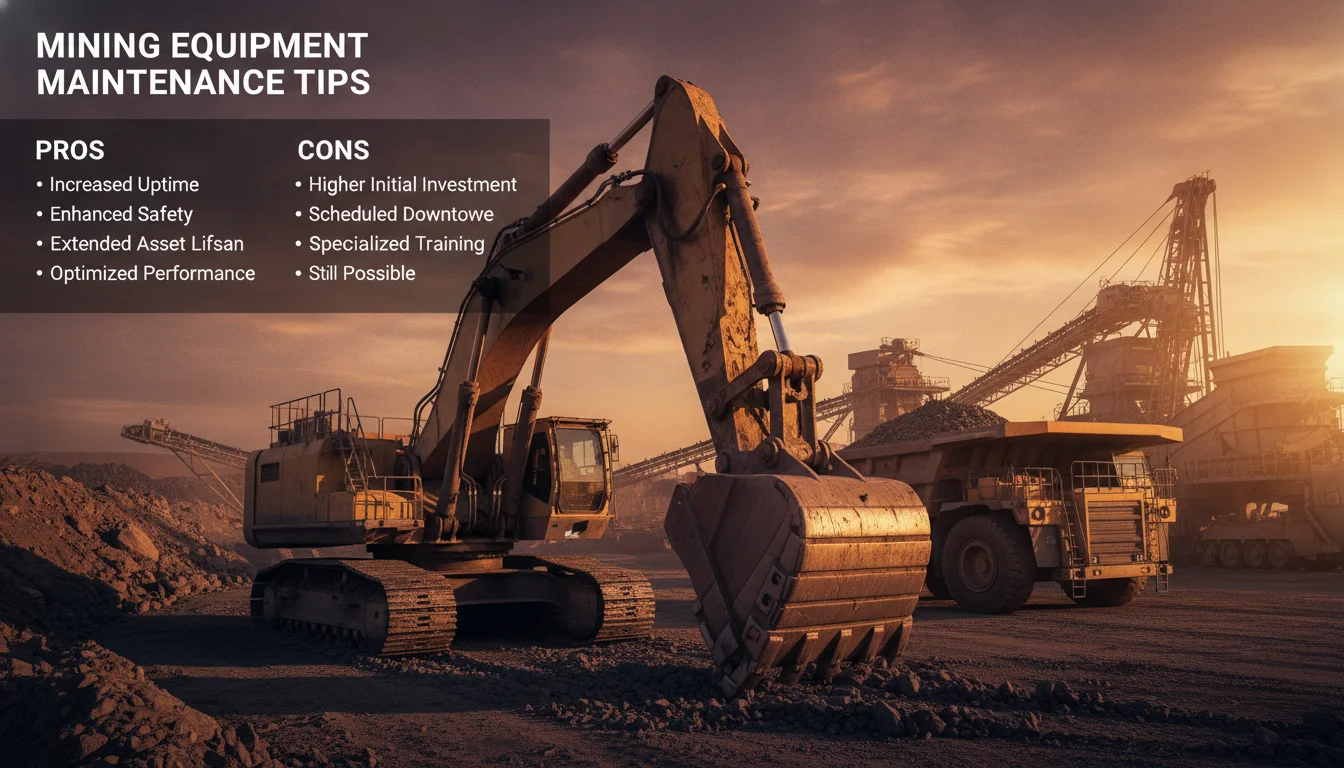
Choosing the right maintenance strategy for your operation requires an honest look at what each approach delivers and where it falls short.
Pros
- Preventive Maintenance: Predictable costs, schedulable downtime, and strong compliance with OEM service bulletins. Works well for equipment with consistent duty cycles.
- Predictive Maintenance: Catches failures before they happen by monitoring actual equipment condition. Reduces unnecessary part replacements and optimizes service intervals.
- Reliability-Centered Maintenance (RCM): Focuses resources on the failures that matter most to production. Reduces over-maintenance of non-critical assets.
- Spare Parts Pre-Positioning: Eliminates the lead-time gap that extends a repair from hours to days. Critical for remote mine sites with limited logistics access.
Cons
- Preventive Maintenance: Can result in replacing parts that still have usable life, increasing consumable costs.
- Predictive Maintenance: Requires upfront investment in sensors, data infrastructure, and trained analysts. Not always cost-effective for older equipment.
- Reliability-Centered Maintenance: Complex to implement without experienced reliability engineers. Initial setup takes time and data.
- Reactive Maintenance: Low upfront cost but high total cost. Acceptable only for truly non-critical, easily replaceable components.
How Mining Equipment Maintenance Actually Works: The Mechanics
Effective mining equipment maintenance tips work by interrupting the failure chain before a minor defect becomes a major breakdown. Understanding the underlying mechanics helps you prioritize correctly.
The Failure Chain in Heavy Mining Equipment
Most equipment failures follow a predictable sequence. A component begins to degrade, often through micro-cracking, seal wear, or lubricant breakdown. If undetected, that degradation accelerates. Friction increases, temperatures rise, and secondary components begin to fail in response. By the time an operator notices a symptom, the damage is already compounding.
Maintenance programs interrupt this chain at the earliest possible point. Daily inspections catch visible symptoms. Oil analysis catches invisible ones, detecting wear metals in the fluid before any external sign appears. Vibration monitoring catches bearing defects weeks before they cause a seizure. Each layer of inspection adds another opportunity to stop the chain.
How Lubrication Protects Components
Lubrication is the most cost-effective maintenance action available on any piece of mining equipment. The right lubricant creates a film between metal surfaces that prevents direct contact, carries heat away from friction zones, and suspends contaminant particles until the next filter change removes them.
According to Mobil lubricants field engineering data, wider viscosity range engine oils, such as 5W-40 formulations, offer greater protection in both cold-start conditions and high-temperature operation under load. For haul trucks climbing loaded out of a pit, or dozers working hard ground, maintaining oil film integrity at operating temperature is critical to preventing accelerated wear. For drivetrain applications, synthetic gear oils with extreme pressure additives provide the best protection under shock loading and wide temperature swings.
How Hydraulic Systems Degrade
Hydraulic systems on excavators and drilling rigs are the most failure-prone subsystems in the fleet. Seals degrade from heat cycling and pressure spikes. Hoses develop micro-cracks from vibration and UV exposure. Fluid absorbs water and particulate contamination over time, reducing its ability to transmit force cleanly and lubricating internal components.
The practical result: a hydraulic system running contaminated fluid will wear its pump, valves, and cylinders at a rate that can be several times higher than a system running clean, properly specified fluid. Checking fluid condition, not just fluid level, is a non-negotiable part of any serious maintenance program.
Mining Equipment Maintenance Checklist: Daily, Weekly, and Monthly
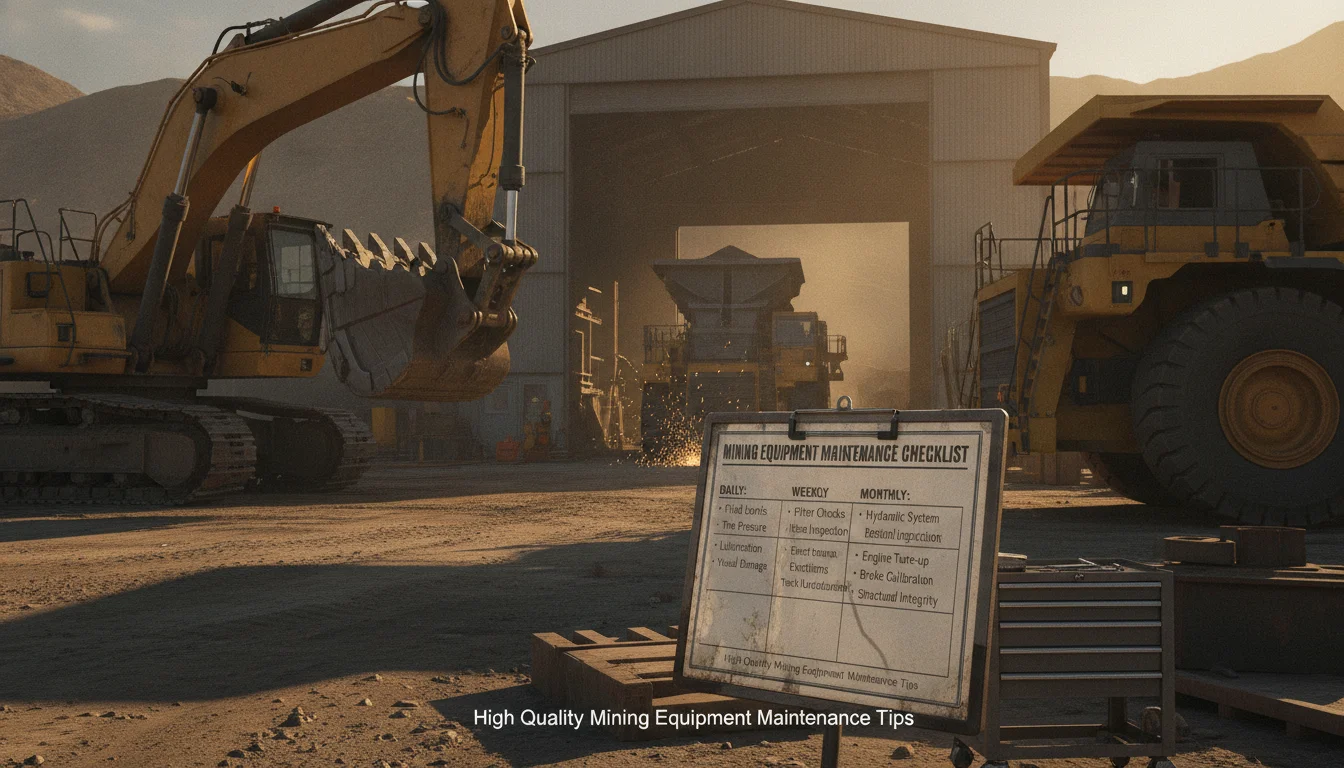
A structured maintenance checklist is the operational backbone of any mining equipment maintenance program. Below is a field-ready breakdown by equipment type and service interval.
Daily Inspections
Daily checks take 15 to 30 minutes per machine and catch the issues most likely to cause a mid-shift breakdown:
| Equipment | Daily Check Items |
|---|---|
| Excavator | Hydraulic fluid level and hose condition, boom and arm for cracks, undercarriage track tension, battery and control panel function |
| Haul Truck | Tire pressure and tread condition, engine oil level, brake system response, suspension visual check |
| Drilling Rig | Drill bit wear and damage, hydraulic fluid level, engine oil and air filter condition, control system function test |
| Conveyor System | Belt alignment and tension, roller and pulley rotation, electrical panel status, bearing temperature |
| Crusher | Jaw and cone wear, drive belt condition, motor performance indicators, safety guard integrity |
Weekly and Monthly Maintenance
Weekly and monthly tasks go deeper than daily walkarounds. They address the components that degrade over cycles rather than shifts:
- Lubrication: Grease all specified points on excavator pins, bushings, and swing bearings. Check drivetrain fluid condition on haul trucks.
- Filter Changes: Replace air and oil filters per OEM service bulletin intervals. In high-dust environments, air filter service intervals may need to be shortened significantly from the standard schedule.
- Fluid Analysis: Pull oil samples from engines, hydraulics, and drivetrains for laboratory analysis. Wear metal trends tell you what is happening inside the machine before any external symptom appears.
- Structural Inspection: Check welds, frames, and boom structures for cracks. Fatigue cracking in structural members is common in high-cycle applications and is far cheaper to repair when caught early.
- Electrical System Check: Test battery condition, inspect wiring harnesses for chafing, and verify sensor calibration on machines equipped with condition monitoring systems.
"For mining operations, it's essential to customize PM schedules based on the equipment's workload and environmental conditions. Heavy-duty machinery operating in extreme conditions requires more frequent inspections and servicing." - Heavy Vehicle Inspection, Mining Equipment Maintenance Strategies, 2024
Preventive Maintenance Strategies That Actually Reduce Downtime
Preventive maintenance is a proactive approach that schedules regular checks, inspections, and routine servicing to address issues before they cause equipment failure. It is the foundation of every high-performing mine maintenance program.
Scheduled Maintenance Based on OEM Guidelines
OEM service bulletins exist for a reason. Caterpillar, Komatsu, Volvo, and Atlas Copco publish detailed service intervals based on engineering data from thousands of machines operating in real-world conditions. These intervals specify oil change frequencies, filter replacement schedules, and component inspection points that reflect actual wear rates under rated operating conditions.
Deviating from OEM intervals without oil analysis data to support the decision is a risk. Extending drain intervals without monitoring fluid condition can void warranty coverage and accelerate internal wear. Conversely, using oil analysis to extend intervals on machines running in clean, moderate conditions is a legitimate cost-saving measure, provided the data supports it.
Operator Training as a Maintenance Tool
Operator training is one of the highest-return investments in any mining equipment maintenance program. A trained operator does three things that an untrained one does not: they operate the machine within its design parameters, they notice early warning signs, and they report them before a small issue becomes a large one.
Specific training priorities include: recognizing abnormal hydraulic response, identifying unusual vibration or noise patterns, understanding pre-shift inspection requirements, and knowing when to stop the machine rather than push through a symptom. According to Rackers Equipment Company maintenance guidance, well-trained operators are better equipped to detect potential issues and understand the importance of routine maintenance, directly reducing the frequency of unexpected breakdowns.
Spare Parts Management: The Overlooked Variable
A maintenance program is only as fast as its parts supply. Downtime is frequently extended not because the repair is complex, but because the required part is not on site. For remote mining operations, this gap can stretch from hours to days.
Effective spare parts management for mining equipment includes: maintaining on-site inventory of high-wear consumables (filters, seals, belts, cutting edges), setting automated reorder thresholds for critical components, and working with a supplier who can deliver OEM-quality parts globally within days, not weeks. At 3GEN Export, we supply OEM-standard spare parts for Caterpillar, Komatsu, Volvo, Atlas Copco, and 40+ additional brands with global 5-day delivery, specifically to close this gap for operations in remote or supply-constrained locations.
Utilizing Predictive Maintenance Technologies in 2026
Predictive maintenance uses real-time condition data to anticipate failures before they occur, allowing maintenance teams to intervene at the optimal point between unnecessary early replacement and costly breakdown.
Condition Monitoring Systems
As of 2026, condition monitoring technology is accessible to operations of all sizes. The core tools include:
- Vibration Sensors: Detect bearing defects, imbalance, and misalignment weeks before failure. Particularly valuable on crusher drive systems and conveyor head pulleys.
- Temperature Monitoring: Infrared and contact sensors flag overheating in electrical panels, hydraulic systems, and drivetrain components before thermal damage occurs.
- Oil Analysis: Laboratory analysis of fluid samples identifies wear metals, contamination, and additive depletion. This is the most cost-effective predictive tool available for engine and drivetrain health monitoring.
- IoT-Connected Telematics: Modern haul trucks and excavators from Caterpillar and Komatsu transmit real-time operating data, including load cycles, fuel consumption, and fault codes, to fleet management platforms.
Data Analysis and Maintenance Scheduling
Collecting condition data is only useful if the data drives decisions. The practical workflow is straightforward: establish baseline readings for each machine, set alert thresholds for deviations, and build maintenance triggers around those thresholds rather than fixed calendar intervals. This approach, sometimes called condition-based maintenance, ensures that service happens when the machine needs it, not simply because the calendar says so.
Historical failure data adds another layer. When you track which components fail most frequently on which equipment models under which operating conditions, you can adjust your preventive maintenance intervals and spare parts inventory to match your actual fleet, not a generic industry average.
How to Apply These Mining Equipment Maintenance Tips: A Step-by-Step Field Process
Applying mining equipment maintenance tips effectively requires a structured process, not just a list of tasks. Here is a practical implementation sequence for a mine site starting or rebuilding its maintenance program.
Step 1: Audit Your Current Equipment and Failure History
Before scheduling a single service, document what you have and what has been failing. List every piece of equipment, its age, its current service status, and its recent failure history. This audit identifies your highest-risk assets and tells you where to concentrate resources first.
Step 2: Build Equipment-Specific Maintenance Schedules
Use OEM service manuals as the starting point. For each machine, define daily, weekly, monthly, and annual service tasks. Assign responsibility for each task to a specific role, whether that is the operator, a site mechanic, or an OEM dealer technician. Vague responsibility is the most common reason maintenance programs fail in practice.
Step 3: Establish Your Parts Inventory
Identify the consumables and wear parts that each machine requires at each service interval. Stock a minimum buffer of the highest-frequency items on site. For critical components with longer lead times, establish a supplier relationship that guarantees fast replenishment. This step alone can cut average repair duration by a significant margin on remote sites.
Step 4: Train Operators on Pre-Shift Inspection Procedures
Develop a written pre-shift checklist for each equipment type. Train every operator to complete it before starting the machine. The checklist should cover fluid levels, visible leaks, tire or track condition, brake response, and any warning lights or fault codes. Pre-shift inspections are the cheapest form of condition monitoring available.
Step 5: Implement Condition Monitoring on Critical Assets
Start with your highest-value, highest-utilization machines. Install vibration sensors on crusher bearings and conveyor head pulleys. Begin oil sampling on all engines and hydraulic systems. Connect telematics data from haul trucks to a central monitoring platform. Expand the program as you build confidence in the data.
Step 6: Review and Adjust Quarterly
A maintenance program that never changes is a program that is not learning. Every quarter, review your failure data, your parts consumption, and your downtime records. Adjust service intervals, update checklists, and revise your parts inventory based on what the data shows. This continuous improvement cycle is what separates high-performing mine maintenance programs from average ones.
Maintenance Strategy Comparison Table
Choosing the right maintenance approach depends on your equipment criticality, budget, and operational context. This table compares the four primary strategies used in mining operations.
| Strategy | Trigger | Best For | Key Advantage | Key Risk |
|---|---|---|---|---|
| Reactive (Run-to-Failure) | Equipment breaks down | Non-critical, low-cost components | Zero upfront maintenance cost | Unpredictable downtime, high emergency repair costs |
| Preventive (Time-Based) | Fixed calendar or hour intervals | Equipment with consistent duty cycles | Predictable scheduling, OEM compliance | May replace parts with remaining life |
| Predictive (Condition-Based) | Sensor data or oil analysis results | High-value, high-utilization assets | Optimized intervals, early failure detection | Requires sensor investment and data expertise |
| Reliability-Centered (RCM) | Failure mode analysis | Complex fleets with diverse equipment | Resources focused on highest-impact failures | Complex to implement, requires reliability engineers |
Safety Standards and MSHA Compliance in Maintenance
Mining equipment maintenance is not only an operational issue. It is a legal and safety obligation. MSHA regulations require documented inspection and maintenance records for all permissible equipment operating underground, and surface operations face equivalent scrutiny under applicable federal and state standards.
According to MSHA Safety Services, maintenance tasks are among the most hazardous activities on a mine site. Working near residual hydraulic pressure, stored electrical energy, and suspended loads creates serious injury risk if proper procedures are not followed. Lockout/tagout (LOTO) procedures must be strictly applied before any maintenance work begins on powered equipment. Every technician working on mining machinery must be trained in energy isolation procedures specific to each machine type.
Beyond LOTO, MSHA compliance requires that equipment is only returned to service after a documented inspection confirms it is safe to operate. Cutting corners on post-maintenance verification is a compliance violation and a safety failure. Build the sign-off step into your maintenance workflow as a non-negotiable final gate.
Common Mistakes to Avoid in Mining Equipment Maintenance
Even experienced maintenance teams fall into patterns that undermine the effectiveness of their programs. These are the most common errors we see across mining operations globally.
Deferring Maintenance to Meet Production Targets
This is the most expensive mistake in mining maintenance. Skipping a scheduled service to keep a machine running through a production push almost always results in a larger failure within weeks. The short-term production gain is real. The subsequent downtime cost is larger. The math rarely favors deferral.
Using the Wrong Lubricant or Fluid Specification
Not all oils are interchangeable. Using a standard engine oil where a TO-4 fluid is specified, or substituting a mineral oil where a synthetic is required, can cause accelerated wear that is not immediately visible. Always cross-reference the OEM fluid specification before filling any system. For drivetrain applications on haul trucks, consolidating fluids where the OEM permits it reduces cross-contamination risk and simplifies inventory management.
Ignoring Early Warning Signs
Operators who push through unusual noises, minor hydraulic sluggishness, or small fluid leaks are not saving time. They are converting a small repair into a large one. A hydraulic hose weeping fluid at a fitting is a 30-minute fix. The same hose failing completely mid-cycle can damage the cylinder, contaminate the surrounding area, and create a fire risk. Train operators to stop and report, not push through.
Inadequate Spare Parts Inventory
Stocking no spare parts to save inventory cost is a false economy on any mine site. When a critical component fails and the replacement is not on site, every hour of shipping time is an hour of lost production. The carrying cost of a reasonable consumables inventory is almost always lower than the cost of a single extended unplanned shutdown.
Neglecting Cleaning as a Maintenance Task
Dirt and debris buildup on mining equipment is not just an aesthetic issue. Accumulated material on cooling fins reduces heat dissipation and causes overheating. Debris packed around seals accelerates seal wear. Mud and rock buildup on undercarriage components increases rolling resistance and track wear. Regular cleaning is a legitimate maintenance task, not optional housekeeping.
Best Practices for Cleaning and Storage
Proper cleaning and storage of mining equipment preserve functionality, prevent corrosion, and reduce the wear that accumulates even when machines are idle.
Cleaning Procedures
Clean equipment after every shift in high-dust or high-mud environments. Use pressure washing to remove material from undercarriage components, cooling systems, and electrical enclosures. After washing, inspect for any damage that the cleaning process has revealed. Pay particular attention to hydraulic hose fittings, which can develop slow leaks that are invisible under a layer of dirt.
Storage Recommendations
When equipment is taken out of service for more than a few days, follow OEM storage procedures. These typically include: topping off fuel tanks to prevent condensation, applying corrosion inhibitor to exposed metal surfaces, retracting hydraulic cylinders to protect rod surfaces, and blocking up undercarriage components to relieve track tension. Store equipment in a clean, dry environment where possible. For outdoor storage in harsh climates, use equipment covers rated for UV and moisture resistance.
A Realistic Scenario: How a Structured Program Changes Outcomes
Consider a mid-size open-pit copper mine operating a fleet of haul trucks, two excavators, and a primary crusher. Before implementing a structured maintenance program, the operation experienced frequent unplanned breakdowns, with the crusher going down multiple times per quarter due to bearing failures and belt issues. Each shutdown idled the entire processing circuit.
After implementing the mining equipment maintenance tips outlined in this guide, the maintenance team made three specific changes: they began monthly oil analysis on all crusher bearings and drive components, they pre-positioned replacement belts and bearing assemblies on site, and they trained operators to report any unusual vibration or noise immediately rather than waiting for the next scheduled inspection.
Within two quarters, bearing failures dropped significantly because the oil analysis was catching degradation weeks before failure. When a belt did need replacement, the on-site inventory meant the repair was completed in hours rather than the two days previously required to source and ship the part. The total cost of the maintenance program increase was a fraction of the downtime cost it eliminated.
This is not a unique outcome. It is the predictable result of applying structured mining equipment maintenance tips consistently over time.
2026 Outlook: Where Mining Maintenance Is Heading
As of 2026, the mining maintenance landscape is shifting in three clear directions. First, autonomous and semi-autonomous equipment is becoming more common in large open-pit operations, which changes the maintenance profile: fewer operator-induced failures, but more complex electronic and sensor systems requiring specialized service. Second, CMMS (Computerized Maintenance Management System) platforms are now accessible to operations of all sizes, making digital maintenance records, automated scheduling, and parts tracking practical even for smaller mines. Third, the pressure to reduce total cost of ownership is driving more mines toward condition-based maintenance models that optimize service intervals rather than defaulting to conservative fixed schedules.
For procurement teams, this year also brings continued pressure on parts lead times and supply chain reliability. OEM dealer networks remain the gold standard for technical support, but global suppliers like 3GEN Export fill a critical gap for operations that need OEM-quality components delivered fast to locations that dealer networks do not prioritize. Our 5-day global delivery capability exists specifically for this scenario.
Frequently Asked Questions
What are the 7 elements of maintenance?
The seven elements of maintenance are: planning, scheduling, execution, documentation, training, continuous improvement, and safety compliance. In mining specifically, safety compliance and documentation carry additional weight because MSHA regulations require auditable records for all permissible equipment inspections and repairs.
What are the four P's of maintenance?
The four P's of maintenance are Predictive, Preventive, Proactive, and Reactive strategies. Most high-performing mining operations use a combination of all four, applying reactive maintenance only to non-critical components while using predictive and preventive approaches for their highest-value assets.
What are the 3 P's of maintenance?
The 3 P's of maintenance refer to Preventive, Predictive, and Proactive maintenance. Proactive maintenance focuses on identifying and eliminating the root causes of failure, such as contamination control and alignment correction, rather than simply responding to wear after it begins.
What are the best practices for maintaining mining equipment?
Best practices include daily pre-shift inspections, OEM-compliant service intervals, proper lubrication with the correct fluid specification, regular oil analysis, operator training, and maintaining an on-site inventory of critical spare parts. Combining preventive and predictive approaches delivers the best balance of cost and reliability for most mining fleets.
How often should mining equipment be inspected?
Critical components on mining equipment should be inspected before every shift. More comprehensive checks, covering fluid analysis, structural integrity, and electrical systems, should be performed weekly and monthly. The exact frequency should be adjusted based on operating hours, environmental conditions, and the OEM service bulletin for each machine.
What is the role of operator training in equipment maintenance?
Operator training converts your crew from passive machine users into active participants in the maintenance program. Trained operators recognize early warning signs, complete pre-shift inspections correctly, operate equipment within design parameters to reduce wear, and report issues before they escalate. According to Rackers Equipment Company, well-trained operators directly reduce the frequency of unexpected breakdowns across the fleet.
How can predictive maintenance improve equipment reliability in mining?
Predictive maintenance uses real-time sensor data, oil analysis results, and historical failure patterns to identify degradation before it causes a breakdown. This allows maintenance teams to schedule repairs during planned downtime windows rather than responding to emergencies. Mines running structured predictive maintenance programs cut unplanned failures by 30 to 50 percent, based on 2026 underground mining operational benchmarks.
Ready to reduce downtime and keep your fleet running? Shop OEM-quality spare parts for Caterpillar, Komatsu, Volvo, Atlas Copco, and 40+ brands with global 5-day delivery at 3genexport.com.