
Mining Machinery Lubrication Guide 2026
This mining machinery lubrication guide covers lubricant types, automated systems, and best practices to cut downtime and extend equipment life in 2026.
Loading article…
Article Not Found
The article you're looking for doesn't exist or may have been removed.
Back to BlogMining machinery lubrication guide is the complete reference for selecting lubricants, configuring delivery systems, and maintaining heavy equipment in demanding mine environments. Proper lubrication directly determines how long your machines run before failure.
Key Takeaways
- Proper lubrication is the single most effective way to extend the service life of mining equipment and prevent unplanned downtime.
- Mineral oils, synthetic oils, and greases each serve distinct functions. Matching the lubricant to the application is non-negotiable.
- Automated and centralized lubrication systems eliminate human error and deliver consistent protection to high-load components.
- Contamination from dust, water, and metal particles is the leading cause of lubricant failure in surface and underground mining.
- Regular inspection intervals, correct lubricant selection, and trained maintenance personnel are the three pillars of a reliable lubrication program.
- As of 2026, programmable logic controller (PLC)-driven systems are the industry standard on new mining machinery from Caterpillar, Komatsu, and comparable OEMs.
Understanding Lubrication in Mining Machinery
Lubrication is the process of applying a substance to reduce friction and wear between moving parts. In mining machinery, effective lubrication is vital because these machines endure extreme loads, abrasive dust, temperature swings, and continuous operating cycles that would destroy unprotected metal surfaces within hours.
What is Lubrication?
Lubrication is the application of a lubricant to separate surfaces in mutual contact, reducing the friction and heat generated when those surfaces move. According to Noria Corporation, every metal surface, no matter how finely finished, carries microscopic high points called asperities. When two surfaces slide against each other without adequate lubrication, those asperities catch, tear apart, and generate free-moving metal particles that circulate through the system and accelerate wear. A thin, continuous film of lubricant keeps those surfaces apart and prevents that chain reaction from starting.
Types of Lubricants
- Mineral Oils: Derived from crude oil, these are the most widely used lubricants in mining machinery. Quality depends heavily on the refining process. Mineral oils suit moderate-temperature, standard-load applications and offer a cost-effective baseline for most equipment.
- Synthetic Oils: Man-made or highly modified molecules engineered for superior performance in extreme conditions. Synthetics offer increased oxidation stability, thermal resistance, and a higher viscosity index compared to mineral oils, making them the preferred choice for high-temperature or high-load components such as final drives and swing gears on large electric shovels.
- Greases: Semi-solid lubricants formed by combining a base oil with a thickening agent. The thickener creates a fibrous, sponge-like structure that holds the oil in place under high pressure and seals out contaminants. Per Phillips 66 Lubricants technical guidance, grease selection requires careful consideration of base oil viscosity, thickener type, and performance additives to match the specific speed, load, and temperature of the application.
Importance of Proper Lubrication
Proper lubrication serves several purposes beyond simple friction reduction:
- Reducing friction and wear on moving parts, extending component service life.
- Cooling components by absorbing and transferring heat generated by friction.
- Preventing contamination ingress from dust, water, and external debris.
- Protecting against corrosion and chemical attack through additive coatings on metal surfaces.
- Transferring energy in hydraulic systems, where oil incompressibility is the operating principle.
How Lubrication Works: The Mechanics Behind the Film
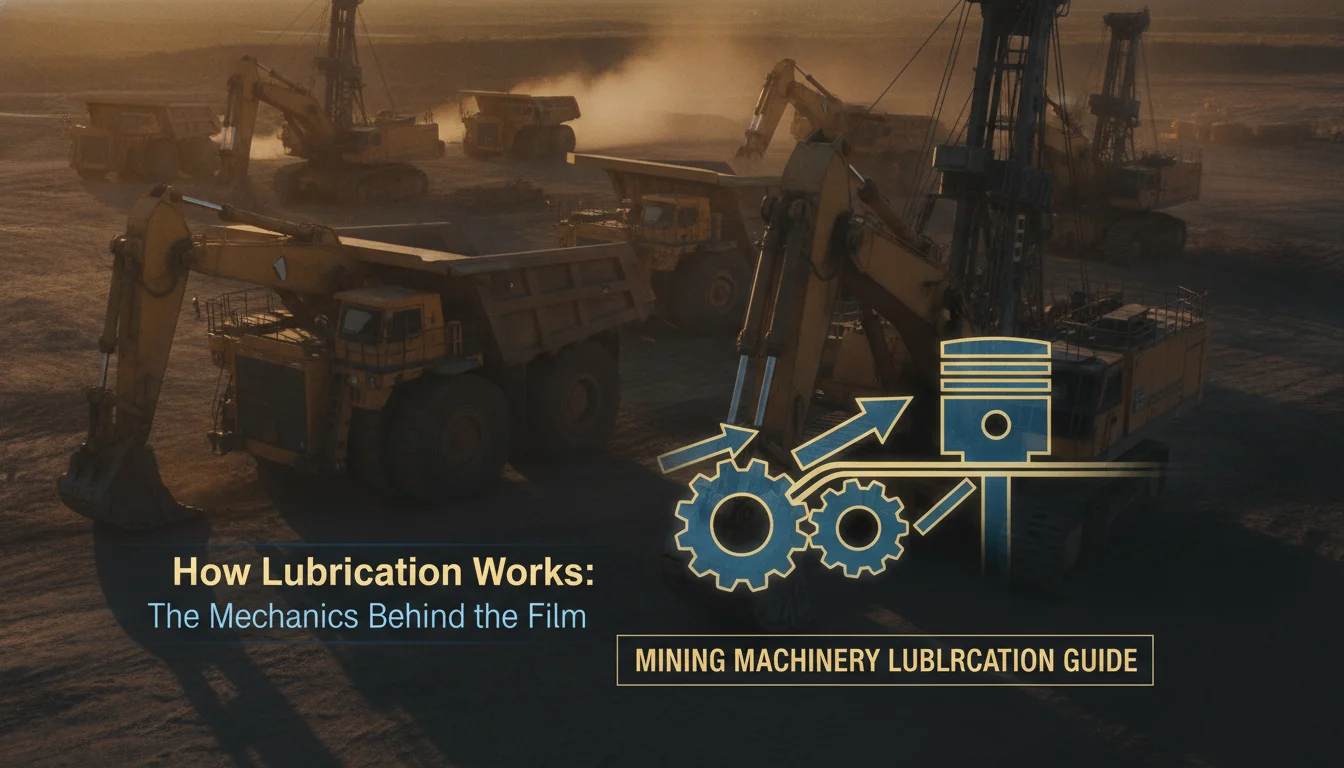
Understanding the physics of lubrication helps maintenance teams make better decisions about lubricant grades, change intervals, and system design. The protection a lubricant provides depends entirely on maintaining a continuous film between moving surfaces.
The Three Lubrication Regimes
Lubrication engineers classify operating conditions into three regimes, and mining machinery passes through all three during a typical work cycle:
- Full-film (hydrodynamic) lubrication: The surfaces are fully separated by a pressurized lubricant film. Friction is minimal and wear is essentially zero. This is the target condition for bearings and gears running at design speed and load.
- Mixed-film lubrication: The film is present but thin enough that asperities occasionally contact each other. This occurs during start-up, slow speeds, or when lubricant viscosity drops due to heat. Wear increases but remains manageable with the right additive package.
- Boundary lubrication: The film breaks down almost entirely. Metal-to-metal contact is frequent. Extreme-pressure (EP) additives in the lubricant chemically react with the metal surface to form a sacrificial layer that limits damage. Mining equipment operating under shock loads or at very low speeds often enters boundary conditions, which is why EP-rated greases and oils are specified for many mining applications.
Viscosity: The Most Critical Lubricant Property
Viscosity is a lubricant's resistance to flow. Too low, and the film thins out under load, allowing metal contact. Too high, and the lubricant generates excessive heat through internal friction and may not reach remote lubrication points in cold conditions. OEM service manuals specify viscosity grades for each component, and those specifications account for the expected operating temperature range of the machine. Deviating from the specified grade, even by one ISO VG step, can shift a component from full-film into mixed-film operation.
The Role of Additives
Base oils alone cannot meet all the demands of mining equipment. Additive packages extend lubricant capability in several ways:
- Anti-wear (AW) additives: Form a protective chemical layer on metal surfaces during mixed-film conditions.
- Extreme-pressure (EP) additives: Activate under high contact stress to prevent welding and scuffing of gear teeth and bearing races.
- Oxidation inhibitors: Slow the chemical degradation of the base oil at elevated temperatures, extending drain intervals.
- Rust and corrosion inhibitors: Coat metal surfaces to prevent moisture attack, critical in underground or wet-weather surface operations.
- Foam inhibitors: Prevent air entrainment in hydraulic systems, which would compress under load and cause erratic cylinder response.
"The ultimate goal of a lubricant is to reduce unwanted friction by separating two solid surfaces with a thin layer of lubricant. Friction, unabated, can cause asperities to rip each other apart, introducing free-moving metal particulates to the lubrication system and causing catastrophic machine failure." - Noria Corporation, Machinery Lubrication
Lubrication Systems in Mining Machinery
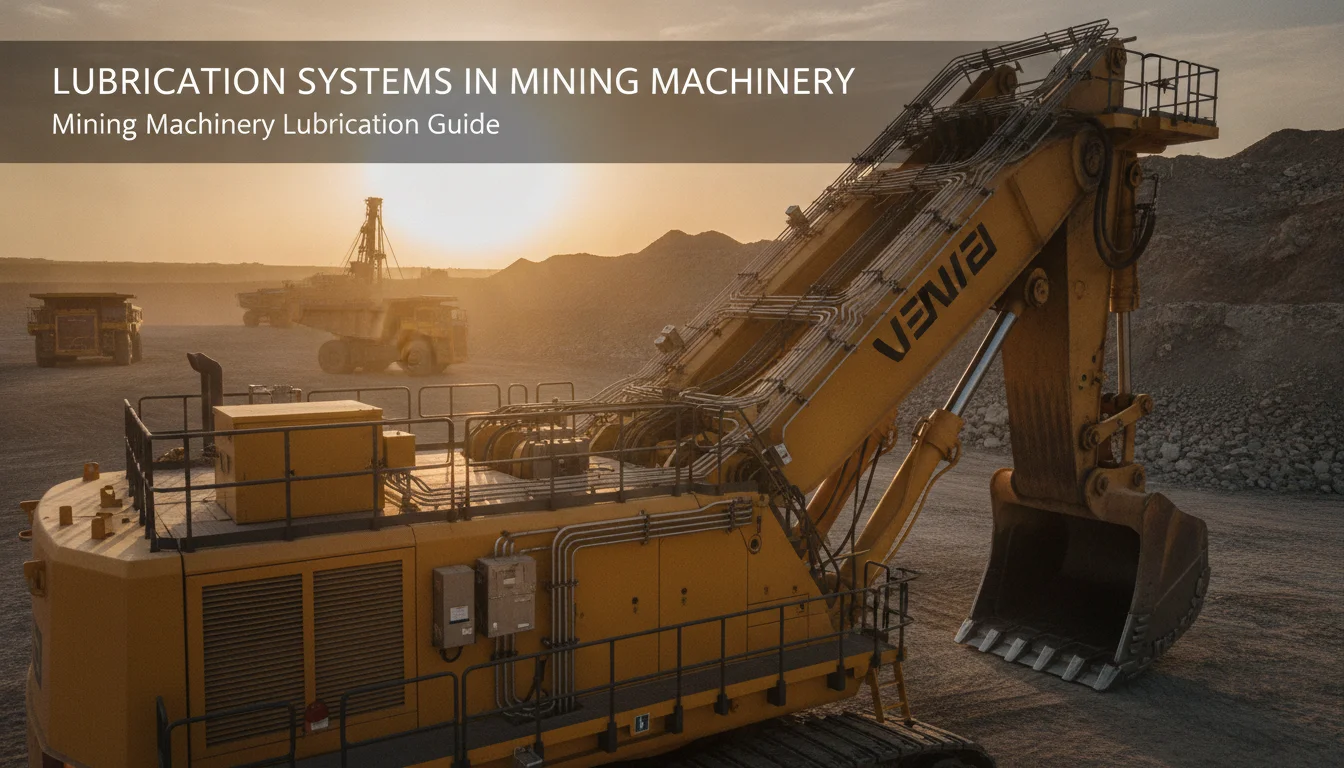
Modern mining equipment uses advanced lubrication systems designed to deliver precise amounts of lubricant to critical components automatically, consistently, and without relying on manual intervention during machine operation.
Types of Lubrication Systems
- Manual Lubrication Systems: Require operators or lube technicians to apply lubricants at scheduled intervals using grease guns, oil cans, or portable dispensing equipment. Effective when performed correctly, but vulnerable to missed intervals, incorrect quantities, and access difficulties on large machines.
- Automated Lubrication Systems: Use pumps, timers, and metering valves to deliver lubricant automatically while the machine operates. Eliminate the need to stop equipment for routine greasing and ensure consistent application regardless of operator attention.
- Centralized Lubrication Systems: Distribute lubricant to multiple points from a single reservoir through a network of distribution lines and injectors. Reduce maintenance time significantly on complex machines with dozens of lubrication points, such as large rope shovels and draglines.
Components of Lubrication Systems
Key components of a centralized or automated lubrication system include:
- Lubricant Reservoir: Stores the lubricant supply. Sized to match the machine's consumption rate and the desired refill interval.
- Pumps: Move lubricant from the reservoir to the distribution network. Electric, pneumatic, or hydraulically driven depending on the machine's available power sources.
- Distribution Lines: Steel or high-pressure nylon tubing that routes lubricant from the pump to each lubrication point. Must be routed to avoid heat sources and mechanical damage.
- Metering Injectors or Valves: Control the precise volume of lubricant delivered to each point. Adjustable to match the consumption rate of each component.
- Control Systems: Programmable logic controllers (PLCs) regulate timing, volume, and alarm functions. As noted by Machinery Lubrication, modern systems are capable of dispensing the right product, in the right amount, to the right point, at the right time.
Centralized System Configurations
Three primary configurations are used in mining applications, each suited to different machine types and operating conditions:
- Single-line progressive systems: Lubricant flows through a series of progressive divider valves in sequence. Simple, reliable, and easy to monitor. A blockage at any point stops the entire circuit, making fault detection straightforward.
- Dual-line parallel systems: Two supply lines alternate pressure to deliver lubricant. Well-suited for large machines with many lubrication points spread over long distances, such as draglines and large electric shovels.
- Multi-point systems: Individual pumps serve specific zones or components. Offer the highest flexibility for complex machines with varied lubricant requirements across different systems.
Benefits of Automated Lubrication Systems
Automated lubrication systems offer several concrete advantages over manual programs:
- Consistent lubricant application regardless of operator schedule or attention.
- Lubrication delivered while the machine is running, meaning components receive protection under actual load conditions rather than at rest.
- Reduced risk of over-lubrication, which wastes product and can damage seals.
- Reduced maintenance labor on machines with large numbers of grease points.
- Improved safety by eliminating the need for technicians to access lubrication points on moving or elevated equipment.
"Properly implemented automatic lubrication extends component lifespan compared to manual methods while reducing lubricant waste through measured dispensing. These systems have become indispensable in contemporary mining operations where equipment uptime directly impacts productivity and safety outcomes." - Hyma Group, Mining Automatic Lubrication System Guide
Lubricant and System Comparison Table
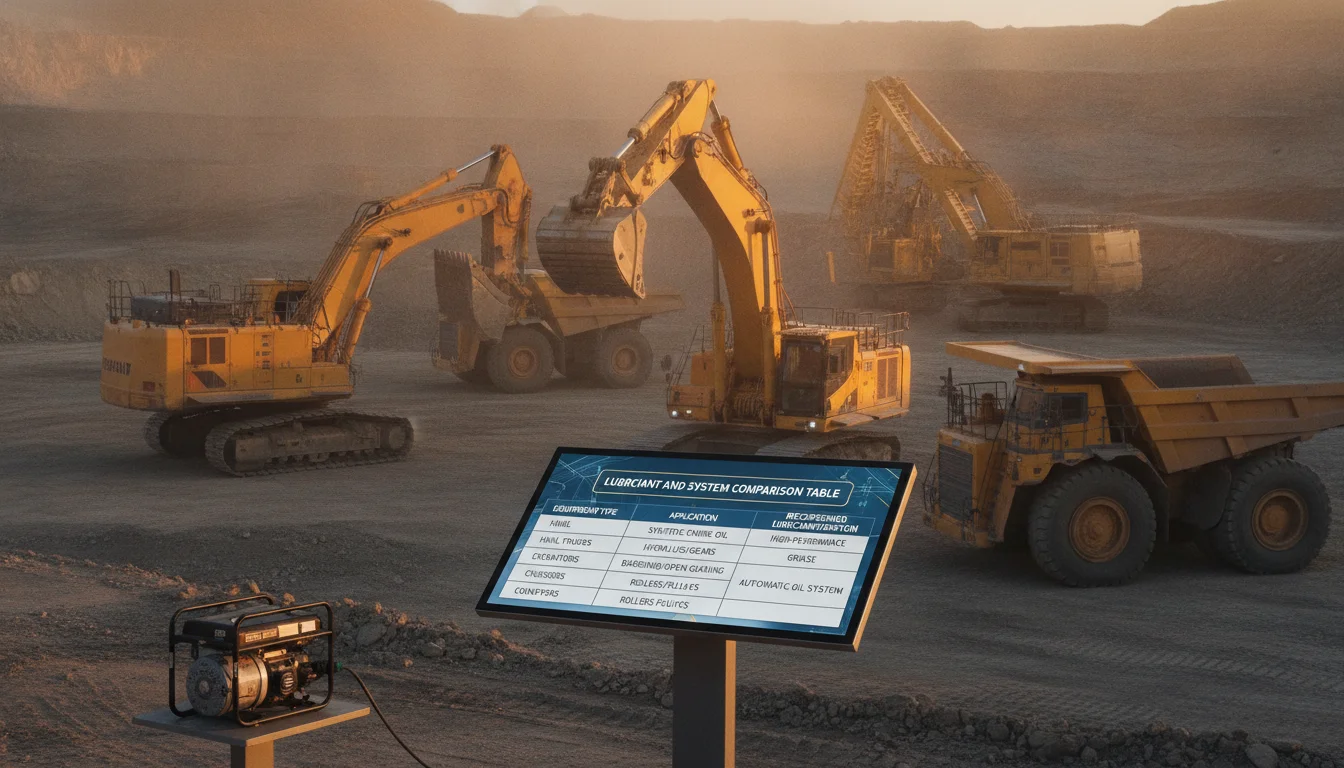
Use this reference table to match lubricant type and delivery system to your equipment and operating conditions. Selecting the wrong combination is one of the most common and costly mistakes in mining maintenance programs.
| Lubricant / System Type | Best Application | Key Advantage | Key Limitation | Typical Mining Equipment |
|---|---|---|---|---|
| Mineral Oil | Standard-load, moderate-temperature components | Cost-effective, widely available | Degrades faster at high temperatures | Diesel engine crankcases, hydraulic systems (standard duty) |
| Synthetic Oil | High-temperature, high-load, or extended-drain applications | Superior oxidation stability, wider temperature range | Higher unit cost | Final drives, swing gears, high-cycle hydraulic systems |
| EP Grease (Mineral Base) | Bearings, pins, bushings under high load | Stays in place, seals out contaminants | Requires correct NLGI grade selection | Excavator pins, truck wheel bearings, shovel crowd gears |
| EP Grease (Synthetic Base) | Extreme temperature or extended re-greasing intervals | Better performance at temperature extremes | Higher cost, compatibility checks required | Large rope shovel boom pins, dragline components |
| Manual Lubrication System | Small fleets, simple machines, low point-count equipment | Low capital cost, no system maintenance | Dependent on technician discipline and access | Small dozers, light support equipment |
| Centralized Automated System | Large, complex machines with many lubrication points | Consistent delivery, reduced labor, improved safety | Higher installation cost, requires system maintenance | Large haul trucks, electric shovels, draglines, drills |
How to Apply This: A Step-by-Step Lubrication Program for Mining Operations
Building a reliable lubrication program requires more than buying the right grease. Follow these steps to implement a program that reduces unplanned failures and controls maintenance costs across your fleet.
Step 1: Audit Your Current Equipment and Lubrication Points
Start by creating a complete inventory of every machine in your fleet and every lubrication point on each machine. Reference the OEM service manual for each model. Document the specified lubricant type, viscosity grade, quantity, and interval for every point. This audit becomes your master lubrication schedule and the baseline against which you measure compliance.
Step 2: Consolidate Your Lubricant Inventory
Most mining fleets run too many different lubricant products, which increases storage complexity, raises the risk of cross-contamination, and makes training harder. Work with your lubricant supplier to rationalize the product list. Identify where a single high-quality synthetic product can cover multiple applications without violating OEM specifications. Fewer products mean fewer mistakes.
Step 3: Select and Install the Right Delivery System
Match the delivery system to the machine. Large haul trucks, electric shovels, and drills with many lubrication points benefit from centralized automated systems. Smaller support equipment may be adequately served by a disciplined manual program. For machines transitioning from manual to automated systems, work with the system manufacturer to map every lubrication point and size the reservoir, pump, and injectors correctly before installation.
Step 4: Establish Inspection and Monitoring Routines
Automated systems still require regular inspection. Check reservoir levels at the start of each shift. Inspect distribution lines for damage, kinking, or leaks weekly. Verify that injectors are cycling correctly by observing fresh grease at each point during a manual check. Set PLC alarms for low-reservoir and system-fault conditions so operators receive immediate notification rather than discovering a failure after component damage has occurred.
Step 5: Implement Oil Analysis
Oil analysis is the most cost-effective diagnostic tool available to mining maintenance teams. Sampling engine oil, hydraulic fluid, and gear oil at regular intervals reveals contamination levels, wear metal trends, and lubricant degradation before any of those conditions cause a failure. Establish baseline samples on new machines and track trends over time. A sudden increase in iron or silicon particles in a sample is an early warning that requires investigation, not a wait-and-see response.
Step 6: Train Your Maintenance Team
A lubrication program is only as good as the people executing it. Train every technician on the master lubrication schedule, correct application techniques, contamination control procedures, and how to identify early signs of lubricant failure. Refresher training annually keeps standards from drifting. Document all lubrication activities in your maintenance management system so compliance is visible and auditable.
Step 7: Review and Optimize Annually
As of 2026, the best-performing mining operations treat their lubrication program as a living document. Review oil analysis trends, component replacement records, and lubricant consumption data each year. Adjust intervals, product selections, and system settings based on actual field performance rather than defaulting to the original OEM schedule indefinitely. Machines operating in unusually dusty, wet, or high-temperature conditions may need shorter intervals than the standard recommendation.
Best Practices for Mining Machinery Lubrication
Implementing best practices in lubrication significantly enhances the performance and reliability of mining machinery across all equipment categories.
Regular Maintenance Checks
Routine inspections of lubrication systems are essential. Check lubricant levels at the start of each shift, inspect hoses and fittings for leaks weekly, and verify that pumps are cycling correctly. Any sign of lubricant starvation at a grease point requires immediate investigation. Do not assume the automated system is working correctly without physical verification.
Choosing the Right Lubricant
Selecting the appropriate lubricant is critical. Factors to consider include operating temperature range, load requirements of the specific component, speed of operation, environmental exposure (water, dust, chemicals), and compatibility with any lubricant already present in the system. Always start with the OEM specification and only deviate when you have a documented technical justification from your lubricant supplier.
Training and Education
Providing training for maintenance personnel on lubrication best practices ensures they understand the importance of proper lubrication and how to implement it correctly. Trained technicians catch problems earlier, make fewer application errors, and respond more effectively when a system fault occurs.
Common Mistakes to Watch Out For
Even well-intentioned maintenance programs make predictable errors. Recognizing these mistakes before they occur is far less expensive than correcting the equipment damage they cause.
Over-Greasing Bearings
More grease is not better. Over-greasing a bearing forces the excess lubricant past the seal, which then attracts and holds contaminants against the seal face. The result is accelerated seal wear and contamination ingress, the opposite of the intended protection. Follow the OEM-specified quantity precisely. If you are using an automated system, verify injector output volumes during commissioning.
Mixing Incompatible Lubricants
Mixing greases with different thickener types, or topping up a system with a different base oil type without flushing, can cause the lubricant to soften, harden, or lose its additive effectiveness. Always check compatibility before introducing a new product into a system that contains residual lubricant. When in doubt, flush and refill completely.
Ignoring Contamination Control
Storing lubricant drums outdoors without covers, using dirty dispensing equipment, or leaving reservoir fill ports open during maintenance are all common contamination pathways. Contaminants introduced during storage and handling are just as damaging as those generated internally by the machine. Use sealed, labeled containers, clean dispensing equipment, and filtered fill ports on all reservoirs.
Skipping Intervals Under Production Pressure
Production pressure is the most common reason lubrication intervals get skipped. One missed greasing cycle on a heavily loaded pin joint in a surface mining excavator can initiate wear that shortens component life significantly. Automated systems largely eliminate this risk, but manual programs require management commitment to hold the line on maintenance schedules even when the machine is productive and the temptation is to keep running.
Using the Wrong Viscosity Grade
Ambient temperature affects lubricant viscosity significantly. A gear oil that performs correctly at 30°C may be too thick to circulate properly at -10°C during a cold-weather startup, starving components during the most vulnerable period of machine operation. Always verify that your selected viscosity grade covers the full temperature range your equipment will experience, including cold starts.
Neglecting Lubrication System Maintenance
Automated lubrication systems require their own maintenance. Reservoirs must be refilled before they run dry. Distribution lines must be inspected for damage. Injectors can clog or fail. A system that is installed and then ignored will eventually fail silently, providing no lubrication while the operator assumes the machine is protected. Build system inspection into every shift pre-check.
Worked Example: Lubrication Program for a Large Haul Truck Fleet
Consider a surface coal mining operation running a fleet of large diesel-electric haul trucks. Each truck has multiple grease points covering the front suspension, rear suspension, steering linkage, body hinge pins, and fifth wheel. The operation runs two 12-hour shifts per day, seven days a week, in a high-dust environment with seasonal temperature variation from -5°C to 40°C.
Under a manual lubrication program, each truck requires a lube technician to access every grease point at the OEM-specified interval. In a high-production environment, this means either stopping the truck during a shift or scheduling lubrication during planned maintenance windows. Missed points are common because access to some locations requires the truck to be positioned correctly and the technician to work in confined spaces near hot components.
After installing a centralized automated lubrication system on each truck, the operation sees several changes. Grease is delivered to every point while the truck is operating, meaning components receive lubrication under actual load conditions. The PLC is programmed to match the OEM interval for each point, with alarm outputs connected to the truck's cab display so the operator sees a warning if the system detects a fault. Reservoir refill is scheduled as part of the weekly planned maintenance stop rather than requiring a separate visit.
The lubricant selection is also reviewed. The original mineral-base EP grease is replaced with a synthetic-base EP grease with a wider operating temperature range, covering both the cold-start conditions in winter and the high ambient temperatures in summer without requiring a seasonal product change. This simplifies the lubricant inventory and eliminates the risk of technicians applying the wrong seasonal product.
The practical outcome: fewer unplanned bearing replacements, reduced lubricant consumption through measured dispensing, and maintenance technicians redirected from routine greasing to higher-value inspection and diagnostic work. This is the standard result when a mining machinery lubrication guide is applied systematically rather than treated as a reference document that sits on a shelf.
Common Challenges in Mining Machinery Lubrication
Mining operations face unique challenges that affect lubrication effectiveness and require specific countermeasures beyond standard industrial practice.
Extreme Operating Conditions
Mining machinery operates in harsh environments including extreme temperatures, high dust concentrations, water ingress, and continuous heavy loading. These conditions degrade lubricants faster than standard industrial applications. Lubricant selection must account for the actual operating environment, not just the nominal design conditions of the machine.
Contamination Issues
Contaminants such as dirt, water, and metal particles compromise lubricant effectiveness and accelerate component wear. Implementing filtration systems on hydraulic circuits, using sealed lubrication points, and maintaining strict contamination control during lubricant storage and handling are the primary defenses. Oil analysis provides early warning when contamination levels are rising before they reach damaging concentrations.
Cost Management
Balancing the cost of high-quality lubricants against operational budgets is a real challenge in mining procurement. The correct framing is total cost of ownership rather than unit price per liter. A premium synthetic lubricant that extends drain intervals and reduces component wear typically costs less over the life of the machine than a cheaper mineral product that requires more frequent changes and allows higher wear rates.
Pros and Cons of Automated vs. Manual Lubrication in Mining
Both approaches have a place in mining operations. The right choice depends on machine complexity, fleet size, operating environment, and available maintenance resources.
Pros
- Automated systems deliver lubricant while the machine operates, providing protection under real load conditions rather than at rest.
- Consistent, measured delivery eliminates both under-lubrication and over-lubrication errors.
- Reduced labor requirements free maintenance technicians for higher-value diagnostic and repair work.
- Improved safety by removing the need for technicians to access lubrication points on moving or elevated equipment.
- PLC monitoring and alarm functions provide real-time system status and fault notification.
Cons
- Higher capital cost for system installation compared to manual greasing equipment.
- System maintenance is required: distribution lines, injectors, and reservoirs all need regular inspection and servicing.
- A silent system failure can go undetected if operators do not verify system function during pre-shift checks.
- Incorrect initial setup (wrong injector sizing, incorrect PLC programming) can result in under- or over-lubrication despite the system appearing to operate normally.
2026 Outlook: Where Mining Lubrication Technology Is Heading
This year, the mining industry is seeing accelerating adoption of condition-based lubrication, where sensors monitor bearing temperature, vibration, and lubricant condition in real time and trigger lubrication events based on actual need rather than fixed time intervals. This approach reduces lubricant consumption and extends component life beyond what fixed-interval programs can achieve.
OEMs including Caterpillar and Komatsu are integrating lubrication system status into their fleet telematics platforms, giving maintenance managers remote visibility into reservoir levels, system faults, and lubrication event logs across entire fleets. This data integration is making it practical to manage lubrication compliance at scale without requiring a technician to physically inspect each machine.
Biodegradable lubricants are also gaining traction in environmentally sensitive mining areas where fluid spills carry regulatory and remediation costs. Synthetic ester-based products now meet the performance requirements of most mining applications while offering significantly better environmental profiles than conventional mineral oils.
For procurement teams sourcing replacement parts and lubrication system components, the practical implication is clear: specify OEM-compatible components, verify lubricant approvals against current OEM service bulletins, and build lubrication system parts into your planned maintenance inventory. A failed pump or a cracked distribution line that stops a centralized lubrication system is a low-cost part with a high-cost consequence if it is not in stock when needed.
Explore our full brand catalog and parts categories to source OEM-quality lubrication system components, seals, filters, and maintenance parts for Caterpillar, Komatsu, Volvo, and 40+ equipment brands with global delivery.
Frequently Asked Questions
What is the primary purpose of lubrication in mining machinery?
The primary purpose of lubrication in mining machinery is to reduce friction between moving parts, which minimizes wear and heat generation and extends equipment service life. Without adequate lubrication, metal asperities on component surfaces contact each other, tear apart, and generate wear particles that circulate through the system and cause progressive damage leading to failure.
How often should lubrication systems be checked?
Lubrication systems should be checked at the start of every shift as part of the pre-operation inspection, with more detailed weekly inspections covering distribution lines, injectors, and reservoir levels. The frequency of lubricant application itself varies by component and must follow the OEM service manual specification, adjusted for actual operating conditions such as unusually high dust, heat, or load.
What are the benefits of automated lubrication systems in mining?
Automated lubrication systems deliver consistent lubricant quantities to every point while the machine operates, eliminating the missed intervals and access difficulties that affect manual programs. They reduce maintenance labor, improve technician safety, and provide PLC-based monitoring that alerts operators to system faults before component damage occurs.
How do I choose the right lubricant for my mining machinery?
Start with the OEM service manual specification for each component, which defines the required lubricant type, viscosity grade, and performance classification. Then verify that the selected product covers your actual operating temperature range, is compatible with any lubricant already in the system, and meets any environmental requirements for your site. Work with your lubricant supplier to confirm the selection before changing products on critical components.
What are the most common contaminants that affect mining machinery lubrication?
The most common contaminants are dust and fine abrasive particles from the mining environment, water from precipitation or dust suppression systems, and metal wear particles generated internally by the machine. All three accelerate lubricant degradation and component wear. Oil analysis at regular intervals is the most reliable method for detecting contamination before it reaches damaging levels.
Can improper lubrication lead to equipment failure?
Yes. Improper lubrication, whether from wrong product selection, missed intervals, contamination, or incorrect quantity, leads to increased friction, elevated operating temperatures, accelerated wear, and ultimately component failure. In large mining machines where bearing and gear replacements require significant downtime and cost, the financial impact of a single lubrication-related failure typically far exceeds the cost of a complete annual lubrication program.