
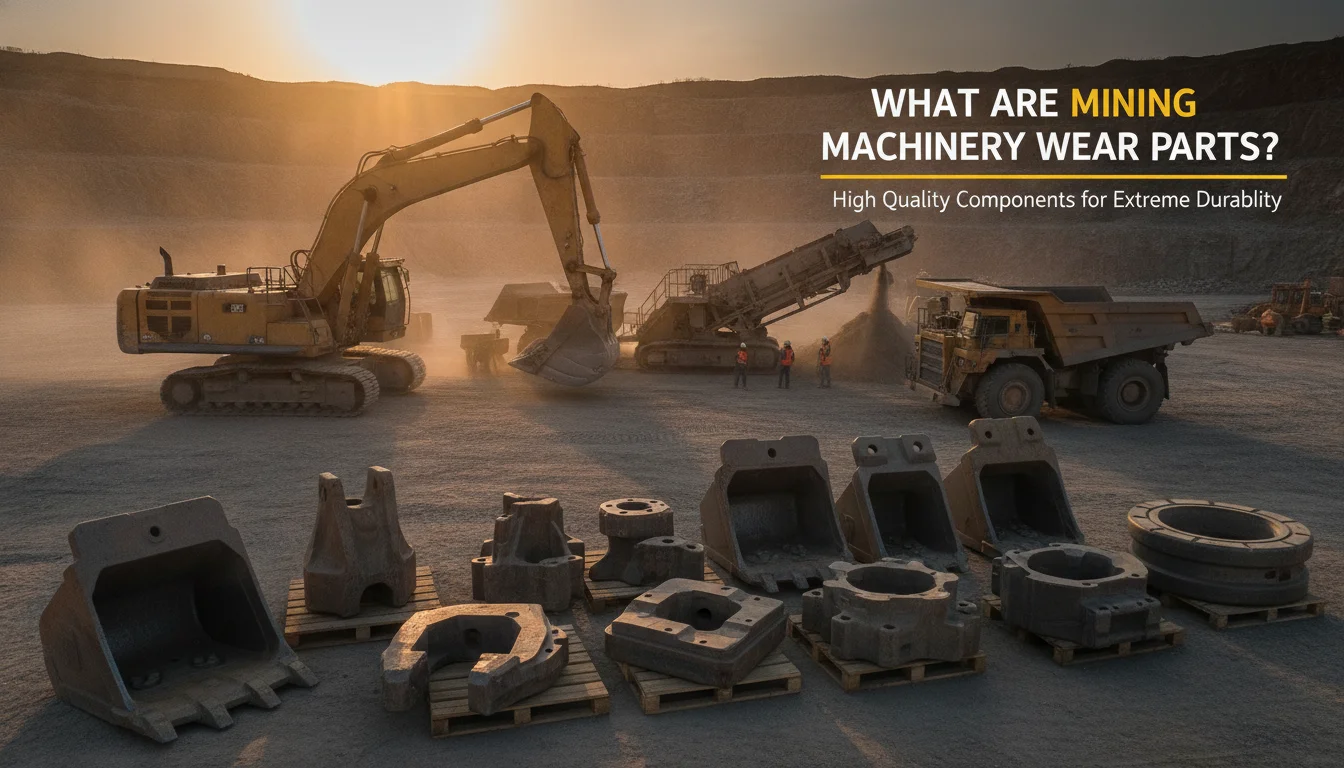
Mining Machinery Wear Parts: Buyer's Guide 2026
Mining machinery wear parts selection guide: materials, cost-per-hour analysis, and OEM-quality sourcing for crushers, GET, and screens worldwide.
Loading article…
Article Not Found
The article you're looking for doesn't exist or may have been removed.
Back to BlogMining machinery wear parts are consumable components that absorb abrasion, impact, and sliding contact to protect expensive structural equipment. This guide covers crusher liners, ground engaging tools, and screen media so procurement teams can reduce downtime and lower total operating cost.
Key Takeaways
- Evaluate wear parts by cost per hour, not purchase price alone.
- Chrome white iron outlasts AR400 by a factor of 10 and AR600 by a factor of 3 in abrasive conditions.
- Carbide-inserted alloys can double or even multiply service life in high-abrasion zones.
- Track wear with measurements and replace before adapter or structural damage occurs.
- Always request material certificates, field case studies, and confirmed lead times from suppliers.
- OEM-quality aftermarket parts can match or exceed original performance when manufactured to correct chemistry and fit.
What Are Mining Machinery Wear Parts?
this type of parts are replaceable components whose primary function is to accept wear and protect the parent machine. These parts include crusher liners, ground engaging tools (GET), screen media, pump casings, and conveyor skirting. They are designed to be replaced on a schedule because their material is sacrificed to protect larger castings and frames.
According to Heavy Vehicle Inspection, every bucket tooth, shovel lip, and crusher liner on a site is being consumed hour by hour. In most operations, nobody can tell the actual wear rate until something fails. That makes wear parts a predictable cost in principle but an unmanaged surprise in practice.
Definition and Scope
The scope of this kind of wear parts extends from primary gyratory crushers to conveyor skirting and slurry pump impellers. Common categories include crusher liners, screen panels, pump liners, chute liners, bucket teeth, adapters, and grader blades. Each category serves a distinct wear mode, which is why material selection matters as much as dimensional fit.
Common Wear Part Categories
- Crusher wear parts: jaw liners, cone liners, gyratory liners, impactor blow bars, and mill liners.
- Ground engaging tools (GET): bucket teeth, adapters, cutting edges, ripper tips, and grader blades.
- Screen media: wire cloth, polyurethane panels, rubber screens, and punch plates.
- Conveyor components: belting, idlers, shafting, and skirt board rubber.
- Pump and pipeline parts: slurry pump liners, impellers, and fabricated pipe sections.
Why Wear Parts Are a Predictable Cost
Wear is a function of ore hardness, throughput, and material chemistry. The right the machinery wear parts make wear predictable by matching those variables to a known material performance curve. Suppliers such as Penticton Foundry publish relative wear life data, enabling buyers to calculate replacement intervals instead of guessing.
Material Selection: Steel, Chrome White Iron, Carbide, and Overlay
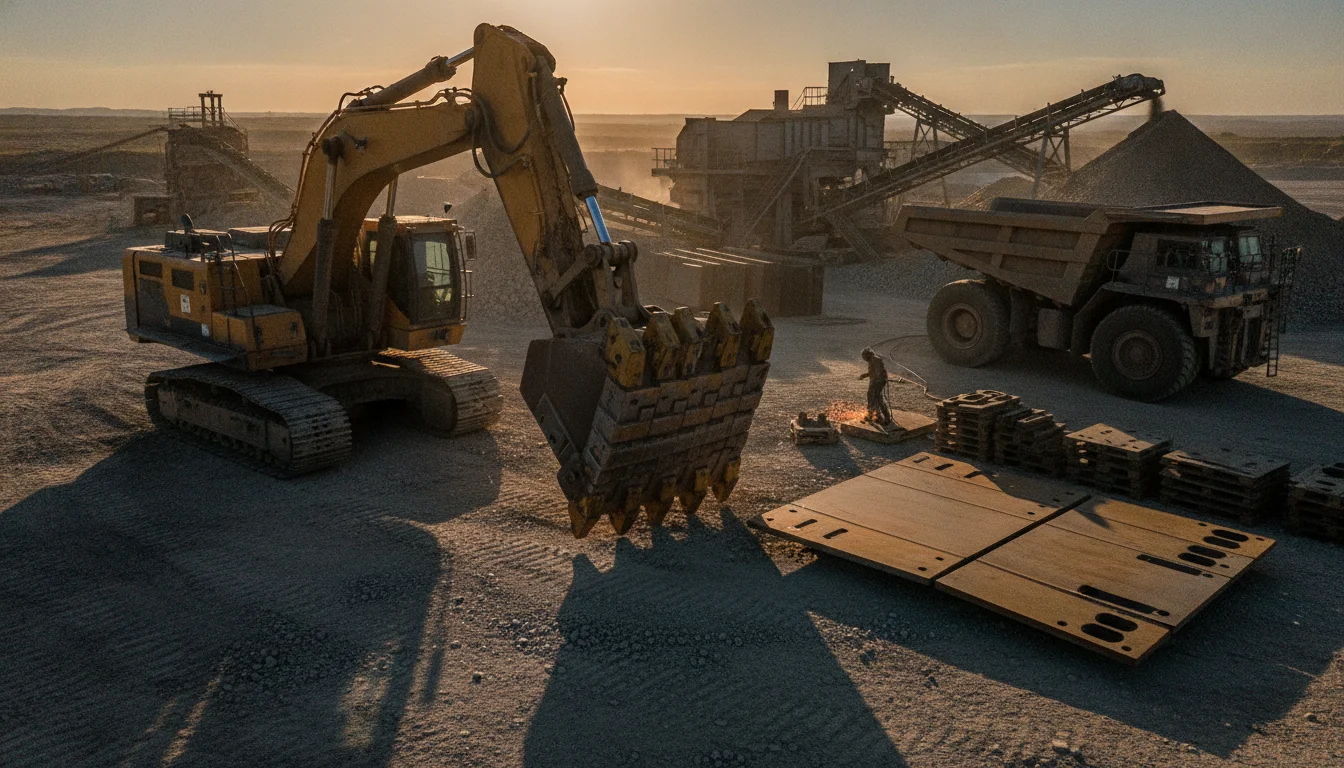
Material selection is the single most important decision in specifying wear parts. The four major families are manganese steels, chrome white irons, carbide-inserted alloys, and weld-overlay plates. Each has a specific combination of hardness, toughness, and impact resistance that suits different wear modes.
Manganese and Alloy Steels
Manganese steel, often called Hadfield steel, work-hardens under impact. It is tough and well suited to crusher liners and bucket lips where repeated hammering occurs. Mining Wear Parts casts manganese liners with end-user specific chemistry and reengineers profiles to improve fit and service life.
Chrome White Iron
Chrome white iron is a cast iron alloy with high chromium carbides that resist sliding and gouging abrasion. According to Penticton Foundry, high chrome white iron outlasts AR400 by a factor of 10 and AR600 by a factor of 3 in mining abrasive conditions. This material is ideal for chute liners, grizzly screens, apron feeder liners, and cyclone components.
"We inspected the Apron Feeder liners you supplied early in 2016. They are in near new condition after 10 months of service. I am very pleased with their performance thus far." - Maintenance Manager, New Gold (via Penticton Foundry)
Carbide-Inserted and Overlay Products
Carbide-inserted alloys embed titanium carbide particles in a steel matrix. WISE Mining Machinery reports that its TiC-inserted alloy wear parts double service life, while Farmonaut states that carbide mining wear parts can last up to 10 times longer than traditional steel in abrasive conditions. Overlay products like Duroxite are targeted at severe sliding wear from quartz-bearing ore, with cutting edges hardened up to 600 HBW and an operating temperature range from -40°C to 400°C, according to Abraservice.
| Material Type | Relative Wear Life | Best Applications | Example Products |
|---|---|---|---|
| Manganese steel | Work-hardens under impact | Jaw/cone/gyratory liners, bucket lips | MWP manganese crusher liners |
| Chrome white iron | 10x AR400, 3x AR600 | Chutes, grizzlies, apron feeders, cyclones | Penticton chrome white iron castings |
| TiC-inserted alloy | Doubles service life | Jaw plates, hammer heads, cone liners | WISE Mining Machinery parts |
| Carbide wear parts | Up to 10x longer than steel | Drills, cutting edges, high-abrasion zones | Farmonaut-recommended carbide parts |
| MARBAIN heat-treated steel | 30% wear resistance improvement vs. traditional austempering | Ground engaging tools, crawler shoes, wear plates | Fisher Barton components |
| Hardox / Duroxite overlay | Hardness up to 600 HBW | Cutting edges, chutes, bucket liners | Abraservice fabricated parts |
Pros and Cons of Aftermarket Mining Machinery Wear Parts
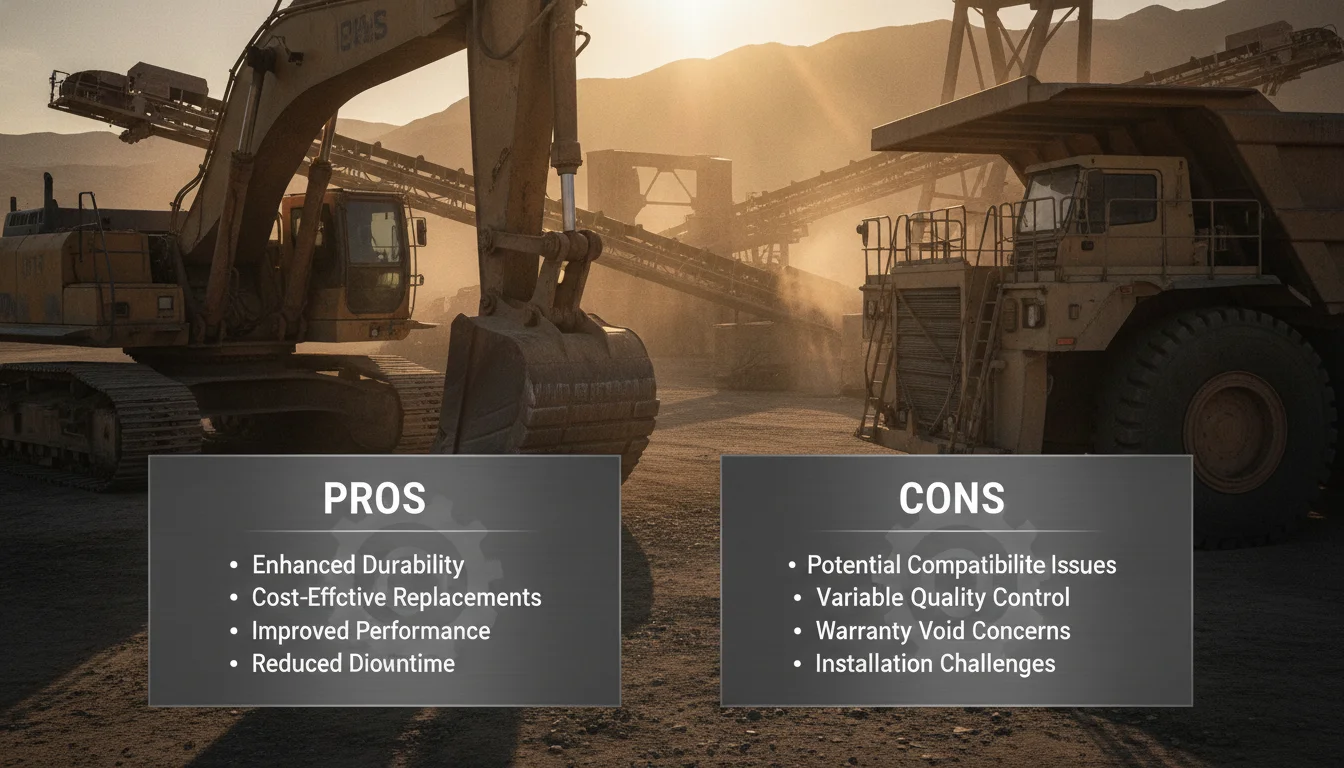
Aftermarket wear parts are a practical reality for most global mining operations. Understanding where they excel and where they require caution helps procurement teams make confident decisions.
Pros
- Competitive pricing compared to OEM catalog prices, often with equivalent or superior material chemistry.
- Faster availability: suppliers like Unified Screening and Crushing maintain large ready-to-ship inventories of crusher wear parts, reducing lead times for critical components.
- Custom engineering options: aftermarket manufacturers can reengineer liner profiles and GET geometry to suit specific ore conditions, something OEM catalogs rarely offer.
- Documented performance: reputable suppliers provide material certificates, hardness reports, and field case studies to back performance claims.
- Broader compatibility: quality aftermarket parts cover 40-plus equipment brands from a single supplier relationship.
Cons
- Variable quality across suppliers: without material certificates, buyers have no way to verify alloy chemistry or heat treatment compliance.
- Fit risk on complex geometries: poorly patterned liners or GET adapters can seat incorrectly, accelerating wear on adjacent structures.
- Warranty considerations: aftermarket parts are warranted by the manufacturer, not the OEM, so buyers must confirm the supplier's own warranty terms before ordering.
- Lead time uncertainty from low-tier suppliers: not all aftermarket sources carry stock, and custom orders from offshore foundries can extend lead times significantly.
What to Look For When Buying Mining Machinery Wear Parts
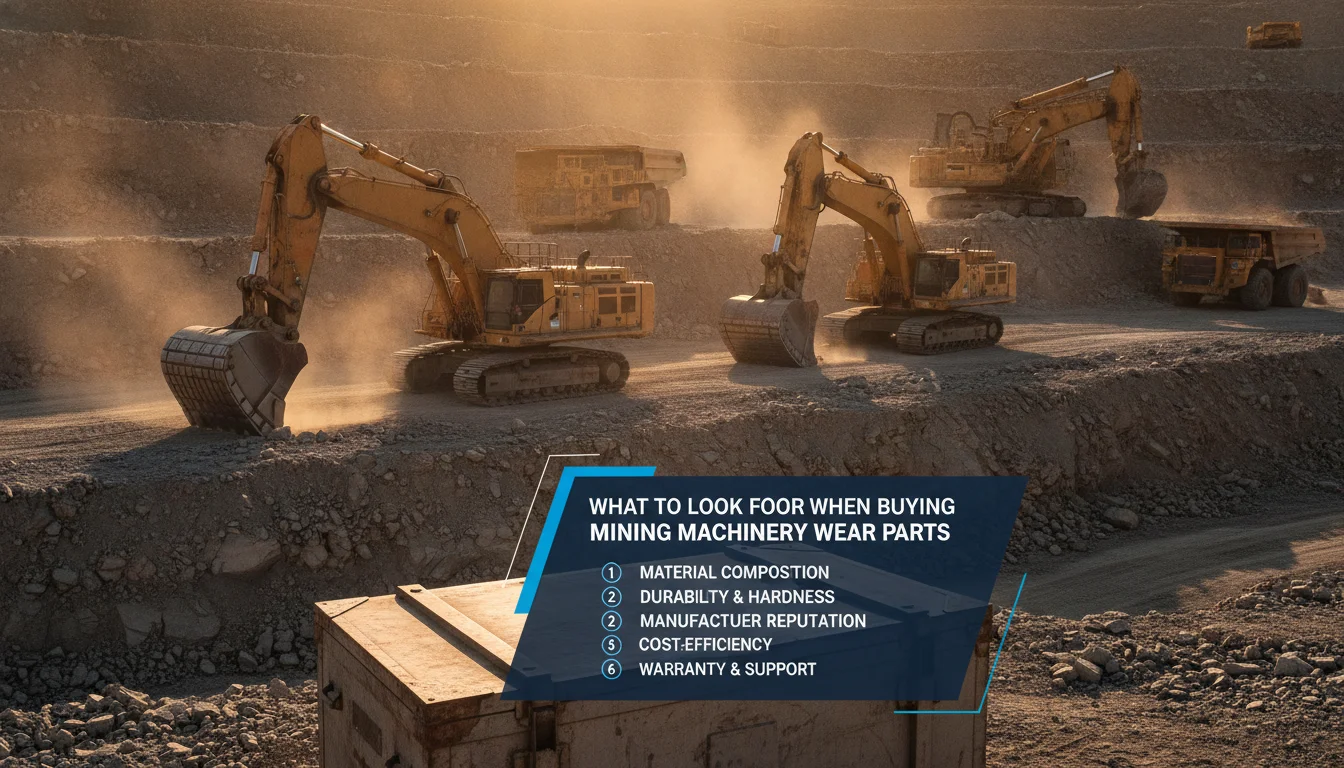
Buying parts requires more than matching a part number. You need to evaluate dimensional fit, material chemistry, supplier inventory, and the true cost of ownership. Start with the operating conditions, not the catalog.
Dimensional Fit and OEM Compatibility
Aftermarket parts are not all created equal. Precision machining, pattern accuracy, and hole placement determine whether a liner seats correctly or a tooth locks onto an adapter. Mining Wear Parts notes that all brand names, model names, and marks are used for identification purposes only and parts are manufactured by them, not the OEM. Verify drawings, 3D scans, or sample measurements before ordering.
Hardness and Toughness Trade-Offs
A common mistake is chasing maximum hardness. Hard materials resist abrasion but can crack under impact. Manganese steel offers toughness; chrome white iron offers abrasion resistance; carbide inserts offer both in specific zones. Fisher Barton's MARBAIN material improves wear resistance by 30% compared to traditional austempering while reducing brittleness, which shows that balanced metallurgy matters more than a single hardness number.
Cost Per Hour Instead of Purchase Price
The only honest way to compare two GET or liner products is cost per hour, not the upfront tag. Heavy Vehicle Inspection warns that a $40 bucket tooth can destroy a $4,000 structure behind it if not replaced on time, and wear passing the adapter can cause a 10x cost jump. Any procurement team sourcing mining machinery should ask each supplier for field wear data or case studies that show cost per hour for the specific application.
"Every bucket tooth, shovel lip and crusher liner on your site is being consumed right now, hour by hour, and in most operations nobody can tell you the actual wear rate until something fails." - Heavy Vehicle Inspection
Price Range Expectations: Budget, Mid-Range, and Premium Tiers
Price tiers for mining machinery wear parts should align with your ore hardness, production targets, and maintenance labor cost. Higher upfront cost often lowers total cost per ton when downtime is expensive.
Budget Tier (Standard Manganese and Basic Steel)
Budget wear parts typically use standard manganese or low-alloy steels. They suit low-abrasion, low-impact applications or short-term projects. The risk is frequent replacements and higher labor costs, especially if the machine operates in a remote location.
Mid-Range (Heat-Treated Steels and Chrome White Iron)
Mid-range options include heat-treated alloy steels, chrome white iron castings, and quality manganese with controlled chemistry. These parts balance price and wear life. According to Mining Wear Parts, reengineered manganese liners and bi-metallic parts can reduce operating cost without reaching premium prices.
Premium Tier (Carbide-Inserted, MARBAIN, and Overlay)
Premium mining machinery wear parts use TiC inserts, MARBAIN heat treatment, or Hardox/Duroxite overlays. These are justified in high-abrasion, high-tonnage operations. WISE Mining Machinery's TiC-inserted parts double service life, and Abraservice's Duroxite overlay targets severe quartz sliding wear. Expect to pay more per part, but with documented lower cost per hour in the right application.
Step-by-Step Supplier Evaluation Process
Choosing a supplier for mining machinery wear parts is a repeatable process. Follow these steps to avoid unplanned downtime and unverified performance claims.
- Document operating conditions: Record ore type, moisture, impact energy, and current part life in hours.
- Request material certificates: Ask for chemistry, hardness, and microstructure reports. Verify the alloy matches the wear mode.
- Request field references: Ask for case studies from similar mines. Mining Wear Parts published a D10T dozer GET cost reduction case study showing measurably lower operating cost, which demonstrates real field results rather than catalog claims.
- Confirm inventory and lead time: Check stock levels of critical parts. Unified Screening and Crushing maintains large ready-to-ship crusher wear part inventories, and WISE Mining Machinery operates with 10,000-ton annual capacity. Fast delivery reduces the need to overstock.
- Evaluate warranty terms: Confirm whether the supplier warranties their own parts and what the return policy covers for custom-engineered liners or fabricated components.
Matching Wear Parts to Equipment Profiles
Use these combinations as starting points for common applications:
- Jaw crusher in abrasive rock: Manganese jaw liners plus chrome white iron cheek plates.
- Cone crusher in high-impact ore: Manganese cone liners with work-hardening properties plus TiC inserts in high-wear zones.
- Bucket loading sharp quartz: Carbide-inserted teeth plus Hardox 500 Tuf cutting edges.
- Screen deck handling wet fines: Polyurethane panels plus rubber crown bar supports.
Common Supplier Evaluation Mistakes
Avoid these pitfalls: buying on price alone, ignoring lead times for remote sites, skipping material certificates, and failing to track cost per hour after installation. These mistakes turn predictable wear into unplanned downtime.
Abraservice Custom Fabrication: Cutting Edges and Pipe Sections
Abraservice produces cutting edges in any shape and profile, using steels with hardness up to 600 HBW that operate across a temperature range from -40°C to 400°C. Beyond cutting edges, the company fabricates pipe sections, chute sections, pan conveyor slats, feeder liner plates, and shovel bucket floors. Parts are produced from the machine builder's drawings or by measuring existing components and recreating well-fitting replacements. For operations dealing with severe quartz sliding wear, Duroxite overlay plate is the recommended solution. This level of custom fabrication capability matters for sites where standard catalog parts simply do not fit the equipment or the ore conditions.
Care and Maintenance for Extended Wear Life
Even the best mining machinery wear parts fail early if installed or maintained poorly. A disciplined maintenance routine extends component life and prevents collateral damage to expensive structures.
Inspection and Measurement
Measure wear at fixed intervals using calipers, depth gauges, or ultrasonic thickness meters. Record remaining thickness against the manufacturer's discard threshold. Heavy Vehicle Inspection notes that teeth get changed when they look bad, liners when throughput drops, and adapters get destroyed quietly behind them. Scheduled measurement stops that cycle before it starts.
Rotating and Rebuilding
Rotate liners and screens where possible to even out wear patterns. Rebuild worn surfaces with hardfacing or weld overlay if the substrate is sound. Mining Wear Parts offers hard facing services for grader blades in Pilbara iron ore operations, extending life without full replacement.
Documentation and Tracking
Track cost per hour for each product family. A simple log of part number, installation date, hours run, and removal reason builds a database that proves which supplier earns its place on your fleet. As Heavy Vehicle Inspection states, cost per hour is the only honest way to compare two GET products side by side.
Selecting the right mining machinery wear parts means combining material chemistry, precise dimensional fit, supplier lead time, and measured cost per hour. Use the comparison table and step-by-step process above to move from guesswork to managed wear costs. Shop OEM-quality spare parts with global 5-day delivery at 3genexport.com.
Frequently Asked Questions
What are the most common mining machinery wear parts?
Crusher liners, ground engaging tools, screen media, pump liners, and conveyor skirting are the most common. These parts absorb abrasion and impact to protect expensive structural components from premature failure.
How do I choose the right wear material for my application?
Match the wear mode to the material: impact calls for manganese steel, sliding abrasion calls for chrome white iron or carbide, and severe quartz sliding calls for overlay plates like Duroxite. Always verify the material chemistry with a certificate before ordering.
Are aftermarket mining machinery wear parts as good as OEM?
Aftermarket parts can match or exceed OEM life when manufactured to correct chemistry and dimensional fit. Always request material certificates and field case studies before buying, and confirm the supplier's own warranty terms.
What is the best value in mining wear parts?
The best value is the lowest cost per hour, not the lowest purchase price. A mid-range chrome white iron part often outperforms a cheaper manganese part in abrasive ore over a full replacement cycle.
How often should I replace bucket teeth and crusher liners?
Replace when measured thickness reaches the manufacturer's discard threshold, not when the part looks worn. Delaying replacement of a $40 tooth can damage a $4,000 adapter or bucket lip, creating a cost jump that far exceeds the savings from running the part longer.
Can I return unused wear parts?
Return policies vary by supplier. Confirm restocking fees and return windows before ordering, especially for custom-engineered liners or fabricated parts with no standard resale market.