
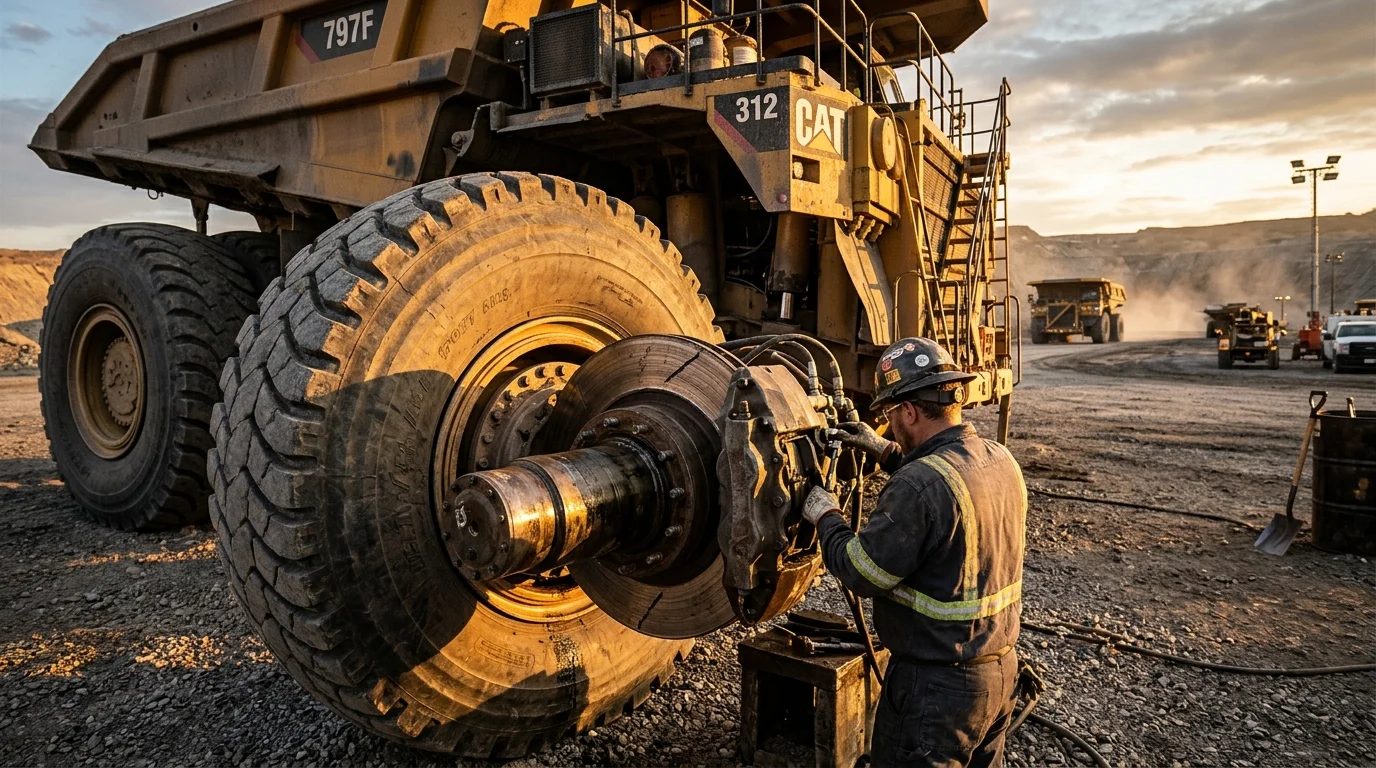
Mining Truck Brake Parts: Complete Guide 2026
Mining truck brake parts are critical for fleet safety. Compare OEM vs aftermarket options, maintenance tips, and get fast global delivery at 3genexport.
Loading article…
Article Not Found
The article you're looking for doesn't exist or may have been removed.
Back to BlogMining truck brake parts are the safety-critical components that stop ultra-class haul trucks carrying payloads up to 400 tons on steep pit grades. Choosing the right parts, maintaining them correctly, and sourcing them fast keeps your fleet running and your operators safe.
Key Takeaways
- Mining haul trucks rely on four distinct braking systems: service, retarder, parking, and emergency.
- Cryogenically treated rotors outlast conventional rotors by a significant margin, as confirmed by Alcoa's field trial on Komatsu 730E trucks.
- OEM parts guarantee fit and performance; quality aftermarket parts can reduce procurement costs when compatibility is verified.
- Pre-shift brake inspections are required by MSHA standard 30 CFR 56.14101 and are non-negotiable for safe operations.
- Replace brake pads before they wear below the manufacturer's minimum thickness to maintain full stopping power.
- Global sourcing from a specialist supplier cuts lead times and keeps your fleet moving.
Understanding Mining Truck Brake Parts
Mining truck brake systems are engineered specifically for severe-environment, mission-critical duty: stopping hundreds of tons of loaded truck on grades that can run 8 to 10% for thousands of feet. The four systems work together, and a defect in any one of them is a life-safety issue, not just a maintenance inconvenience. According to industry inspection data, brake-related problems account for roughly 30% of haul truck incidents, which is why regulators and fleet managers treat brake condition as the highest-priority daily check.
Main Components of Mining Truck Brakes
- Brake Pads: The friction material that clamps against the rotor to generate stopping force. In mining applications, pads face extreme heat cycles and must resist both wear and cracking.
- Brake Rotors: Large-diameter discs that absorb and dissipate braking energy. On a Komatsu 730E, for example, each front side uses a 46-inch diameter rotor operated by three calipers, while each rear side runs two 25-inch rotors.
- Calipers: Hydraulic or mechanical assemblies that apply clamping force to the pads. Wilwood Engineering and Carlisle Brake & Friction both manufacture calipers purpose-built for haul truck and earthmoving duty.
- Hydraulic Systems: Master cylinders, fluid reservoirs, proportioning valves, and brake control manifolds that translate pedal input into consistent clamping force across all axles.
- Oil-Cooled Disc Assemblies: Used on wet-brake configurations such as the Cat 735 articulating haul truck, which uses 11 oil-bathed discs per wheel-brake unit on the front and middle axles.
Types of Mining Truck Brake Systems
Four distinct systems protect a loaded haul truck on every descent:
- Service Brakes: The primary stopping system, required by MSHA 30 CFR 56.14101 to stop and hold the loaded truck on the steepest grade it travels.
- Retarder Brakes: Electric or hydraulic retarders that control speed continuously on long descents, preventing service brake fade under sustained load.
- Parking Brakes: Spring-applied, hydraulically released systems that hold the truck stationary on grade when the engine is off.
- Emergency/Secondary Brakes: The last line of defense if service brakes fail, required to be independent of the primary system.
Pros and Cons of OEM vs Aftermarket Brake Parts
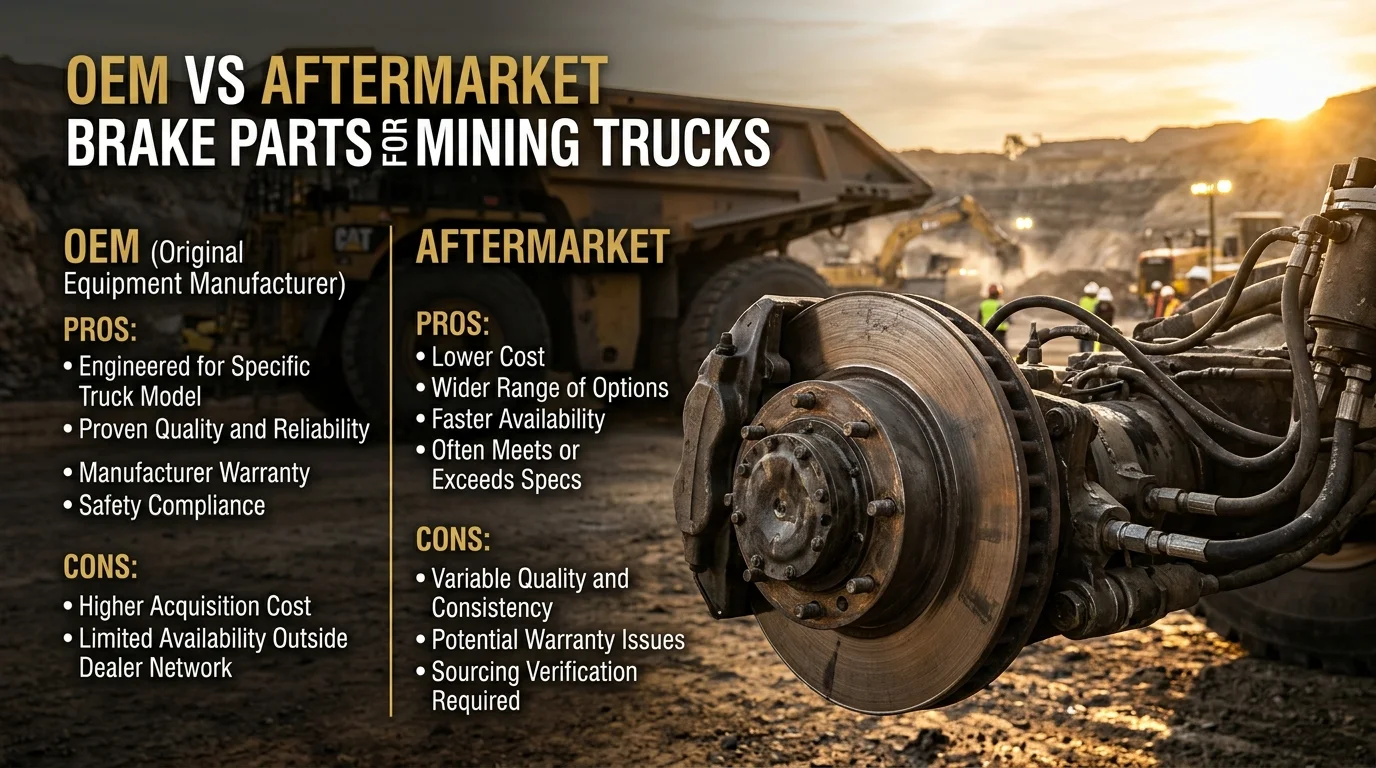
Pros
- OEM parts guarantee dimensional accuracy and material specification for your exact truck model, eliminating compatibility risk.
- Quality aftermarket parts can reduce procurement costs and shorten lead times, especially for high-volume consumables like brake pads and slack adjusters.
- Cryogenically treated components deliver measurably longer service life, reducing the total number of replacement events per machine per year.
- Specialist global suppliers stock both OEM and verified aftermarket options, giving procurement teams flexibility without sacrificing quality.
Cons
- OEM parts carry higher unit costs and can have longer lead times from the original manufacturer, which hurts fleet availability.
- Low-quality aftermarket parts vary widely in material specification and may fail prematurely under the thermal and mechanical loads of mining duty.
- Cryogenic treatment adds upfront cost per component, which requires a longer planning horizon to justify through lifecycle savings.
- Sourcing from multiple vendors without a single point of accountability increases the risk of receiving mismatched or incorrectly labeled parts.
What to Look For When Buying Brake Parts for Haul Trucks
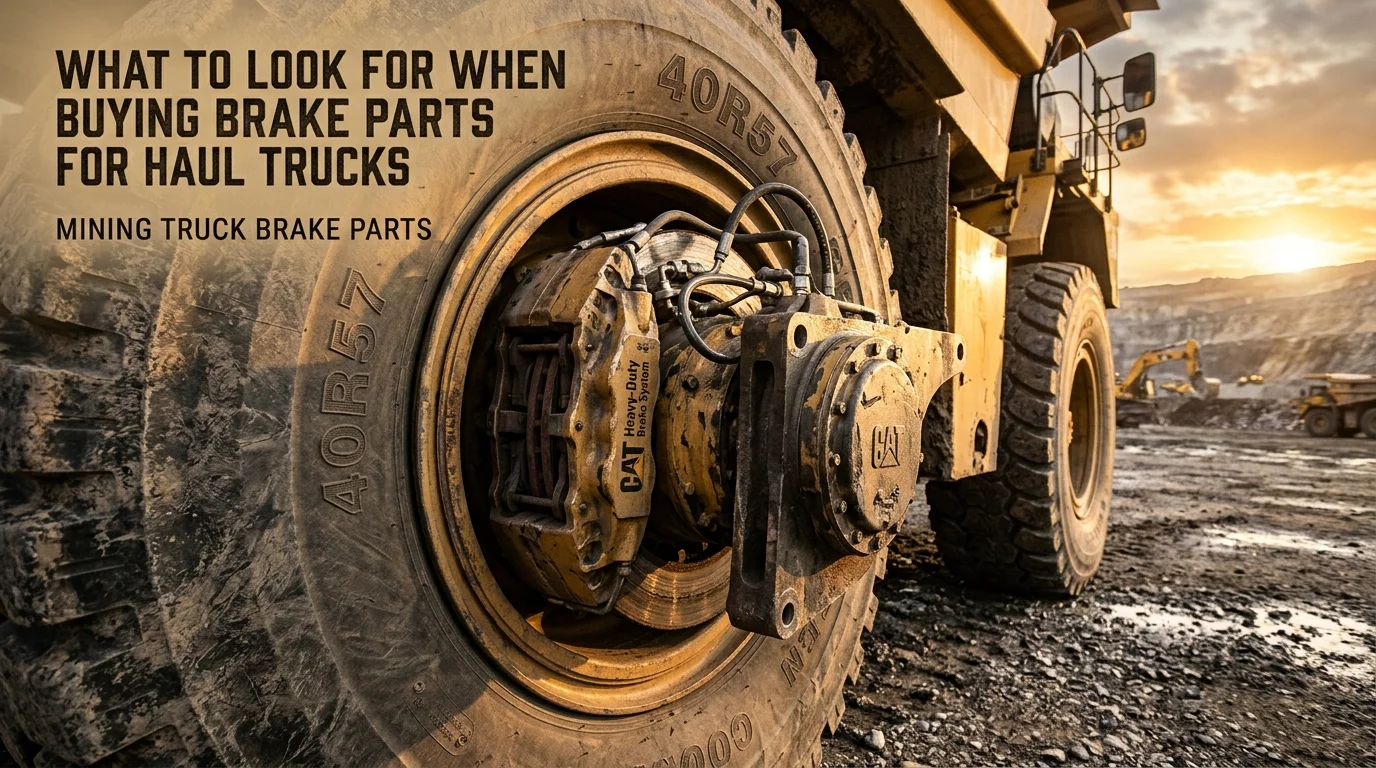
The right purchase decision starts with three criteria: material quality, verified compatibility, and total cost of ownership, not just unit price.
Material Quality
Brake components for mining duty must handle extreme thermal cycling, abrasive dust, and sustained mechanical load. Look for rotors and pads made from iron, steel, carbon fiber, or aluminum alloys that meet OEM material specifications. Cryogenically treated rotors have demonstrated superior resistance to surface cracking in field conditions, as documented in Alcoa's Komatsu 730E trial. Carlisle Brake & Friction has engineered high-density paper and carbon paper friction discs specifically for large-scale wet brake systems used in haul trucks.
Fit and Compatibility
Verify part numbers against your truck's service manual before ordering. OEM parts carry the original equipment manufacturer's dimensional guarantee. Aftermarket parts should cross-reference to a verified OEM part number. For Caterpillar, Komatsu, Volvo, and other major brands, our team at 3GEN Export can confirm compatibility before your order ships.
Total Cost of Ownership
Unit price is only part of the equation. Downtime on an ultra-class haul truck costs between $5,000 and $20,000 per hour, according to industry maintenance data. A brake pad or rotor that lasts longer between replacements reduces both parts spend and labor cost over the machine's life. Cryogenically treated rotors, for instance, demonstrated that the treated rotor outlasted at least three conventional rotors in Alcoa's documented field trial, making the higher upfront cost straightforward to justify.
Cryogenic Treatment: A Proven Case Study
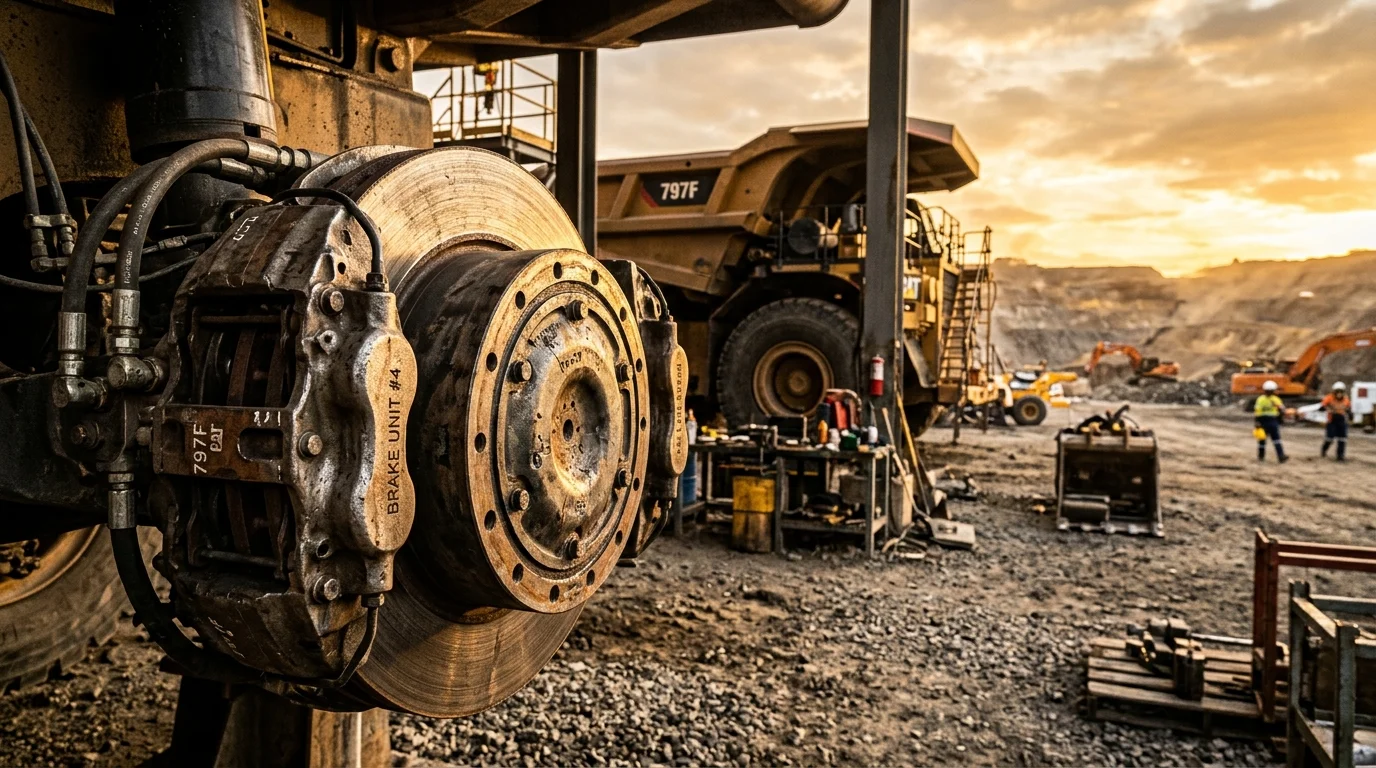
Cryogenic treatment of brake rotors is one of the most well-documented performance upgrades available for mining haul truck brake systems. Alcoa's mining operation in Western Australia ran a controlled field trial on Komatsu 730E trucks, comparing cryogenically treated rotors against untreated rotors on opposite sides of the same truck.
The results were clear. After one month, the treated rotor showed no cracks while the untreated rotor had severe surface cracking. Pad wear on the treated side measured 1.5 mm versus 7 mm on the untreated side. At the five-month mark, the untreated side had already gone through its second replacement rotor, and that second rotor was cracking more severely than the first. The treated rotor was still in service with only minor cracking.
"It is obvious to date that the treated rotor will outlast at least 3 conventional rotors and in fact will be monitored weekly just to see how far it will go before it needs to be discarded." - Alcoa Mining Operations Report, Western Australia (via Controlled Thermal Processing)
The Komatsu 730E trucks in this trial have a gross weight of 715,000 pounds and stop from speeds up to 35 mph. Each front side carries a 46-inch diameter rotor operated by three calipers. The thermal and mechanical demands are extreme, which is exactly why material treatment makes such a measurable difference.
Comparing Brake Component Types
| Part Type | Common Materials | Durability | OEM vs Aftermarket | Key Consideration |
|---|---|---|---|---|
| Brake Pads | Carbon composite, friction material | High | OEM recommended | Replace before minimum thickness is reached |
| Brake Rotors | Iron, cryogenically treated steel | Very High (treated) | OEM preferred | Cryogenic treatment extends service life significantly |
| Calipers | Aluminum, steel | Medium to High | Aftermarket available | Verify hydraulic port compatibility |
| Hydraulic Components | Steel, aluminum | High | OEM recommended | Fluid compatibility and pressure rating critical |
| Slack Adjusters | Steel | High | Both available | Automatic adjusters reduce manual inspection frequency |
Mining Haul Truck Brake Inspection Checklist
Pre-shift brake inspection is required by MSHA standard 30 CFR 56.14101 for all self-propelled mobile equipment. Any safety defect must be tagged out until repaired. Here is the core inspection sequence your team should follow every shift.
Step 1: Visual Check of Brake Components
Walk around the truck and inspect rotors, calipers, and pad assemblies for visible cracks, scoring, or fluid leaks. On wet-brake systems, check for oil contamination around the wheel-end seals. Flag any rotor with deep or open cracking for immediate replacement.
Step 2: Hydraulic System Check
Verify fluid levels in the master cylinder reservoir. Check brake lines and fittings for leaks or chafing. Confirm that brake control manifold pressure readings are within the manufacturer's specified range.
Step 3: Retarder Function Test
Engage the retarder at low speed and confirm it applies smoothly and holds the truck's speed on a controlled grade. A retarder that hesitates, surges, or fails to hold speed must be investigated before the truck enters service on a descent.
Step 4: Parking Brake Grade-Hold Test
Apply the parking brake on a representative grade and confirm the truck holds stationary with the engine running. MSHA requires the parking brake to hold the loaded truck on the steepest grade it travels.
Step 5: Service Brake Stopping Test
Perform a controlled stop at low speed and confirm pedal feel, stopping distance, and brake balance are within normal parameters. Spongy pedal feel or pulling to one side indicates a hydraulic or pad issue that needs attention before the shift starts.
Step 6: Document and Tag Out
Record inspection results for every system. Any defect that affects safe operation requires an immediate tag-out. Keep records audit-ready for MSHA compliance.
Care and Maintenance of Brake Parts
Regular maintenance is the difference between a brake system that performs reliably for its full service life and one that fails at the worst possible moment.
Inspection Schedule
Conduct pre-shift inspections before every operating shift. Check for wear, fluid levels, rotor condition, and any signs of thermal damage. Daily inspection is not optional on heavy mining equipment: it is a regulatory requirement and your primary early-warning system.
Replacement Protocols
Replace brake pads at the first sign of significant wear. According to manufacturer service bulletins, pads worn below the minimum specified thickness lose their ability to generate consistent stopping force and must be replaced immediately. Rotors showing deep surface cracking should be replaced rather than machined, as cracking compromises structural integrity under thermal load.
Cleaning and Lubrication
Keep brake components clean and use only manufacturer-recommended lubricants on caliper slide pins and hardware. Avoid petroleum-based products on friction surfaces. On wet-brake systems, maintain oil quality and change intervals per the OEM service schedule to prevent friction disc glazing.
"Investing in high-quality brake components is not just about regulatory compliance. It's about ensuring operator safety and protecting the operational continuity of your fleet. Timely replacement and disciplined maintenance schedules consistently deliver lower total maintenance costs over the machine's life." - 3GEN Export Technical Team, based on fleet maintenance experience across Caterpillar, Komatsu, and Volvo haul truck fleets
Frequently Asked Questions
What are the main components of mining truck brakes?
Mining haul truck brake systems include brake pads, rotors, calipers, hydraulic master cylinders, proportioning valves, and retarder assemblies. Each component plays a specific role: pads and rotors generate friction, calipers apply clamping force, and the hydraulic system transmits pedal input to all axles consistently.
How often should brake parts on haul trucks be inspected?
MSHA standard 30 CFR 56.14101 requires self-propelled mobile mining equipment to be inspected before every shift. Any defect affecting safe operation must be tagged out until repaired. Daily inspection is both a regulatory requirement and the most effective way to catch wear before it becomes a failure.
What is the difference between OEM and aftermarket brake parts?
OEM parts are manufactured to the original equipment manufacturer's exact specifications for a specific truck model, guaranteeing dimensional fit and material performance. Aftermarket parts can offer cost savings and shorter lead times, but quality varies significantly. Always verify aftermarket parts against the OEM part number before installation on safety-critical systems.
Are cryogenically treated brake rotors worth the investment?
Yes, based on documented field evidence. Alcoa's controlled trial on Komatsu 730E haul trucks showed that a cryogenically treated rotor outlasted at least three conventional rotors under identical operating conditions. Pad wear on the treated side measured 1.5 mm versus 7 mm on the untreated side over the same period, reducing both parts and labor costs.
What is the 30/30/30 rule for brakes?
The 30/30/30 rule is a general heavy vehicle brake adjustment guideline, not a mining-specific standard. In mining haul truck operations, MSHA's 30 CFR 56.14101 is the governing standard, requiring service brakes to stop and hold the loaded truck on the steepest grade it operates and mandating pre-shift inspection before every operating shift.