
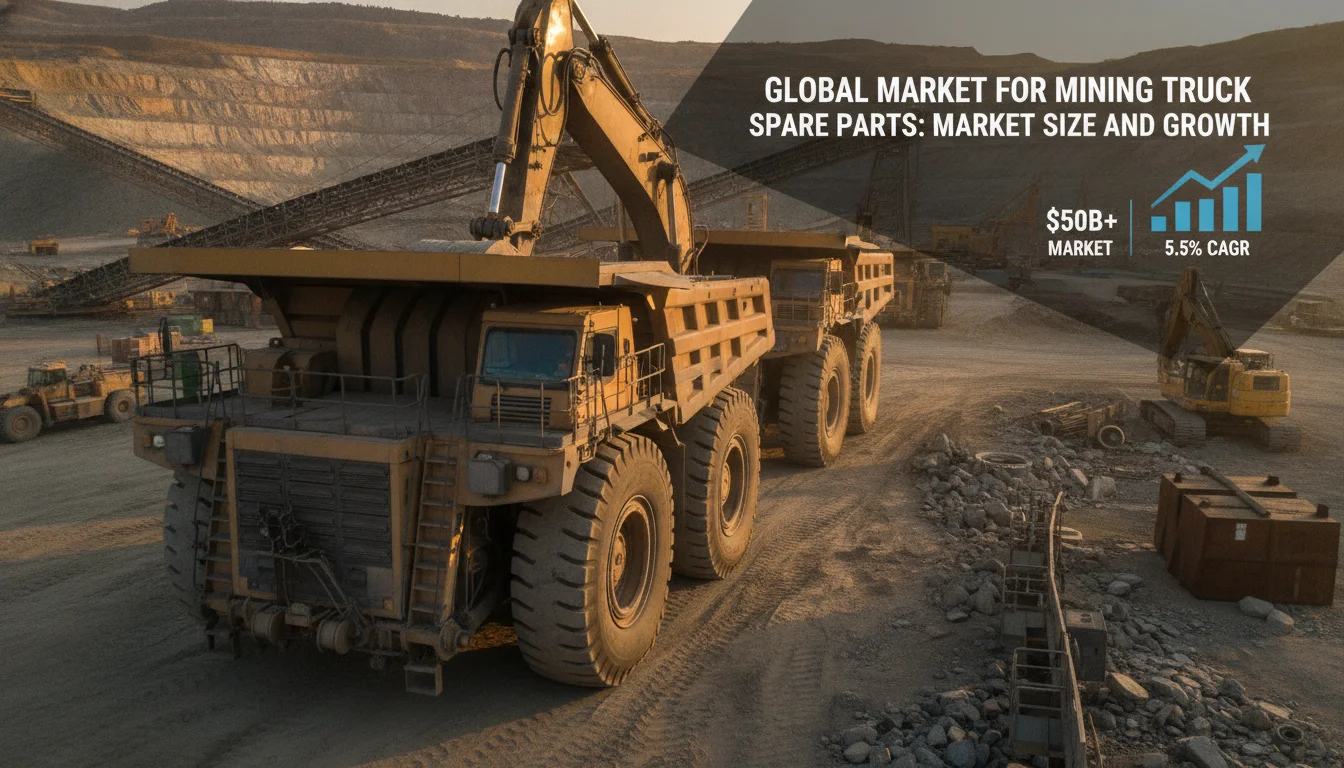
Mining Truck Spare Parts Global Market 2026
The mining truck spare parts global market hits $174B in 2025. Explore OEM vs aftermarket sourcing, regional trends, and fast global delivery options.
Loading article…
Article Not Found
The article you're looking for doesn't exist or may have been removed.
Back to BlogThe mining truck spare parts global market is the segment covering all replacement components, from engine assemblies to hydraulic cylinders, needed to keep heavy haul trucks running in surface and underground mines worldwide. As of 2026, this market sits within a broader construction and mining equipment spare parts sector valued at USD 174.04 billion, according to Mordor Intelligence.
Key Takeaways
- The global market sits within a broader sector valued at USD 174.04 billion in 2025, forecast to reach USD 264.12 billion by 2030 at a CAGR of 8.7%.
- Aftermarket channels are expanding at 12% annually as OEMs discontinue parts for trucks older than 10 to 20 years.
- Asia-Pacific leads both market size and growth velocity, powered by mining and infrastructure booms in China, India, and Indonesia.
- Electrification, advanced materials, and predictive maintenance are reshaping part specifications and procurement strategies across the industry.
- Quality aftermarket solutions can reduce downtime by up to 28% and extend component life by as much as 40%, per industry reports.
- Remanufactured components offer up to 50% cost savings while supporting circular economy goals in Europe and North America.
Market Size and Growth of the Mining Truck Spare Parts Global Market
The this type of market is a critical yet often underestimated segment of the heavy machinery ecosystem. It covers all components needed to maintain, repair, and upgrade the massive dump trucks operating in mines worldwide. These parts range from engine and powertrain assemblies to hydraulic cylinders, electrical systems, and undercarriage wear items. According to a Mordor Intelligence report, the broader construction and mining equipment spare parts market was valued at USD 174.04 billion in 2025 and is expected to climb to USD 264.12 billion by 2030, reflecting a CAGR of 8.7%. This expansion underscores the increasing importance of after-sales support as mining operations scale up globally.
Overall Market Valuation and Forecast
The mining truck spare parts segment is substantial within the broader equipment aftermarket. The mining truck market itself (new vehicles) is measured separately: Market Research Future estimates the mining truck market at USD 16.56 billion in 2024, growing to USD 24.79 billion by 2035 at a CAGR of 3.73%. The Business Research Company puts the mining truck market at USD 31.09 billion in 2025, forecast to reach USD 42.14 billion by 2030 at a CAGR of 6.2%. The aftermarket for parts typically represents a larger, more stable revenue stream over the 20-plus year lifespan of a mining truck. Research Nester projects the combined dump and mining trucks market will reach USD 58.11 billion by 2035, with a 5.5% CAGR. Every new truck added to the global fleet eventually requires thousands of replacement components, feeding directly into the spare parts pipeline.
Regional Dynamics and Spending Patterns
Spending on mining truck spare parts varies sharply by region. Asia-Pacific not only constitutes the largest market but is also expanding fastest, driven by massive infrastructure projects and mineral extraction in China, India, and Indonesia. North America and Europe focus more on modernizing existing fleets and adopting advanced technologies. Global Market Insights highlights that regulatory pressures in these mature markets push companies toward upgrades meeting stricter emissions and safety standards, generating distinct demand for emission-related components and advanced electronics.
Pros and Cons of the Mining Truck Spare Parts Global Market
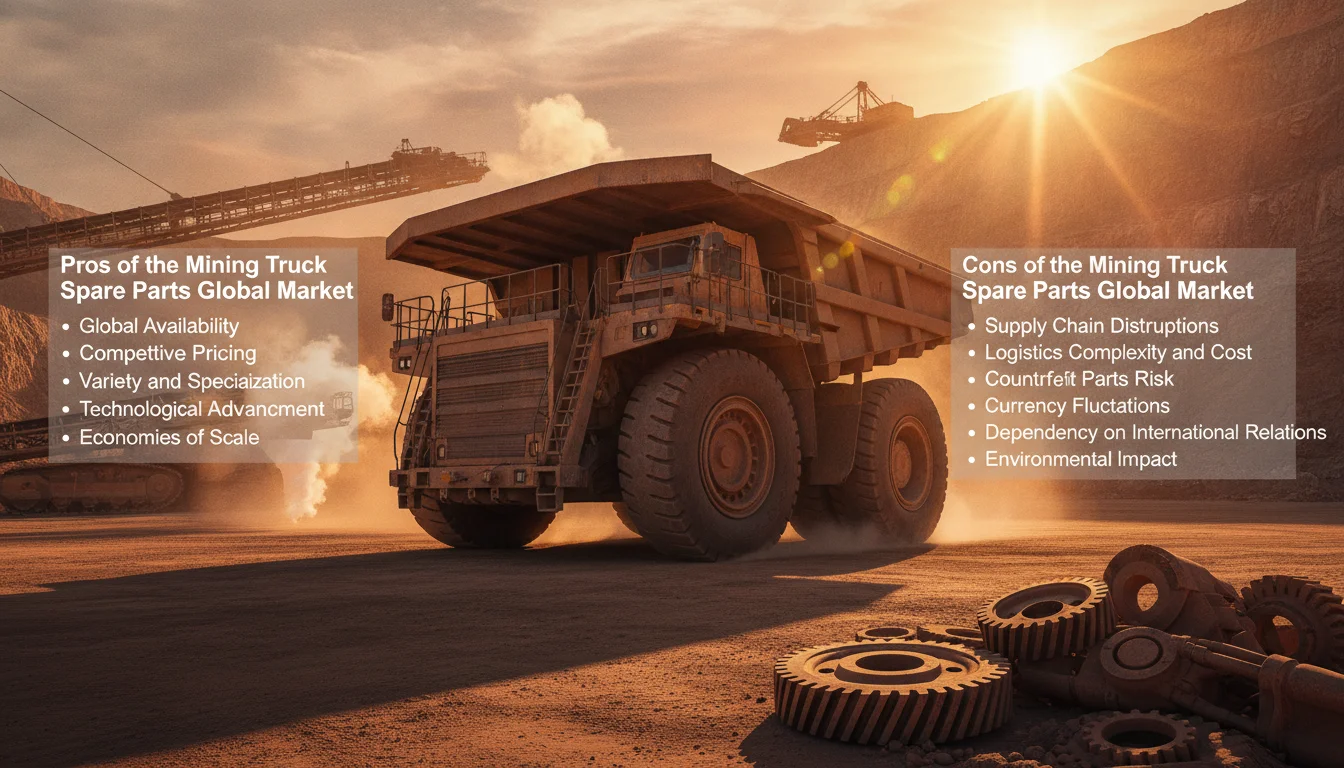
Pros
- Resilient, non-discretionary demand: Mines cannot stop operating, so spare parts spending holds up even during commodity price dips.
- Long asset lifespans: Mining trucks run for 20-plus years, creating decades of repeat parts revenue per vehicle.
- Aftermarket innovation: Advanced casting, composite materials, and predictive maintenance tools are raising aftermarket quality to near-OEM levels.
- Global growth tailwinds: Rising mineral demand for copper, lithium, and iron ore is expanding active fleets worldwide.
- Digital procurement: Online platforms and supplier portals have cut lead times by up to 50%, improving availability for remote mine sites.
Cons
- OEM discontinuation risk: Parts for trucks older than 10 to 20 years are frequently discontinued, forcing operators into complex aftermarket sourcing.
- Quality variance in aftermarket: Not all third-party suppliers meet OEM specifications; poor-quality parts can accelerate wear and increase total cost of ownership.
- Supply chain concentration: Production capacity for specialized mining truck components is concentrated in a few regions, creating bottlenecks during disruptions.
- Compliance cost pressure: Regulatory changes, particularly around emissions, increase costs for both manufacturers and buyers of replacement components.
- High carrying costs: The specialized nature of parts forces many operators to hold large safety stocks, tying up working capital.
Key Drivers in the Mining Truck Spare Parts Global Market
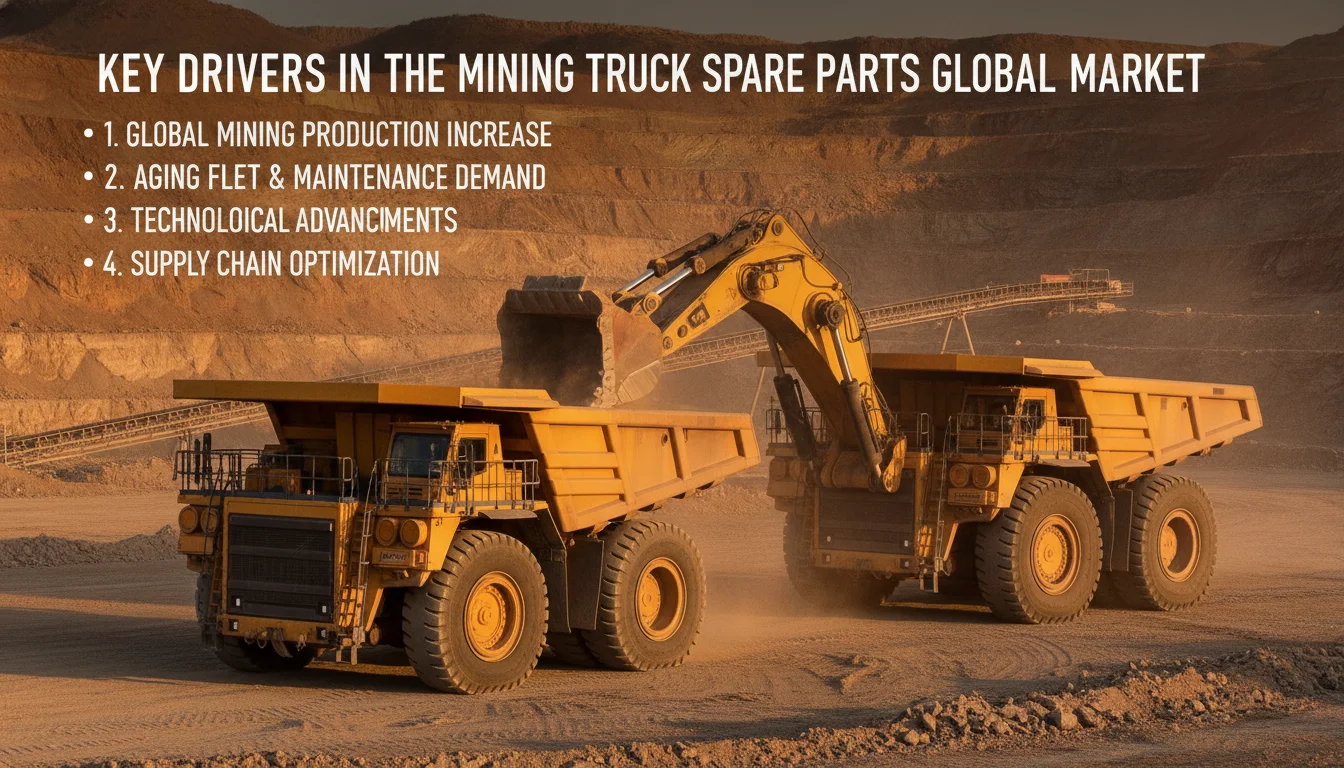
Several forces converge to propel the this kind of global market forward. Rising global mineral consumption, aging equipment fleets, and the constant pressure to maximize uptime all force mine operators to invest heavily in maintenance. The sub-sections below detail these drivers.
Expanding Mining Activities and Infrastructure Development
The relentless demand for minerals, including copper for electrification, lithium for batteries, iron ore for steel, and coal for energy, has spurred new mining projects and expansions worldwide. Transparency Market Research notes that rapid industrialization and urbanization are increasing the need for mined commodities, which directly elevates the requirement for haulage trucks and their associated spare parts. According to Mordor Intelligence, global urbanization rates rose from 55.6 percent to 57.3 percent between 2019 and 2023, fueling construction of housing, transportation, and commercial spaces that demand raw materials. Each new mine site or expanded pit requires a fleet of dump trucks operating around the clock in abrasive conditions, ensuring a steady stream of replacement orders for everything from tires to transmissions.
Aging Machinery and Fleet Maintenance Requirements
Mining trucks are built for extreme longevity, often staying in service for 20 years or more. That durability means a significant portion of the global fleet is now aging. Spuncast highlights that OEMs typically discontinue parts after a decade or two, leaving operators scrambling for alternatives. As machines pass the 10-year mark, wear components demand frequent replacement. The Mordor Intelligence study confirms that an aging installed base necessitates consistent upkeep, making maintenance and repair the single largest operational cost for many mines. This creates a resilient, non-discretionary demand profile for spare parts, insulating the the truck spare parts global market from short-term commodity price swings.
"When a mining truck is out of service, it can cost an operation millions of dollars. OEMs of large mining trucks will discontinue a part after a certain time, often a decade or two, making it nearly impossible to find replacement parts." - Joe Ferch, Business Development Manager, Spuncast
Technological Trends Reshaping Spare Parts Specifications
Technology is rewriting the rulebook for the market. As new trucks incorporate electrification, automation, and IoT connectivity, the replacement parts market must evolve in lockstep. Even older trucks now benefit from material and design innovations that boost longevity.
Electrification and Advanced Materials
The shift toward sustainability is accelerating the adoption of electric drive systems and hybrid technologies in mining trucks. Hebei Huigong reports that electric dump trucks can reduce operating costs by about 20 percent compared to diesel models, creating demand for specialized electrical components, battery management systems, and high-voltage cabling. Advanced composite materials are also entering the parts stream: research cited by the Mining Association shows that parts made from lightweight composites can decrease vehicle weight by 15 percent, improving fuel efficiency and reducing stress on other components. Improved metallurgy for steel parts extends durability, with some components showing lifespan extensions of over 30 percent, directly lowering replacement frequency.
Digitalization and Predictive Maintenance
Digital platforms are transforming how parts are procured and managed across the mining truck. Online marketplaces and supplier portals have cut lead times by up to 50 percent, according to Hebei Huigong, enabling mines to reduce stockpiling costs while maintaining availability. Predictive maintenance is even more impactful: by embedding sensors on critical components and analyzing the data, mines can forecast failures before they occur. This approach cuts maintenance costs by roughly 25 percent and slashes unplanned downtime. MarketsandMarkets notes that autonomous haulage systems further reduce fuel consumption and human error, increasing component life and altering demand patterns for brake systems and driveline components.
"By 2040, the International Council on Mining and Metals aims to see zero-emission surface mining equipment, a target that will accelerate turnover of parts catalogs and reshape procurement strategies across the industry." - MarketsandMarkets, Mining Machinery Market Report
Aftermarket vs. OEM: Sourcing Strategies for Mining Truck Spare Parts
A key decision for fleet managers is whether to buy OEM parts or source from the aftermarket. Each channel has distinct advantages and challenges, and the choice directly impacts cost, uptime, and machine longevity.
| Criteria | OEM Parts | Aftermarket Parts |
|---|---|---|
| Quality Consistency | Engineered to exact factory specifications, ensuring perfect fit and function. | Wide quality variance; premium aftermarket suppliers use ISO-certified processes and high-grade materials. |
| Price | Typically 20-40 percent higher than aftermarket alternatives, reflecting R&D and brand premium. | Often more cost-effective, with prices driven down by competition and reverse engineering. |
| Availability for Older Models | Discontinued after 10-20 years, creating obsolescence risks. | Specialist aftermarket firms can manufacture or source parts for legacy trucks, extending asset life. |
| Warranty & Support | Generally includes a manufacturer warranty and technical support. | Warranties vary; reputable suppliers offer guarantees, but coverage may be less comprehensive. |
| Innovation Adoption | May be slower to integrate new materials or geometries due to standardized production. | Agile aftermarket companies often pioneer advanced manufacturing like centrifugal casting, which can enhance component strength. |
The Role of OEM Parts and Discontinuation Challenges
OEMs such as Caterpillar, Komatsu, and Hitachi are the first choice for many mines because their parts are guaranteed to match the original design. However, as the Spuncast case study illustrates, when an OEM discontinues a critical component, such as a rear suspension cylinder, mine operators face serious consequences. Downtime costs can run into millions of dollars, as a single truck out of service halts production and incurs labor penalties. This obsolescence problem is especially acute for machines over 15 years old, which still represent a large portion of the global fleet. A robust aftermarket ecosystem has arisen specifically to fill the gaps left by OEMs.
Aftermarket Growth and Quality Considerations
The aftermarket segment is growing at 12 percent annually, per Hebei Huigong. This growth is fueled not only by discontinued parts but also by the promise of cost savings and improved performance. Companies like UHCO CHRISTENSEN use centrifugal casting to produce replacement cylinders that exceed original specifications in durability. When evaluating aftermarket suppliers, buyers should verify certifications such as ISO 9001, inspect material test reports, and check customer references. A well-chosen aftermarket partner can reduce downtime by up to 28 percent and extend component life by as much as 40 percent through recalibration and refurbishment services.
Component-Level Insights: What Parts Are Most in Demand?
Not all spare parts wear at the same rate. Understanding which components see the highest replacement frequency helps procurement teams prioritize inventory and negotiate better contracts across the global market.
Engine and Powertrain Components
Engines, transmissions, and differentials are among the costliest and most critical assemblies. Diesel engines in mining trucks operate under extreme loads and dusty conditions, leading to frequent rebuilds of cylinders, pistons, and fuel injection systems. Mordor Intelligence includes engine parts as a primary product type alongside transmission components such as torque converters and final drives. With the gradual shift toward electric drivetrains, demand is rising for electric motors, inverters, and cooling systems, parts that are currently proprietary and often require specialized sourcing.
Hydraulic Systems and Electrical Parts
Hydraulic cylinders, pumps, and valves are the muscle of any dump truck, powering the bed lift and steering. These components are subject to seal failures and rod scoring, making hydraulic repair kits a high-volume item. Electrical parts, including sensors, wiring harnesses, and control modules, are likewise in constant demand due to the harsh, high-vibration environment. The integration of telematics and autonomous systems has added a new layer of electronic complexity, making diagnostic-capable aftermarket parts essential. According to Mordor Intelligence's segmentation, electrical parts constitute a distinct and growing category within the this type of market.
Key Truck Brands and Compatible Part Categories
The brands that dominate new truck sales also define the largest aftermarket part categories. Caterpillar's 797 series, Komatsu's 930E, and Liebherr's T 284 are among the highest-payload trucks in global fleets, and their wear parts, including GET (ground engaging tools), brake assemblies, and suspension components, represent significant recurring spend. Komatsu HD785 and 730E models are widely used in mid-size operations across Asia-Pacific and Latin America, with a deep aftermarket ecosystem supporting them. Terex TR100 and BELAZ 75131 trucks are common in Eastern European and Central Asian mines, where aftermarket sourcing is often the only viable option for older units. Procurement teams should map their fleet by model and age to identify which part categories carry the highest obsolescence risk.
Regional Deep Dive: Where the Mining Truck Spare Parts Global Market Is Headed
Geographic disparities in mining intensity, fleet age, and regulatory environments create distinct conditions across the this kind of global market. The following regional analysis draws on multiple data sets to paint a complete picture.
Asia-Pacific: The Engine of Growth
Asia-Pacific dominates the the truck spare parts global market by both size and growth velocity. Mordor Intelligence and The Business Research Company concur that this region is the largest and fastest-growing. China alone operates the world's largest mining fleet and is home to a sprawling spare parts manufacturing hub, as documented in the video series "Inside China's Truck Spare Parts Market." India's ambitious infrastructure goals and Indonesia's mineral exports further amplify demand. Research Nester projects Asia-Pacific will hold a 34.5 percent share of the combined dump and mining trucks market by 2035, which directly correlates to a leading share in spare parts consumption.
North America and Europe: Modernization and Regulation
In North America, the largest mining truck market in 2025 per The Business Research Company, the focus is on retrofitting older trucks with emission-compliant engines and advanced safety features. Stringent EPA regulations drive demand for diesel particulate filters (DPFs), selective catalytic reduction (SCR) systems, and upgraded electronics. Europe similarly emphasizes sustainability: per MarketsandMarkets, the International Council on Mining and Metals aims for zero-emission surface mining equipment by 2040, which will accelerate turnover of parts catalogs. These regions also exhibit a stronger preference for certified remanufactured components, which offer a middle ground between OEM and generic aftermarket.
Competitive Landscape and Key Industry Players
The market features a mix of OEM giants and specialized aftermarket suppliers. Their strategies differ markedly, yet all are shaped by the macro trends discussed above.
Major OEMs and Aftermarket Specialists
On the OEM side, Caterpillar (US), Komatsu (Japan), Hitachi Construction Machinery (Japan), Volvo (Sweden), Sandvik (Sweden), and Liebherr (Germany) dominate new truck sales and thus control a large share of the genuine parts market. Their global dealer networks provide convenience but often at premium pricing. In the aftermarket arena, companies like Huigong (Hebei) Technology Co., Spuncast, and regional distributors have carved out niches by offering alternatives at competitive prices. Hebei Huigong exemplifies this model by stocking Komatsu-compatible parts and using data to reduce lead times. The Fortescue-Liebherr collaboration for zero-emission haul trucks, announced in July 2024, signals a future where OEMs and mine operators co-develop parts ecosystems from the ground up.
Strategies for Market Positioning
To stay competitive, suppliers are increasingly bundling services with parts. Full-service maintenance contracts, on-site inventory management, and predictive maintenance analytics are becoming common differentiators. Some aftermarket firms now offer IoT-enabled parts that communicate wear data directly to maintenance teams. Geographic expansion into high-growth regions, specifically establishing local distribution centers in Southeast Asia and Africa, shortens supply chains and cuts freight costs. As the market matures, consolidation is likely, with larger players acquiring niche manufacturers to broaden their product lines.
Challenges and Future Outlook for the Mining Truck Spare Parts Global Market
Despite its strong fundamentals, the mining truck spare parts global market faces real headwinds. Fluctuating commodity prices can delay investments, and regulatory changes impose compliance costs on manufacturers. The long-term trajectory remains positive, underpinned by the world's sustained appetite for minerals.
Supply Chain and Cost Pressures
Global supply chains for heavy machinery parts have been tested by geopolitical tensions, raw material inflation, and shipping disruptions. Global Market Insights warns that regulatory shifts raising compliance costs can squeeze margins, especially for smaller aftermarket producers. The specialized nature of mining truck components means production capacity is concentrated in a few regions, creating bottlenecks. Buyers are mitigating these risks by diversifying supplier bases and investing in safety stock, which increases carrying costs but protects against critical shortages.
Sustainability and the Circular Economy
The industry's sustainability push is a double-edged sword. It generates demand for new, greener parts while also pressuring suppliers to reduce waste and adopt remanufacturing practices. Remanufactured components, including starters, alternators, and turbochargers, are gaining acceptance because they offer up to 50 percent cost savings while reducing raw material consumption. Regulatory frameworks in Europe and North America increasingly incentivize circular economy models, which could reshape the aftermarket landscape significantly. Looking ahead, the mining truck spare parts global market is set not only for growth but for structural transformation, with technology and sustainability as its twin drivers.
How 3GEN Export Serves the Mining Truck Spare Parts Global Market
We've supplied OEM-quality spare parts for Caterpillar, Komatsu, Volvo, and 40-plus brands since 2006. Our procurement team understands the pressure of keeping a haul truck fleet running: a single machine down can cost an operation millions, and waiting weeks for parts is not an option. We stock hydraulic cylinders, engine rebuild kits, transmission components, electrical assemblies, and undercarriage wear parts for the most common mining truck models globally. Every part ships with full traceability documentation and meets OEM specifications. Our global logistics network delivers to mine sites across Asia-Pacific, Africa, Latin America, North America, and Europe, typically within five business days. Browse our brand catalog or explore parts categories to find what your fleet needs today.
Frequently Asked Questions
What are the main types of spare parts for mining trucks?
Mining truck spare parts fall into categories including engine components, hydraulic systems, transmission parts, electrical systems, and undercarriage wear items. The exact mix depends on the truck model and application, but engine parts and hydraulics typically account for the highest replacement volume.
How big is the mining truck spare parts global market in 2025?
The broader construction and mining equipment spare parts market, which includes mining trucks, is valued at USD 174.04 billion in 2025 according to Mordor Intelligence. Mining trucks represent a significant portion of that figure given their critical role in global extraction operations.
What factors drive demand for mining truck spare parts?
Key drivers include an aging global fleet requiring frequent maintenance, expansion of mining activities due to rising mineral demand, technological advancements that require new part specifications, and OEM discontinuation of parts for older models. Digitalization and predictive maintenance also increase demand for sensor-enabled components.
What is the difference between OEM and aftermarket spare parts?
OEM parts are made by the original equipment manufacturer to exact factory specifications, ensuring compatibility but often at a higher cost. Aftermarket parts are produced by third-party companies and can be more affordable, sometimes incorporating innovative materials or manufacturing methods, but quality varies significantly between suppliers.
Which region dominates the mining truck spare parts global market?
Asia-Pacific is the largest and fastest-growing market, driven by massive mining and infrastructure projects in China, India, and Southeast Asia. North America holds the largest share among mature markets, with a strong focus on modernization and regulatory compliance.
What are the key trends shaping the mining truck spare parts market in 2026?
Electrification is creating demand for electric drivetrain components, while advanced composite materials improve part durability. Digital procurement platforms are reducing lead times, and predictive maintenance is enabling data-driven replacement scheduling. The aftermarket is growing at 12 percent annually as OEMs discontinue legacy parts, making quality third-party sourcing more critical than ever.