
Off Highway Equipment Maintenance Tips: 2026 Guide
Off highway equipment maintenance tips that cut downtime and repair costs. OEM parts, fluid analysis, daily inspections, and global delivery from 3GEN
Loading article…
Article Not Found
The article you're looking for doesn't exist or may have been removed.
Back to BlogOff highway equipment maintenance tips are proven practices that keep heavy machinery running at peak efficiency while reducing unplanned downtime and repair costs. Procurement managers and fleet supervisors who follow a structured maintenance program protect both their equipment investment and their project timelines.
Key Takeaways
- A structured preventive maintenance schedule is the single most effective way to extend equipment lifespan and reduce total repair spend.
- Daily pre-shift inspections catch fluid leaks, undercarriage wear, and filter issues before they escalate into costly failures.
- Fluid analysis acts as a diagnostic blood test for your machine, revealing contamination and wear trends before a breakdown occurs.
- Genuine OEM parts maintain manufacturer-specified tolerances and compatibility, while generic aftermarket alternatives often introduce premature wear.
- Detailed maintenance logs protect resale value and give procurement teams the data they need to plan parts inventory and service intervals.
- As of 2026, IoT-enabled condition monitoring and maintenance management software are standard tools for serious fleet operators worldwide.
Understanding Off Highway Equipment Maintenance
Off highway equipment maintenance is the full set of systematic processes that keep construction, mining, and energy machinery in safe, productive working condition. According to manufacturer specifications and industry maintenance data, this discipline divides into two distinct strategies: preventive and reactive.
What is Preventive Maintenance?
Preventive maintenance is a proactive approach that involves regular inspections, scheduled servicing, and planned component replacement to stop failures before they happen. For off highway fleets, this means following OEM-defined service intervals based on machine hours, not just calendar months. A proper preventive maintenance program covers everything from daily fluid checks to annual component rebuilds, and it directly reduces unscheduled downtime caused by equipment breakdown.
What is Reactive Maintenance?
Reactive maintenance occurs after a piece of equipment has already failed. While you can't eliminate reactive work entirely, relying on it as your primary strategy is the most expensive approach to fleet management. Urgent field repairs, expedited parts shipping, and lost production hours compound quickly. The goal of any serious maintenance program is to push reactive events to the margins.
Why Maintenance Matters for Off Highway Fleets
Regular maintenance delivers measurable returns across three areas:
- Extended Equipment Lifespan: Well-maintained machinery lasts longer and retains higher resale value. A Cat 323D3 excavator with a full service history commands significantly more on the used market than a comparable unit with incomplete records.
- Cost Efficiency: According to MacAllister Machinery's maintenance data, preventive maintenance can reduce machinery repair bills by 25 percent. On an $80,000 machine with $24,000 in projected maintenance costs over 5,000 operating hours, that translates to $6,000 in direct savings.
- Safety and Compliance: Worn-out brakes, leaking hydraulics, and faulty electrical systems are direct safety risks. Regular checks identify potential hazards before they injure operators or damage surrounding equipment.
- Lower Litigation Risk: A documented maintenance program demonstrates due diligence. If an equipment failure leads to an incident, your service records are your first line of legal defense.
"Preventive maintenance is more than regular maintenance like lubricating and changing filters. A proper preventive maintenance program is all-inclusive. It's an intentional approach to equipment management from the time equipment is purchased until the end of its useful life." - MacAllister Machinery, Caterpillar dealer, Indiana
How Off Highway Equipment Maintenance Works: The Underlying Mechanics
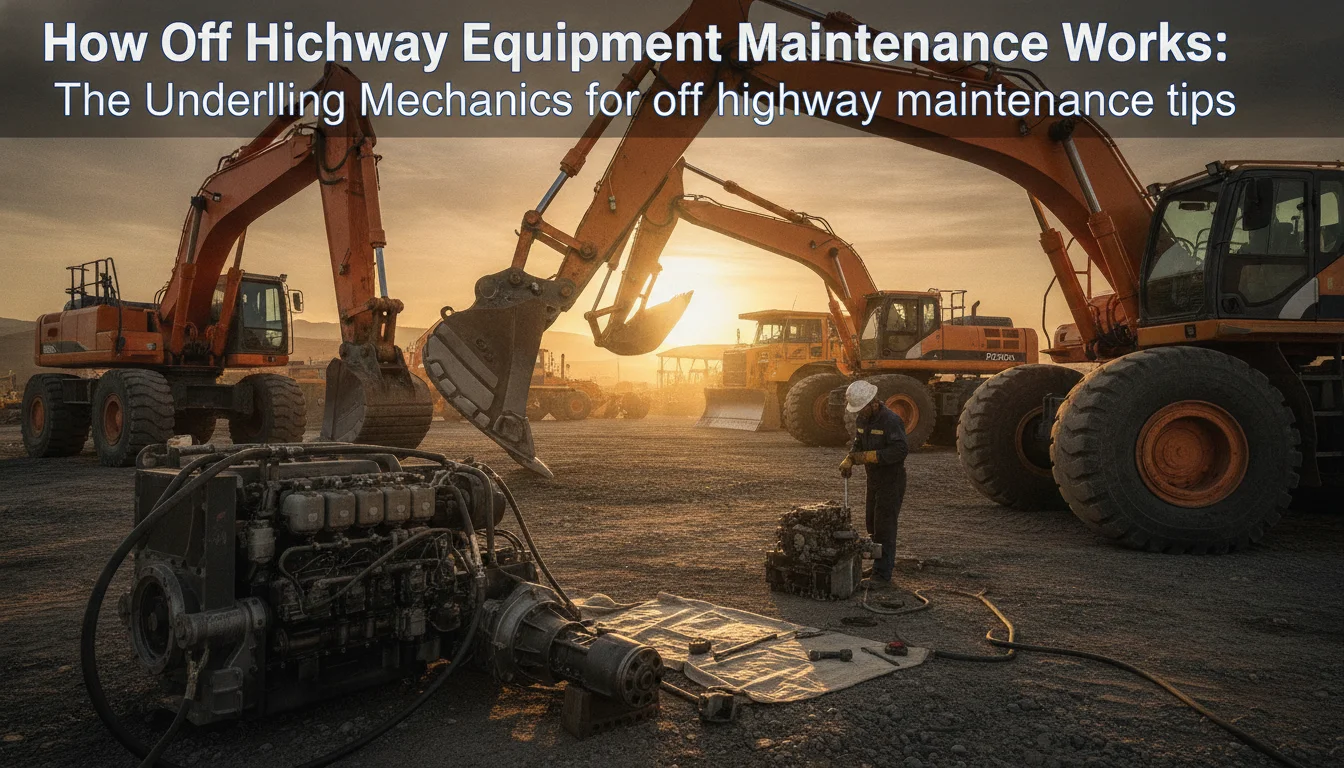
Off highway equipment maintenance works by systematically monitoring and servicing the interdependent systems that keep heavy machinery operational: the engine, hydraulics, drivetrain, undercarriage, cooling system, and filtration. Understanding how each system degrades helps you prioritize the right interventions at the right intervals.
Engine and Lubrication Systems
Diesel engines in off highway equipment operate under sustained high-load conditions that accelerate oil degradation. Engine oil forms a protective film between metal surfaces, but heat, combustion byproducts, and contamination break down that film over time. Once the oil's protective capacity drops, metal-on-metal contact accelerates wear on bearings, cylinder walls, and valve train components. OEM service bulletins specify oil change intervals in machine hours because load cycles, not calendar time, determine degradation rate.
Air filtration is equally critical. Construction and mining sites generate constant dust and particulate. Contaminants that breach a worn or clogged air filter enter the combustion chamber and slowly abrade cylinder walls and piston rings. Checking air filters frequently, and replacing them before they reach maximum restriction, is one of the simplest ways to protect engine longevity.
Hydraulic Systems
Hydraulic systems power the working functions of excavators, loaders, and bulldozers. These systems operate at high pressure, and any contamination in the hydraulic fluid, whether water ingress, particulate, or degraded fluid, causes accelerated wear on pumps, valves, and cylinders. Hydraulic fluid analysis reveals contamination levels and fluid condition before a pump failure occurs. Checking hydraulic fluid levels and inspecting hoses, cylinders, and fittings for leaks during every pre-shift walkaround is non-negotiable.
Undercarriage and Running Gear
The undercarriage on tracked machines (excavators, bulldozers, crawler loaders) is one of the highest-wear systems on the machine. Track tension, sprocket condition, idler wear, and roller condition all interact. Improper track tension causes rapid wear across multiple components simultaneously. Tracks that are too tight overload bearings; tracks that are too loose allow jumping and accelerated sprocket wear. Daily undercarriage inspection and correct tension adjustment are foundational off highway equipment maintenance tips that many operators skip under time pressure.
Cooling Systems
Overheating is a leading cause of catastrophic engine failure in off highway equipment. The cooling system manages heat rejection under sustained high-load operation. Coolant degrades over time, losing its corrosion inhibitor package and becoming acidic. Acidic coolant attacks cylinder liners, causing pitting and eventual liner failure. Cleaning radiators, monitoring coolant condition, and maintaining correct coolant concentration protect against overheating, over-cooling, and cracked heads.
Drivetrain and Greasing Points
Pins, bushings, and joints on off highway equipment require regular greasing to prevent metal-to-metal contact under load. In dusty or wet conditions, grease intervals shorten significantly because contamination washes or pounds grease out of joints faster. Using a quality synthetic grease that resists impact and washout, particularly in heavily loaded applications, extends service intervals and reduces component wear.
How to Apply These Off Highway Equipment Maintenance Tips: A Step-by-Step Program
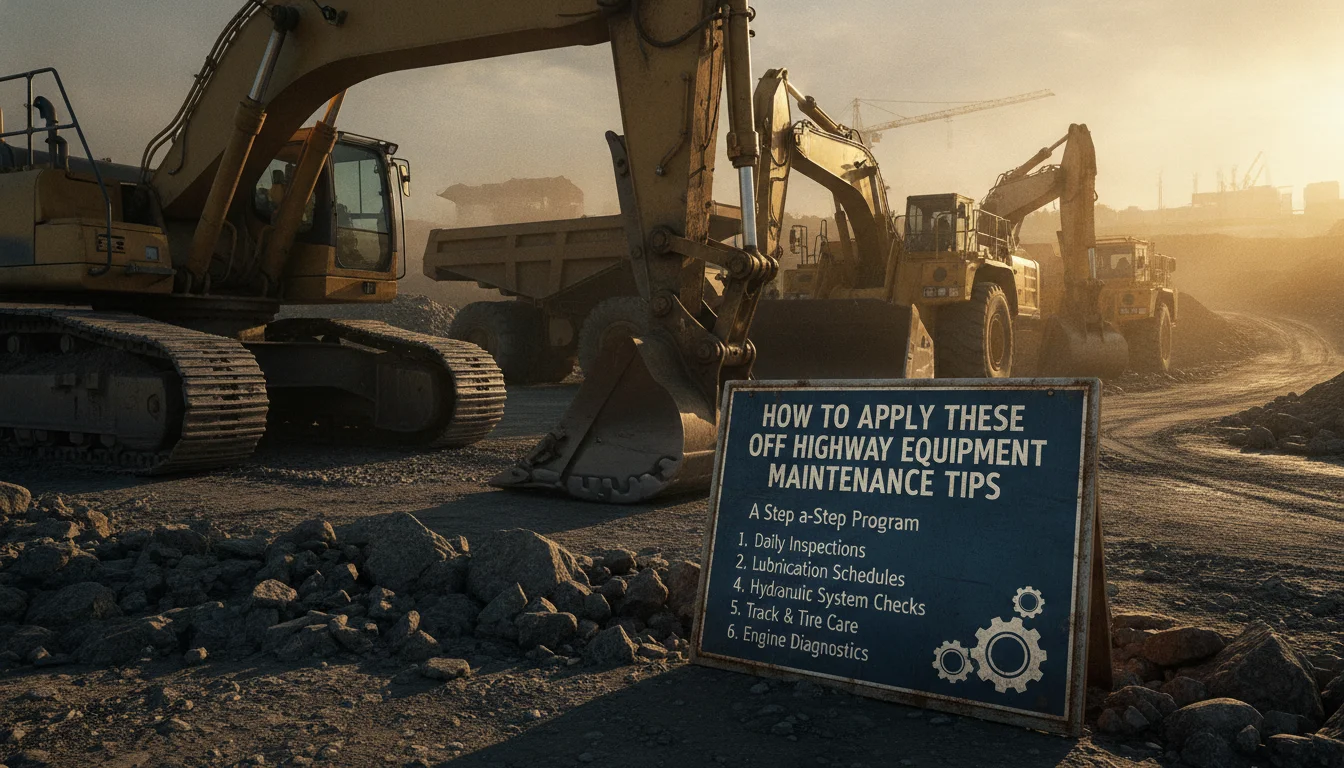
Applying off highway equipment maintenance tips effectively requires building a structured program, not just reacting to problems as they appear. Follow these steps to establish a maintenance program that works in real-world fleet operations.
Step 1: Build a Tiered Preventive Maintenance Schedule
Start with the OEM service manual for each machine in your fleet. Extract the recommended service intervals for every major system and organize them into a tiered schedule:
- Daily (pre-shift): Visual walkaround, fluid level checks, leak inspection, tire or track condition, air filter restriction indicator
- Every 250 hours: Engine oil and filter change, hydraulic filter inspection, greasing of all points, undercarriage measurement
- Every 500 hours: Fuel filter replacement, coolant analysis, hydraulic fluid sampling, belt and hose inspection
- Annual / every 2,000 hours: Comprehensive machine inspection, component wear assessment, cooling system flush, full fluid analysis panel
These intervals align with industry best practice as documented by Caterpillar dealers and confirmed across competitor maintenance programs. Adjust intervals based on operating conditions: dusty mines and quarries demand shorter filter and grease intervals than standard construction sites.
Step 2: Train Operators to Own the Daily Inspection
The equipment operator is your first line of defense against catastrophic failure. Before every shift, operators must complete a structured pre-shift inspection. This is not optional and not delegable to a maintenance technician after the fact. Provide operators with a printed or mobile-app checklist covering:
- All fluid levels (engine oil, coolant, hydraulic fluid, fuel)
- Visible leaks at hoses, cylinders, and fittings
- Track tension and undercarriage condition (or tire pressure and tread for wheeled machines)
- Air filter restriction indicator
- Brake and steering function check before moving the machine
- Any unusual sounds or vibrations during startup
If a leak is spotted, the machine must be tagged out and repaired before operation. Pushing through the first signs of a hydraulic leak is one of the most common and costly mistakes we see across fleets.
Step 3: Implement Fluid Analysis as a Diagnostic Tool
Fluid analysis is the single best diagnostic opportunity available to fleet managers. Think of it as a blood test for your machine. Regular oil, coolant, and hydraulic fluid sampling reveals contamination sources, wear metal trends, and fluid condition before a failure occurs. According to AMSOIL's maintenance guidance, fluid analysis benefits include maximum drain intervals, extended equipment life, reduced instances of major mechanical problems, and increased resale value. Submit samples to a certified fluid analysis laboratory at each major service interval and track trends over time.
Step 4: Keep a Detailed Maintenance Log for Every Machine
Maintenance logs are the institutional memory of your fleet. Without them, recurring issues go undetected, warranty claims become difficult to support, and resale value suffers. Each log entry should record:
- Date and machine hours at service
- Type of maintenance performed
- Parts replaced (with part numbers)
- Fluid analysis results
- Observations from the inspection
- Technician name and sign-off
Digital maintenance management software makes this practical at scale. Many platforms integrate with mobile apps so operators can log inspection findings in the field in real time.
Step 5: Source OEM-Quality Parts and Fluids
Parts quality directly affects how long your maintenance intervals hold. Generic aftermarket parts are often manufactured to broader tolerances than OEM specifications require. In high-load, high-cycle applications like mining excavators or quarry loaders, tolerance gaps translate to accelerated wear and shorter component life. Always specify OEM or OEM-equivalent parts for critical systems: hydraulic seals, filters, undercarriage components, and drivetrain elements.
Step 6: Wash Equipment Regularly
Frequent washing is an often-overlooked maintenance task. Mud and dirt accumulation makes it difficult to spot fluid leaks, cracked hoses, and structural damage during inspections. Extended exposure to mud, dirt, and dust also accelerates rust formation and surface wear. Schedule regular wash-downs as part of your maintenance program, particularly after operation in wet or muddy conditions.
Maintenance Approach Comparison Table
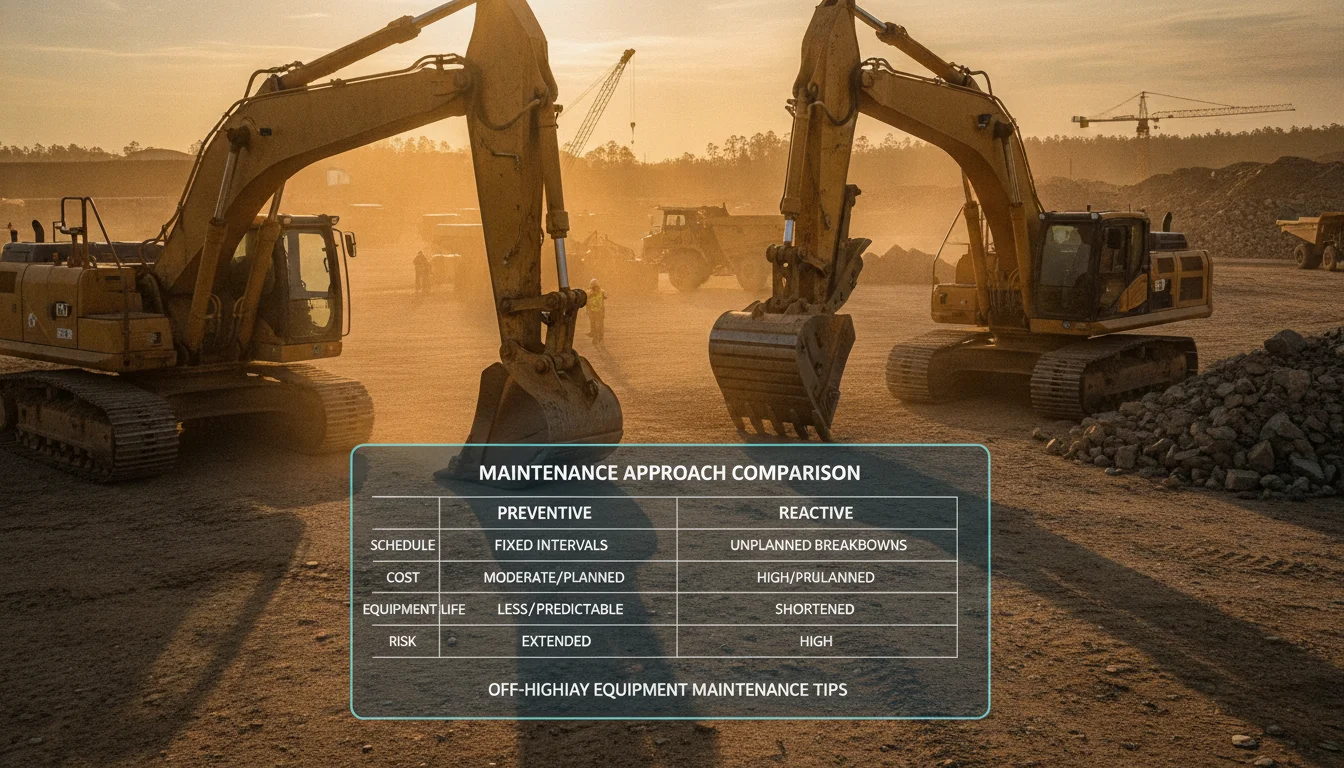
Choosing the right maintenance strategy depends on your fleet size, operating environment, and risk tolerance. The table below contrasts the three primary approaches used across off highway equipment fleets.
| Approach | Description | Cost Profile | Downtime Risk | Best For |
|---|---|---|---|---|
| Reactive Maintenance | Fix after failure occurs | High (emergency labor, expedited parts) | Very High | Low-value, easily replaced equipment |
| Preventive Maintenance | Scheduled service at fixed intervals | Moderate (planned spend) | Low | Most off highway fleets; standard best practice |
| Predictive Maintenance | Data-driven service based on condition monitoring | Higher upfront (sensors, software), lower long-term | Very Low | Large fleets, high-value machines, mining operations |
| Proactive Maintenance | Root cause elimination to prevent recurring failures | Moderate to High | Low | Fleets with recurring failure patterns |
Key Maintenance Practices for Off Highway Equipment
Implementing a structured maintenance program is the foundation of any serious fleet operation. The following practices represent the core of effective off highway equipment maintenance tips applied across construction, mining, and energy fleets worldwide.
1. Develop a Preventive Maintenance Schedule
Creating a preventive maintenance schedule means setting regular service intervals based on machine hours and manufacturer recommendations, not guesswork. Your schedule should include:
- Daily pre-shift inspections
- Weekly lubrication checks and greasing
- Monthly fluid analysis submissions
- Annual comprehensive evaluations and component wear assessments
2. Conduct Daily Inspections
Daily inspections are the fastest, cheapest form of maintenance available. Operators should check for:
- Fluid leaks at all hoses, fittings, and cylinders
- Wear and condition of tires or tracks
- Correct fluid levels: engine oil, coolant, hydraulic fluid
- Air filter restriction indicator status
- Any unusual sounds during startup and warm-up
3. Maintain a Detailed Maintenance Log
Keeping a maintenance log is essential for tracking service history and identifying recurring issues. This log should include dates of service, types of maintenance performed, parts replaced with part numbers, and observations from inspections. Logs also protect resale value: a machine with complete records commands a stronger price on the used market.
Pros and Cons of Preventive Maintenance Programs
Pros
- Reduced repair costs: Planned maintenance is consistently less expensive than emergency repairs and expedited parts sourcing.
- Higher equipment availability: Scheduled downtime is predictable and manageable; unplanned breakdowns are not.
- Better resale value: Complete service records and well-maintained components support stronger resale pricing.
- Improved operator safety: Regular inspections catch brake wear, hydraulic leaks, and structural fatigue before they create hazards.
- Lower litigation exposure: Documented maintenance programs demonstrate due diligence in the event of an incident.
Cons
- Upfront time and resource commitment: Building and sustaining a PM program requires dedicated personnel, scheduling discipline, and initial investment in software or tracking tools.
- Planned downtime: Machines pulled for scheduled service are temporarily unavailable, which requires fleet planning to avoid project delays.
- Risk of over-maintenance: Servicing components before they actually need it wastes parts and labor if intervals are set too conservatively.
- Training requirement: Operators and technicians need consistent training to execute inspection checklists correctly and recognize early warning signs.
Common Maintenance Mistakes to Avoid
Even experienced fleet managers make avoidable errors. These are the most common mistakes we see when reviewing off highway equipment maintenance tips with new clients.
1. Neglecting Regular Inspections
Failing to conduct daily pre-shift inspections is the most common and costly mistake in off highway fleet management. Operators under schedule pressure skip the walkaround, and minor issues, a slow hydraulic leak, a developing track crack, a clogged air filter, go unnoticed until they become major failures. Make the daily inspection non-negotiable and tie it to machine startup authorization.
2. Using Non-OEM Parts
Using generic aftermarket parts may look cost-effective on a purchase order, but the math changes when you account for shorter service life and the labor cost of replacing a failed component ahead of schedule. Many aftermarket parts are manufactured to broad tolerances that span multiple machine makes and models. In precision hydraulic and drivetrain applications, those tolerance gaps matter. Always specify OEM or OEM-equivalent parts for critical systems.
3. Ignoring Fluid Analysis
Fluid analysis is a critical diagnostic tool that reveals contamination, wear metal trends, and fluid condition before a failure occurs. Skipping fluid analysis is like ignoring blood test results: the problem exists whether or not you look for it. Regular oil, coolant, and hydraulic fluid testing is one of the highest-ROI maintenance investments available to fleet managers.
4. Skipping Equipment Washing
Mud and dirt accumulation is not just cosmetic. It conceals fluid leaks, accelerates rust formation, and makes accurate inspections impossible. Regular washing is a legitimate maintenance task, not a luxury. Schedule wash-downs after operation in wet or muddy conditions and before any detailed inspection.
5. Ignoring Track Tension and Undercarriage Wear
Undercarriage components represent a significant portion of tracked machine operating costs. Incorrect track tension, whether too tight or too loose, accelerates wear across sprockets, idlers, and rollers simultaneously. Check track tension daily on tracked machines and adjust per OEM specifications. Measure undercarriage wear at each major service interval to plan component replacement before a failure occurs in the field.
6. Excessive Idling
Unnecessary idling adds machine hours without productive output, accelerating service interval arrival and increasing fuel consumption. It also causes incomplete combustion at low load, which can lead to carbon buildup in the engine. Establish idling policies for your fleet and train operators to shut down machines during extended breaks.
Tips for Specific Equipment Types
Different types of off highway equipment require specialized maintenance approaches. The following guidance covers the most common machine categories in construction and mining fleets.
1. Excavators
For excavators, the hydraulic system and undercarriage are the highest-priority maintenance areas. Focus on:
- Checking hydraulic fluid levels and inspecting hoses and cylinders for leaks at every pre-shift inspection
- Inspecting the undercarriage daily for track tension, sprocket wear, and roller condition
- Monitoring track tension and adjusting per OEM specifications
- Greasing all pins and bushings daily in dusty or wet operating conditions
- Submitting hydraulic fluid samples for analysis at each major service interval
2. Bulldozers
Bulldozers operate under sustained high-load conditions that stress the drivetrain, cooling system, and undercarriage. Key maintenance priorities include:
- Blade and ripper wear inspection and replacement before worn edges reduce productivity
- Cooling system checks to prevent overheating under sustained pushing loads
- Regular greasing of all pivot points, particularly the blade lift and tilt cylinders
- Daily undercarriage inspection given the high ground-contact loads bulldozers generate
3. Loaders
For wheel loaders, tire condition and hydraulic system health are the primary maintenance concerns. Ensure:
- Daily checks of tire pressure and tread depth (tires are a major operating cost on wheel loaders)
- Regular inspection of bucket cutting edges and attachment wear points
- Monitoring engine performance and emissions, particularly on machines operating in regulated environments
- Greasing of all articulation and bucket linkage points per OEM schedule
A Realistic Maintenance Scenario: Mining Excavator Fleet
Consider a fleet supervisor managing six hydraulic excavators at a quarry operation. The machines run two shifts per day, accumulating roughly 4,000 operating hours per year each. Without a structured maintenance program, the fleet historically experienced two to three unplanned hydraulic pump failures per year across the fleet, each requiring emergency parts sourcing, field repair, and two to four days of machine downtime.
After implementing the off highway equipment maintenance tips outlined in this guide, including daily pre-shift inspections, 250-hour fluid sampling, and a switch to OEM hydraulic filters and seals, the fleet reduced unplanned hydraulic failures significantly over the following 12 months. Fluid analysis identified contamination in one machine's hydraulic system early enough to flush and replace the fluid before pump damage occurred. The maintenance log revealed that one machine consistently consumed more engine oil between services, prompting an early investigation that found a developing valve stem seal issue, repaired at a fraction of the cost of a full engine rebuild.
The supervisor also switched from generic aftermarket hydraulic filters to OEM-specification filters sourced through 3GEN Export, with parts delivered globally within five days. The total cost of the parts switch was offset within the first quarter by avoided emergency repair costs.
"Fluid analysis can help identify potential sources of contaminants while providing an idea of what mechanical issues may be looming. It is well worth the investment in comparison to the investment of heavy machinery." - AMSOIL Heavy Equipment Maintenance Guide
Leveraging Technology in Maintenance
Technology plays a significant role in enhancing off highway equipment maintenance programs. As of 2026, the most effective fleet operations combine traditional inspection discipline with digital tools that provide real-time visibility and automated scheduling.
1. Maintenance Management Software
Maintenance management software centralizes scheduling, work order tracking, parts inventory, and service history in a single platform. It ensures no maintenance task is overlooked and gives fleet managers a real-time view of each machine's service status. Many platforms generate automatic alerts when a machine approaches a service interval based on hours logged.
2. IoT Sensors and Condition Monitoring
IoT sensors mounted on equipment provide real-time data on temperature, pressure, fluid levels, and vibration. This data feeds into condition monitoring platforms that flag anomalies before they become failures. For high-value machines in remote mining or energy applications, condition monitoring can justify its cost many times over by preventing a single catastrophic failure. Caterpillar's Product Link system is one example of OEM-integrated telematics that supports this approach.
3. Mobile Apps for Inspections
Mobile inspection apps allow operators to complete and submit pre-shift checklists digitally, with photos attached to flagged items. This creates an immediate, timestamped record of each inspection and routes issues directly to the maintenance team for action. The result is faster response times and a complete audit trail.
2026 Outlook: Where Off Highway Equipment Maintenance Is Heading
This year, the off highway equipment maintenance sector is seeing accelerated adoption of predictive maintenance tools across construction and mining fleets. OEM telematics integration, AI-driven anomaly detection, and remote diagnostics are moving from large enterprise fleets to mid-size operations as software costs decrease. Procurement teams are also placing greater emphasis on parts supply chain resilience: sourcing OEM-quality components from global suppliers with verified lead times rather than relying on single-source local distributors.
The shift toward electric and hybrid off highway equipment is also introducing new maintenance requirements, particularly around battery thermal management and high-voltage system safety. Fleet managers who build strong maintenance fundamentals now, structured schedules, detailed logs, fluid analysis, and OEM parts sourcing, will be best positioned to adapt as machine technology evolves.
Frequently Asked Questions
What is the 10 rule in maintenance?
The 10 rule in maintenance refers to the guideline that performing maintenance tasks every 10 hours of operation keeps equipment in optimal condition during high-intensity work cycles. It is most commonly applied to greasing intervals and daily inspection requirements on machines operating in demanding environments like quarries and mines.
What are the four P's of maintenance?
The four P's of maintenance are Predictive, Preventive, Proactive, and Reactive. These categories define the full spectrum of maintenance approaches, from data-driven condition monitoring at one end to emergency repair at the other. Most effective off highway equipment maintenance programs combine preventive and predictive strategies.
What are the 3 P's of maintenance?
The 3 P's of maintenance are Planned, Preventive, and Predictive. These three strategies share a common focus on scheduling maintenance activity before failures occur, rather than responding after the fact. Applying all three to an off highway fleet produces the lowest total cost of ownership over the machine's service life.
What are the 7 elements of maintenance?
The 7 elements of maintenance are Planning, Scheduling, Execution, Documentation, Training, Continuous Improvement, and Safety. Together, these elements form a complete maintenance management framework. Skipping any one of them, most commonly Documentation or Training, creates gaps that lead to recurring failures and rising repair costs.
How often should heavy equipment be serviced?
Heavy equipment should be serviced according to the manufacturer's recommendations, typically at 250-hour and 500-hour intervals for major fluid and filter changes, with daily pre-shift inspections before every shift. According to industry maintenance data, service intervals are based on machine hours rather than calendar time because operating load determines component wear rate.
Why is fluid analysis important in off highway equipment maintenance?
Fluid analysis is important because it identifies contamination, wear metal concentrations, and fluid degradation before they cause mechanical failures. It is one of the highest-ROI diagnostic tools available to fleet managers, providing early warning of issues that would otherwise only become visible after a costly breakdown. Most OEM service programs recommend fluid analysis at every major service interval.
What is the difference between OEM and aftermarket parts for off highway equipment?
OEM parts are manufactured to the exact specifications of the original equipment manufacturer, ensuring correct tolerances, material grades, and compatibility with the machine's systems. Aftermarket parts are often produced to broader tolerances that span multiple machine types, which can introduce accelerated wear in precision applications like hydraulic systems and drivetrains. For critical components, OEM or OEM-equivalent parts are the correct choice.
Need OEM-quality spare parts for your off highway fleet? Shop with confidence at 3genexport.com, with global 5-day delivery on parts for Caterpillar, Komatsu, Volvo, Atlas Copco, and 40+ brands. Our procurement team is ready to support your next parts order with verified compatibility and competitive pricing.