
Power Generation Equipment Spare Parts Guide
Source OEM-quality power generation equipment spare parts for turbines, generators & boilers. Fast global delivery. Reduce downtime. Shop 3genexport.com.
Loading article…
Article Not Found
The article you're looking for doesn't exist or may have been removed.
Back to BlogPower generation equipment spare parts are the replacement components required to maintain and repair generators, turbines, transformers, and boilers. Sourcing the right parts keeps power plants running and prevents costly unplanned outages.
Key Takeaways
- OEM-standard spare parts preserve performance, efficiency, and warranty coverage.
- Genuine parts are engineered and tested to exact manufacturer specifications - non-genuine alternatives often cause premature failures.
- Critical spare parts categories include bearings, seals, gaskets, valves, filters, and instrumentation.
- A proactive inventory of high-wear components is the single most effective way to minimize unplanned downtime.
- Verified global suppliers with fast lead times are essential for procurement teams managing multi-site operations.
What Is Power Generation Equipment?
Power generation equipment is the machinery that converts energy sources into electricity at industrial scale. Understanding each major system helps procurement teams identify which this type of parts to stock and when to replace them.
- Generators: Convert mechanical energy into electrical energy. The core output device in virtually every power plant configuration.
- Turbines: Convert thermal, hydraulic, or mechanical energy into rotational power that drives the generator.
- Transformers: Step voltage up or down for efficient transmission and distribution across the grid.
- Boilers: Generate high-pressure steam to drive turbines in thermal power plants, using coal, natural gas, or oil as fuel.
- Heat Exchangers: Transfer heat between process streams to improve thermal efficiency and maintain safe operating temperatures.
- Pumps: Circulate water, cooling fluids, and fuel across plant systems.
- Switchgear and Protection Systems: Protect electrical equipment and ensure safe operation under fault conditions.
- Control Systems: Monitor, regulate, and optimize plant performance in real time.
Core Subsystems That Drive Parts Demand
Three subsystems generate the highest volume of spare parts requests across the plants we supply:
- Cooling Systems: Maintain safe operating temperatures for turbines and generators. Cooling system failures cascade quickly into major equipment damage.
- Lubrication Systems: Deliver oil to bearings, shafts, and rotating assemblies. Contaminated or depleted lubrication is a leading cause of bearing failure.
- Governor and Control Systems: Regulate speed and load. Springs, bellows, and pilot valve components from these systems appear on virtually every two-year turbine spare parts list.
Why Genuine Power Generation Equipment Spare Parts Matter
Genuine this kind of spare parts are the only components engineered and tested to the original manufacturer's exact specifications. The business case for OEM parts goes well beyond compliance.
Performance and Efficiency
OEM parts are manufactured to meet the precise tolerances the original equipment was designed around. According to manufacturer specifications, non-genuine components may fit physically but lack the precision required for optimal operation, resulting in decreased engine performance and increased fuel consumption. Over time, that performance gap compounds: one underperforming component stresses adjacent parts, accelerating wear across the assembly.
Quality and Reliability
Genuine components are sourced from high-grade materials and undergo rigorous testing before release, minimizing compatibility risks. As Manfred Schlagbauer, Director Business Division Service at ELIN Motoren, states: "Electric machines can only achieve the highest reliability standards, efficiency, and safety by using original spare parts." Substandard alternatives may appear cost-effective initially but frequently fail ahead of schedule, triggering emergency repairs that cost far more than the original saving.
"The availability of high-quality spare parts is critical to maintaining electric motors' performance and operational readiness. Electric machines can only achieve the highest reliability standards, efficiency, and safety by using original spare parts." - Manfred Schlagbauer, Director Business Division Service, ELIN Motoren
Warranty Coverage
Using non-genuine parts can void your equipment warranty. Most manufacturers require OEM-approved components to maintain warranty protection. If a failure occurs and the investigation reveals substitute parts, the manufacturer is under no obligation to cover repair costs. Genuine parts purchased through authorized channels carry their own warranty coverage, giving procurement teams a second layer of financial protection.
Safety
Substandard components introduce risks that aren't always visible during normal operation. High temperatures, internal deformation, clogs, and vibration anomalies are common failure modes linked to unauthorized parts. In power generation environments, those failures don't just damage equipment - they put operators and technicians at risk. OEM the generation equipment spare parts are manufactured to the most stringent safety standards to ensure safe, continuous operation.
"Do not let short-term gains cloud your judgment. In the long run, the benefits of using genuine components far outweigh any initial savings." - Rehlko Power Systems, Southeast Asia
Common Power Generation Equipment Spare Parts and Their Functions
parts span a wide range of mechanical, electrical, and instrumentation categories. Below is a reference table covering the most commonly sourced components across turbine, generator, and boiler systems.
| Part Category | Primary Function | Typical Application |
|---|---|---|
| Bearings | Support rotating machinery, reduce friction | Turbines, generators, pumps |
| Seals and Gaskets | Prevent leaks in high-pressure, high-temperature environments | Turbine shafts, valve bodies, boiler flanges |
| Valves | Control steam, water, and fuel flow across critical circuits | Boiler feed lines, cooling circuits, fuel systems |
| Filters and Strainers | Remove contaminants to protect pumps and heat exchangers | Oil systems, water systems, fuel lines |
| Motors and Gearboxes | Drive auxiliary equipment | Pumps, fans, conveyors |
| Nozzles | Control direction and flow of steam or fuel | Boilers, turbine inlets |
| Grate Bars | Support fuel during combustion under extreme heat | Solid-fuel fired boilers |
| Air Preheaters and Economizers | Preheat air or water using exhaust gases to improve boiler efficiency | Thermal power plant boilers |
| Instrumentation | Measure temperature, pressure, vibration, and electrical parameters | Plant-wide monitoring and protection systems |
| Electrical Components | Ensure stable power distribution, automation, and system protection | Switchgear, control panels, distribution boards |
| AVR (Automatic Voltage Regulator) | Regulate generator output voltage | Standby and industrial generators |
| Carbon Brushes and Windings | Maintain electrical contact and electromagnetic function | Generators, electric motors |
Turbine-Specific Spare Parts
Turbine maintenance schedules typically call for a two-year operating spare parts inventory. Based on standard turbine spare parts lists used across the industry, that inventory covers items including inlet and exhaust casing studs and bolts, diaphragm sealing rings, spring strips for front and rear glands, front and rear turbine bearings, main and auxiliary thrust pads, governor springs and pilot valve springs, oil sealing rings for the main oil pump, piston rings for main safety valves, and oil strainer gauzes.
Each of these power generation must meet specific thermal, mechanical, and chemical resistance requirements to perform reliably under continuous high-stress conditions.
Pros and Cons of OEM vs. Aftermarket Power Generation Equipment Spare Parts
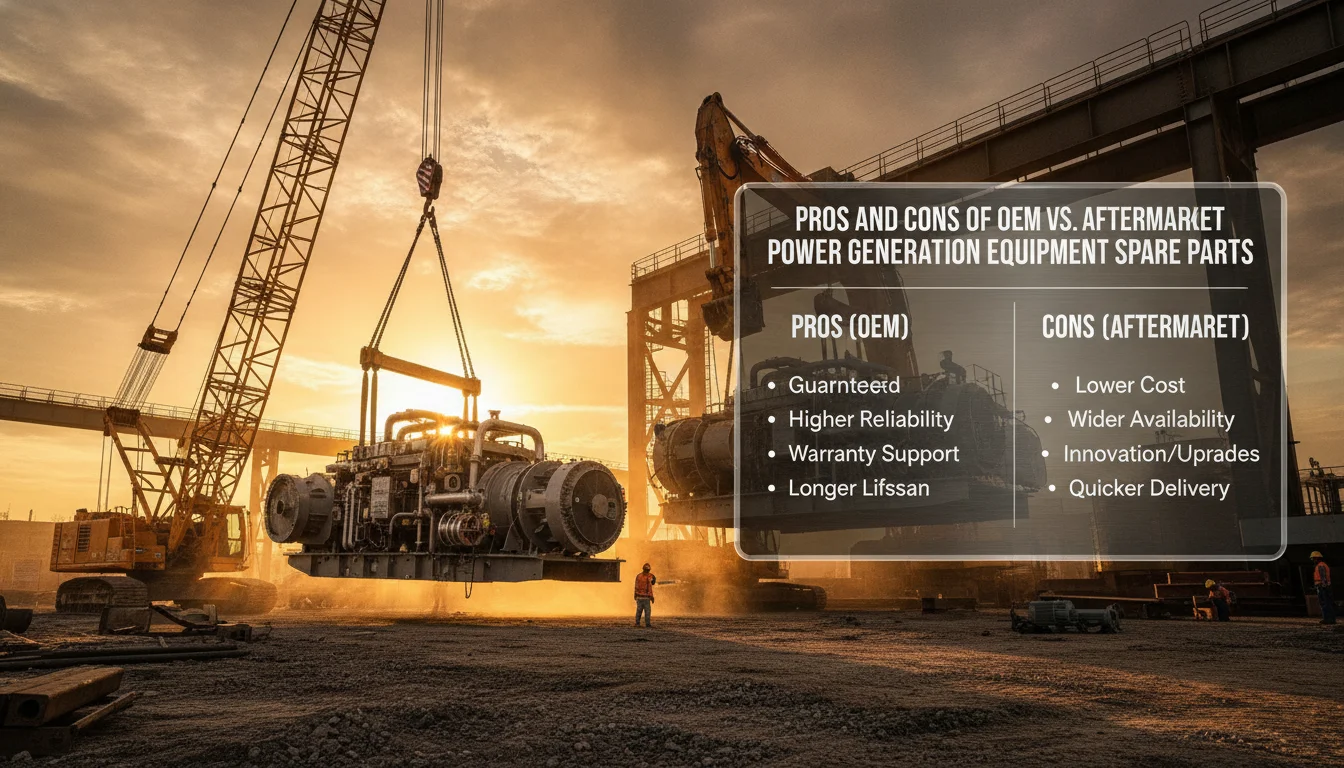
Procurement teams regularly face the OEM versus aftermarket decision. Here's an honest breakdown to support that evaluation.
Pros
- Exact fit and specification compliance: OEM parts are engineered to the original design tolerances, eliminating compatibility guesswork.
- Warranty protection: Using genuine components keeps manufacturer warranties intact and provides parts-level warranty coverage.
- Predictable service life: OEM components are tested for the expected operational lifespan of the equipment, supporting accurate maintenance planning.
- Safety assurance: Manufactured to the most stringent safety standards, reducing risk to personnel and equipment.
- Reduced total cost of ownership: Fewer premature failures mean fewer emergency repairs and less unplanned downtime over the equipment lifecycle.
Cons
- Higher upfront cost: OEM parts typically carry a price premium over aftermarket alternatives.
- Longer lead times for rare components: Specialized OEM parts for older equipment may require extended sourcing time if not held in stock by your supplier.
- Limited supplier options: Genuine OEM parts are only available through authorized channels, which can restrict competitive pricing.
Pro Tip: For high-criticality components - bearings, seals, governor assemblies - always specify OEM. For lower-criticality consumables like filter elements and strainer gauzes, qualified aftermarket alternatives from verified suppliers can be acceptable, provided they meet OEM specifications and are sourced from reputable manufacturers.
How to Source Power Generation Equipment Spare Parts: A Step-by-Step Process
Sourcing spare parts efficiently reduces both downtime and total maintenance costs. Follow these steps to build a reliable procurement process.
Step 1: Identify Your Parts Requirements
Start with your equipment's OEM service bulletin and maintenance schedule. Identify which components are due for replacement based on operating hours, condition monitoring data, or scheduled intervals. Cross-reference against your current inventory to determine what needs to be ordered. Keeping a running inventory of high-wear items - bearings, seals, filters - is the most effective way to avoid emergency sourcing situations.
Step 2: Confirm Part Numbers and Specifications
Always source by OEM part number, not by description alone. A bearing described as "front turbine bearing" covers dozens of different specifications across equipment models. Confirm the part number from the equipment nameplate, the OEM service manual, or the original spare parts list. Include the equipment make, model, and serial number in every parts request.
Step 3: Identify Verified Suppliers
Look for suppliers who specialize in this type of parts and can demonstrate OEM compatibility. Verify their credentials, quality certifications, and track record with similar equipment. Platforms that connect procurement teams with pre-qualified suppliers - and allow side-by-side comparison of OEM compatibility, lead times, and pricing - significantly reduce sourcing risk. At 3GEN Export, we supply OEM-standard parts for Caterpillar, Komatsu, Volvo, Atlas Copco, and more than 40 additional brands, with global delivery in as few as 5 days.
Step 4: Submit Requests for Quotation
Send RFQs to multiple verified suppliers simultaneously. Include the OEM part number, quantity, required delivery location, and urgency level. Compare responses on price, lead time, OEM compatibility confirmation, and warranty terms. Don't evaluate price in isolation - a cheaper part with a longer lead time may cost more in downtime than a premium part that ships immediately.
Step 5: Verify and Place Your Order
Before placing the order, confirm the supplier's quality documentation, country of origin, and warranty coverage. For critical components, request material certificates or test reports. Once satisfied, place the order and establish a delivery tracking process so your maintenance team can plan around the arrival date.
Care and Maintenance of Power Generation Equipment Spare Parts
Proper handling and storage of this kind of spare parts directly affects their service life and performance once installed.
- Regular Inspections: Conduct routine condition checks on installed components to identify wear before failure occurs. Vibration analysis, thermography, and oil analysis are standard tools for this purpose.
- Correct Storage Conditions: Store parts in a clean, dry, climate-controlled environment. Bearings and seals are particularly sensitive to moisture and contamination. Keep components in original packaging until installation.
- Timely Replacement: Replace worn components on schedule rather than running them to failure. Emergency replacements under unplanned outage conditions cost significantly more than scheduled maintenance replacements.
- Traceability: Maintain records of every part installed - part number, supplier, installation date, and operating hours at installation. This data supports warranty claims and future maintenance planning.
Pro Tip: For rotating components like bearings and shaft seals, follow OEM installation torque specifications precisely. Improper installation is a leading cause of premature bearing failure, even when the part itself is genuine OEM quality. Per OEM service bulletins, always use calibrated torque tools and follow the specified installation sequence.
As of 2026: Trends Shaping Power Generation Parts Procurement
Updated for 2026, procurement teams are navigating a parts landscape shaped by several converging pressures. Supply chain disruptions over recent years have pushed more plant operators toward holding larger on-site inventories of critical the generation equipment spare parts rather than relying on just-in-time sourcing. At the same time, the expansion of renewable energy plants - solar, wind, and biomass - is creating demand for a new category of spare parts alongside traditional thermal and hydro plant components.
Global sourcing is increasingly standard. Procurement managers at power utilities and independent power producers worldwide now routinely source parts from international suppliers, prioritizing verified OEM compatibility and fast delivery over proximity. This year, the ability to receive critical components within 5 business days from a global supplier is a baseline expectation, not a premium service.
For teams managing aging fleets, obsolescence is a growing challenge. OEM support for older turbine and generator models can be limited, making qualified aftermarket sources and specialist exporters increasingly important partners in the maintenance supply chain.
Frequently Asked Questions
What are the common spare parts for a generator?
Common power generation for generators include bearings, seals, gaskets, valves, filters, automatic voltage regulators (AVRs), carbon brushes, and windings. Each component plays a specific role in maintaining generator output quality and operational reliability. Stocking these items in advance significantly reduces response time when a failure occurs.
What is power generating equipment?
Power generating equipment is the machinery used to convert energy sources - thermal, hydraulic, mechanical, or nuclear - into electricity at industrial scale. Core equipment includes turbines, generators, boilers, transformers, heat exchangers, pumps, and associated control and protection systems. These systems form the backbone of power plants, utilities, and backup power infrastructure worldwide.
What are the main components of a power generator?
The main components of a power generator include the rotor, stator, alternator, automatic voltage regulator (AVR), cooling system, fuel system, circuit breaker, and control panel. Supporting components such as bearings, shaft seals, and windings are the most frequently replaced power generation equipment spare parts in routine maintenance programs.
How can I find parts for my Generac generator?
Parts for Generac generators are available through authorized dealers, OEM distribution networks, and specialist industrial parts exporters. Always source by OEM part number and confirm compatibility with your specific model and serial number before ordering. For fast global delivery of OEM-compatible generator parts, contact the 3GEN Export team directly.
How can I minimize downtime in my power plant?
Minimizing downtime starts with maintaining an inventory of critical power generation equipment spare parts based on your equipment's maintenance schedule and historical failure data. Combine proactive inventory management with regular condition monitoring - vibration analysis, oil sampling, thermography - to catch wear before it becomes failure. A reliable global supplier with short lead times is the final piece of that strategy.
What should I consider when sourcing spare parts for power generation equipment?
Key factors include the supplier's OEM compatibility verification, quality certifications, lead times, warranty terms, and track record with your specific equipment brands. Price matters, but total cost of ownership - factoring in part lifespan, installation risk, and downtime exposure - is the more relevant metric for procurement decisions on critical components.
Shop OEM-quality power generation equipment spare parts with global 5-day delivery at 3genexport.com. Our team supports procurement managers and maintenance supervisors across mining, construction, and energy sectors with verified OEM-standard components for Caterpillar, Komatsu, Volvo, Atlas Copco, and 40+ additional brands.