
Transmission Parts for Heavy Trucks: Full Guide
Source OEM, remanufactured, and aftermarket transmission parts for heavy trucks by brand, part number, and warranty. Fast global delivery at 3genexport.
Loading article…
Article Not Found
The article you're looking for doesn't exist or may have been removed.
Back to BlogTransmission parts for heavy trucks are the gears, shafts, bearings, synchronizers, seals, and shift components that keep Eaton Fuller, Meritor, Spicer, Mack, and ZF units running under full load. Match part numbers carefully, understand core charges, and confirm warranty terms before you order.
Key Takeaways
- Match the part number to your transmission serial plate, not just the manufacturer name.
- Core charges are refundable deposits: return your old unit or pay the difference.
- Remanufactured units typically include new bearings, seals, and synchronizers.
- Aftermarket gears and kits can reduce cost but require verification against OEM specs.
- Warranty terms vary widely by brand and supplier. Request them in writing before you pay.
- Export buyers should confirm freight terms and core return logistics with the supplier upfront.
Selecting heavy trucks is a decision that directly affects uptime, fuel efficiency, and total cost per mile. This guide covers component categories, brand compatibility, price tiers, and the service practices that separate a dependable rebuild from a short-term patch.
What Are Heavy Truck Transmission Components?
A heavy-duty truck transmission converts engine power into usable torque at the wheels while managing gear ratio changes across load conditions. It is a complex assembly of shafts, gears, bearings, synchronizers, shift mechanisms, and seals, all operating under extreme load and heat. When any of these elements fail, the entire drivetrain suffers.
Core Components in a Heavy Truck Transmission
Mainshafts and countershafts carry the gears and transfer torque through the gear train. Gears are available as mainshaft gears, countershaft gears, and sliding clutches. Fleetsworld, for example, lists aftermarket mainshaft and countershaft gears with part numbers such as 56-8-12 and 104-8-1. Bearings support the shafts and reduce friction. Replacement bearing kits are standard in remanufactured units. Synchronizers match gear speeds during shifts, and seals, O-rings, and gaskets prevent fluid leaks. Shift components include air filters, regulators, shift knobs, medallion valves, and splitter valve kits.
Manual, Automated Manual, and Automatic Differences
Manual transmissions are the traditional heavy-truck gearboxes, with configurations ranging from 4-speed to 20-speed. Automated manual transmissions (AMTs) use the same gear architecture but add electronic controls and actuators. Automatics use planetary gear sets and torque converters. Allison is the dominant name in heavy-duty automatic transmissions, particularly in refuse, transit, and emergency vehicle applications.
Each transmission type has a different replacement part family. Knowing whether you have an Eaton Fuller 13-speed, a Meritor manual, or an Allison automatic is the first step in sourcing the correct this type of trucks.
Top Brands and Compatibility

Several manufacturers dominate the market for this kind of heavy trucks. According to Adelman's Truck Parts, their inventory covers Eaton-Fuller, Rockwell, Spicer, Mack, Clark, Allison Automatic, GM, New Process, Fabco, and International Harvester transmissions. Weller Truck Parts remanufactures units for Eaton/Fuller, BorgWarner, New Process, Clark, IHC, TTC Spicer, Isuzu, GMC, Mack, Noster, ZF, and Meritor.
Eaton Fuller and RoadRanger Systems
Eaton Fuller is the standard in linehaul and vocational trucking. Parts for these units include air line kits, filter regulators, shift knobs, cruise control modules, and shift medallion valves. PGT Truck Parts lists specific Eaton Fuller part numbers including the A-5373 air filter regulator and K-3539 cruise control module. According to Pro Gear and Transmission, most of their technicians are trained and certified by the Eaton RoadRanger Academy, which reinforces the importance of matching Eaton-specific components to the correct application.
Meritor, Spicer, and Mack Lineups
Meritor and Spicer support a wide range of medium- and heavy-duty applications. Maxim Truck and Trailer lists Meritor components such as rear diff input seals and O-rings alongside Fuller parts. Pro Gear and Transmission offers rebuilt Mack, Rockwell, Spicer, and Eaton Fuller transmissions, and stocks dedicated Mack, Rockwell, and Spicer transmission parts separately.
When buying, always verify the OEM part number stamped on the old component. Even same-brand transmissions may use different gears depending on ratio and torque rating.
Allison Automatics and Vocational Options
Allison is the dominant name in automatic heavy-truck transmissions, especially in refuse, transit, and emergency vehicles. W.W. Williams offers Allison transmission service and legacy Allison transmission parts, which signals that rebuild support for older Allison units remains available. If your fleet mixes Allison automatics, automated manuals, and traditional manuals, a supplier who stocks all three reduces sourcing time considerably.
OEM vs. Remanufactured vs. Aftermarket Transmission Parts for Heavy Trucks
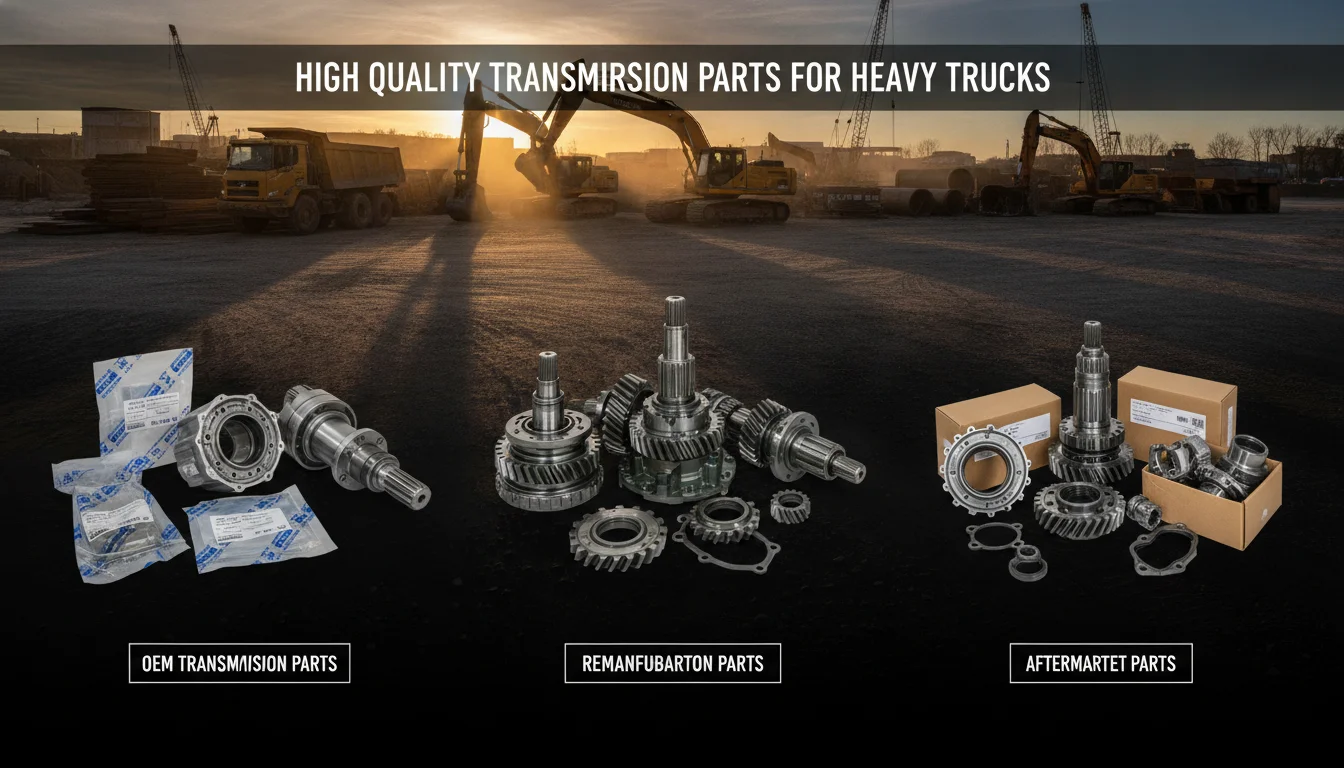
Understanding the difference between OEM, remanufactured, and aftermarket options is the foundation of any smart heavy-truck transmission purchase. Each category carries a distinct cost, warranty, and reliability profile.
OEM Parts: Fit and Price
OEM parts are produced by or for the original transmission manufacturer, such as Eaton, Meritor, or ZF. They meet the exact specifications of the original unit, which reduces fitment risk. Maxim Truck and Trailer's transmission parts catalog shows OEM and OEM-quality parts with list prices ranging from a gasket at $1.53 to a Fuller comp pump assembly at $3,227.55. OEM parts typically carry the shortest lead time when stocked domestically, but cost more than equivalent aftermarket components.
Remanufactured Units and Component Kits
Remanufacturing means disassembling a used transmission, inspecting every part, and replacing all bearings, seals, and synchronizers before reassembly. According to Adelman's, they stock over 1,000 units of medium and heavy-duty truck transmissions from 4 speeds to 20 speeds, and rebuild units on an exchange basis. Returning your old transmission in any like-core condition cancels the core charge. Component kits, such as input shaft replacement kits and splitter valve replacement kits, let a shop refresh specific subsystems without buying a complete unit.
"Our expert staff completely disassembles all heavy-duty transmissions, thoroughly inspects every part, and replaces all bearings, seals, and synchronizers." - Adelman's Truck Parts
Aftermarket and Used Parts: Value and Risk
Aftermarket parts are components made by third-party manufacturers to fit OEM specifications. Used parts are pulled from retired or wrecked trucks. Both can reduce cost significantly. Fleetsworld lists 373 aftermarket transmission products, with individual items ranging from a $10.83 snap ring to a high of $1,421.32. The risk is variation in material hardness, heat treatment, and dimensional tolerance. A used gear may look fine but carry hidden fatigue. Reputable suppliers inspect and grade used parts, but confirm the return policy before purchasing.
Pros and Cons of Each Sourcing Option
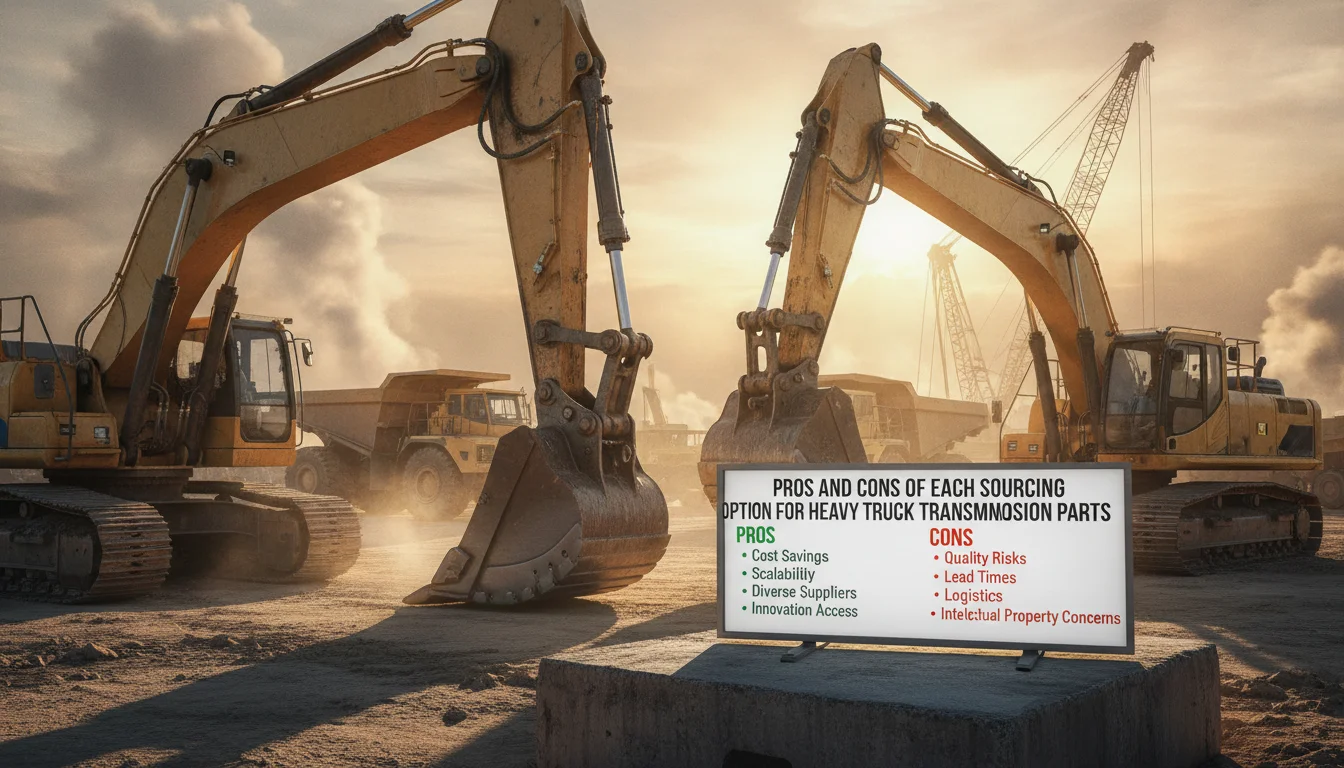
The right sourcing strategy depends on your downtime tolerance, budget, and the age of your equipment. Here is a direct comparison.
Pros
- OEM parts deliver exact fit, manufacturer warranty, and reduced fitment risk for critical applications.
- Remanufactured units offer new internal components at a fraction of new-unit pricing, with exchange programs that keep costs predictable.
- Aftermarket kits and gears provide wide availability and lower price points, especially for older or out-of-production models.
- Used parts offer the lowest initial cost and can be the only option for legacy transmissions no longer in production.
Cons
- OEM parts carry the highest price and may have longer lead times if not stocked domestically.
- Remanufactured units require a core return. Quality depends entirely on the remanufacturer's process and inspection standards.
- Aftermarket components carry dimensional tolerance risk and may void OEM warranty if not approved by the transmission manufacturer.
- Used parts have unknown fatigue life and typically carry no warranty, making them a calculated risk in any repair.
What to Look For When Buying Transmission Parts for Heavy Trucks
Material, Fit, and Part Number Verification
A successful purchase starts with the correct part number. Use the transmission serial plate or tag, not just the truck VIN, because the same truck model may have multiple transmission options. Check material specifications on gears and shafts. Heavy-duty transmissions demand case-hardened steel and high-quality bearing steel. If a part is listed as aftermarket, ask for the OEM cross-reference number. Pro Gear and Transmission offers an industry part number identification service, which reduces mis-shipments and costly returns.
Warranty, Core Charges, and Exchange Policies
Warranty periods for remanufactured transmissions vary by supplier. Weller Truck Parts advertises a warranty section on their site under a "Quality. Guaranteed." commitment. Adelman's rebuilt units are sold on an exchange basis, and any like core is acceptable. If you do not have a core or freight is an issue, the core charge is described as reasonable. Always confirm whether the core charge is refundable upon return and who pays return freight. Ask about labor coverage if a part fails shortly after installation.
Price Ranges and Budget Expectations
Transmission parts for heavy trucks span a wide price range. Budget-tier items such as gaskets, O-rings, and snap rings cost under $30. Mid-range components such as countershaft gears, input shafts, and shift kits typically run from roughly $80 to $600. Premium components and assemblies, including oil coolers, heat exchangers, and complete pump assemblies, can exceed $1,000 and reach $3,227.55 as listed in Maxim's catalog. For a complete gearbox, Adelman's inventory of over 1,000 units means buyers can access exchange pricing rather than new-unit pricing.
"A robust transmission, equipped with high-quality parts, is essential for delivering power, ensuring reliability, and maximizing the lifespan of the truck." - Maxim Truck & Trailer, Transmission Parts Category
PTO, Transfer Case, and Cross-Compatible Drivetrain Parts
Transmission parts for heavy trucks rarely exist in isolation. Power take-off (PTO) units, transfer cases, and differential assemblies all connect directly to the transmission and share compatibility requirements. PGT Truck Parts offers free manuals and identification guides for PTOs and transfer cases alongside transmission models. General Truck Parts stocks transmission components alongside PTO assemblies, hydraulic wet kit parts, and differential components, which matters for fleet buyers who need a single source for a full drivetrain overhaul.
When sourcing parts for a multi-axle or all-wheel-drive application, verify that the PTO drive gear and transfer case input spline match the transmission output. A mismatch here causes the same downtime as a failed gear, but is far easier to avoid with the right identification guide in hand.
Export and International Shipping for Heavy Truck Transmission Parts
Global procurement of transmission parts for heavy trucks adds a layer of logistics planning that domestic buyers rarely face. Core return freight across borders can be expensive, and some suppliers restrict core exchanges to domestic addresses. Adelman's explicitly states they ship heavy-duty transmissions anywhere in the world. Pro Gear and Transmission also ships internationally.
As of 2026, buyers in Africa, the Middle East, Southeast Asia, and Latin America are sourcing remanufactured Eaton Fuller and Allison units through export-focused suppliers rather than waiting on regional dealer networks. At 3GEN Export, we ship OEM-quality transmission parts for heavy trucks globally, with a standard 5-day delivery target and full documentation for customs clearance. Confirm Harmonized System (HS) codes with your supplier before ordering to avoid customs delays on gearbox assemblies and major subassemblies.
Step-by-Step Buying Process for Transmission Components
Follow this sequence to reduce the chance of ordering the wrong part or paying unnecessary core fees.
- Step 1: Record the transmission model and serial number. The data plate is usually on the side of the gearbox. Note the number of speeds and whether it is manual, AMT, or automatic.
- Step 2: Identify the failed component. Use a transmission parts manual or identification guide. PGT Truck Parts offers free manuals and guides for transmission models, PTOs, and transfer cases.
- Step 3: Choose the part category. Decide between OEM, remanufactured, aftermarket, or used. Weigh warranty length, core charge, and downtime tolerance against your budget.
- Step 4: Request a quote with the part number. Provide the OEM number, not just a description. Suppliers like Pro Gear and Transmission and General Truck Parts can cross-reference industry part numbers.
- Step 5: Confirm core return and freight terms before paying. Ask if the core charge is refundable and who pays return shipping, especially for international orders.
- Step 6: Inspect the part on arrival. Check for damage, count gear teeth if applicable, and compare markings to the old part before installation.
Care and Maintenance for Heavy Truck Transmissions
Preventive maintenance costs far less than transmission replacement. According to Maxim Truck and Trailer, the transmission system is responsible for converting the engine's power into movement, ensuring smooth gear shifts, and optimizing fuel efficiency. Protecting that system starts with fluid and filter discipline.
Fluid and Filter Service Intervals
Heavy truck transmission oil coolers and filters should be serviced at intervals specified by the transmission manufacturer. Maxim lists transmission oil coolers and heat exchangers as standard service parts. Contaminated fluid destroys bearings and synchronizers faster than any other factor. Use the fluid type recommended for the specific transmission: Eaton and Meritor manuals have distinct lube specifications, while Allison automatics require Allison-approved automatic transmission fluid.
Inspection Points and Common Failure Signs
During routine service, inspect for oil leaks at the input and output shafts, metal particles in the drain plug magnet, and hard shifting or gear clash. Replace air filters and regulators on automated and manual-shifted transmissions, because contaminated air causes slow or missed shifts. Pay close attention to splitter valve kits and range valves on multi-speed Eaton Fuller units. Failure in these components often mimics internal gear damage and leads to unnecessary teardowns.
Pro/Con Comparison Table
The table below summarizes the main buying options for transmission parts for heavy trucks.
| Option | Pros | Cons | Best For |
|---|---|---|---|
| OEM Parts | Exact fit, manufacturer warranty, shorter lead time if stocked | Higher price, limited aftermarket alternatives | Fleets requiring OEM compliance or critical applications |
| Remanufactured Units | New bearings, seals, synchronizers; lower cost than new | Core charge required; quality depends on remanufacturer | Full transmission rebuilds or major overhauls |
| Aftermarket Kits and Gears | Lower price, wide availability, many part numbers | Dimensional tolerance risk; may void warranty if not approved | Budget-conscious shops and older trucks |
| Used Parts | Lowest initial cost, immediate availability for legacy models | Unknown fatigue life, typically no warranty | Emergency repairs or discontinued applications |
Frequently Asked Questions
How do I identify which transmission parts I need?
Use the transmission serial plate or tag to find the exact model and serial number. Cross-reference that number with a parts manual or supplier identification guide to get the correct OEM part number. Never rely on the truck VIN alone, as the same chassis may have shipped with multiple transmission options.
What is a core charge and do I have to pay it?
A core charge is a refundable deposit added to a remanufactured or rebuilt transmission price. You pay it at purchase, then recover it when you return a rebuildable old unit. If you have no core to return, the core charge becomes a non-refundable fee, so confirm this policy before ordering.
Are remanufactured transmission parts as good as new?
Quality remanufactured parts can match OEM performance when the rebuilder replaces all bearings, seals, and synchronizers and inspects every component. Adelman's rebuild process does exactly that, which is why remanufactured units are widely accepted across fleet maintenance programs.
What is the best value for heavy truck transmission parts?
For full transmission overhauls, remanufactured units on exchange offer the best balance of cost and reliability. For targeted repairs, OEM or quality aftermarket kits matched by part number usually deliver the lowest total cost when you factor in labor and warranty coverage.
How long do heavy truck transmission parts last?
Service life depends on load cycles, fluid maintenance discipline, and part quality. OEM and premium remanufactured components are built to last hundreds of thousands of miles under normal operating conditions. Used parts carry unknown remaining life and should be treated as a short-term solution.
What is the return policy for transmission parts if I order the wrong one?
Policies vary by supplier. Many accept returns only for unused parts in original packaging. Always confirm the return window, restocking fee, and whether electrical or custom-order parts are returnable before you pay. International buyers should also clarify who covers return freight costs.
Finding reliable transmission parts for heavy trucks means verifying part numbers, understanding OEM versus remanufactured versus aftermarket trade-offs, and confirming warranty and core terms before you buy. Whether you're sourcing a single seal kit or a complete remanufactured gearbox for a global fleet, the process is the same: identify precisely, source carefully, and inspect on arrival.
Shop OEM-quality transmission parts for heavy trucks with global 5-day delivery at 3genexport.com.