
Wind Turbine Gearbox Parts: 2026 Buying Guide
Wind turbine gearbox parts buyers guide: OEM specs, part types, pricing tiers, and maintenance tips. Fast global delivery at 3genexport.com.
Loading article…
Article Not Found
The article you're looking for doesn't exist or may have been removed.
Back to BlogKey Takeaways
- Understanding the components of wind turbine gearbox parts is crucial for maintenance and efficiency.
- Different gearbox types offer varying benefits based on turbine design and operational conditions.
- Choosing reliable suppliers minimizes downtime and enhances turbine performance.
- Regular maintenance and monitoring are essential to extend the lifespan of gearbox components.
- As of 2026, leading gearbox manufacturers include Flender/Winergy, ZF-Hansen, Bosch Rexroth, Eickhoff, and Gamesa Gearbox.
- Price tiers range from basic replacement components to premium OEM assemblies, so matching budget to operational risk is critical.
Wind Turbine Gearbox Parts: 2026 Buying Guide
Wind turbine gearbox parts are the mechanical components inside a turbine drivetrain that convert low-speed rotor rotation into the high-speed shaft output needed to generate electricity. Getting procurement right on these parts directly determines turbine uptime, O&M costs, and fleet reliability.
Understanding Wind Turbine Gearbox Parts
A wind turbine gearbox is a critical drivetrain component that steps up the low rotational speed of the blades to the higher speed required by the generator. According to manufacturer specifications from OEMs such as Flender/Winergy and Eickhoff, the gearbox typically consists of several integrated assemblies working under continuous load:
- Casing: The outer shell that houses internal components and shields them from environmental contamination, moisture, and mechanical shock.
- Sun Gear: The central gear that drives the surrounding planetary gears and sets the primary gear ratio.
- Planetary Gears: These gears orbit the sun gear and collectively increase rotational speed while distributing load across multiple contact points.
- Ring Gear: The outer gear that meshes with the planetary gears, enabling torque multiplication across the stage.
- Lubrication System: A pressurized oil circuit essential for reducing friction, dissipating heat, and extending component life between service intervals.
Components of a Wind Turbine Gearbox
The main components of a wind turbine gearbox include:
- Bearings: Support the rotating shafts and reduce friction at high-load contact points. Bearing failure is one of the most common causes of unplanned gearbox downtime.
- Seals: Prevent external contamination from entering the gearbox and stop lubricant from escaping. Seal degradation accelerates wear across every internal component.
- Gears: Helical, spur, and bevel gear types each facilitate power transfer at different efficiency levels and noise profiles.
- Shafts: Transmit rotational energy from the rotor hub through the gearbox stages to the generator input shaft.
"Gearbox issues create long outages that increase planned and unplanned crew-hours while pushing maintenance budgets into unpredictable territory for most operators." - Midwest Power Products, Wind Turbine Gearbox Operations Guide, 2026
Types of Gearboxes in Wind Turbines
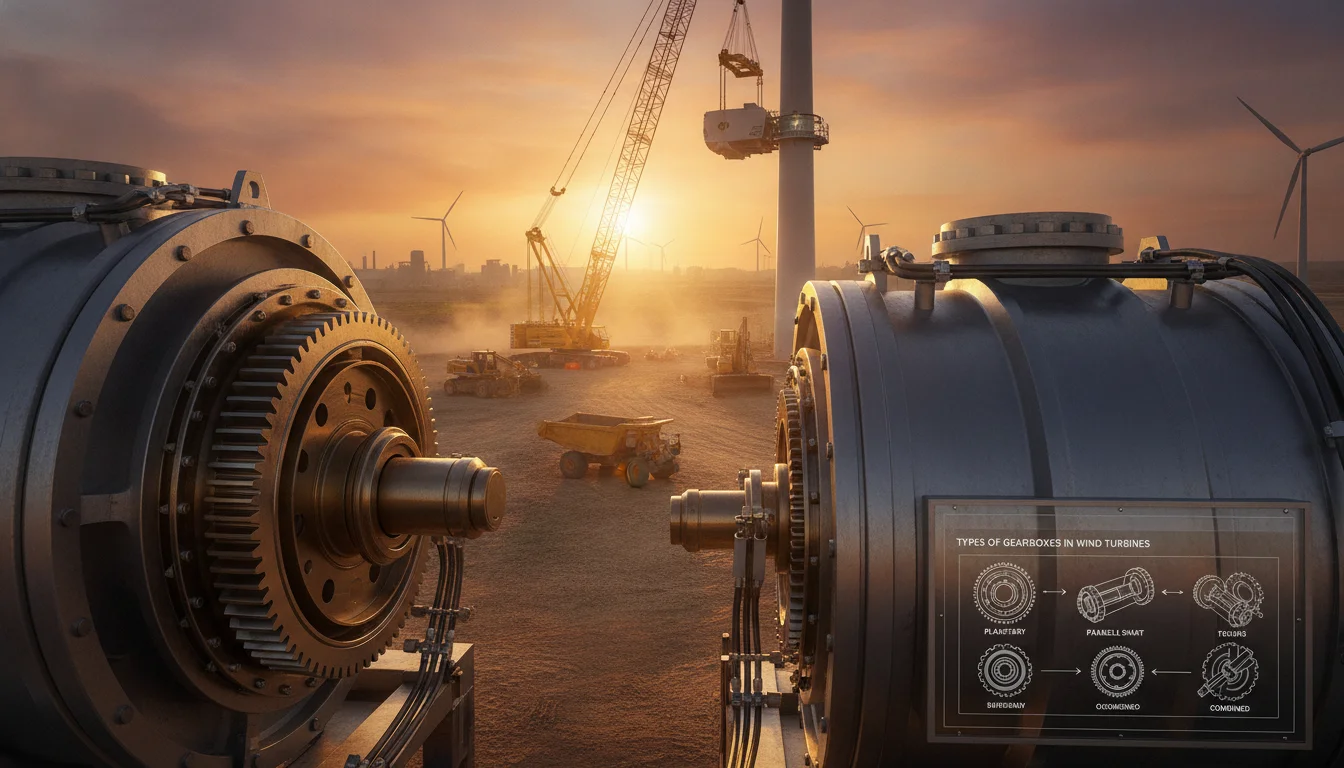
Wind turbines use three primary gearbox configurations, each suited to different turbine sizes, site conditions, and O&M strategies. Choosing the wrong configuration for your application increases both capital cost and long-term maintenance exposure.
- Planetary Gearboxes: Known for their compact design and high torque output, making them the standard choice for large utility-scale turbines. Multiple gear stages are common in turbines above 1.5 MW.
- Helical Gearboxes: Offer smooth, quiet operation and high efficiency. Well-suited to medium-sized turbines where noise and vibration management are priorities.
- Direct Drive Systems: Eliminate the gearbox entirely, reducing the number of mechanical failure points. The trade-off is a significantly larger and heavier generator, which increases nacelle weight and tower loading.
Industry maintenance data shows that geared systems - particularly planetary configurations - remain dominant across the global installed fleet, meaning the demand for replacement gearbox parts continues to be substantial through 2026 and beyond.
Comparison of Gearbox Types
| Gearbox Type | Best For | Advantages | Disadvantages | Typical Application |
|---|---|---|---|---|
| Planetary | Large utility-scale turbines | High torque, compact design, load distribution | Complex assembly, higher repair cost | Turbines 1.5 MW and above |
| Helical | Medium-sized turbines | Smooth operation, efficient, lower noise | Higher unit cost than spur gears | Turbines 500 kW to 1.5 MW |
| Direct Drive | Offshore and low-maintenance sites | Fewer moving parts, low maintenance burden | Higher initial investment, heavier nacelle | Offshore wind, remote sites |
| Hybrid | Mid-to-large turbines | Balances gearbox simplicity with generator size | Less standardized, sourcing can be complex | Select onshore and offshore platforms |
Key Gearbox Manufacturers to Know
Sourcing this type of parts starts with knowing which manufacturers produced the original equipment in your fleet. Compatibility with the OEM specification is non-negotiable for warranty compliance and long-term reliability.
Based on active market listings and supplier data, the leading gearbox manufacturers supplying the global wind fleet include:
- Flender/Winergy: One of the most widely installed gearbox brands globally, with units found in GE, Vestas, and Siemens Gamesa turbines. Part numbers such as PZAB 3494.1 (for GE 2.75 MW) and PEAS 4355.5 are actively traded in the aftermarket.
- ZF-Hansen: Known for robust multi-stage planetary designs. The Hansen EH 804 AN 21 is a common unit found in Vestas V80 and Gamesa G80 platforms.
- Bosch Rexroth: Supplies gearboxes and drivetrain components across multiple turbine OEM platforms, with strong aftermarket parts availability.
- Eickhoff: The CPNHZ 264 series is used in GE 2.3 MW turbines. Eickhoff units are known for high gear ratios and robust construction.
- Gamesa Gearbox: Integrated into Siemens Gamesa turbine platforms, with dedicated aftermarket support through approved repair networks.
- Jahnel-Kestermann (Ja/Ke): Supplies gearboxes for NEG Micon and other legacy turbine platforms, with refurbished units available for older fleet assets.
"Spares in Motion and our approved sellers can source, supply, and refurbish wind turbine gearboxes from the main manufacturers like Flender/Winergy, ZF-Hansen, Bosch Rexroth, Eickhoff, Gamesa Gearbox and other manufacturers." - Spares in Motion, Wind Turbine Gearboxes Product Catalogue
When sourcing replacement parts, always cross-reference the OEM part number stamped on the gearbox casing. Using a mismatched gear ratio or bearing specification - even from a reputable supplier - can cause premature failure and void any remaining warranty coverage.
What to Look For When Buying Wind Turbine Gearbox Parts
Reliable wind turbine gearbox parts share four non-negotiable characteristics: verified material quality, confirmed model compatibility, traceable manufacturing standards, and a supplier with documented quality assurance processes. Here is what each criterion means in practice.
Material Quality and Manufacturing Standards
Gearbox internals operate under continuous cyclic loading, temperature swings, and lubricant exposure. Gear teeth must be case-hardened to resist pitting and spalling. Bearing races require tight dimensional tolerances to maintain shaft alignment under load. Seals must be rated for the specific lubricant viscosity and operating temperature range of your gearbox model.
Ask suppliers for material certifications and heat treatment records. OEM-standard parts will carry documentation tracing the steel grade, heat treatment process, and dimensional inspection results. Aftermarket parts without this documentation carry higher risk, particularly for high-load components like planetary carriers and ring gears.
Compatibility Verification
Compatibility is more than matching a part number. Gear ratios, shaft diameters, bearing bore sizes, and seal groove dimensions must all match the original specification exactly. A planetary gear set with a slightly different module (tooth size) will not mesh correctly with the existing ring gear, causing rapid wear and potential catastrophic failure.
Always provide the gearbox model number, turbine platform, and rated power when requesting a quote. Reputable suppliers will cross-reference these against their parts database before confirming availability.
Supplier Reputation and Lead Time
Lead time pressure is real in wind O&M. According to industry maintenance data, lead times for replacement gearbox units directly affect turbine availability and annual generation targets. A supplier who cannot confirm stock and shipping timeline within 24 hours of inquiry is a risk to your project schedule.
Evaluate suppliers on: documented quality management systems, references from comparable wind operators, global logistics capability, and willingness to provide OEM part number cross-references. At 3GEN Export, we maintain global inventory across multiple gearbox brands and offer 5-day delivery to most international destinations.
Condition Options: New, Used, and Refurbished
Not every procurement situation calls for a new OEM part. Understanding the condition tiers helps you match cost to operational risk:
- New OEM: Full manufacturer specification, maximum service life, highest cost. Appropriate for critical components like planetary carriers and main bearings.
- New Aftermarket (OEM-standard): Manufactured to OEM specification by an approved third party. Suitable for most replacement scenarios when documentation is provided.
- Refurbished/Overhauled: Disassembled, inspected, worn components replaced, reassembled to specification. Units like the Jahnel-Kestermann PSC 1001-48 are available with overhaul certification and 4,000-hour run records. Cost-effective for legacy turbine platforms where new OEM supply is limited.
- Used (Inspected): Removed from decommissioned turbines, inspected, and sold with condition reports. Suitable for short-term gap coverage or low-criticality applications. Always request oil analysis and inspection records.
How to Choose the Right Parts for Your Application
Choosing wind turbine gearbox parts correctly requires matching the component specification to three variables: turbine platform, operating environment, and maintenance strategy. Here is a practical framework used by experienced procurement teams.
Step 1: Identify Your Turbine Platform and Gearbox Model
Pull the nameplate data from the gearbox casing. You need the manufacturer name, model number, gear ratio, rated power (kW or MW), and oil volume. For example, a Flender PZAB 3494.1 in a GE 2.75 MW turbine has a gear ratio of 138.726 and operates at 50 Hz. These figures are not interchangeable with a different model, even from the same manufacturer.
Step 2: Define the Failure Mode
Different failure modes require different parts. Overheating typically points to lubrication system components: oil pumps, filters, coolers, and seals. Noise and vibration usually indicate bearing wear or gear surface damage. Identifying the root cause before ordering prevents repeat failures and wasted procurement spend.
Step 3: Decide on Condition and Budget
Match the condition tier to the remaining service life of the turbine and the criticality of the component. A turbine with 15 years of remaining operation warrants new OEM bearings. A turbine approaching end-of-life may be better served by a refurbished gearbox assembly at lower cost.
Step 4: Verify Supplier Credentials
Request quality documentation before placing an order. This includes material certificates, dimensional inspection reports, and - for refurbished units - overhaul records with component replacement details. Suppliers who cannot provide this documentation should not be supplying critical drivetrain components.
Step 5: Confirm Logistics and Lead Time
Large gearbox assemblies can weigh 25,000 kg or more (per market listing data for Eickhoff CPNHZ 264 units). Shipping logistics for heavy components require advance planning: crane availability at the site, customs clearance timelines for international shipments, and packaging specifications to prevent transit damage. Confirm all of this before finalizing the purchase order.
Price Range Guidance for Wind Turbine Gearbox Parts
Pricing for wind turbine gearbox parts varies widely based on component type, condition, manufacturer, and turbine platform. The ranges below reflect the general market as of 2026 and are intended as planning benchmarks, not fixed quotes.
| Tier | Price Range (USD) | Typical Components | Best For |
|---|---|---|---|
| Budget | $1,000 – $5,000 | Seals, bearings, lubrication filters, minor hardware | Routine maintenance, consumable replacements |
| Mid-Range | $5,000 – $15,000 | Gear sets, shaft assemblies, refurbished sub-assemblies | Component-level repairs on active fleet turbines |
| Premium | $15,000 and above | Complete gearbox assemblies, new OEM planetary stages | Full gearbox replacement, long-life critical applications |
For reference, market listings show complete gearbox assemblies such as the Winergy PZAB 3494.1 for GE 2.75 MW turbines listed at approximately $129,280 (new, immediate availability). This illustrates that full assembly replacement sits well above the component-level price ranges above and requires dedicated capital planning.
Budget procurement decisions should account for total cost of ownership, not just unit price. A low-cost bearing that fails in 18 months costs far more than a premium OEM bearing that runs for the full service interval, once you factor in crane mobilization, crew time, and lost generation.
Care and Maintenance of Gearbox Parts
Regular maintenance is the single most effective way to extend the service life of wind turbine gearbox parts and avoid unplanned downtime. According to manufacturer specifications and industry maintenance data, the following practices are non-negotiable for any geared wind turbine fleet.
Lubrication Management
Lubrication quality and oil change intervals are the primary drivers of gearbox longevity. Use only the lubricant grade specified by the gearbox OEM - viscosity grade, additive package, and synthetic vs. mineral base all affect gear and bearing surface protection. Contaminated or degraded oil is a leading cause of premature bearing failure.
Conduct oil sampling and analysis at regular intervals. Oil analysis can detect metal particle contamination (early indicator of gear or bearing wear), water ingress, and additive depletion before they cause visible damage. This is far cheaper than reactive replacement.
Inspection Schedule
Routine visual and borescope inspections should cover: seal condition and evidence of oil leakage, gear tooth surface condition (pitting, spalling, or scuffing), bearing noise during operation, and casing integrity. Many operators integrate gearbox inspections into scheduled blade inspections to minimize crane mobilization costs.
Condition Monitoring Systems
Vibration-based condition monitoring systems (CMS) are now standard on most utility-scale turbines. These systems track vibration signatures from bearings and gear meshes continuously, flagging deviations from baseline before they escalate to failure. Per industry maintenance data, early detection through CMS allows planned repairs rather than emergency replacements, which significantly reduces total downtime per event.
Common Issues and Troubleshooting
Some common gearbox issues include:
- Overheating: Often caused by inadequate lubrication, blocked oil coolers, or excessive load from grid events. Check oil level, cooler condition, and operating load history.
- Noise: Can indicate gear misalignment, tooth surface damage, or bearing failure. Borescope inspection and oil analysis should be the first diagnostic steps.
- Vibration: May signal imbalance, worn gear teeth, or bearing race damage. Cross-reference with CMS data to identify the specific component and stage.
- Oil Leaks: Typically caused by seal degradation or casing gasket failure. Address promptly - oil loss accelerates wear across all internal components and creates environmental compliance issues.
Pro Tip: Gearbox Oil Change Intervals
Follow the OEM-specified oil change interval precisely. Running extended intervals to reduce maintenance costs is a false economy. Degraded lubricant loses its viscosity index and anti-wear additive protection, increasing metal-to-metal contact at gear and bearing surfaces. If your turbines operate in high-temperature climates or experience frequent start-stop cycles, consider reducing the interval below the OEM recommendation and monitoring oil condition through regular sampling.
Pros and Cons of OEM vs. Aftermarket Wind Turbine Gearbox Parts
Pros
- OEM parts: Full specification compliance, manufacturer warranty, traceable documentation, and maximum service life expectancy.
- OEM-standard aftermarket parts: Cost savings of 20-40% versus OEM list price in many categories, faster availability from distributor stock, and equivalent performance when properly certified.
- Refurbished assemblies: Significant cost reduction for complete gearbox replacement, particularly on legacy turbine platforms where new OEM supply is limited or discontinued.
- Global supplier networks: Access to immediate inventory across multiple condition tiers reduces lead time risk and supports fleet-wide procurement planning.
Cons
- OEM parts: Higher unit cost, longer lead times from manufacturer, and potential supply constraints for older turbine models being phased out of active production.
- Aftermarket parts: Quality varies significantly between suppliers. Without proper documentation, there is no guarantee of dimensional accuracy or material specification compliance.
- Refurbished assemblies: Residual service life is uncertain without full overhaul records. Hidden wear on non-replaced components can lead to early failure.
- Used parts: Condition is difficult to verify without comprehensive inspection. Unsuitable for high-criticality components like main bearings or planetary carriers.
2026 Outlook: What's Changing in Wind Gearbox Procurement
As of 2026, the wind energy sector is navigating a period of significant fleet aging. A large portion of the global installed base consists of turbines commissioned between 2000 and 2012, many of which are now entering their second major maintenance cycle. This is driving strong demand for replacement wind turbine gearbox parts across all condition tiers.
Key trends shaping procurement this year:
- Legacy fleet support: Turbines from manufacturers like NEG Micon, Vestas V80, and early GE platforms require parts that are no longer in active OEM production. Aftermarket and refurbished supply chains are filling this gap.
- Condition monitoring integration: More operators are using CMS data to drive predictive parts procurement, ordering components before failure occurs rather than reactively.
- Supply chain diversification: Following logistics disruptions in recent years, procurement teams are qualifying multiple suppliers per component category to reduce single-source risk.
- Offshore expansion: Growing offshore wind capacity is increasing demand for high-specification gearbox components rated for marine environments, with stricter sealing and corrosion protection requirements.
For procurement managers planning fleet maintenance budgets this year, building a pre-qualified supplier list for critical gearbox components - bearings, seals, and lubrication system parts - is a practical risk mitigation step that reduces emergency procurement costs when failures occur.
Shop OEM-quality spare parts with global 5-day delivery at 3genexport.com. Our team maintains active inventory across Flender/Winergy, ZF-Hansen, Bosch Rexroth, and other leading gearbox brands, with full documentation support for every order.
Frequently Asked Questions
What are the components of a wind turbine gearbox?
The main components include the casing, sun gear, planetary gears, ring gear, and lubrication system. Supporting components include bearings, seals, shafts, and gear sets in helical, spur, or bevel configurations. Each component plays a specific role in transferring and stepping up rotational speed from the rotor to the generator.
What are the main components of a gearbox?
The core mechanical components of any industrial gearbox are the gear sets (which transmit and modify torque), the bearings (which support rotating shafts), the seals (which contain lubricant and exclude contamination), and the casing (which houses and protects the assembly). In wind turbine applications, the lubrication system is equally critical given the continuous duty cycle and remote operating conditions.
How much does a wind turbine gearbox cost?
Individual wind turbine gearbox parts range from $1,000 to over $15,000 depending on component type and manufacturer. Complete gearbox assemblies for utility-scale turbines can reach well above $100,000 for new OEM units. Refurbished assemblies offer cost savings for operators managing legacy fleet assets where new OEM supply is limited.
How long does a wind turbine gearbox last?
With proper maintenance, a wind turbine gearbox can last between 10 to 20 years. Actual service life depends heavily on lubrication quality, load patterns, installation accuracy, and the effectiveness of condition monitoring. Turbines operating in high-turbulence or high-temperature environments typically see shorter gearbox intervals than those in moderate conditions.
What should I consider when selecting gearbox parts?
The four critical selection criteria are: material quality and manufacturing documentation, confirmed compatibility with your specific turbine model and gearbox serial number, supplier reputation and quality assurance processes, and total cost of ownership across the expected service interval. Lead time and logistics capability are equally important for minimizing downtime exposure.
Where can I find reliable wind turbine gearbox parts?
Look for suppliers who specialize in wind turbine drivetrain components and can provide OEM part number cross-references, material certifications, and documented quality management systems. Global distributors with active inventory across multiple gearbox brands - including Flender/Winergy, ZF-Hansen, and Eickhoff - reduce lead time risk and support multi-brand fleet procurement. At 3GEN Export, we supply OEM-standard wind turbine gearbox parts with global 5-day delivery and full documentation support.