Marketplace of Heavy Machinery Spare Parts

3115535800, 3115 5358 00 LINER ATLAS COPCO


Categories: Transmission & Drive Components
$1.750,00
90 in stock
- Our spare parts are engineered to seamlessly integrate with your machinery.
- Delivery anywhere in the world in max. 10 days
- 1 year manufacturer warranty
- Your transactions are protected by the most advanced security measures.
- Shipping fees are included in the prices of all our products.
Product Video
Product Description
3115535800, 3115 5358 00 LINER ATLAS COPCO
The 3115535800, 3115 5358 00 LINER ATLAS COPCO is a precision-machined wear sleeve designed to protect critical bores and keep moving assemblies running true inside Atlas Copco rock drilling systems. In drilling, small tolerances decide everything: efficiency, heat build-up, seal life, and how smoothly energy transfers through the drifter. This liner acts like the “quiet guardian” inside the assembly, absorbing wear, stabilizing alignment, and helping maintain consistent lubrication paths so the tool can deliver steady performance under repetitive high-load cycles.
At 3GEN Export, we supply this part as an OEM-standard component, built for fit, durability, and repeatable performance. We ship worldwide in 5 working days, helping you reduce downtime and keep your drilling schedule predictable.
What the liner does in the system
A liner in a rock drilling setup typically serves as a sacrificial wear surface between a housing and a moving or rotating element. Instead of allowing an expensive body or cylinder bore to wear out, the liner takes the friction, micro-impact, and contamination exposure.
The 3115535800, 3115 5358 00 LINER ATLAS COPCO is engineered to:
Maintain alignment of internal motion (reducing uneven wear patterns)
Protect the main housing bore from scoring, ovality, and erosion
Support stable lubrication distribution through ports/grooves
Help seals and rings work in a cleaner, more controlled surface environment
Reduce vibration-related “chatter” that accelerates fatigue in surrounding parts
When liners wear, the symptoms often show up elsewhere first: unusual noise, rising operating temperature, oil film breakdown, inconsistent drilling response, accelerated seal leaks, and metal debris in the hydraulic circuit. Replacing the liner at the right time can prevent a chain reaction of damage.
Key design highlights (based on the part geometry)
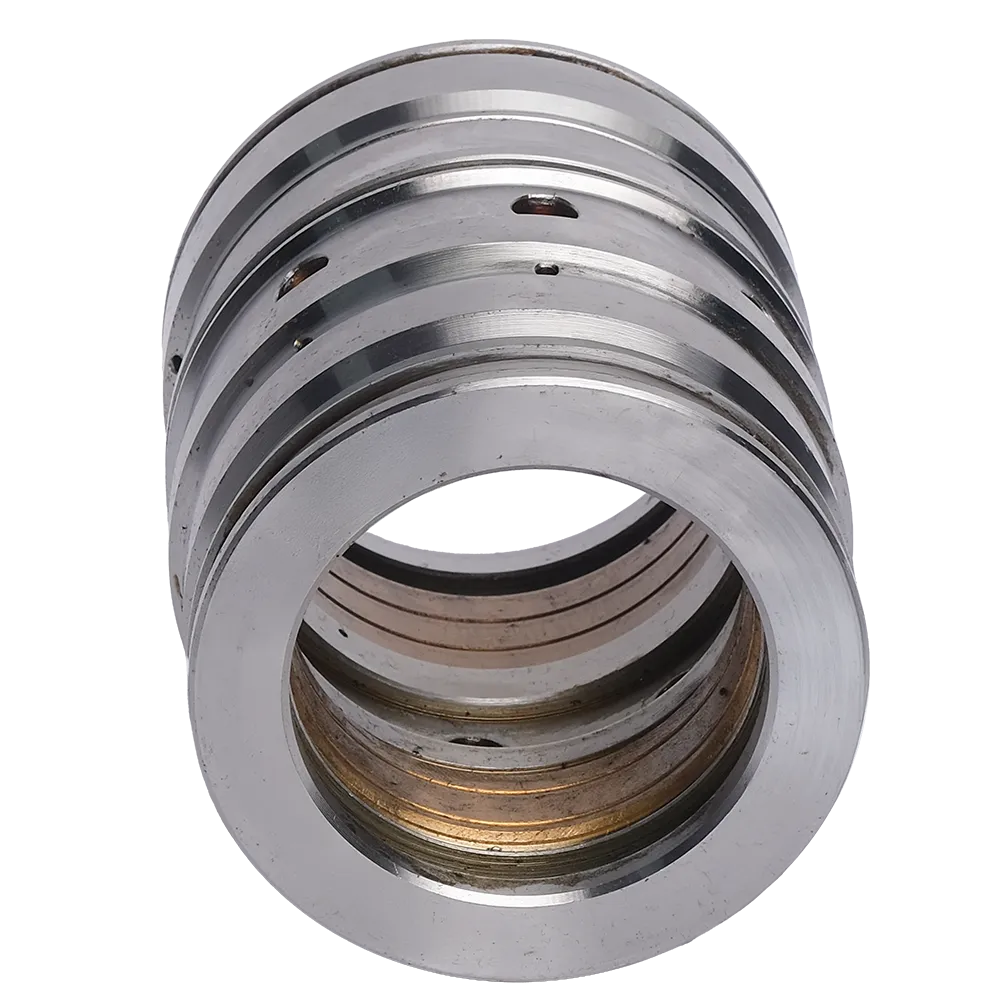
From the images, this liner shows features commonly associated with high-duty internal sleeves:
Multiple circumferential grooves that can support oil film formation and distribution
Radial lubrication ports/holes for fluid passage or pressure balancing
A robust wall thickness to resist deformation under load
A finely machined internal surface intended for controlled clearance
A hardened, ground external surface suited for stable seating in the housing
These details matter because the liner isn’t just a “tube.” It’s part of the oil-management and stability system that keeps friction low and movement consistent.
Materials and manufacturing approach
To perform well in rock drilling conditions, an OEM-standard liner is typically manufactured from a high-strength alloy steel chosen for toughness and wear resistance. The most important properties are not only hardness, but also resistance to micro-cracking under repeated load cycles.
For the 3115535800, 3115 5358 00 LINER ATLAS COPCO, the production focus is usually:
CNC turning and boring to achieve concentricity
Precision drilling of lubrication holes for consistent flow
Heat treatment to improve wear resistance and fatigue strength
Grinding/honing to ensure controlled surface finish (critical for lubrication film stability)
Dimensional verification to ensure correct press-fit or slip-fit (depending on the assembly)
A liner that is “close enough” can still cause premature failures. Small deviations in roundness, surface finish, or port alignment can increase friction, raise temperature, and shorten service life. That’s why OEM-standard consistency is the target, not just basic compatibility.
Where the 3115535800, 3115 5358 00 LINER ATLAS COPCO is used
This part belongs to a liner family that appears in Atlas Copco hydraulic drifter applications. In the same liner series, variants are listed for drifters used on rigs such as COP 1838HD+ and COP 1840+ and Atlas Copco Boomer installations. 3GEN Export
Because Atlas Copco part families can include multiple revisions (for example, close-number variants like 3115535804 are sold as a liner for COP 1838HD+/COP 1840+ applications), you should match by:
Drifter model (COP series)
Machine/rig model (Boomer family)
Drifter serial number or parts book reference
The 3115535800, 3115 5358 00 LINER ATLAS COPCO should be confirmed against your parts list to ensure you’re selecting the correct revision within the liner group. 3GEN Export
Performance benefits in real operation
More stable drilling response
A well-fitted liner helps maintain consistent internal clearances. That stability supports smoother energy transfer and reduces performance variation that operators often describe as “soft hits” or “uneven drilling feel.”
Longer seal and ring life
When a bore becomes scratched or loses roundness, sealing components degrade quickly. By protecting the housing surface, the liner helps seals operate in a more controlled environment and can reduce leakage risk over time.
Better oil film behavior
Grooves and ports are not cosmetic. They can support oil film renewal and help distribute lubrication to where contact stress is highest. When the oil film stays stable, friction drops, heat drops, and wear slows down.
Lower downstream repair costs
Replacing a liner is usually far cheaper than replacing a housing or body assembly. When this component is renewed at the right interval, it can protect much more expensive parts around it.
Technical details and practical specifications
Exact specifications can vary by revision and application, but the 3115535800, 3115 5358 00 LINER ATLAS COPCO is typically characterized by the following functional specs:
Type: Internal wear liner / sleeve (drifter system application)
Machining: Precision turned, drilled lubrication ports, groove features
Fit concept: Controlled seat in housing bore (commonly press-fit or tight tolerance seat)
Surface: Wear-resistant finish suitable for repetitive high-load cycles
Lubrication: Multi-port design supporting oil distribution pathways
Estimated weight
Net part weight (estimated): approximately 4.0–5.5 kg
Packing/shipping weight (estimated): approximately 5.0–6.5 kg
Final weight can vary by revision and packing method. If you need an exact shipment weight for logistics, 3GEN Export can confirm it at dispatch.
Installation guidance
Correct installation is just as important as correct part selection. A liner installed with poor alignment or contamination will wear quickly no matter how well it is produced.
Before installation
Depressurize and lock out the hydraulic system.
Clean the housing bore thoroughly; remove any burrs or embedded debris.
Inspect the mating bore for scoring, ovality, or heat discoloration.
Confirm that lubrication channels and ports in the housing are clear.
If the assembly uses seals or O-rings near the liner, replace them as a set.
Installation steps
Check orientation: ensure ports/holes align with the housing’s oil feed passages.
Use proper tooling: press tools should apply even force without tilting the liner.
Avoid impact damage: do not hammer directly onto the liner surface.
Verify seating depth: confirm the liner is seated to the correct stop/shoulder.
After installation, rotate/move the assembly by hand where possible to confirm smooth travel.
After installation
Run an initial low-load test cycle to confirm stable pressure and temperature.
Monitor for leaks and abnormal noise.
Check oil condition after early hours of operation for unexpected metal particles.
Maintenance tips to extend liner life
Use clean hydraulic oil and follow filtration intervals strictly.
Monitor oil temperature; excessive heat accelerates wear.
Avoid prolonged operation with misalignment in the boom/guide system (it loads the drifter unevenly).
Inspect for early symptoms: vibration changes, noise increase, leakage, or reduced efficiency.
If your operation is in highly abrasive environments, shorten inspection intervals.
Why buy from 3GEN Export
3GEN Export supplies OEM-standard heavy machinery spare parts for demanding field conditions. With the 3115535800, 3115 5358 00 LINER ATLAS COPCO, you are choosing a component intended to match the fit expectations of professional drilling operations, where downtime is expensive and performance consistency is non-negotiable.
OEM-standard supply from 3GEN Export
Worldwide delivery in 5 working days
Quality-focused sourcing for reliability and repeatable fit
If you share your drifter type (COP model) or machine/rig model, I can format a tighter compatibility list for your product page and reduce the risk of revision mismatch.
Manufactured in Turkey, these products are made using the latest technologies and built to meet the highest international standards. Each machine is a high-quality copy of the original, ensuring durability, precision, and performance that you can rely on for modern construction and metalworking projects.