
Construction Machinery Parts Export: 2026 Buying Guide
Our 2026 guide to construction machinery parts export covers supplier vetting, HS codes, Incoterms, and pricing tiers for global B2B buyers.
Loading article…
Article Not Found
The article you're looking for doesn't exist or may have been removed.
Back to BlogConstruction machinery parts export is the cross-border sale and shipment of components used in excavators, bulldozers, loaders, cranes, and other heavy equipment. This guide covers supplier selection, HS codes, pricing, and shipping steps for 2026.
Key Takeaways
- OEM part numbers and machine serial numbers are non-negotiable before you request a quote for parts export.
- Compare suppliers by warehouse depth, shipping speed, brand coverage, and Incoterms, not just unit price.
- Use HS heading 8431 as the master classification for most parts; 84314990 is the highest-volume subheading.
- Expect three price tiers: budget wear parts under $100, mid-range components up to $600, and premium parts above $600.
- Confirm packaging, export documents, and tracking before payment.
Understanding the Global Market for Construction Machinery Parts Export
The global market for this type of export spans undercarriage parts, hydraulic pumps, engine assemblies, fasteners, seals, and filters shipped across borders daily. Buyers in Latin America, the Caribbean, Africa, the Middle East, Asia, and Europe continue to source from U.S. and global exporters because of parts availability and dependable performance. According to K International Transport, U.S. heavy equipment is seen globally as a dependable investment due to its performance and availability of replacement parts.
"Used U.S. machinery is trusted worldwide for quality and availability of parts. In many developing markets, pre-owned construction and agricultural equipment offers the best value," notes K International Transport, which has supported U.S. equipment exporters for more than 30 years.
What Counts as a Construction Machinery Part?
A construction machinery part is any component that can be fitted to a machine classified under HS headings 8425 to 8430, including cranes, bulldozers, excavators, loaders, and related equipment. Common categories include transmission and drive components, hydraulic system parts, engine components, undercarriage parts, pins and bushings, exhaust and emission systems, and electrical parts.
Why Buyers Source from U.S. and Global Exporters
Buyers choose established exporters because track record reduces risk on high-value shipments. Stu Import Export, an Orlando, Florida exporter, cites over 21 years of experience shipping aftermarket John Deere, Caterpillar, Komatsu, Bobcat, and Mack Truck parts. Ring Power exports heavy construction machinery and parts worldwide, including bulldozers, excavators, dump trucks, cranes, forklifts, air compressors, generators, and engines. According to the U.S. International Trade Administration, export assistance is available for firms with 51% U.S. content, and the agency also coordinates advocacy support for U.S. firms competing on Multilateral Development Bank tenders overseas.
How to Choose a Construction Machinery Parts Export Supplier
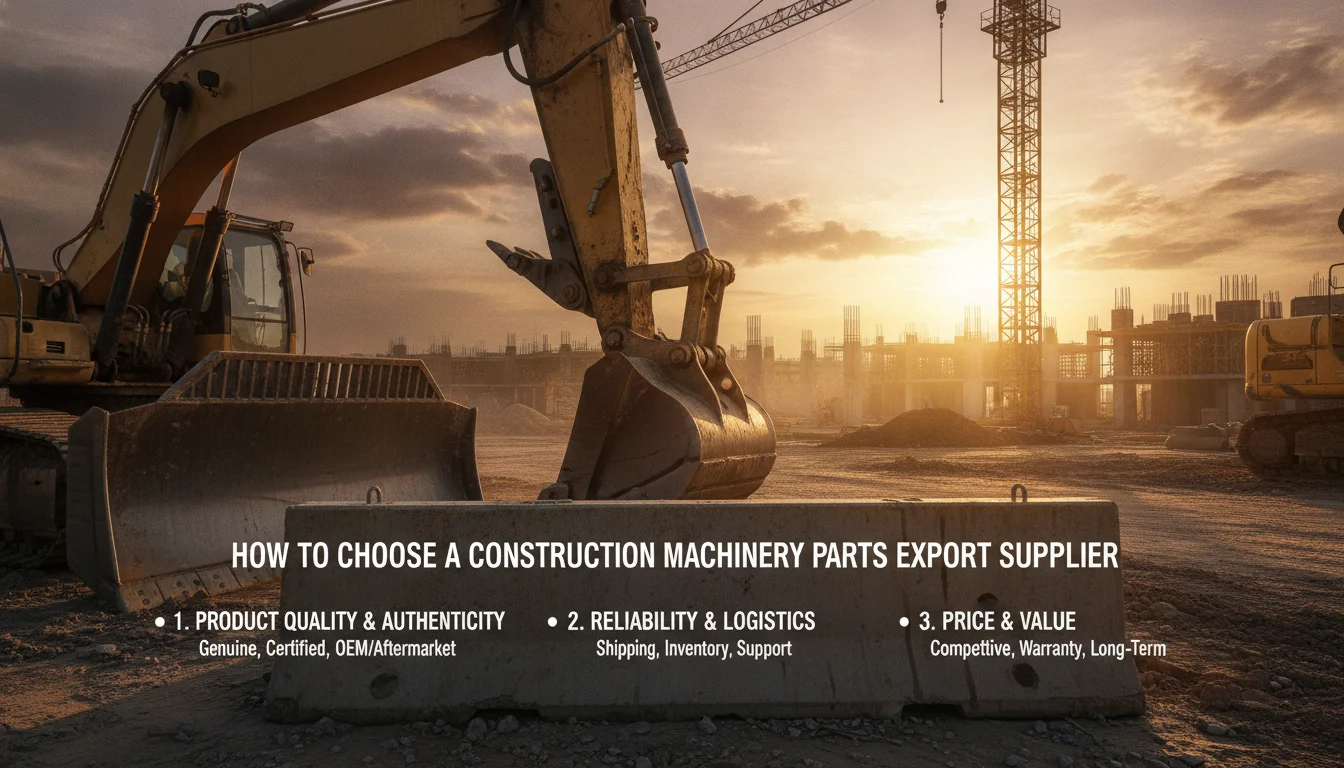
Choosing a construction machinery parts export supplier means weighing four criteria: part authenticity, inventory depth, shipping speed, and customs documentation capability. Do not choose on unit price alone.
OEM vs Aftermarket Parts
OEM parts are components produced by the original equipment manufacturer or its licensed suppliers. Aftermarket parts are replacement components made by third-party manufacturers to fit OEM equipment. Independent exporters such as Stu Import Export specialize in aftermarket John Deere, Bobcat, Caterpillar, and Mack Truck parts. 3GEN Export lists new and replacement parts for Komatsu, Volvo, Mitsubishi, Atlas Copco, and Case machines, covering categories from hydraulic system components to transmission and drive parts.
Warehouse Depth and Inventory
A deep inventory reduces lead time on urgent orders. Some exporters operate large self-owned warehouses; one manufacturer-direct exporter cites a 10,000 m² self-owned warehouse with a full range of spare parts for major excavators, offered under EXW and FOB terms. Florida-based exporters maintain local stock that enables same-day service to several Caribbean destinations.
Shipping Speed and Regional Coverage
Shipping speed for construction machinery parts export varies by carrier, route, and destination port. Stu Import Export states it offers same-day service to several Caribbean areas and operates as American Airlines' largest cargo shipper in Orlando. 3GEN Export advertises global delivery in 5-7 days for heavy machinery spare parts. Check whether your supplier offers air freight, ocean freight, and courier options for your port before committing.
Pro Tip: Ask any prospective supplier for their average pick-to-ship time on in-stock items, not just their advertised transit time. A supplier quoting 5-7 day global delivery is describing time in transit once the part leaves the warehouse, and that clock only starts after inventory is confirmed and packed.
HS Codes and Compliance for Construction Machinery Parts Export
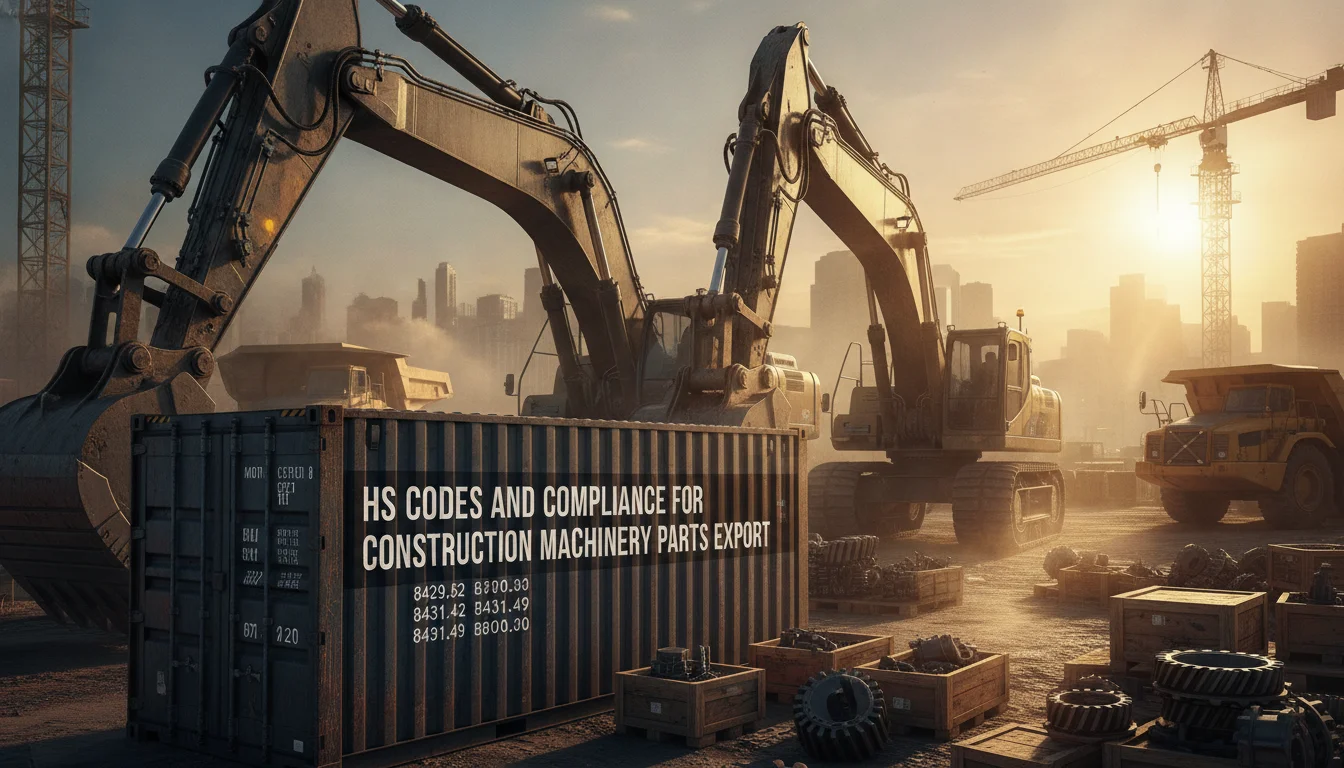
Customs classification is one of the most common bottlenecks in construction machinery parts export, since HS codes determine duty rates, clearance requirements, and trade statistics.
Key HS Codes from Trade Data
According to Seair Exim Solutions, the master HS code for construction machinery parts is 8431, covering parts suitable for use solely or principally with machinery of headings 8425 to 8430. The most-used subheading in its shipment database is 84314990, with 10,212 shipment records. Other common codes include 40169320 for rubber O-rings (6,857 records), 40169330 for rubber oil seals (6,857 records), 40094200 for hoses with fittings (4,484 records), and 73181500 for screws and bolts (2,685 records).
Incoterms and Documentation
Incoterms are standardized trade terms that define buyer and seller obligations for delivery, insurance, and freight. EXW means Ex Works: the buyer bears all costs and risks from the seller's premises. FOB means Free on Board: the seller clears goods for export and loads them on the vessel, with risk transferring once on board. Exporters in this market commonly quote EXW and FOB. Essential documents include commercial invoice, packing list, bill of lading or air waybill, certificate of origin, and any required export declaration.
Price Range Expectations and Value Tiers
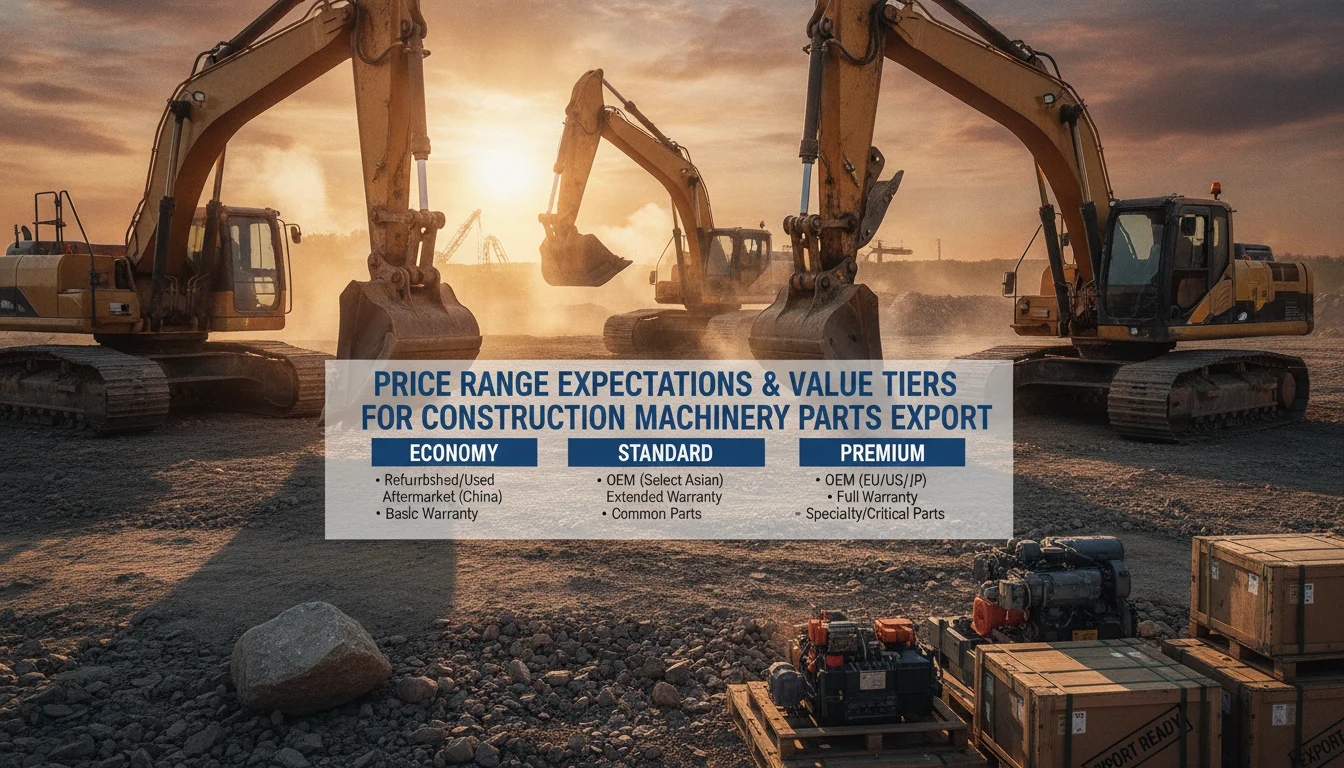
Pricing for construction machinery parts export varies by brand, part complexity, material, and condition. Use these three tiers to set expectations before you request a formal quote.
Budget, Mid-Range, and Premium
- Budget tier under $100: small hardware, seals, shims, spacers, and filters. On 3GEN Export's marketplace, a Komatsu shim is listed at $96.
- Mid-range $100-$600: bushings, retainers, gears, and transmission components. 3GEN Export lists a Komatsu bushing at $600 and a Mitsubishi oil pressure component at $426.
- Premium above $600: couplings, complete gears, engine assemblies, and hydraulic pumps. 3GEN Export lists a Komatsu coupling at $1,960 and a Komatsu gear at $2,600.
What Drives Price Differences?
OEM parts generally cost more than aftermarket equivalents. Material grade, brand licensing, stock availability, and shipping terms all affect final price. EXW prices exclude freight, import duties, and local taxes; FOB includes export clearance but not destination charges.
Comparison Table: Export Supplier Types
| Supplier Type | Strengths | Limitations | Best For |
|---|---|---|---|
| OEM dealership export, e.g. Ring Power | Genuine parts, rigorous quality control, full machine range | Higher prices, sometimes longer lead times | Fleets needing factory-spec components |
| Independent aftermarket exporter, e.g. Stu Import Export | Broad brand coverage, fast shipping, competitive pricing | Aftermarket quality varies; supplier vetting required | Mixed fleets and urgent replacements |
| Manufacturer-direct exporter | Large 10,000 m² warehouse, EXW/FOB terms, full excavator range | Longer transit from overseas, time zone and language gaps | High-volume excavator undercarriage and hydraulic parts |
| HS code data platform, e.g. Seair | Shipment-level import/export data, code lookup | Not a parts supplier; data only | Market research and customs classification |
How to Order Construction Machinery Parts for Export: Step by Step
Use this sequence to minimize errors and delays:
- Step 1: Record machine details. Capture the make, model, serial number, and existing part number. If the part is missing, take photos of the mounting location.
- Step 2: Request multiple quotes. Contact at least two suppliers and include the HS code, quantity, destination port or airport, and preferred Incoterm.
- Step 3: Verify compatibility and quality. Ask for photos, dimensions, OEM cross-reference numbers, and quality certificates.
- Step 4: Confirm packaging and documentation. This matters especially for hydraulic or engine components.
- Step 5: Arrange freight and track the shipment. For air freight, confirm the tracking number format with the carrier.
What to Look For When Buying: Material, Fit, and Packaging
Material Specifications
Check steel grades for undercarriage parts, pins, and bushings. Rubber components must meet the correct durometer and temperature rating. For hydraulic parts, confirm pressure ratings and fluid compatibility.
Fit and Compatibility
Cross-reference the OEM part number, not just the machine model. Many exporters list multiple part numbers for the same component, such as Mitsubishi part numbers MC840219 and 6263105800, or Komatsu part numbers 23B-70-72190 and 23B-73-51490.
Three Common Parts Packages
- Excavator undercarriage package: track chains, bottom rollers, top rollers, sprockets, idlers, and pins/bushings. This combination is frequently shipped by exporter-direct suppliers under FOB terms.
- Wheel loader drive package: transmission components, drive shafts, filters, and seals. Independent exporters list Mitsubishi and Komatsu drive parts.
- Hydraulic system package: pumps, cylinders, control valves, hoses, and O-rings. 3GEN Export lists Atlas Copco check valves and Volvo mufflers as separate categories.
Packaging and Export Readiness
Proper packaging prevents damage in transit. Look for anti-corrosion coatings, marine-grade packing, and clear labels. Hydraulic components may require special handling or hazardous material declarations.
Used Equipment vs. Parts: A Related but Separate Export Category
Exporting used construction machinery is a distinct trade category from parts export, though the two markets overlap heavily. Many buyers who purchase used excavators or loaders from U.S. sellers immediately need a parallel source for replacement components once the machine reaches its destination country. K International Transport notes that demand for used American equipment continues to grow across Africa, Latin America, the Middle East, Asia, and Europe, largely because of that same parts availability advantage. If you are sourcing a used machine, confirm your parts supplier before the equipment ships, not after it breaks down on a job site.
Care and Maintenance for Imported Heavy Equipment Parts
Even unused parts can fail if stored incorrectly. Follow these storage rules:
- Keep hydraulic components sealed and protected from temperature swings.
- Store rubber seals and hoses away from UV light, ozone, and oil fumes.
- Use first-in, first-out rotation to avoid aged seals and gaskets.
- Apply volatile corrosion inhibitor packaging for long-term storage of steel parts.
Industry maintenance data shows that rubber seals and hoses degrade faster in storage than in service when exposed to UV light and ozone, which is why FIFO rotation and proper packaging matter as much for shelf stock as for installed components.
Pros and Cons
Pros
- Access to OEM and aftermarket parts for 40+ brands through a single sourcing relationship, reducing the number of vendors a fleet manager has to manage.
- Established exporters offer multiple freight options, including air, ocean, and courier, giving buyers flexibility on cost versus speed.
- Deep warehouse inventory from manufacturer-direct and dealership exporters shortens lead time on high-turnover wear parts.
- Global delivery windows as short as 5-7 days for in-stock items keep downtime manageable on active job sites.
Cons
- Aftermarket quality varies by manufacturer, so vetting each supplier's quality control process is essential.
- EXW pricing excludes freight, duties, and taxes, which can make budget comparisons confusing across quotes.
- Ocean freight from overseas manufacturer-direct exporters can take several weeks, which does not suit emergency orders.
- Incorrect HS classification can trigger customs delays or unexpected duty assessments.
Final Word on Construction Machinery Parts Export
The construction machinery parts export market rewards buyers who treat sourcing as a process, not a transaction. Compare OEM and aftermarket suppliers, confirm HS codes and Incoterms, and build a relationship with an exporter that has proven warehouse depth and shipping speed. That approach reduces downtime and lowers total landed cost across the life of the machine. As of 2026, buyers who standardize on a documented sourcing checklist consistently report fewer clearance delays than those who shop purely on price.
Frequently Asked Questions
What is the most important thing to check before ordering parts for export?
Confirm the machine serial number and the exact OEM part number. Different production years and regional configurations can use different components, even for the same model.
What is the HS code for construction machinery parts?
The primary HS heading is 8431, which covers parts for machinery under headings 8425 to 8430. The most common subheading in export data is 84314990.
What is the HS code for excavator spare parts?
Excavator spare parts generally fall under the same HS heading 8431, since excavators are classified within headings 8425 to 8430. Specific components like rubber seals or hoses may carry separate codes, such as 40169330 for oil seals or 40094200 for hoses with fittings.
Should I buy OEM or aftermarket parts for export?
OEM parts guarantee factory specifications but cost more. Aftermarket parts from reputable exporters can offer equivalent performance at lower cost. Choose based on machine age, downtime cost, and warranty needs.
What are EXW and FOB terms?
EXW means you pay all freight and assume risk from the seller's warehouse. FOB means the seller clears export and loads the goods, with risk transferring once on board the vessel.
How long does international parts delivery take?
It varies by route and method. 3GEN Export advertises global delivery in 5-7 days for in-stock parts, while ocean freight from Asia can take several weeks.
What are the best value parts to buy aftermarket?
Wear parts such as pins, bushings, filters, seals, and undercarriage components typically offer the best aftermarket value. High-precision engine or transmission internals may be better sourced as OEM.
Ready to source OEM-quality parts without the guesswork? Shop OEM-quality spare parts with global 5-day delivery at 3genexport.com and put a documented sourcing process behind every order.