
Global Heavy Parts Supply Chain: 2026 Guide
The global heavy parts supply chain drives uptime for mining, construction & energy fleets. Learn sourcing, logistics & supplier strategies for 2026.
Loading article…
Article Not Found
The article you're looking for doesn't exist or may have been removed.
Back to BlogThe global heavy parts supply chain is the interconnected network of manufacturers, distributors, and logistics providers that keeps construction, mining, and energy equipment running. When a critical part fails on a $300,000 excavator, every day of downtime costs $2,000 or more in lost productivity.
Key Takeaways
- Equipment downtime costs $2,000+ per day, according to industry maintenance data - sourcing speed is everything.
- Reactive parts ordering guarantees maximum downtime; proactive stocking eliminates the wait.
- 82% of construction companies still track parts manually, driving significantly higher failure rates compared to digitally managed fleets.
- Diversifying your supplier base across OEM and verified aftermarket sources reduces single-source risk.
- Digital tools - inventory software, IoT tracking, and cloud platforms - are now standard practice for competitive procurement teams.
- As of 2026, sustainability and near-shoring are reshaping how companies structure their supply networks.
The Structure of the Global Heavy Parts Supply Chain
The supply chain consists of various interconnected components that work together to deliver parts efficiently. Understanding this structure is vital for businesses looking to optimize their operations.
1. Key Components of the Supply Chain
- Manufacturers: Original Equipment Manufacturers (OEMs) produce the machinery and its parts, ensuring quality and compatibility.
- Distributors: These entities manage the logistics of transporting parts from manufacturers to end-users, often holding large inventories to meet demand.
- Retailers: Retailers sell parts directly to consumers or businesses, providing a crucial link between distributors and end-users.
2. Types of Parts in the Supply Chain
The supply chain covers a wide range of components, each with strict compatibility requirements tied to the OEM specification:
- Hydraulic components: Pumps, motors, cylinders, and seal kits must meet precise pressure and flow ratings. A $40 hydraulic hose fitting, if out of stock, can idle a $300,000 machine for a week.
- Electrical systems: ECUs, sensors, and wiring harnesses are critical for the functionality of modern equipment and increasingly difficult to source outside authorized channels.
- Engine parts: Diesel engines require filters, injectors, pumps, and overhaul kits - all of which carry OEM part numbers that must be cross-referenced before dispatch.
- Undercarriage components: Track chains, rollers, and sprockets for excavators and dozers wear predictably and are ideal candidates for proactive stocking.
- Final drives and swing gearboxes: High-value assemblies with long lead times if not held in regional inventory.
3. Geographic Considerations
Geography shapes lead times, customs complexity, and total landed cost across the this type of chain:
- Regional suppliers: Local suppliers reduce shipping times and costs, making them valuable partners for routine consumables.
- International logistics: Understanding customs regulations and international shipping requirements is critical for cross-border operations. STS-Global notes that some destinations have special import regulations requiring heat-treated wooden crate packing and step-by-step shipment tracking.
- Market demand: Different regions have varying demand for specific parts based on local industries - mining-heavy regions in Latin America and Southeast Asia, for example, consume undercarriage and hydraulic parts at a higher rate than markets dominated by road construction.
How the Global Heavy Parts Supply Chain Actually Works
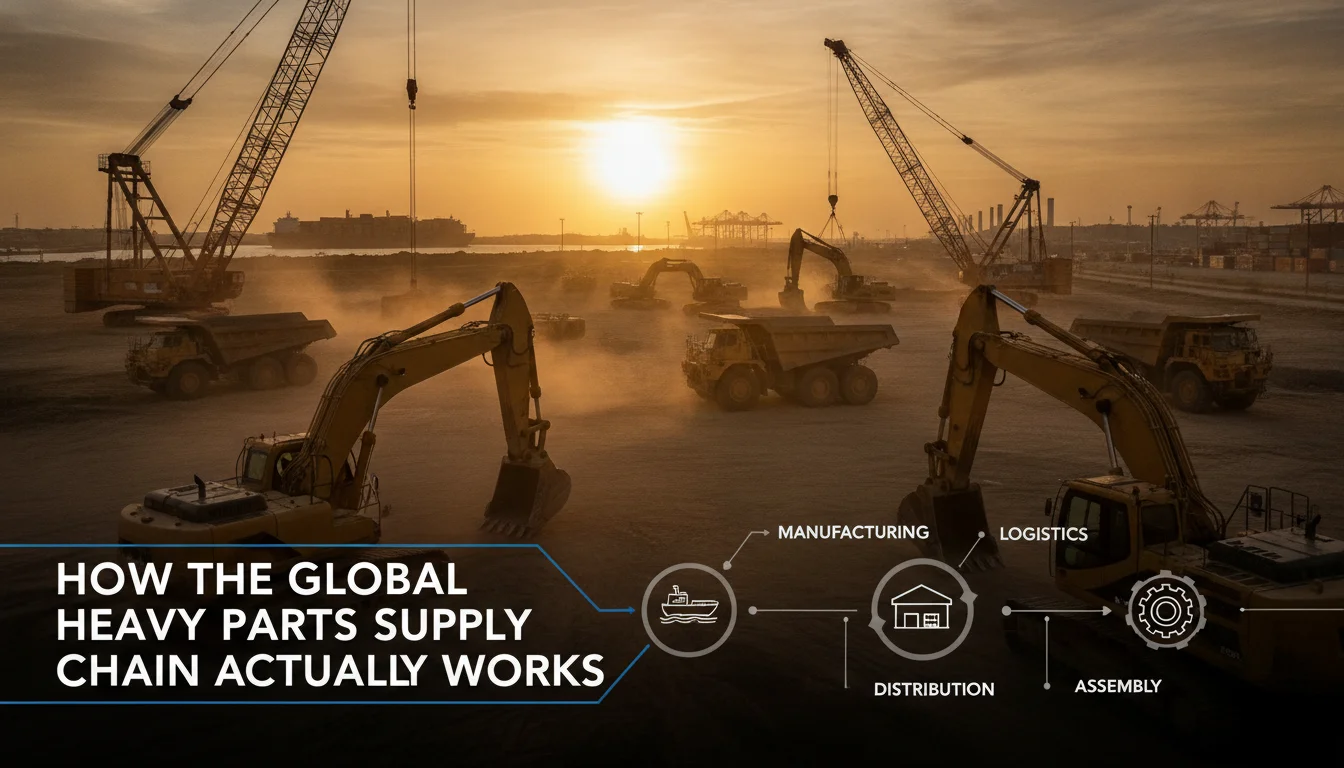
The this kind of supply chain moves a part from factory floor to job site through a sequence of coordinated steps, each of which can accelerate or delay the final delivery.
It starts at the OEM or authorized manufacturer. Caterpillar, Komatsu, Volvo, Cummins, and similar brands assign unique part numbers to every component they produce. Those numbers are the backbone of the entire system. A procurement manager searching for a Komatsu PC200 hydraulic pump must match the exact part number against the OEM catalog before ordering - an incorrect cross-reference wastes time and money.
From the manufacturer, parts flow to regional distribution centers or specialized distributors. These warehouses hold inventory for the most common equipment models in their target markets. Parts Supply Inc., based in Miami, maintains over 100,000 parts in stock for excavators, loaders, bulldozers, and forklifts, with same-day dispatch capability for in-stock items. That kind of regional stocking is what separates a 24-hour turnaround from a 3-week ocean freight wait.
Once an order is placed, the logistics layer takes over. Air freight handles urgent, high-value parts. Sea freight moves bulk or lower-priority orders at lower cost. Courier services cover last-mile delivery in markets with reliable postal infrastructure. Each mode carries different cost, speed, and customs implications - and a good distributor coordinates all three depending on urgency and destination.
At the receiving end, the part must be verified against the OEM spec before installation. According to manufacturer specifications, installing an incorrect part - even one that physically fits - can void warranties and cause premature failure. This verification step is non-negotiable in professional fleet maintenance.
"The main goal in the spare parts industry is to minimize the downtime of your valuable assets such as vessels, oil rigs, wind turbines, generators, manufacturing equipment, and heavy machinery. Whenever an asset needs repair or maintenance, the piece of machinery undergoes a full stop - which is a highly costly scenario." - Lokad, Spare Parts Supply Chain Overview
How to Optimize Your Global Heavy Parts Supply Chain: A Step-by-Step Approach
Optimizing the the heavy parts supply chain requires a structured process, not a one-time fix. Here are the concrete steps procurement managers and fleet supervisors should follow.
Step 1: Audit Your Current Parts Inventory
Start by cataloging every part currently in stock against the machines in your fleet. Identify gaps: which critical components have zero on-shelf quantity? Which are overstocked and tying up capital? Use OEM service manuals to build a master list of high-wear items for each machine model.
Step 2: Set Min/Max Stock Levels for Critical Parts
For every high-wear or long-lead-time part, establish a minimum stock threshold that triggers a reorder and a maximum level that prevents overstocking. Industry maintenance data shows that automated reorder alerts at minimum thresholds are one of the most effective tools for preventing stockouts. A hydraulic pump that takes 3-10 business days to arrive should never reach zero on the shelf.
Step 3: Qualify Multiple Suppliers Per Part Category
Never rely on a single source for critical components. Qualify at least two suppliers per major part category: one OEM-authorized source and one verified aftermarket supplier. This gives you price leverage and a backup when your primary source is out of stock or facing shipping delays.
Step 4: Implement Digital Inventory Tracking
Replace spreadsheets and manual logs with inventory management software that links parts consumption to specific machine IDs and work orders. According to industry maintenance data, 82% of construction companies still track parts manually - and those operations experience significantly higher failure rates compared to digitally managed fleets. Barcode or QR scanning eliminates ghost inventory and double-ordering.
Step 5: Negotiate Lead Times and Shipping Terms Upfront
Before a breakdown happens, agree on lead times, shipping modes, and emergency escalation paths with your key suppliers. STS-Global commits to replying to requests on most common spares within 24 hours. That kind of service-level agreement should be a baseline requirement, not a bonus.
Step 6: Review and Adjust Quarterly
Parts consumption patterns shift as machines age and project types change. Review your stocking levels and supplier performance every quarter. Replace underperforming suppliers before a critical failure exposes the gap.
Challenges in the Global Heavy Parts Supply Chain
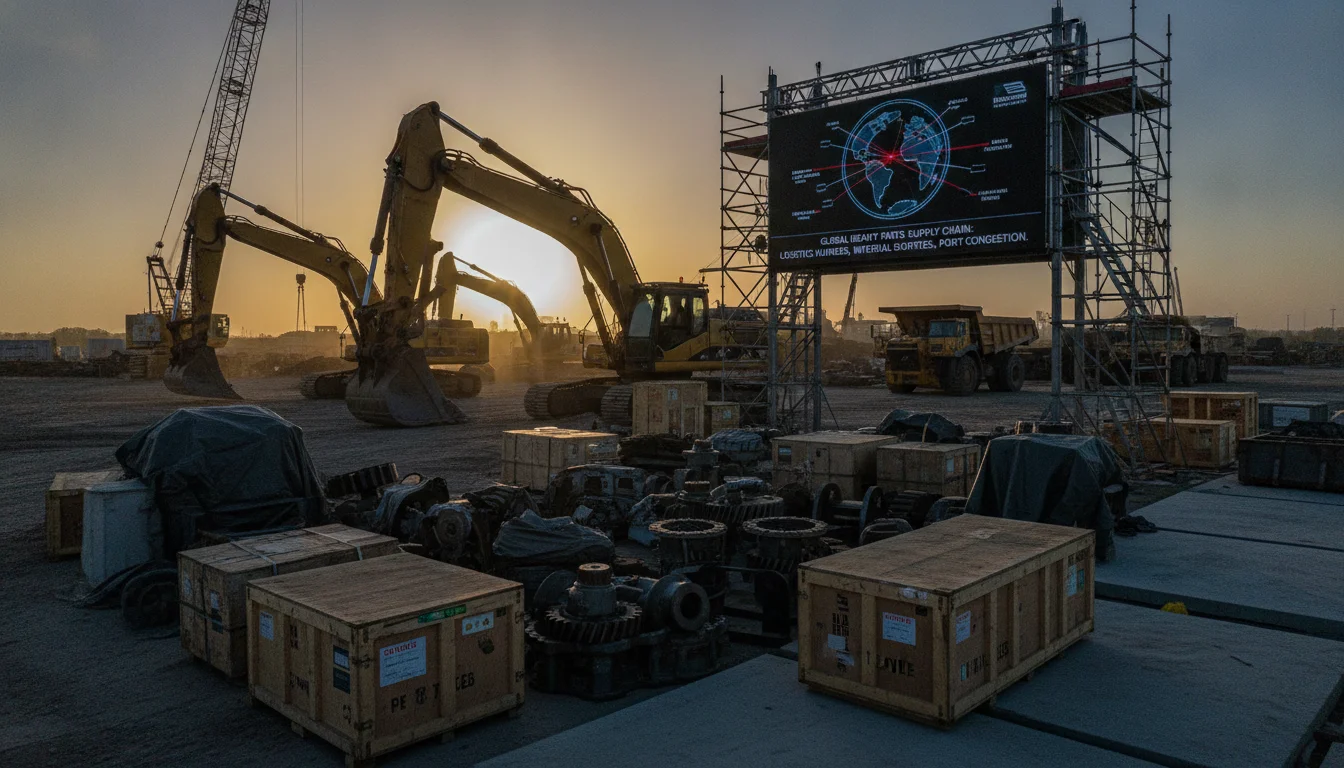
The chain faces persistent challenges that directly affect equipment uptime and procurement costs.
1. Inventory Management
Effective inventory management is the difference between a two-hour repair and a two-week shutdown:
- Stockouts: Running out of critical parts causes significant operational delays. Reactive ordering - placing an order only after failure - guarantees the longest possible downtime every time.
- Overstocking: Excess inventory ties up capital and increases storage costs. The goal is precision stocking, not a warehouse full of slow-moving parts.
- Demand forecasting: Accurate forecasting requires linking parts consumption data to machine hours, age, and operating conditions - not just gut feel.
2. Logistics and Transportation
Logistics challenges can significantly affect the supply chain at every stage:
- Shipping delays: Port congestion, customs holds, and carrier capacity constraints can add days or weeks to expected delivery times.
- Transportation costs: Fluctuating fuel prices and shifting freight rates affect total landed cost, especially for air freight on urgent orders.
- Customs regulations: International shipments require accurate documentation, correct HS codes, and sometimes special packing (such as heat-treated wooden crates) to clear customs without delay.
3. Supplier Relationships
Building strong relationships with suppliers is essential for a resilient supply chain:
- Reliability: Dependable suppliers ensure timely delivery of parts, even during peak demand periods.
- Quality control: Every part should be verified against OEM specs before dispatch. Parts Supply Inc. cross-references every part number against OEM catalogs and sends a photo of actual stock for buyer confirmation when part numbers are ambiguous.
- Communication: Open lines of communication - WhatsApp, email, or direct phone - help address issues before they escalate into downtime events.
Comparison: OEM Parts vs. Verified Aftermarket Parts
Choosing between OEM and aftermarket parts is one of the most consequential decisions in managing the global heavy. The right answer depends on the part type, machine age, and your tolerance for risk.
| Factor | OEM Parts | Verified Aftermarket Parts |
|---|---|---|
| Price | Higher - manufacturer premium applies | Lower - typically 20-40% less than OEM list price |
| Availability | May require factory order for older models | Often in stock at regional distributors |
| Lead Time | Can be 3-10 business days or longer | Same-day to 72-hour dispatch from stocked warehouses |
| Compatibility Guarantee | Full OEM spec match, warranty intact | Requires cross-reference verification against OEM catalog |
| Best For | Warranty-period machines, critical safety components | Out-of-warranty fleets, high-wear consumables, budget-sensitive operations |
| Quality Assurance | Factory QC, traceable batch numbers | Varies by supplier - insist on ISO-certified sources |
| Brands Supported | Caterpillar, Komatsu, Volvo, Cummins, Bosch | Cross-brand compatibility for Caterpillar, Komatsu, Volvo, Doosan, Hyundai, and others |
Pro Tip: For hydraulic pumps, final drives, and engine overhaul kits, always verify the part number against the OEM service manual before ordering - regardless of whether you choose OEM or aftermarket. A mismatched part that physically fits can cause premature failure and void any supplier warranty.
Pros and Cons of a Globally Distributed Heavy Parts Supply Chain
A globally distributed supply network offers real advantages, but it also introduces risks that a purely local strategy avoids. Understanding both sides helps procurement teams make better sourcing decisions.
Pros
- Wider parts availability: Access to OEM and aftermarket inventory across multiple continents means fewer stockouts for rare or discontinued components.
- Competitive pricing: Multiple international suppliers create price competition, reducing procurement costs on high-volume parts.
- Faster emergency sourcing: When a local supplier is out of stock, a global network provides alternative sources that can air-freight parts within days.
- Brand coverage: A global distributor can cover Caterpillar, Komatsu, Volvo, Atlas Copco, Cummins, and 40+ other brands from a single point of contact.
- Scalability: As your fleet grows or diversifies into new equipment brands, a global supply relationship scales with you.
Cons
- Longer lead times for sea freight: Ocean shipping is cost-effective but slow. For urgent repairs, air freight costs can be significant.
- Customs complexity: Cross-border shipments require accurate documentation and knowledge of destination country import regulations.
- Quality variability: Not all international suppliers maintain consistent quality standards. Vetting is essential before placing large orders.
- Currency and pricing risk: Exchange rate fluctuations can affect landed cost, especially for long-term supply contracts priced in foreign currencies.
- Communication time zones: Working across multiple time zones can slow response times if your supplier doesn't offer extended support hours.
Common Mistakes to Avoid in Heavy Parts Procurement
Most procurement failures in the supply chain trace back to a small set of recurring errors. Recognizing them early saves significant time and money.
Mistake 1: Ordering Only After Failure
Reactive procurement is the single biggest driver of extended downtime. A hydraulic pump that takes 3-10 business days to arrive means a $300,000 machine sits idle at $2,000+ per day while you wait. Proactive stocking of critical spares eliminates that wait entirely.
Mistake 2: Relying on a Single Supplier
Single-source dependency is a structural risk. When that supplier faces a stockout, a shipping disruption, or a quality issue, your operation has no fallback. Qualifying at least two suppliers per critical part category is basic risk management.
Mistake 3: Skipping Part Number Verification
Ordering by machine model alone - without confirming the exact OEM part number - leads to compatibility errors. Always cross-reference the part number against the OEM service manual or catalog before placing an order. Reputable distributors will do this verification for you, but you should never assume it happens automatically.
Mistake 4: Ignoring Total Landed Cost
A part priced attractively at origin can become expensive after freight, customs duties, and handling fees are added. Always request a landed cost estimate - including shipping to your destination - before comparing supplier quotes.
Mistake 5: Manual Inventory Tracking
Spreadsheets and paper logs create ghost inventory - parts that appear to be in stock but aren't. Industry maintenance data shows that 82% of construction companies still rely on manual tracking, and those operations experience significantly higher failure rates. Digital inventory systems with barcode scanning and automated reorder alerts are now accessible at every budget level.
Mistake 6: Choosing Price Over Supplier Reliability
The cheapest quote rarely delivers the best total value. A supplier who ships the wrong part, misses the delivery window, or provides no after-sale support costs far more than the price difference. Evaluate suppliers on lead time consistency, part number accuracy, and communication quality - not price alone.
A Realistic Scenario: Mining Fleet Hydraulic Failure in a Remote Location
Consider a mining operation running a fleet of Komatsu PC360 excavators at a remote site. A hydraulic main pump fails on a Monday morning. The machine is down. The site supervisor checks the local parts store - no stock. The nearest OEM dealer is three days away by road.
A procurement team with a proactive supply strategy would already have a spare pump on the shelf, sourced during the previous quarter's inventory review. The repair takes four hours. The machine is back in production by Monday afternoon.
A reactive team places an emergency order on Monday. The distributor confirms stock and dispatches by air freight within 24 hours. The part clears customs on Wednesday, arrives on site Thursday. The machine has been idle for three days at $2,000+ per day in lost production.
The difference between these two outcomes isn't the supplier - it's the procurement strategy. Both teams used the same global supply network. One used it proactively; the other didn't.
"Armstrong & Associates estimates the global spare parts logistics market at $52.7 billion a year, representing approximately 6.9 percent of total third-party logistics revenue. The industrial sector - which includes heavy machinery - accounts for $10.9 billion of that total." - Global Trade Magazine, Spare Parts Logistics Report
Strategies for Optimizing the Global Heavy Parts Supply Chain
To overcome challenges and improve efficiency, businesses can implement several proven strategies across sourcing, technology, and supplier collaboration.
1. Implementing Technology Solutions
Technology plays a vital role in modernizing supply chain operations:
- Inventory management software: Digital tools track inventory levels and automate reordering, eliminating the manual lag that causes stockouts.
- Supply chain analytics: Data analytics provide insights into demand patterns, supplier performance, and total cost-per-machine-hour.
- Blockchain technology: This technology enhances transparency and traceability, helping buyers verify part authenticity and chain of custody.
- IoT integration: Real-time tracking of parts and equipment location reduces lost inventory and improves delivery visibility.
2. Diversifying Suppliers
Diversifying the supplier base reduces single-source risk across the global heavy parts supply chain:
- Multiple sourcing: Engaging multiple suppliers for critical parts reduces dependency on any single source.
- Local sourcing: Partnering with regional suppliers decreases lead times and transportation costs for routine consumables.
- Supplier evaluation: Regular performance reviews identify reliability issues before they cause operational disruptions.
3. Enhancing Collaboration
Collaboration among stakeholders leads to measurably better outcomes:
- Cross-functional teams: Involving maintenance, procurement, and operations in supply chain decisions improves alignment and reduces emergency orders.
- Supplier partnerships: Strategic partnerships with key suppliers unlock priority stock access, faster response times, and joint forecasting.
- Industry networks: Participating in industry groups provides market intelligence and early warning on parts shortages or supplier disruptions.
Key Players in the Global Heavy Parts Supply Chain
Several companies and organizations play a significant role in the global heavy parts supply chain.
1. Major OEMs
Leading manufacturers such as Caterpillar, Komatsu, and Volvo are at the forefront of the heavy machinery industry, producing high-quality equipment and parts. Cummins and Bosch supply critical engine and fuel system components across multiple OEM brands. These manufacturers publish detailed parts catalogs and service bulletins that form the reference standard for the entire supply network.
2. Distributors and Wholesalers
Specialized distributors bridge the gap between OEM production and end-user demand. Parts Supply Inc., operating out of Miami with over 30 years in business, maintains more than 100,000 parts in stock across excavators, loaders, bulldozers, and forklifts. STS-Global, based in Scandinavia, specializes in heavy machinery spare parts for brands including Liebherr, JCB, CAT, Hyster, Komatsu, and John Deere, with worldwide delivery capability.
3. Logistics Providers
Logistics companies ensure timely delivery across the global heavy parts supply chain, coordinating sea, air, and courier modes depending on urgency and destination. Specialized freight providers handle the customs documentation, packing requirements, and last-mile delivery that general carriers often cannot manage for heavy industrial components.
Future Trends in the Global Heavy Parts Supply Chain
As of 2026, several trends are actively reshaping how companies source, stock, and deliver heavy machinery parts. Procurement teams that adapt early will hold a clear cost and uptime advantage.
1. Sustainability Initiatives
Environmental concerns are driving companies to adopt sustainable practices across their supply networks:
- Green logistics: Consolidating shipments and optimizing routing reduces carbon output without sacrificing delivery speed.
- Recycling programs: Remanufactured and reconditioned parts - particularly for high-value assemblies like hydraulic pumps and final drives - reduce waste and offer cost savings compared to new OEM components.
- Energy-efficient operations: Warehouse and distribution center operators are investing in energy-efficient infrastructure to reduce operational costs and meet corporate sustainability targets.
2. Digital Transformation
The adoption of digital technologies is transforming supply chain management at every level:
- IoT integration: Real-time tracking of parts and equipment enables predictive maintenance scheduling and reduces emergency orders.
- AI and machine learning: These tools improve demand forecasting accuracy, helping procurement teams stock the right parts before failure occurs rather than after.
- Cloud-based platforms: Cloud computing enables better collaboration and data sharing among supply chain partners across multiple time zones and geographies.
3. Near-Shoring and Supply Chain Resilience
This year, near-shoring has moved from a theoretical strategy to an operational priority for many procurement teams. The disruptions of recent years exposed the fragility of single-region sourcing. Companies are now building regional inventory buffers closer to their operating sites, reducing dependence on long ocean freight routes. This doesn't replace global sourcing - it complements it with a regional safety net.
4. Globalization and Market Expansion
As markets continue to expand, companies are extending their supply networks into new regions:
- Emerging markets: Latin America, Southeast Asia, and Sub-Saharan Africa represent growing demand centers for heavy equipment parts, driven by infrastructure investment and mining activity.
- Cross-border trade: Understanding international trade regulations is essential for successful market entry and avoiding costly customs delays.
- Local partnerships: Collaborating with established local firms accelerates market entry and provides on-the-ground logistics knowledge that global distributors alone cannot replicate.
Frequently Asked Questions
What is the global heavy parts supply chain?
The global heavy parts supply chain is the network of manufacturers, distributors, logistics providers, and end-users involved in producing and delivering spare parts for heavy machinery and equipment. It covers everything from OEM factory production to last-mile delivery at a remote mining or construction site.
Why is inventory management important in the supply chain?
Effective inventory management prevents the two most costly outcomes: stockouts that idle expensive machines, and overstocking that ties up capital in slow-moving parts. Industry maintenance data shows that proactive stocking with automated reorder alerts is one of the most effective tools for reducing parts-related downtime. A $40 fitting can idle a $300,000 machine for a week if it's not on the shelf.
What challenges do companies face in the heavy parts supply chain?
The most common challenges are reactive inventory management, single-source supplier dependency, customs and logistics complexity for cross-border shipments, and the difficulty of accurate demand forecasting across diverse machine fleets. Each of these is addressable with the right combination of digital tools and supplier relationships.
How can technology improve the supply chain?
Digital inventory systems, IoT-based asset tracking, and AI-driven demand forecasting all reduce the gap between parts need and parts availability. According to industry maintenance data, companies using digital fleet management systems experience significantly lower failure rates compared to those relying on manual tracking. Cloud platforms also improve coordination across suppliers, warehouses, and end-users in different time zones.
What is the difference between OEM and aftermarket heavy parts?
OEM parts are produced by the original equipment manufacturer and carry a full compatibility guarantee for the specific machine model. Verified aftermarket parts are produced by third-party manufacturers to OEM specifications and typically offer shorter lead times and lower prices. For warranty-period machines and safety-critical components, OEM is the safer choice. For out-of-warranty fleets and high-wear consumables, verified aftermarket parts from ISO-certified suppliers deliver strong value.
Who are reputable suppliers for mining and construction parts?
Reputable suppliers in this space include OEM-authorized dealers for Caterpillar, Komatsu, Volvo, and Cummins, as well as specialized distributors like Parts Supply Inc. (Miami) and STS-Global (Scandinavia), which stock parts for a wide range of heavy equipment brands with global shipping capability. When evaluating any supplier, confirm their part number verification process, lead time commitments, and quality certifications before placing a critical order.
What future trends are shaping the global heavy parts supply chain?
As of 2026, the most significant trends are near-shoring of regional inventory buffers, AI-driven demand forecasting, IoT-enabled real-time parts tracking, and growing demand from emerging markets in Latin America and Southeast Asia. Sustainability is also a rising priority, with remanufactured parts and green logistics gaining traction across major procurement organizations.
Ready to reduce downtime and simplify your procurement process? Shop OEM-quality spare parts with global 5-day delivery at 3genexport.com.