
Global Shipping Heavy Equipment Parts: 2026 Guide
Global shipping heavy equipment parts requires expert logistics. Learn methods, docs, customs tips, and how 3GEN delivers OEM parts worldwide in 5 days.
Loading article…
Article Not Found
The article you're looking for doesn't exist or may have been removed.
Back to BlogKey Takeaways
- Global shipping heavy equipment parts requires careful planning, precise documentation, and the right freight partner.
- Choosing between ocean, air, and rail freight depends on part size, urgency, and budget.
- Proper industrial-grade packaging and crating prevents costly transit damage.
- Customs clearance is the most common bottleneck - correct paperwork eliminates it.
- Working with an experienced freight forwarder cuts risk, cost, and lead time significantly.
- As of 2026, OEM-quality parts from global suppliers like 3GEN Export can reach most destinations within 5 days.
Global shipping heavy equipment parts is the international transport of OEM and aftermarket components for construction, mining, and energy machinery across borders. When a Caterpillar excavator or Komatsu dozer goes down, every hour of downtime costs real money - and sourcing the right part fast, from the right supplier, is what separates a two-day fix from a two-week crisis.
Understanding Global Shipping for Heavy Equipment Parts
Global shipping for heavy equipment parts covers the full chain from supplier warehouse to job site: freight booking, export documentation, customs clearance, and final-mile delivery. The process is more demanding than standard parcel shipping because of the size, weight, and regulatory complexity of industrial components.
What Are Heavy Equipment Parts?
Heavy equipment parts are components used in large machinery across construction, mining, agriculture, and energy sectors. These include:
- Engine components: Pistons, cylinder liners, crankshafts, and gasket sets essential for machine operation.
- Hydraulic parts: Cylinders, pumps, control valves, and seal kits that power machine functions.
- Undercarriage parts: Track chains, rollers, idlers, and sprockets that support movement and stability.
- Wear parts: Bucket teeth, cutting edges, and filters that require regular replacement under normal operating cycles.
- Transmission components: Gearboxes, torque converters, and clutch packs critical for drivetrain integrity.
Brands like Caterpillar, Komatsu, Volvo, Atlas Copco, and Cummins have global fleets running on every continent. When a part fails in a remote mining region or on a large infrastructure project, local availability is rarely guaranteed. That's where international sourcing becomes essential.
Why Global Sourcing Matters in 2026
Supply chain disruptions over recent years have pushed procurement managers to diversify their supplier base. Relying on a single regional distributor is a risk most fleet operators can no longer afford. Sourcing parts internationally - from established exporters with verified OEM-standard inventory - gives procurement teams access to broader stock, competitive pricing, and faster fulfillment than waiting on backorders from a local dealer.
"Moving heavy equipment across borders takes knowledge and experience. The wrong freight forwarder turns a routine shipment into a held, damaged, or delayed one." - Texas International Freight, industry freight specialist with a 4.7-star rating across 47 verified reviews.
How Global Shipping of Heavy Equipment Parts Actually Works
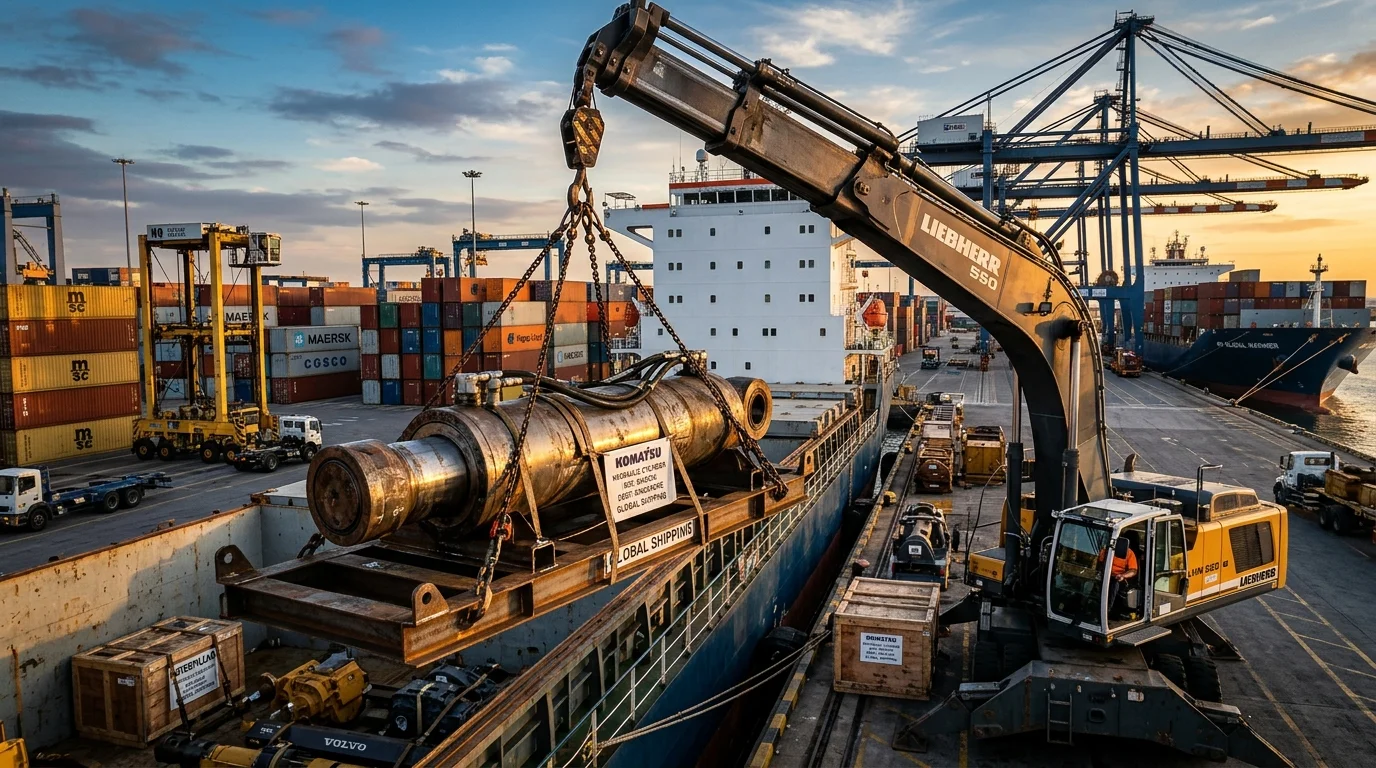
The shipping process follows a structured sequence from order confirmation to delivery. Understanding each stage helps procurement managers set realistic timelines and avoid the mistakes that cause delays.
Step 1: Part Identification and Order Confirmation
Every shipment starts with accurate part identification. Submit your part number, machine model, and serial number to your supplier. Misidentified parts are the leading cause of returns and project delays. At 3GEN Export, we cross-reference OEM part numbers against our inventory database before confirming any order.
Step 2: Packaging and Crating
Heavy and precision-machined components cannot ship in standard cardboard. According to export logistics best practices, parts must be secured in moisture-resistant industrial crates or reinforced packaging matched to the component's weight and fragility. High-tensile fasteners, rubber O-rings, and heavy cast-metal housings each require different packaging approaches.
- Use industrial-grade wooden crates for heavy castings and engine blocks.
- Wrap hydraulic components in moisture-barrier film before crating.
- Secure all items internally with bracing to prevent movement during ocean transit.
- Label every package with part number, handling instructions, and destination customs codes.
Per industry standards, any load wider than 2.59 meters (8.5 feet) is classified as oversized freight and requires special handling arrangements.
Step 3: Documentation Preparation
Documentation errors are the single most common cause of customs holds. Prepare the full document set before the shipment leaves the warehouse:
- Export Declaration: Required by the exporting country's customs authority.
- Commercial Invoice: Must accurately state part numbers, descriptions, quantities, and declared value.
- Packing List: Itemized breakdown of every component in the shipment.
- Certificate of Origin: Required by many destination countries for duty calculation.
- Customs Documentation: Country-specific import permits or compliance certificates where applicable.
Step 4: Freight Booking and Mode Selection
Choose your freight mode based on urgency, part dimensions, and budget. Your freight forwarder coordinates the booking, vessel or aircraft space, and port handling.
Step 5: Customs Clearance at Destination
Your freight forwarder or customs broker submits documentation to the destination country's customs authority, pays applicable duties and taxes, and secures release. This stage can take anywhere from a few hours to several days depending on the country and document accuracy.
Step 6: Final-Mile Delivery
Once cleared, the shipment moves from the port or airport to the buyer's facility or job site. For remote mining or construction sites, this often requires coordination with local transport providers. As of 2026, 3GEN Export's logistics network supports delivery to most major industrial regions within 5 days of shipment.
Shipping Method Comparison: Ocean vs. Air vs. Rail
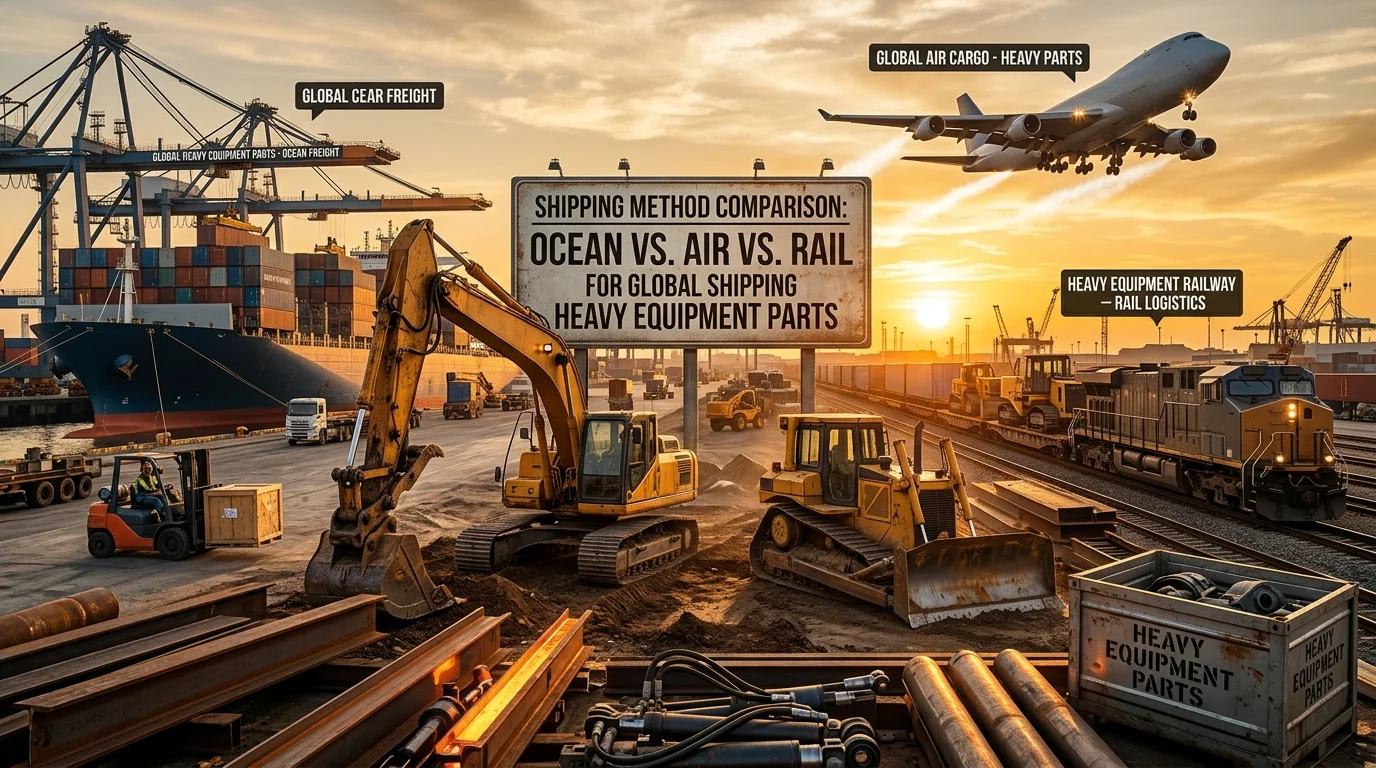
Selecting the right freight mode is one of the most consequential decisions in the shipping process. Each option involves trade-offs between cost, speed, and suitability for different part types.
| Shipping Method | Best For | Typical Transit Time | Cost Level | Weight/Size Limit |
|---|---|---|---|---|
| Ocean Freight (FCL) | Large bulk orders, heavy castings, full container loads | 2–6 weeks depending on route | Lowest per kg | High - suited for oversized and heavy cargo |
| Ocean Freight (LCL) | Smaller orders sharing container space | 3–7 weeks (consolidation adds time) | Low to medium | Flexible - charged by cubic meter |
| Air Freight | Urgent parts, high-value components, small-to-medium weight | 2–7 days door to door | Highest per kg | Practical limit varies by carrier |
| Rail Freight | Land-based routes (Europe-Asia corridor, cross-border) | 2–4 weeks | Medium | High capacity for heavy loads |
| Express Courier | Small parts, seal kits, filters, sensors | 1–5 business days | Medium to high | Weight and size restrictions apply |
For most B2B procurement scenarios, the decision comes down to urgency versus cost. A failed hydraulic pump on an active mining site justifies air freight. A planned maintenance order for undercarriage wear parts is better suited to ocean freight with a 4–6 week lead time built into the maintenance schedule.
Pros and Cons of International Heavy Equipment Parts Sourcing
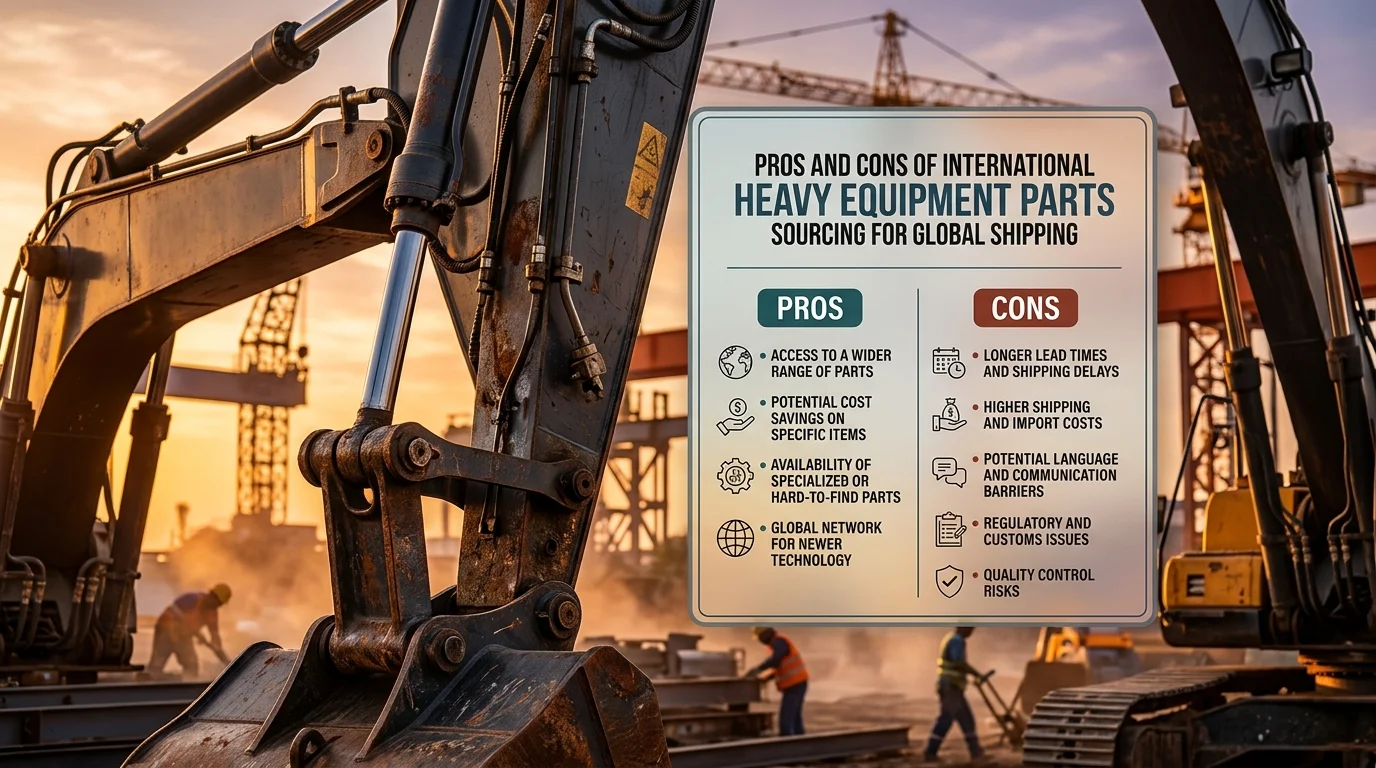
International sourcing delivers real advantages for fleet operators and procurement teams, but it also introduces complexity that local purchasing avoids. Here's an honest assessment.
Pros
- Access to broader inventory: Global suppliers carry stock that regional dealers often don't hold, especially for older machine models or less common brands.
- Competitive pricing: OEM-standard parts sourced directly from established exporters typically cost less than buying through multiple distribution layers.
- Faster fulfillment on hard-to-find parts: A supplier with global sourcing relationships can locate and ship a part in days that a local dealer might take weeks to backorder.
- Supplier diversification: Reduces dependency on a single regional distributor and protects against local stock shortages.
- OEM-quality assurance: Reputable exporters provide parts that meet or match original manufacturer specifications, backed by quality documentation.
Cons
- Longer baseline lead times: Ocean freight shipments take weeks, not days. Planning ahead is non-negotiable for non-urgent orders.
- Customs complexity: Each destination country has different import rules, duties, and compliance requirements that add administrative burden.
- Documentation risk: A single error on a commercial invoice or export declaration can hold a shipment at the border for days.
- Currency and payment risk: International transactions involve exchange rate exposure and may require letters of credit or advance payment terms.
- Returns and warranty claims: Resolving a warranty issue with an overseas supplier is more complex than returning a part to a local branch.
Key Considerations for Shipping Heavy Equipment Parts
Several operational factors determine whether a shipment arrives on time, intact, and within budget.
1. Choosing the Right Shipping Method
Match the freight mode to the part's urgency and dimensions. Ocean freight suits large, planned orders. Air freight is the right call for critical components that can't wait. Rail freight works well for land-connected markets in Europe and Asia.
2. Packaging and Crating Standards
Proper packaging is not optional - it's the difference between a part that arrives ready to install and one that arrives damaged and unusable. Use industrial-grade crates, moisture-resistant wrapping, and internal bracing. Label every package clearly with part numbers and handling instructions.
3. Documentation Requirements
Every international shipment of heavy equipment parts requires a complete document set. Missing or inaccurate paperwork is the leading cause of customs delays. Prepare your export declaration, commercial invoice, packing list, and any country-specific certificates before the shipment is booked.
Customs and Regulations
Customs clearance is where most international shipments either flow smoothly or grind to a halt. Understanding the process removes the uncertainty.
Customs Clearance Process
The customs clearance process follows a consistent sequence regardless of destination country:
- Submit the complete documentation set to customs authorities at the destination port or airport.
- Pay applicable import duties and taxes based on the declared value and HS tariff classification of the parts.
- Ensure compliance with any destination-country import regulations, including safety standards or restricted goods lists.
- Receive customs release and coordinate final-mile delivery to the end destination.
Common Customs Challenges
The same problems appear repeatedly in international heavy equipment parts shipments:
- Missing or incorrect documentation, which triggers holds and re-inspection requirements.
- Incorrect HS tariff classification, which can result in unexpected duties or compliance flags.
- Unforeseen tariff changes or trade policy updates that affect landed cost calculations.
- Biosecurity requirements for used machinery or components with residual fluids.
"A common hesitation among first-time buyers is: 'How complex is the shipping, and will customs clearance cause weeks of frustrating delays?' Understanding how global shipping and logistics actually work for heavy machinery spare parts removes the uncertainty." - Kayzer Parts, international heavy machinery parts exporter, 2026.
Working with Freight Forwarders
Partnering with a freight forwarder is the most reliable way to manage the complexity of international heavy equipment parts shipments.
Benefits of Using a Freight Forwarder
- Expertise: Freight forwarders know international shipping regulations, port procedures, and customs requirements across multiple countries.
- Cost efficiency: They negotiate carrier rates and find the most cost-effective routing for your cargo.
- Risk management: Experienced forwarders handle documentation correctly, reducing the risk of customs holds, damage claims, and delivery failures.
- Insurance coordination: They match cargo insurance to the value and nature of your shipment, protecting your investment in transit.
Choosing the Right Freight Forwarder
Not all freight forwarders have experience with heavy industrial components. When evaluating options, prioritize:
- Demonstrated experience shipping heavy equipment parts and oversized industrial cargo.
- Verifiable customer reviews and industry references.
- Full-service capability: customs brokerage, cargo insurance, and final-mile delivery coordination.
- Established relationships with carriers on your target trade lanes.
Cost Factors in International Parts Shipping
Shipping costs for heavy equipment parts vary based on several interconnected factors. Understanding each one helps procurement managers build accurate landed-cost budgets.
1. Weight and Dimensions
Freight is priced on actual weight or volumetric weight, whichever is greater. Heavy castings like engine blocks are charged on actual weight. Bulky but lighter items like filter housings may be charged on volumetric weight. Oversized loads - anything wider than 2.59 meters - incur additional handling fees.
2. Shipping Method
Air freight costs significantly more per kilogram than ocean freight. For urgent, high-value components, the premium is justified by the speed. For planned maintenance orders, ocean freight delivers the best cost-per-unit economics.
3. Destination and Duties
The destination country's import duty rates, VAT or GST requirements, and any applicable trade agreement tariffs all affect the total landed cost. Some markets have preferential duty rates for OEM spare parts under bilateral trade agreements.
4. Insurance
Cargo insurance is a necessary cost for high-value parts shipments. The premium reflects the declared value and the risk profile of the route. Skipping insurance to save cost is a false economy when a single damaged engine component can cost more than a year's worth of insurance premiums.
Common Mistakes to Avoid When Shipping Heavy Equipment Parts
The same errors appear repeatedly in international heavy equipment parts shipments. Knowing them in advance is the most efficient way to avoid them.
Mistake 1: Incorrect Part Identification
Ordering the wrong part number is more common than most procurement teams admit. Always confirm the OEM part number against the machine's serial number and service manual before placing an order. A part that ships across the world and doesn't fit is a total loss of time and freight cost.
Mistake 2: Underestimating Documentation Requirements
Many first-time international buyers assume their supplier handles all paperwork. In reality, the buyer is responsible for ensuring the import documentation meets destination-country requirements. Work with your freight forwarder to build a documentation checklist before the first shipment.
Mistake 3: Choosing the Wrong Packaging
Standard commercial packaging is not designed for ocean freight. Vibration, humidity, and handling stress during a multi-week sea voyage will damage unprotected components. Industrial crates with moisture-resistant lining and internal bracing are the minimum standard for ocean shipments.
Mistake 4: Ignoring Lead Times in Maintenance Planning
Ocean freight takes weeks. Procurement managers who treat international sourcing like local purchasing create unnecessary emergency situations. Build international lead times into your planned maintenance schedule and carry strategic stock of high-wear items.
Mistake 5: Skipping Cargo Insurance
Transit damage and loss do occur. A hydraulic pump or engine assembly shipped without insurance leaves the buyer with no recourse if the shipment is damaged at sea or during port handling. Always insure shipments at full replacement value.
Realistic Scenario: Sourcing a CAT 320 Hydraulic Pump Under Time Pressure
A mining contractor in West Africa is running a fleet of CAT 320 excavators on a large earthworks project. One machine goes down with a failed main hydraulic pump. The local dealer has no stock and quotes a 3–4 week backorder from the regional distribution center.
The procurement manager contacts 3GEN Export with the OEM part number. We confirm stock availability within the same business day. The part ships via air freight from our warehouse, clears customs at the destination airport within 48 hours with the correct documentation set, and reaches the job site within 5 days of the original order. The machine is back in operation before the project timeline is affected.
This scenario plays out regularly across our customer base. The difference between a two-day fix and a three-week delay is supplier readiness, documentation accuracy, and the right freight mode for the urgency level.
Best Practices for Shipping Heavy Equipment Parts
These practices separate procurement teams that consistently get parts on time from those that manage one crisis after another.
1. Plan Ahead
Start the procurement process early. Build international lead times into your maintenance schedule. For planned overhauls, order parts 6–8 weeks in advance when using ocean freight.
2. Communicate with Suppliers
Maintain direct communication with your parts supplier on stock availability, lead times, and shipping readiness. Surprises in international logistics are almost always avoidable with proactive communication.
3. Monitor Shipments
Use carrier tracking systems and freight forwarder portals to monitor shipment progress in real time. Address any customs queries or documentation requests immediately - delays compound quickly once a shipment is held.
4. Build a Preferred Supplier Relationship
Working with a consistent international parts supplier builds institutional knowledge on both sides. Your supplier learns your machine fleet, your documentation requirements, and your delivery preferences. That relationship translates directly into faster order processing and fewer errors.
3GEN Export: OEM-Quality Parts with Global Delivery
At 3GEN Export, we supply OEM-standard spare parts for Caterpillar, Komatsu, Volvo, Atlas Copco, Cummins, and 40+ additional brands. Our inventory covers engine components, hydraulic parts, undercarriage assemblies, wear parts, and transmission components for construction, mining, and energy equipment.
We ship to customers across the Middle East, Africa, Southeast Asia, Europe, and the Americas. Our logistics network is built for speed: most orders ship within 24 hours of confirmation, and our standard international delivery target is 5 days to major industrial regions. Every shipment includes full documentation support, customs clearance coordination, and cargo insurance options.
Submit your part number and machine model at 3genexport.com for a same-day quote. Our team responds within one business day.
Frequently Asked Questions
How do I ship heavy equipment parts internationally?
Start by confirming the correct OEM part number and machine model. Choose a freight mode based on urgency and part size: air freight for critical components, ocean freight for planned bulk orders. Prepare a complete documentation set including export declaration, commercial invoice, and packing list. Work with a freight forwarder experienced in industrial cargo to manage customs clearance and final-mile delivery.
What documents are required for shipping heavy equipment parts?
Core documents include an export declaration, commercial invoice with accurate part descriptions and declared values, packing list, and certificate of origin. Some destination countries require additional import permits, safety compliance certificates, or biosecurity clearances for used components. Your freight forwarder should provide a country-specific document checklist before shipment.
What are the common challenges in shipping heavy equipment parts?
The most frequent issues are incorrect or missing documentation causing customs holds, wrong part identification leading to returns, inadequate packaging resulting in transit damage, and underestimating lead times for ocean freight. Working with an experienced supplier and freight forwarder eliminates most of these risks before they occur.
How can I reduce shipping costs for heavy equipment parts?
Consolidate multiple part orders into a single shipment to maximize container utilization and reduce per-unit freight cost. Plan maintenance orders far enough in advance to use ocean freight instead of air. Work with a freight forwarder who can negotiate carrier rates on established trade lanes. Also ensure correct HS tariff classification - misclassification often results in overpaid duties.
What is the role of a freight forwarder in shipping heavy equipment parts?
A freight forwarder manages the full logistics chain: freight booking, documentation preparation, customs clearance, cargo insurance, and final-mile delivery coordination. For heavy equipment parts, their knowledge of oversized cargo handling, port procedures, and destination-country import rules is particularly valuable. The right forwarder turns a complex international shipment into a managed, trackable process.
How long does international shipping of heavy equipment parts take?
Transit time depends on the freight mode and destination. Air freight delivers most shipments in 2–7 days door to door. Ocean freight typically takes 2–6 weeks depending on the origin-destination trade lane. As of 2026, suppliers like 3GEN Export with established logistics networks can deliver OEM-quality parts to most major industrial regions within 5 days using air freight or express courier services.