
Heavy Machinery Parts Quality Assurance Guide 2026
Heavy machinery parts quality assurance ensures OEM-standard reliability. Learn inspection steps, QA tools, and supplier vetting for global procurement
Loading article…
Article Not Found
The article you're looking for doesn't exist or may have been removed.
Back to BlogKey Takeaways
- Heavy machinery parts quality assurance is a systematic process that prevents defects before they reach your equipment.
- Implementing a structured quality control process reduces operational risk and unplanned downtime.
- Regular inspections and testing at every production stage identify defects early, extending equipment life.
- Understanding the difference between quality assurance and quality control is essential for effective procurement management.
- According to industry maintenance data, the average heavy equipment breakdown costs $2,000+ per day in downtime - most of that time is spent waiting for parts, not performing repairs.
- Adopting best practices in parts management, including digital tracking and supplier audits, can cut failure rates significantly.
Heavy machinery parts quality assurance is a systematic process that ensures machinery components meet specified standards of performance, safety, and reliability. It covers inspections, tests, and evaluations across the entire production and supply chain, from raw material sourcing through final shipment.
Understanding Quality Assurance in Heavy Machinery
quality assurance refers to the full set of processes and procedures that ensure components consistently meet established performance and safety standards. This covers not only the finished part but every upstream step: raw material sourcing, machining tolerances, surface treatment, and final assembly.
What is Quality Assurance?
Quality assurance is a proactive approach that focuses on preventing defects and ensuring that processes are followed correctly. It encompasses a range of activities, including:
- Defining quality standards based on OEM specifications and industry regulations
- Implementing quality management systems across the supply chain
- Conducting regular audits and inspections at every production stage
As MachineMetrics notes in their quality assurance overview, QA is the way manufacturers manage product quality, as opposed to quality verification after the fact. That distinction matters enormously in heavy equipment procurement, where a single non-conforming seal or bearing can cascade into a multi-week equipment failure.
Importance of Quality Assurance in Heavy Machinery
The stakes in heavy equipment are higher than in most industries. A failed hydraulic pump on a Komatsu PC360 excavator does not just cost the price of the part. It costs the daily rental rate of the machine, the labor standing idle, and potentially the contractual penalties for missed project milestones. According to industry maintenance data, the average heavy equipment breakdown costs $2,000+ per day in downtime - and the repair itself often takes only hours. What takes days is sourcing and receiving the right part.
Rigorous this type of assurance addresses this directly by:
- Minimizing operational risks through defect prevention
- Enhancing equipment longevity by catching tolerance deviations early
- Reducing repair costs by eliminating non-conforming parts before installation
- Improving customer satisfaction and project delivery reliability
- Reducing downtime by limiting potential operational failures
Quality Assurance vs. Quality Control
Quality assurance and quality control serve different purposes, and confusing them leads to gaps in your procurement process. QA is proactive: it defines the standards, audits the processes, and prevents defects from occurring. Quality control (QC) is reactive: it inspects finished products and identifies defects that have already occurred.
In practice, you need both. QA sets the framework; QC is the safety net. For procurement managers sourcing Caterpillar, Volvo, or Atlas Copco spare parts from global suppliers, QA means vetting the supplier's production process before you place an order. QC means inspecting the shipment before it clears customs.
Key Elements of Heavy Machinery Parts Quality Assurance
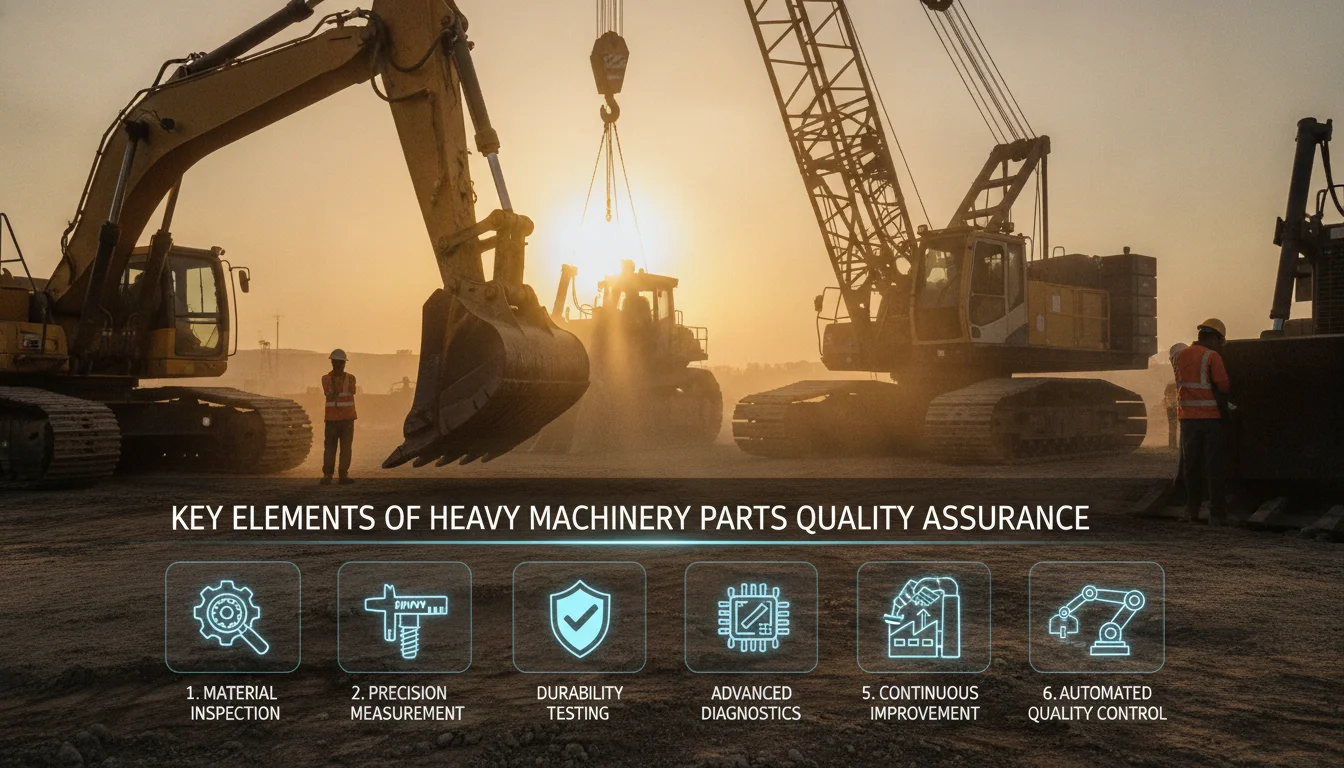
Effective this kind of quality assurance depends on several interconnected elements working together across the supply chain. Miss one, and the entire system has a gap.
1. Inspection and Testing
Regular inspections and testing are fundamental to quality assurance. This includes:
- Incoming Inspection: Assessing raw materials and components before they enter production. For machined parts, this means verifying material certifications, dimensional checks, and hardness testing against OEM specifications.
- In-Process Inspection: Monitoring the manufacturing process in real time to identify and correct quality issues before they compound. This is where tolerance drift gets caught before it becomes a scrap batch.
- Final Inspection: Conducting thorough checks on finished products to confirm they meet all specifications before dispatch. For spare parts, this typically includes dimensional inspection, functional testing, and documentation review.
- Pre-Shipment Inspection: A final verification step conducted before parts leave the supplier's facility, confirming quantity, packaging integrity, and compliance with order specifications.
According to HQTS's spare parts inspection methodology, inspectors follow a strict checklist covering visual inspection, quantity verification, dimensional inspection, and documentation review as standard practice for heavy machinery components.
2. Documentation and Traceability
Maintaining detailed records of inspections, tests, and audits is critical for traceability. This documentation helps in:
- Identifying trends in defects across production batches
- Ensuring compliance with industry standards and customer requirements
- Facilitating continuous improvement by creating an auditable history
- Supporting warranty claims and root cause analysis when failures occur in the field
For parts destined for Caterpillar or Komatsu equipment, traceability documentation should include material certifications, inspection reports, test results, and the specific machine models the part is compatible with. This is non-negotiable for OEM-standard supply.
3. Supplier Quality Management
Effective quality assurance extends to every supplier in your chain. Establishing strong relationships and conducting regular audits ensures that suppliers maintain the standards you require. This includes:
- Supplier audits covering production processes, equipment calibration, and quality management systems
- Performance evaluations based on defect rates, delivery reliability, and documentation quality
- Quality agreements that define acceptance criteria, inspection protocols, and corrective action timelines
How Heavy Machinery Parts Quality Assurance Works: The Full Process
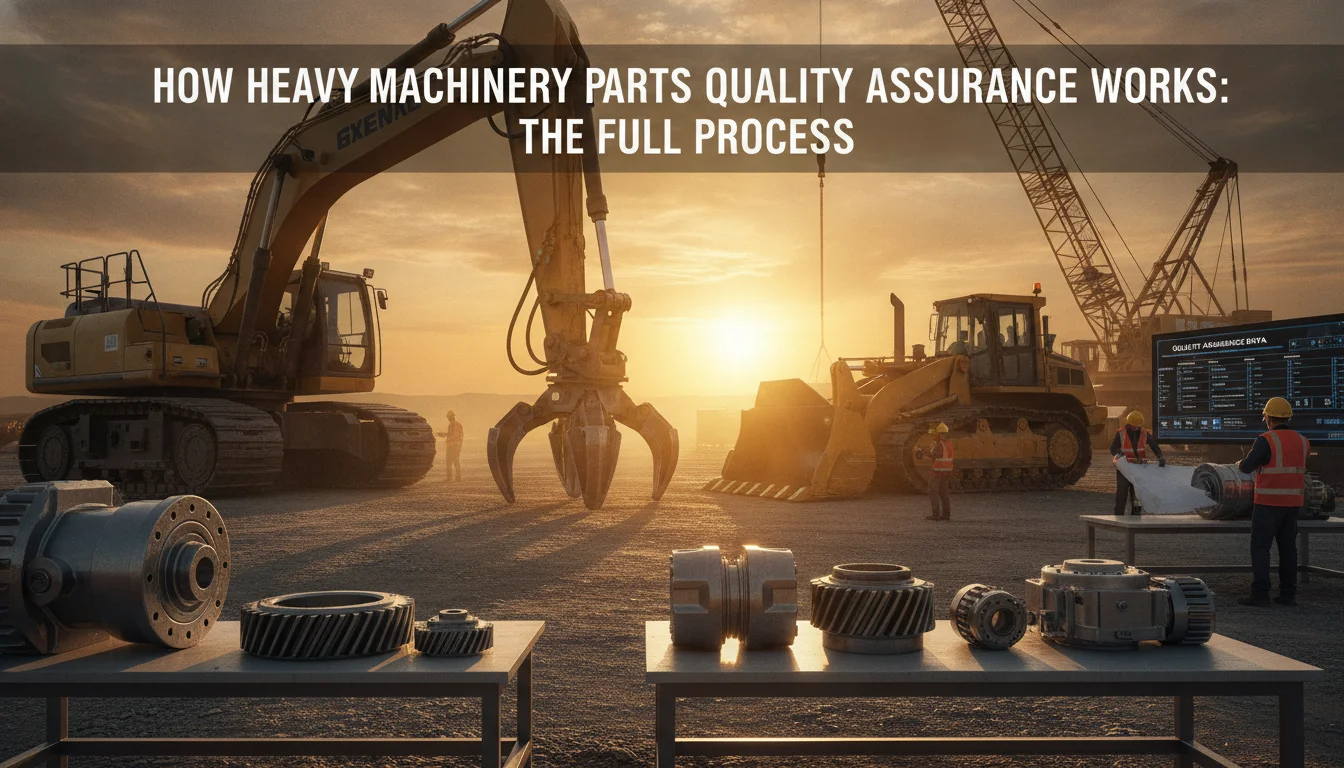
the machinery parts quality assurance works by embedding verification checkpoints at every stage of the part's journey, from raw material to your warehouse shelf. Understanding this end-to-end process helps procurement managers ask the right questions of their suppliers.
Stage 1: Supplier Qualification
Before a single part is ordered, the supplier's facility and processes are evaluated. This involves reviewing their quality management system certifications (ISO 9001 is the baseline standard for most OEM-grade suppliers), inspecting their production equipment and calibration records, and assessing their track record with comparable parts and brands.
For 3GEN Export, this stage determines whether a supplier can produce parts to Caterpillar, Komatsu, Volvo, or Atlas Copco specifications. A supplier may produce excellent generic components but lack the tooling or process controls for the tight tolerances that OEM-standard parts require.
Stage 2: Material Verification
Raw materials are verified against the required specifications before production begins. For heavy machinery components, this typically means chemical analysis to confirm alloy composition, hardness testing, and review of material certifications from the mill or foundry. A hydraulic cylinder rod made from the wrong steel grade will pass visual inspection but fail under operating pressure.
Stage 3: In-Process Monitoring
During machining and assembly, key dimensions and process parameters are monitored at defined intervals. Coordinate measuring machines (CMMs), laser trackers, and calibrated hand tools are used to verify that tolerances are being held. As Baker Industries notes in their quality inspection overview, it is the process discipline - not just the certificates on the wall - that determines whether parts are consistently conforming.
Stage 4: Final Inspection and Testing
Finished parts undergo a complete inspection against the approved drawing or OEM specification. For spare parts, this includes:
- Dimensional inspection confirming all critical measurements
- Hardness testing for wear-critical components like pins, bushings, and cutting edges
- Functional testing where applicable (hydraulic components, filters, seals)
- Visual inspection for surface defects, coating quality, and marking accuracy
Stage 5: Pre-Shipment Verification
Before parts leave the supplier, a pre-shipment inspection confirms that the correct parts, in the correct quantities, with the correct documentation, are packed and ready for dispatch. This is the last line of defense before parts enter the logistics chain. For international shipments, this step also verifies export documentation and compliance with destination country import requirements.
"Quality is not just about the finished part - it is about verifying every step of the process that produced it. A part that passes final inspection but was made with unverified materials or out-of-calibration tooling is a liability waiting to surface in the field." - Industry Quality Management Principle, aligned with ISO 9001:2015 framework
How to Apply Quality Assurance in Your Parts Procurement Process
Applying assurance in your procurement workflow does not require a dedicated QA department. These steps give procurement managers and fleet supervisors a practical framework to protect their operations.
Step 1: Define Your Acceptance Criteria Before You Order
Specify the quality requirements in your purchase order, not after delivery. For each part category, document the applicable OEM part number or equivalent specification, the required material grade, dimensional tolerances, surface treatment requirements, and any applicable certifications (ISO, CE, or OEM approval). Vague purchase orders produce vague parts.
Step 2: Qualify Your Suppliers Before First Order
Request documentation of the supplier's quality management system. ISO 9001 certification is a baseline. For critical components like hydraulic pumps, final drive assemblies, or engine components, ask for evidence of specific process controls: CMM inspection capability, material testing equipment, and calibration records. A supplier audit - even a remote document audit - reveals more than a product sample alone.
Step 3: Require Inspection Reports with Every Shipment
Make inspection documentation a contractual requirement. Every shipment should arrive with a dimensional inspection report, material certification, and a pre-shipment inspection checklist signed by the supplier's QC team. If a supplier cannot provide this, treat it as a red flag.
Step 4: Conduct Incoming Inspection on Receipt
Do not assume that a passed pre-shipment inspection means the parts survived transit undamaged. On receipt, verify quantities, check packaging integrity, and perform spot-check dimensional and visual inspections on a sample from each batch. For high-value components, inspect every unit.
Step 5: Track Parts Performance in the Field
Link parts consumption to specific machine IDs and work orders. When a part fails prematurely, you need the traceability data to identify whether it was a quality issue, an installation error, or an application mismatch. This data feeds back into your supplier performance evaluations and helps you make better sourcing decisions over time.
Step 6: Review Supplier Performance Quarterly
Score each supplier on defect rate, documentation quality, delivery reliability, and responsiveness to corrective actions. Suppliers who consistently underperform on quality metrics should be placed on probation or replaced. Your supply chain is only as reliable as its weakest link.
"Per OEM service bulletin standards for Caterpillar and Komatsu equipment, parts used in critical systems - hydraulics, final drives, engine assemblies - must meet dimensional and material specifications within defined tolerances. Substituting unverified aftermarket parts in these systems voids warranty coverage and increases failure risk." - OEM Service Documentation Guidance
Quality Assurance Tools Used in Heavy Machinery Parts Inspection
The right tools make heavy machinery parts quality assurance measurable and repeatable. Here are the primary inspection and testing tools used across the industry.
Dimensional Inspection Tools
- Coordinate Measuring Machines (CMMs): High-precision automated systems that verify complex geometries against CAD models. Used for machined components with tight tolerances.
- Laser Trackers: Portable metrology tools for large components where a CMM is impractical. Common for structural parts, frames, and large castings.
- Calibrated Hand Tools: Micrometers, calipers, bore gauges, and depth gauges for routine dimensional checks. Calibration records are essential for these tools to produce defensible results.
Material Testing Tools
- Hardness Testers: Rockwell, Brinell, and Vickers hardness testing confirms that heat treatment and material grade meet specification. Critical for pins, bushings, cutting edges, and wear plates.
- Chemical Analysis Equipment: Optical emission spectrometers verify alloy composition. A part made from the wrong steel grade may look identical but behave very differently under load.
- Durability and Functional Testing Rigs: Hydraulic components, seals, and filters are tested under simulated operating conditions to verify performance before shipment.
Quality Assurance Software
- Quality Management Software (QMS): Centralizes inspection records, non-conformance reports, corrective actions, and supplier performance data.
- Data Analytics Platforms: Identify defect trends across batches, suppliers, and part categories. Predictive analytics can flag suppliers whose defect rates are trending upward before a major quality failure occurs.
- Digital CMMS (Computerized Maintenance Management Systems): Link parts consumption to machine IDs and work orders, enabling true cost-per-hour tracking and proactive reordering.
Industry maintenance data shows that construction companies using digital tracking systems see substantially lower failure rates compared to those relying on manual tracking. As of 2026, the adoption of integrated QMS and CMMS platforms is accelerating across mid-size fleet operators who previously relied on spreadsheets and institutional knowledge.
Inspection Processes for Specific Heavy Machinery Part Categories
Not all spare parts carry the same risk profile. Heavy machinery parts quality assurance protocols should be calibrated to the criticality of the component.
Hydraulic Components (Pumps, Cylinders, Seals)
Hydraulic parts are among the highest-risk categories in heavy equipment. A non-conforming seal kit in a CAT 320 excavator's boom cylinder will fail under pressure, causing fluid loss, contamination of the hydraulic system, and potential structural failure of the attachment. Inspection for hydraulic components must include dimensional verification of bore and rod diameters, seal groove geometry, pressure testing of assembled cylinders, and material verification of seal compounds against OEM specifications.
Undercarriage Components (Track Links, Rollers, Sprockets)
Undercarriage wear parts for Komatsu, Caterpillar, and Volvo excavators and dozers are subject to extreme abrasion and impact loads. Quality assurance for these parts centers on hardness testing of wear surfaces, dimensional verification of pitch and link height, and coating or heat treatment verification. A track link with insufficient surface hardness will wear at 2-3 times the normal rate, dramatically increasing total cost of ownership.
Engine and Drivetrain Components
Engine parts - pistons, liners, bearings, gaskets - require the tightest tolerances and the most rigorous material verification. OEM service bulletins for Caterpillar C-series and Komatsu SAA engines specify dimensional tolerances in the range of thousandths of an inch. Any deviation outside these tolerances risks accelerated wear, oil consumption, or catastrophic engine failure. Inspection protocols for engine components must include full dimensional reports, material certifications, and where applicable, pressure and leak testing.
Filters and Consumables
Filters are often treated as low-risk consumables, but a non-conforming hydraulic or engine filter can cause more damage than a failed structural component. Counterfeit or substandard filters with incorrect micron ratings or inadequate bypass valve settings allow contaminants into critical systems. Quality assurance for filters includes verification of filtration rating, flow rate, bypass pressure, and dimensional fit against OEM specifications.
Common Mistakes in Heavy Machinery Parts Quality Assurance
Even experienced procurement teams make avoidable errors in heavy machinery parts quality assurance. Recognizing these patterns is the first step to eliminating them.
Mistake 1: Treating Price as a Proxy for Quality
The cheapest part is rarely the lowest total cost. A hydraulic pump that costs 30% less than the OEM equivalent but fails at 40% of the service life costs more per operating hour, not less. Evaluate suppliers on total cost of ownership, not unit price.
Mistake 2: Skipping Incoming Inspection
Pre-shipment inspections at the supplier's facility are valuable, but they do not guarantee that parts arrived undamaged or that the correct items were shipped. Skipping incoming inspection on receipt is a common shortcut that leads to non-conforming parts being installed in equipment.
Mistake 3: Accepting Samples but Not Auditing Production
A supplier can produce excellent samples while running production with different materials, tooling, or process controls. Sample approval is not a substitute for process audit. The sample tells you what the supplier can produce; the audit tells you what they will produce at volume.
Mistake 4: No Traceability Between Parts and Machines
When a part fails in the field, the ability to trace it back to a specific batch, supplier, and inspection record is essential for root cause analysis and corrective action. Without traceability, every failure investigation starts from zero. Industry data shows that 82% of construction companies still rely on manual tracking for maintenance and parts, which makes this kind of traceability nearly impossible to maintain.
Mistake 5: Ignoring Supplier Performance Trends
A supplier whose defect rate is slowly increasing over six months is signaling a process control problem. Procurement teams that only review quality on a per-shipment basis miss these trends until a major failure forces the issue. Quarterly supplier performance reviews with tracked metrics are essential.
Mistake 6: Applying the Same QA Protocol to All Part Categories
A filter and a final drive assembly do not carry the same risk. Applying the same inspection intensity to every part category wastes resources on low-risk items while under-inspecting high-risk ones. Risk-based inspection planning allocates QA effort where it matters most.
A Realistic Scenario: Quality Failure and Its Cost
Consider a fleet operator running six Komatsu PC290 excavators on a civil infrastructure project. To reduce costs, the procurement team sources hydraulic cylinder seal kits from a new supplier offering a 25% price reduction versus their established source. The supplier provides a product sample that passes visual inspection. No process audit is conducted, and no incoming inspection is performed on the first shipment.
Within three months, two machines develop hydraulic leaks. Investigation reveals that the seal compound used by the new supplier does not meet the temperature and pressure resistance specifications required for the PC290's boom cylinder application. The seals are degrading under normal operating conditions.
The cost: two machines down for a combined total of several days while replacement seals are sourced and installed. Labor for the repair, plus the downtime cost at $2,000+ per machine per day, plus the cost of sourcing emergency replacement parts at premium pricing. The 25% unit cost saving on the seal kits is erased many times over.
This scenario plays out regularly across the industry. The fix is straightforward: require material certifications and application compatibility confirmation from any new supplier before the first order, and conduct incoming inspection on the first shipment from any new source.
Best Practices for Heavy Machinery Parts Quality Assurance
Implementing best practices in heavy machinery parts quality assurance significantly enhances the reliability and safety of your equipment fleet. Here are the practices that consistently deliver results.
1. Establish Clear Quality Standards
Defining clear quality standards is the foundation of effective quality assurance. These standards should be based on:
- OEM specifications and service bulletins for the specific equipment models in your fleet
- Industry regulations applicable to your operating environment
- Customer requirements and contractual obligations
- Internal benchmarks derived from historical performance data
2. Invest in Training and Development
Regular training for everyone involved in quality assurance processes is essential. This ensures that:
- Staff understand the latest OEM specifications and quality standards
- Best practices are consistently applied across shifts and locations
- Employees can identify and escalate quality issues before they become failures
3. Use Technology for Quality Management
Technology streamlines quality assurance processes. Tools such as quality management software, automated inspection systems, and data analytics platforms enhance efficiency and accuracy. As of 2026, cloud-based QMS platforms have made enterprise-grade quality management accessible to mid-size fleet operators who previously lacked the resources for dedicated QA infrastructure.
Challenges in Heavy Machinery Parts Quality Assurance
Despite its importance, several challenges can hinder effective heavy machinery parts quality assurance implementation.
1. Complexity of Machinery Components
The intricate nature of heavy machinery parts makes quality assurance demanding. Components often have strict tolerances and specifications that must be met precisely. A deviation that looks minor on paper can translate to accelerated wear or premature failure under operating loads.
2. Global Supply Chains
With many manufacturers sourcing parts globally, ensuring consistent quality across different suppliers and geographies is genuinely difficult. This requires robust supplier management practices, clear contractual quality requirements, and regular audits - not just initial qualification.
3. Regulatory Compliance
Adhering to various industry regulations and standards across different markets adds complexity. Companies must stay current on changes in regulations - including import compliance requirements for destination markets - to ensure their parts procurement remains compliant.
Comparison of Quality Assurance Approaches
| Approach | Description | Best For | Key Limitation |
|---|---|---|---|
| Traditional Manual Inspection | Manual checks at defined production stages using calibrated hand tools. | Low-volume, high-value parts where human judgment adds value. | Slower, subject to inspector variability and fatigue. |
| Automated Inspection | CMMs, laser trackers, and vision systems for real-time dimensional verification. | High-volume production runs with tight tolerances. | Higher upfront investment; requires calibration and maintenance. |
| Supplier Audits | Regular evaluations of supplier quality management systems and production processes. | New supplier qualification and ongoing performance monitoring. | Resource-intensive; requires trained auditors or third-party services. |
| Pre-Shipment Inspection | Third-party inspection of finished goods before dispatch from supplier. | International sourcing where incoming inspection is impractical. | Catches defects late in the process; does not prevent production issues. |
| Continuous Improvement (Kaizen) | Ongoing systematic efforts to reduce defects and improve process capability. | Established supplier relationships with sufficient data history. | Results are gradual; requires sustained management commitment. |
Future Trends in Heavy Machinery Parts Quality Assurance
The field of heavy machinery parts quality assurance is evolving rapidly. As of 2026, several trends are reshaping how procurement teams and suppliers approach quality management.
1. Increased Automation in Inspection
Automated inspection systems - including machine vision, robotic CMM probing, and AI-assisted defect detection - are becoming more accessible to mid-tier suppliers. This reduces reliance on manual inspection and catches defects that human inspectors might miss, particularly in high-volume production environments.
2. Data-Driven Decision Making
Utilizing data analytics for quality management allows companies to make informed decisions based on real-time production data. Defect trend analysis, process capability monitoring, and predictive quality alerts are moving from large OEM facilities into the broader supply chain. This year, we are seeing more suppliers offer digital inspection reports as standard, rather than paper-based documentation.
3. Sustainability and Responsible Sourcing
Quality assurance processes are increasingly incorporating environmental and ethical sourcing considerations. This means verifying not just dimensional and material compliance, but also that materials are sourced responsibly and that production processes meet environmental standards. For global procurement teams, this adds a new dimension to supplier qualification.
4. Digital Traceability Across the Supply Chain
Blockchain-based and cloud-based traceability systems are gaining traction for high-value spare parts. These systems create an immutable record of a part's journey from raw material to installation, making counterfeit detection and warranty management significantly more reliable. Updated for 2026, this technology is no longer limited to aerospace and automotive - it is entering the heavy equipment spare parts market.
Pros and Cons of Formal Heavy Machinery Parts Quality Assurance Programs
Pros
- Defect prevention: Systematic QA catches non-conforming parts before they reach your equipment, avoiding costly field failures.
- Reduced total cost of ownership: OEM-standard parts with verified quality consistently outperform unverified alternatives over their service life.
- Supplier accountability: Formal QA programs create clear, contractual quality expectations that give you leverage when suppliers underperform.
- Regulatory compliance: Documented QA processes demonstrate due diligence for safety audits, insurance requirements, and contractual obligations.
- Traceability for root cause analysis: When failures do occur, documented QA records enable fast, accurate investigation and corrective action.
Cons
- Upfront resource investment: Building a formal QA program requires time, trained personnel, and investment in inspection tools or third-party services.
- Supplier friction: Some suppliers resist audit requirements or documentation demands, which can complicate sourcing in markets with limited qualified suppliers.
- Process overhead: Documentation, reporting, and audit cycles add administrative load to procurement and maintenance teams.
- Not all parts justify the same investment: Applying full QA protocols to low-risk consumables can be disproportionate to the risk being managed.
Frequently Asked Questions
What are the four types of QC?
The four types of quality control include process control, acceptance sampling, control charts, and statistical quality control. Each type serves a different purpose: process control monitors production parameters in real time, acceptance sampling evaluates batches against defined criteria, control charts track process variation over time, and statistical quality control uses data analysis to identify and address systemic quality issues.
How can I verify the quality of parts before shipment?
Quality verification before shipment is achieved through pre-shipment inspections, which involve checking parts against specified OEM standards and conducting dimensional, material, and functional tests to confirm compliance. For international sourcing, engaging a third-party inspection service to conduct the pre-shipment check at the supplier's facility adds an independent layer of verification. Requiring the supplier to provide a signed inspection report with every shipment creates accountability and a documented record.
What is equipment quality assurance?
Equipment quality assurance refers to the systematic processes implemented to ensure that machinery and its components meet established quality standards throughout the production and supply chain. It is a proactive discipline focused on preventing defects through process control, supplier management, and defined inspection protocols, rather than simply detecting failures after they occur.
Does OSHA require daily equipment inspection?
OSHA does not mandate daily inspections for all equipment categories, but requires employers to ensure that equipment is maintained in safe working condition. For specific equipment types - such as cranes, forklifts, and aerial work platforms - OSHA standards reference manufacturer inspection requirements, which often include pre-shift checks. Regular inspections aligned with OEM service schedules are the most reliable way to maintain both OSHA compliance and equipment reliability.
What is the role of documentation in quality assurance?
Documentation is the backbone of any quality assurance program. It provides a verifiable record of inspections, tests, material certifications, and audits, which enables defect trend analysis, regulatory compliance demonstration, and root cause investigation when failures occur. For heavy machinery spare parts, documentation also supports warranty claims and confirms that parts meet the OEM specifications required for the specific equipment model.
How does technology improve heavy machinery parts quality assurance?
Technology improves heavy machinery parts quality assurance through automated inspection systems that reduce human error, data analytics platforms that identify defect trends across batches and suppliers, and digital CMMS tools that link parts consumption to specific machine IDs. As of 2026, cloud-based quality management software has made these capabilities accessible to procurement teams of all sizes, enabling the kind of data-driven supplier management that was previously limited to large OEM operations.
What is the difference between OEM and aftermarket parts quality?
OEM parts are manufactured to the original equipment manufacturer's exact specifications, with full traceability and quality documentation. Aftermarket parts vary widely: some are manufactured to OEM-equivalent standards with full inspection documentation, while others are produced with looser tolerances and unverified materials. The key is not the OEM vs. aftermarket label, but whether the supplier can demonstrate that their parts meet the dimensional, material, and performance specifications required for your specific equipment application.
At 3GEN Export, we supply OEM-quality spare parts for Caterpillar, Komatsu, Volvo, Atlas Copco, and 40+ brands, with full inspection documentation and global delivery in as few as 5 days. Browse our parts categories or explore parts by brand to find the components your fleet needs, backed by the quality assurance standards your operations depend on.