
Heavy Machinery Spare Parts Quality Standards Guide
Learn heavy machinery spare parts quality standards: how to verify OEM authenticity, avoid counterfeits, and cut downtime with proven procurement steps.
Loading article…
Article Not Found
The article you're looking for doesn't exist or may have been removed.
Back to BlogHeavy machinery spare parts quality standards are the benchmarks that determine whether a replacement component performs safely, fits correctly, and lasts as long as the original. These standards cover OEM authenticity, documentation, material tolerances, and supplier verification, and they exist to reduce downtime and prevent counterfeit failures.
Key Takeaways
- Genuine, OEM, aftermarket, and remanufactured parts are distinct quality categories with different warranty, cost, and risk profiles.
- Documentation is the first line of defense: part numbers, certificates of conformance, and country of origin must match manufacturer catalogs.
- Serial number breaks can make two machines with the same model require different parts, so know your machine's exact serial number before ordering.
- Supplier reputation matters as much as part appearance because counterfeit components are difficult to spot visually.
- Regular inspection, proper storage, and manufacturer maintenance schedules extend part life and reduce unplanned downtime.
- Applying quality standards consistently protects warranty coverage and total cost of ownership, not just the purchase price.
What Are Heavy Machinery Spare Parts Quality Standards?
Defining Quality for Heavy Equipment Components
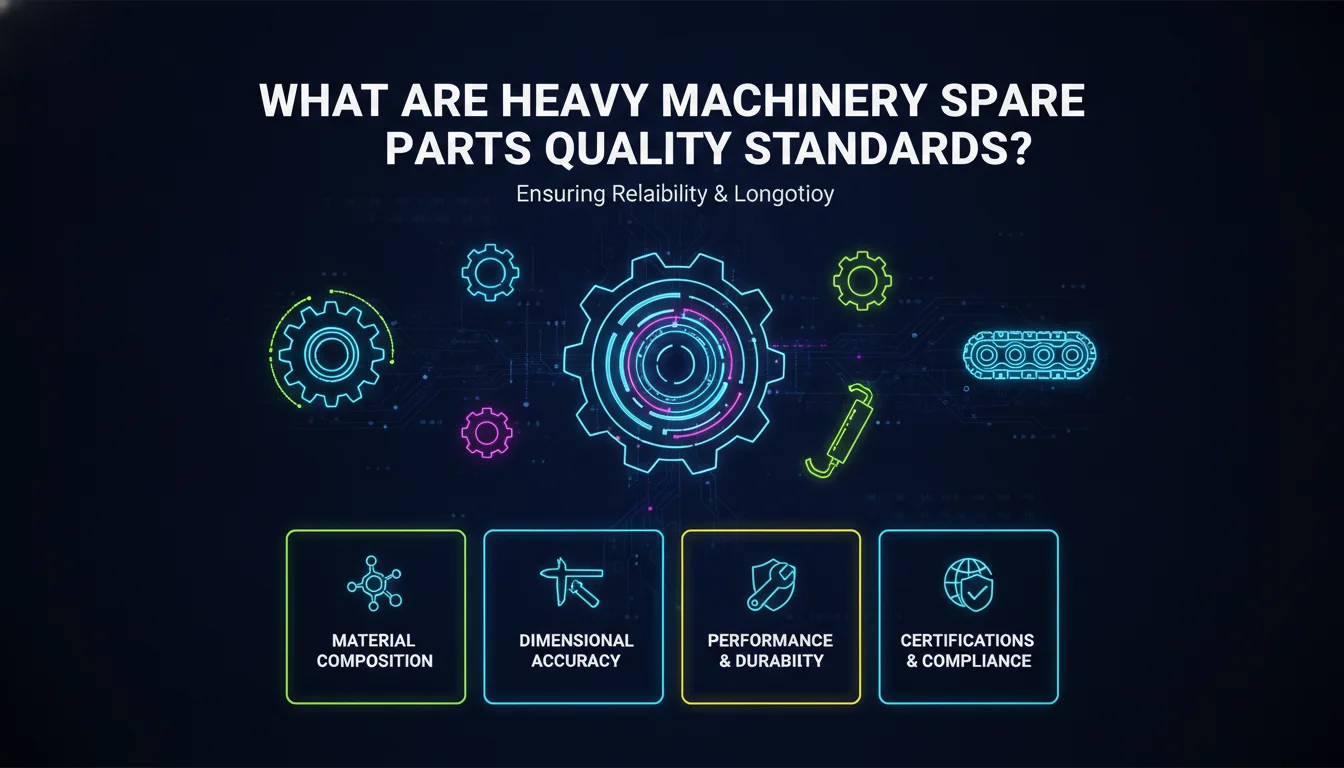
this type of standards are the benchmarks used to evaluate whether a replacement component will perform safely, efficiently, and durably in a specific machine. They cover dimensional accuracy, material composition, heat treatment, surface finish, and compatibility with the original equipment manufacturer's design. A quality standard isn't a single certificate or a brand name alone. It's a chain of evidence that starts with the part's origin and ends with verified performance in the field. For fleet managers, understanding this chain reduces the chance of installing a part that fits poorly, wears prematurely, or damages surrounding components.
According to Gregory Poole, heavy equipment replacement parts are components specifically designed to replace worn, damaged, or failed parts in heavy machinery. These parts can be basic wear items such as filters and belts, or complex assemblies such as hydraulic systems and engine components. The same source notes that replacing parts before they fail keeps machinery running efficiently and extends equipment life span.
Why Quality Standards Vary Across Part Types
Quality expectations differ between consumable and integral parts. Al Marwan explains that consumable parts include fluids, service kits, undercarriage components, buckets, suspension components, and brake parts. These items are consumed during operation and require regular replacement. Integral parts, including engine parts, electrical components, hydraulic systems, drivetrain components, and transmission parts, significantly affect machine operation and therefore carry tighter performance requirements.
A hydraulic pump seal that fails can destroy an entire pump, while a worn air filter may only reduce efficiency. That's why this kind of quality standards are often tiered by criticality: the more a part can damage downstream systems, the stricter the verification should be. A documented quality standard for an engine injector includes pressure rating, spray pattern, and material hardness; for a track pad, it may focus on wear resistance and dimensional fit.
The Difference Between Genuine, OEM, Aftermarket, and Remanufactured
Genuine parts are factory-direct components from the machine's original manufacturer and carry official branding. OEM replacement parts are produced in the same facilities but don't carry the manufacturer's name. Aftermarket parts are third-party alternatives designed to function similarly. Remanufactured parts are rebuilt to like-new condition under controlled processes. McGill Industries states that factory-direct parts arrive with full factory backing and usually include warranty protection, while OEM parts are made by the same production facilities that supply name-brand quality heavy equipment parts but without the branding.
"The quality of replacement parts can vary wildly, from near perfect to downright dangerous," according to McGill Industries. That variation is exactly why sourcing and verification matter more than the category label alone.
A high-quality aftermarket part from a vetted supplier can meet or exceed OEM standards at a competitive price, but an unvetted one can cause premature failure. This is precisely where the machinery spare parts quality standards earn their keep: they give buyers a consistent framework instead of guesswork.
How to Verify Heavy Machinery Spare Parts Quality Standards Before You Buy
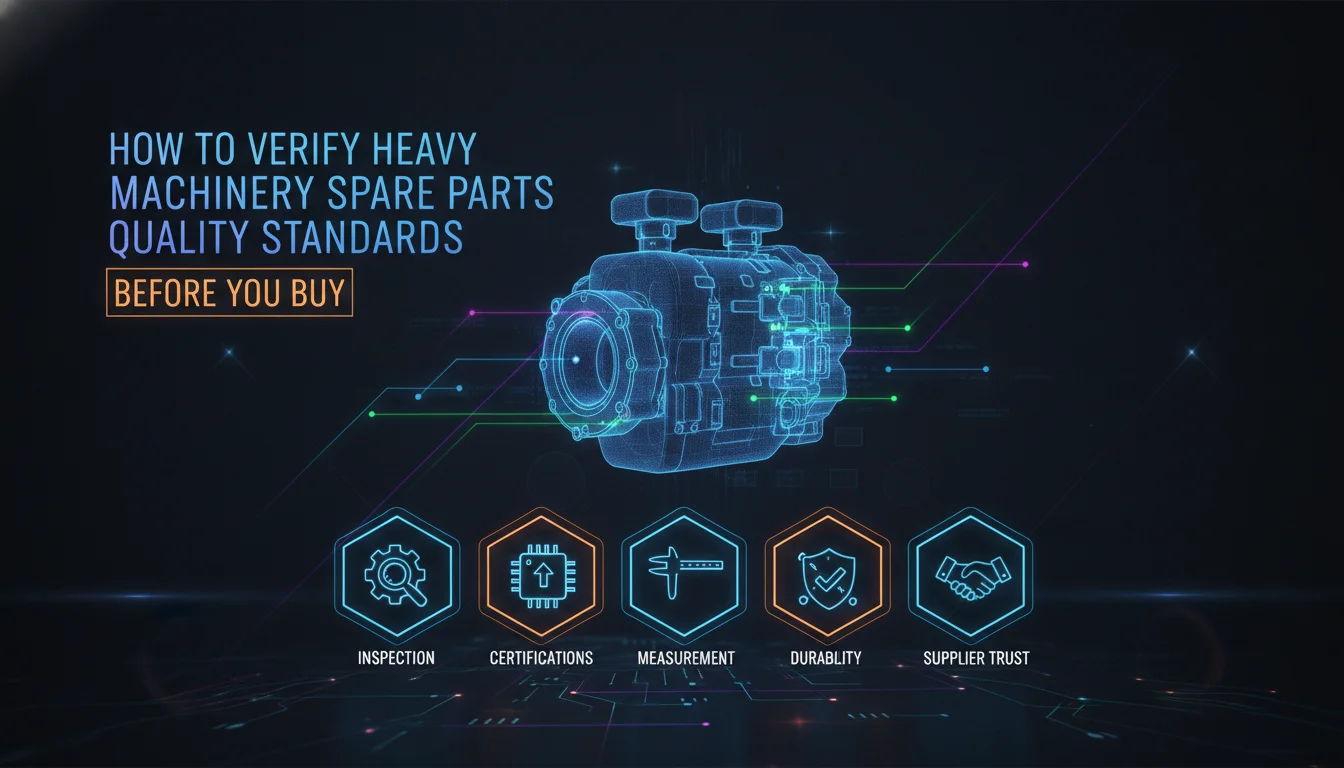
You verify heavy machinery spare parts quality standards by combining documentation review, physical inspection, and supplier assessment, because no single check catches every counterfeit or substandard component. The following process is used by experienced fleet managers and dealer service teams.
Documentation Checks That Catch Counterfeits
Quality parts always come with proper documentation, according to McGill Industries. The baseline includes part numbers that match manufacturer catalogs, a Certificate of Conformance, and country of origin information. If a supplier can't provide these basic documents, treat the part as unverified. Documentation errors, such as misspelled brand names, wrong part number formats, or missing conformance data, are common red flags.
Use this five-step verification process when receiving any heavy machinery spare part:
- Collect machine data. Record make, model, serial number, and serial number break information before ordering. EquipmentShare notes that different makes, models, and production years of the same machine may require different parts.
- Request documentation. Ask for the part number, Certificate of Conformance, and country of origin. Cross-check the part number against the OEM catalog for your machine's serial number range.
- Inspect packaging and markings. Look for proper labels, tamper-evident seals, and consistent branding. Gregory Poole advises checking packaging, labels, and markings that indicate authenticity and quality.
- Verify supplier credentials. Confirm the dealer is authorized or has a documented track record. Ascendum Machinery states that authorized dealers ensure parts meet OEM specifications and protect your machine's warranty.
- Test fit and function. Before full installation, confirm dimensions, thread patterns, pressure ratings, and performance match the original component.
Physical Inspection and Packaging Markings
Physical inspection alone is rarely enough to guarantee a part's authenticity. McGill Industries points out that it's often very difficult to distinguish genuine parts from counterfeits through visual inspection alone; a fake can look identical to the real thing. That's why packaging, labels, and markings matter. Look for consistent printing, correct logos, serial numbers or part codes, and anti-counterfeit features such as holograms or tamper-evident seals. If the box is flimsy, the label is blurry, or the part number is printed on a sticker that can be peeled, stop and verify further.
Applying heavy machinery spare parts quality standards to physical inspection means treating appearance as a preliminary screen, not a final guarantee.
Supplier Reputation and Technical Expertise
Who you buy from matters as much as what you buy. McGill Industries says a reputable heavy equipment supplier doesn't just sell parts, they understand them. The best suppliers ask questions about your application, offer alternatives when appropriate, and stand behind the quality of the parts they sell. An authorized dealer provides technical support, faster sourcing, and fleet-specific knowledge, according to Ascendum Machinery.
A supplier with a deep parts catalog and experienced counter staff can often identify a serial number break or compatibility issue before the part ships. That prevents the most common purchasing error: ordering a part that looks right but won't fit the specific machine. At 3GEN Export, we apply this same layered verification to every order across our parts categories and brand catalog.
The Parts Landscape: Genuine, OEM, Aftermarket, and Remanufactured Options

Factory-Direct and OEM Replacement Parts
Factory-direct parts come straight from the machine's original manufacturer and carry its official branding, such as genuine Caterpillar parts for a Caterpillar excavator. These parts have full factory backing and usually include warranty protection. OEM replacement parts are made by the same production facilities that supply name-brand quality equipment parts but don't carry the brand name. Both are engineered for exact fit and eliminate guesswork.
Warren CAT notes that for Cat equipment, choosing genuine parts made by Caterpillar ensures quality, durability, and longevity. The price may be higher, but the consistency of material and tolerances makes up for the investment in critical applications.
Aftermarket Parts: Price Point vs. Performance
Aftermarket parts are produced by brands that didn't contribute components to the original machine. According to Warren CAT, aftermarket parts are typically designed to a specific price point, and there's no standard of excellence or durability goal for aftermarket parts. Many buyers choose them solely for cost rather than quality, but the savings can be misleading.
Using unapproved aftermarket parts may void the equipment warranty. Ascendum Machinery says many OEM warranties require approved or OEM-certified parts for certain components to remain compliant. In some cases, an aftermarket failure can leave the owner responsible for major repair costs.
Remanufactured Spare Parts and Warranty Compliance
Remanufactured spare parts are components that have been rebuilt to like-new condition through a controlled process. A properly remanufactured part follows strict quality protocols and can often come with warranties comparable to new parts, at significantly lower prices, according to McGill Industries. Ascendum Machinery adds that remanufactured parts are rebuilt to OEM specifications and may be warranty-compliant, offering savings without compromising performance.
Remanufacturing isn't the same as salvaging. Warren CAT explains that remanufactured parts have more advantages than salvaged parts because they undergo disassembly, component replacement, and quality control testing.
| Part Type | Source | Quality and Warranty | Best For |
|---|---|---|---|
| Factory-Direct / Genuine | Original manufacturer | Full factory backing, exact fit | Critical components, warranty protection |
| OEM Replacement | Same production facilities, no brand name | High quality, may not carry official brand warranty | Cost-conscious buyers needing exact fit |
| Aftermarket | Third-party manufacturers | Variable, price-point driven; may void warranty | Non-critical parts when supplier is vetted |
| Remanufactured | Rebuilt to like-new condition | Strict protocols, often warranty-comparable to new | Major components with budget constraints |
| Salvage / Used | Donor machines | Unknown quality, no guarantee | Rarely recommended except for obsolete parts |
When to Replace Heavy Equipment Parts
Wear, Damage, and Performance Signals
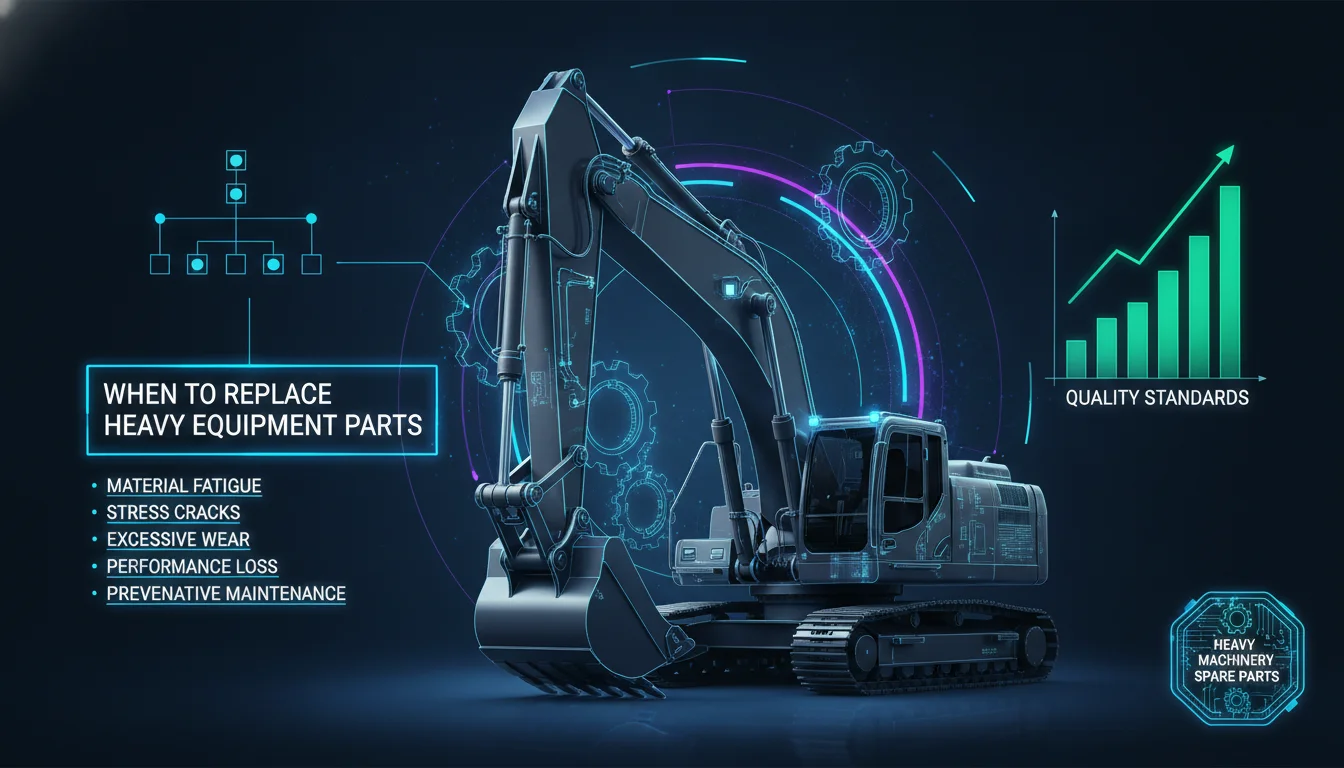
You should replace heavy equipment parts when you see visible wear, physical damage, or reduced performance, whichever comes first. Visible wear and tear on belts, hoses, and undercarriage parts is a clear signal that replacement is near, according to Gregory Poole. Cracks, dents, and physical damage to hydraulic hoses, buckets, and teeth also indicate the need for replacement to ensure safe, efficient operation. Reduced performance, such as power loss, vibrations, leaks, or unusual noises, can point to an underlying problem that requires replacement parts.
Maintenance Intervals and Telematics
Manufacturer-recommended maintenance schedules are the foundation of replacement timing. Gregory Poole advises tracking equipment usage, operating conditions, and performance metrics to predict when parts are likely to reach the end of their service life. Telematics systems and Internet of Things (IoT) devices can track equipment health in real time and provide data insights to predict replacement needs.
Environmental and Operational Factors
Extreme temperatures may accelerate wear and require more frequent parts replacements. Heavy usage or demanding applications also accelerate wear. Training operators to identify early warning signs of potential part failures and adopting a proactive replacement approach based on historical data can help avoid unexpected breakdowns while working, according to Gregory Poole.
Best Practices for Purchasing Parts Without Downtime
Know Your Machine's Make, Model, Serial Number, and Serial Number Breaks
The first line of defense against ordering the wrong part is accurate machine identification. Different makes, models, and production years of the same type of machine may require different parts. EquipmentShare emphasizes that you should always keep your machine's make, model, and serial number handy. Serial number breaks occur when a manufacturer updates a machine's design partway through a production run, meaning two machines with the same model number but different serial numbers may require different parts.
Evaluate Cost, Quality, and Warranty Impacts
Balancing cost and quality is crucial. Ascendum Machinery warns that lower-priced parts may seem attractive, but sacrificing quality can lead to increased downtime and higher long-term costs. Factor in warranty impacts: using unapproved aftermarket parts could void the warranty and leave you responsible for major repair costs. Remanufactured parts built to OEM specifications may offer significant savings while remaining warranty-compliant.
Prioritize Parts Availability and Inventory Tracking
Parts availability should be a top priority to minimize downtime. Ascendum recommends working with suppliers who offer real-time inventory tracking or the ability to source discontinued components quickly. Heavy Vehicle Inspection offers parts and inventory control features that help fleets control stock, track parts usage, and stay audit-ready.
Pro Tip: Build a simple tiered stock list, critical, high-wear, and long lead-time parts, and set reorder points for each tier. Fleets that track this by serial number range avoid the scramble of sourcing discontinued components mid-project.
Maintaining Heavy Machinery Spare Parts in Storage
Regular Inspection Protocols
You maintain stored spare parts by inspecting them on the same schedule as installed components, not just when you pull them for use. MAO Parts recommends regular inspection to identify potential issues early and prevent costly repairs. Inventory that sits for months can develop rust, seal degradation, or package damage, so include stored parts in your preventive maintenance schedule.
Proper Storage Conditions
Store spare parts in a clean, dry environment to protect them from moisture, dust, and extreme temperatures. MAO Parts highlights that moisture and heat can damage seals, hoses, and electronic components before they're ever installed. Use shelving, climate-controlled cabinets for sensitive items, and sealed packaging for metal components.
Following Manufacturer Guidelines
Always follow the manufacturer's recommendations for maintenance and replacement schedules. MAO Parts advises adhering to OEM guidance to ensure optimal performance and longevity. For stored parts, note shelf-life limits on filters, rubber components, and lubricants because these materials degrade even without use.
The Cost of Getting Quality Wrong
Downtime and Ripple Effects
A failed part rarely fails alone. EquipmentShare explains that if a hydraulic hose on an excavator becomes damaged and leaks fluid, it doesn't just affect the hose, it can reduce hydraulic pressure, cause sluggish performance, and damage the pump. The result is costly repairs and extended downtime. In construction, downtime means lost productivity, missed deadlines, and a hit to the bottom line.
McGill Industries puts the cost in perspective: a cheap part that saves $200 today might cost $20,000 in downtime tomorrow. This example illustrates why heavy machinery spare parts quality standards should account for total cost of ownership, not purchase price alone.
Counterfeit and Salvage Risks
Counterfeit components are a larger problem than many fleet managers realize. McGill Industries calls counterfeit parts dangerous impostors, not just cheap alternatives. Salvage parts from used equipment carry unknown quality and no guarantee, according to Warren CAT, and are generally not recommended for installation on critical machinery.
Long-Term Equipment Longevity
Using quality replacement parts protects the entire machine. Gregory Poole says replacing worn parts before they fail keeps equipment running efficiently, prevents costly breakdowns, and increases equipment life span. Over time, the cost of repeated cheap-part failures exceeds the cost of one quality part, especially when labor and downtime are included. This is the core economic argument behind heavy machinery spare parts quality standards: they shift the decision from unit price to lifetime cost.
Pros and Cons
Pros
- Following documented quality standards reduces the risk of installing a counterfeit or mismatched part.
- Verified parts protect OEM warranty coverage on critical components like engines, hydraulics, and drivetrains.
- Consistent verification lowers total cost of ownership by preventing cascading failures, such as a failed seal damaging an entire pump.
- Working with authorized or vetted suppliers gives access to technical support and faster sourcing during breakdowns.
Cons
- Full documentation and supplier verification takes more time upfront than simply ordering the cheapest listed part.
- Genuine and OEM parts typically cost more than unverified aftermarket alternatives.
- Physical inspection alone cannot reliably catch a well-made counterfeit, so buyers must invest in supplier vetting as well.
- Global sourcing across 40+ brands and serial number variations adds complexity that smaller buyers may find difficult to manage without a specialized partner.
Conclusion: Applying Heavy Machinery Spare Parts Quality Standards
Key Principles to Remember
Heavy machinery spare parts quality standards aren't a single specification but a practical framework: verify documentation, match the part to the machine's serial number, understand the difference between genuine, OEM, aftermarket, and remanufactured components, and buy from a supplier that stands behind its parts. No single check is sufficient. The most effective buyers combine physical inspection, documentation review, and supplier reputation into a standard operating procedure. As of 2026, global buyers face longer OEM lead times, which makes this framework more relevant, not less.
Next Steps for Buyers
Build a parts verification checklist from the five-step process in this guide. Train maintenance teams to flag documentation gaps and packaging inconsistencies. Use telematics and inventory tracking to anticipate part needs before failure. Review your supplier relationships: an authorized dealer with technical support and real-time inventory visibility reduces both downtime and the risk of counterfeit or substandard parts. For related buying guidance, see our articles on hydraulic seal kit replacement and sourcing OEM-standard undercarriage parts on the 3GEN Export blog.
3GEN Export ships OEM-quality spare parts for Caterpillar, Komatsu, Volvo, Atlas Copco, and 40+ other brands, with global 5-day delivery. Shop our verified catalog at 3genexport.com and put these heavy machinery spare parts quality standards to work on your next order.
Frequently Asked Questions
Should spare parts be capitalized or expensed?
Heavy machinery spare parts are typically expensed if they're routine replacement items consumed within a normal operating cycle. Major components that extend the machine's useful life or improve its value may need to be capitalized according to accounting standards. Consult your accountant for specific treatment.
What is the HS code for spare parts for agricultural machinery?
HS codes vary by country and component; agricultural machinery parts often fall under Chapter 84 or 87 of the Harmonized System. Contact a customs broker or use your national tariff schedule to confirm the specific code.
What is a spare parts list?
A spare parts list is a structured inventory of components required for maintenance and repair of a specific machine, including part numbers, descriptions, quantities, and recommended replacement intervals.
What is the HS code for spare parts for textile machinery?
Textile machinery spare parts generally fall under Chapter 84 or 85 depending on the component type. Always verify with your country's customs authority before shipping.
Are OEM parts always better than aftermarket parts?
OEM parts are engineered to the original specifications and typically offer exact fit and warranty protection. Aftermarket parts can be high quality but require supplier vetting because there's no uniform durability standard, according to Warren CAT.
How can I tell if a heavy machinery spare part is counterfeit?
Check documentation such as part numbers, Certificate of Conformance, and country of origin. Physical inspection alone is unreliable, so source from a reputable supplier with established expertise, as highlighted by McGill Industries.