

How to Identify Genuine OEM Parts: Full Guide
Learn how to identify genuine OEM parts using VIN lookup, packaging checks, and part numbers. Avoid counterfeits with our expert procurement guide.
Loading article…
Article Not Found
The article you're looking for doesn't exist or may have been removed.
Back to BlogKey Takeaways
- Genuine OEM parts are made by the original manufacturer and meet exact quality and dimensional standards.
- Packaging security features, part numbers, and manufacturer markings are your first line of verification.
- Your equipment's serial number or VIN is the most reliable tool for confirming correct OEM part fitment.
- Prices significantly below market rate are a reliable warning sign for counterfeit components.
- Authorized dealers and manufacturer-hosted catalogs remain the safest sourcing channels in 2026.
- Counterfeit parts can void warranties, cause equipment failure, and create serious safety hazards on job sites.
How to Identify Genuine OEM Parts: Full Guide
How to identify genuine OEM parts is a critical skill for any procurement manager or fleet supervisor: OEM parts are components manufactured by the original equipment maker to exact design specifications, and distinguishing them from counterfeits protects your machinery, your warranty, and your operation's safety.
Why This Matters More Than Ever in 2026
Counterfeit heavy equipment parts have become harder to detect. Modern fakes copy logos, packaging, barcodes, and even serial numbers with increasing precision. According to industry reports cited by powersports retailers, counterfeit components represent a multi-billion dollar problem globally, and the sophistication of these fakes has increased dramatically over the past decade. For procurement teams sourcing Caterpillar, Komatsu, Volvo, or Atlas Copco components across international supply chains, the stakes are especially high. A counterfeit hydraulic seal or a fake filter element doesn't just undermine performance - it can cause catastrophic failure on a mining site or construction project where downtime costs thousands per hour.
This guide walks you through every practical method for verifying part authenticity, from packaging inspection to serial number cross-referencing, so your team can source with confidence.
Understanding OEM Parts
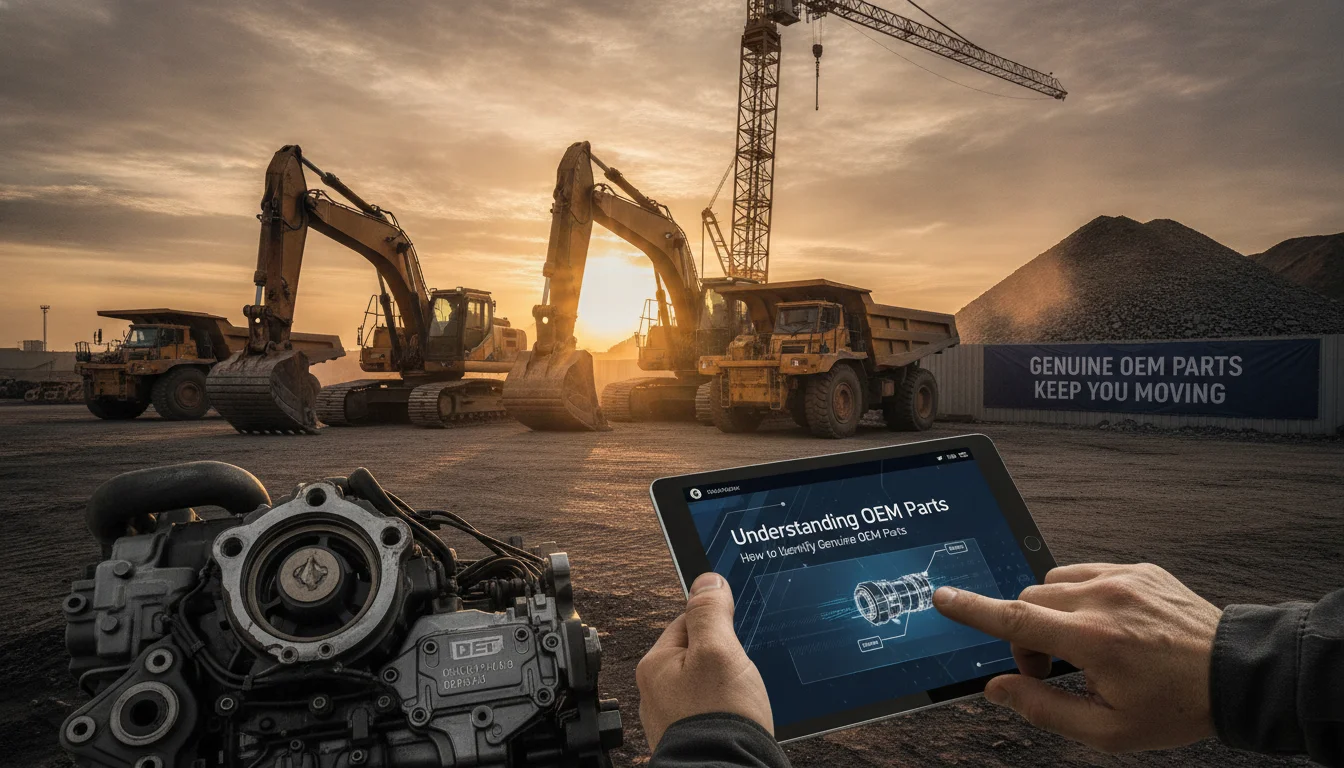
Definition of OEM Parts
OEM parts, or Original Equipment Manufacturer parts, are components produced by the same manufacturer that made the original parts for your machine. These parts are designed to fit and function exactly as the factory-installed components, ensuring reliability and performance across the equipment's full service life.
It's worth distinguishing between three categories you'll encounter in the market:
- Genuine/OE Parts: Made by the original manufacturer, sold in branded packaging, often with the manufacturer's guarantee. These are the parts your machine was built with.
- OEM-equivalent Parts: Made by an external supplier that also supplies the original manufacturer. Identical in specification but packaged under the supplier's own brand. As Interpart notes, Bosch frequently supplies components to original equipment makers, then sells the same part under its own label.
- Aftermarket Parts: Made by third-party manufacturers to approximate OEM specifications. Quality varies significantly across suppliers.
Benefits of Using Genuine OEM Parts
- Quality Assurance: OEM parts undergo rigorous testing and quality control, guaranteeing durability under the operating conditions your machine was designed for.
- Perfect Fit: Manufactured to exact dimensional tolerances, these parts require no modification during installation.
- Warranty Protection: Many manufacturers require OEM parts for warranty claims to remain valid. Installing non-genuine components can void coverage entirely.
- Predictable Performance: Genuine parts deliver the same output and efficiency as the original components, keeping your maintenance intervals predictable.
Pros and Cons of Genuine OEM Parts
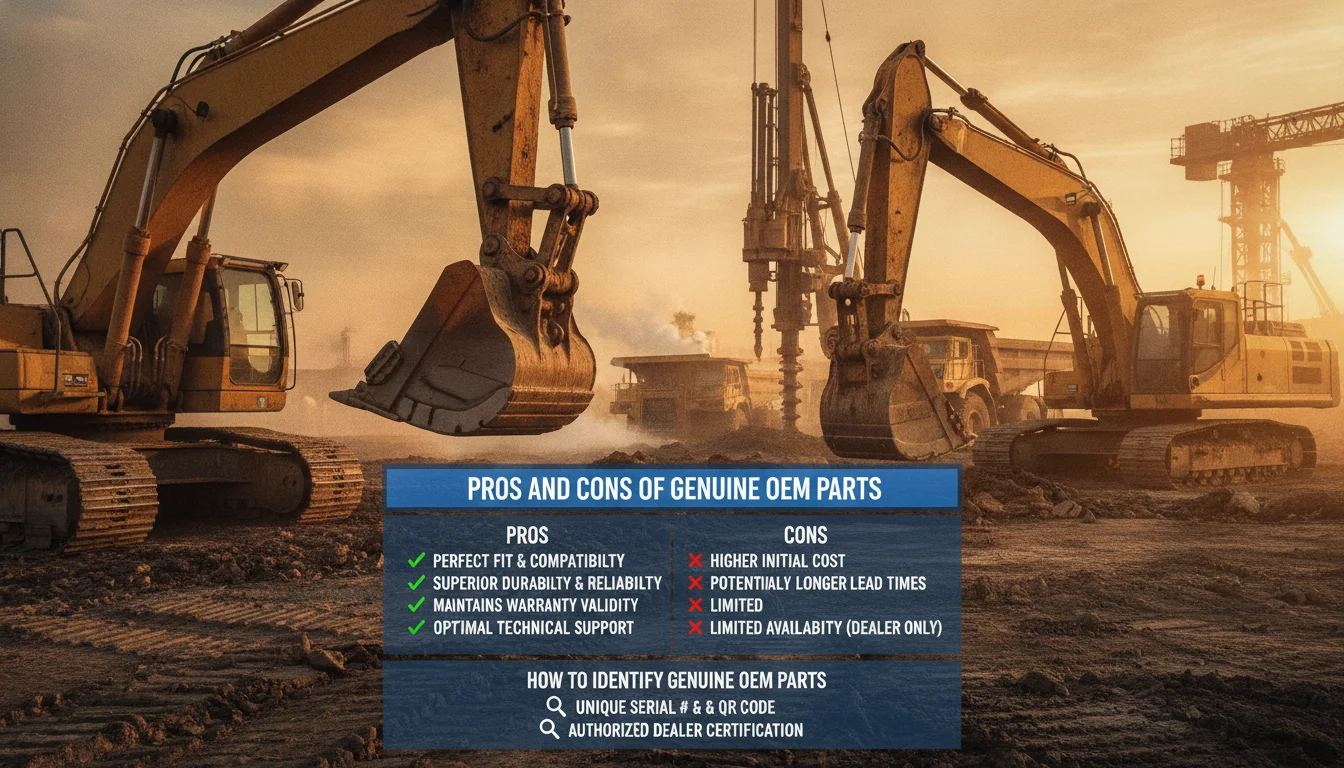
Pros
- Exact fit guaranteed: Designed to factory tolerances, so installation is straightforward and no shimming or modification is needed.
- Warranty compliance: Using genuine parts keeps manufacturer warranties intact, protecting your capital investment.
- Traceable supply chain: Genuine OEM parts carry verifiable part numbers, date codes, and country-of-origin markings that can be cross-checked against manufacturer databases.
- Longer service intervals: Because materials and tolerances match original specifications, genuine parts typically last through the full recommended service interval without premature failure.
- Liability protection: In regulated industries like mining and energy, using certified genuine parts supports compliance documentation.
Cons
- Higher unit cost: Genuine OEM parts carry a price premium over aftermarket alternatives, which can strain procurement budgets on high-volume maintenance programs.
- Longer lead times in some regions: Sourcing directly from manufacturer networks can mean extended delivery windows, particularly for less common part numbers in remote markets.
- Availability gaps: For older or discontinued equipment models, genuine OEM parts may be difficult to source through standard channels.
How Genuine OEM Part Authentication Works
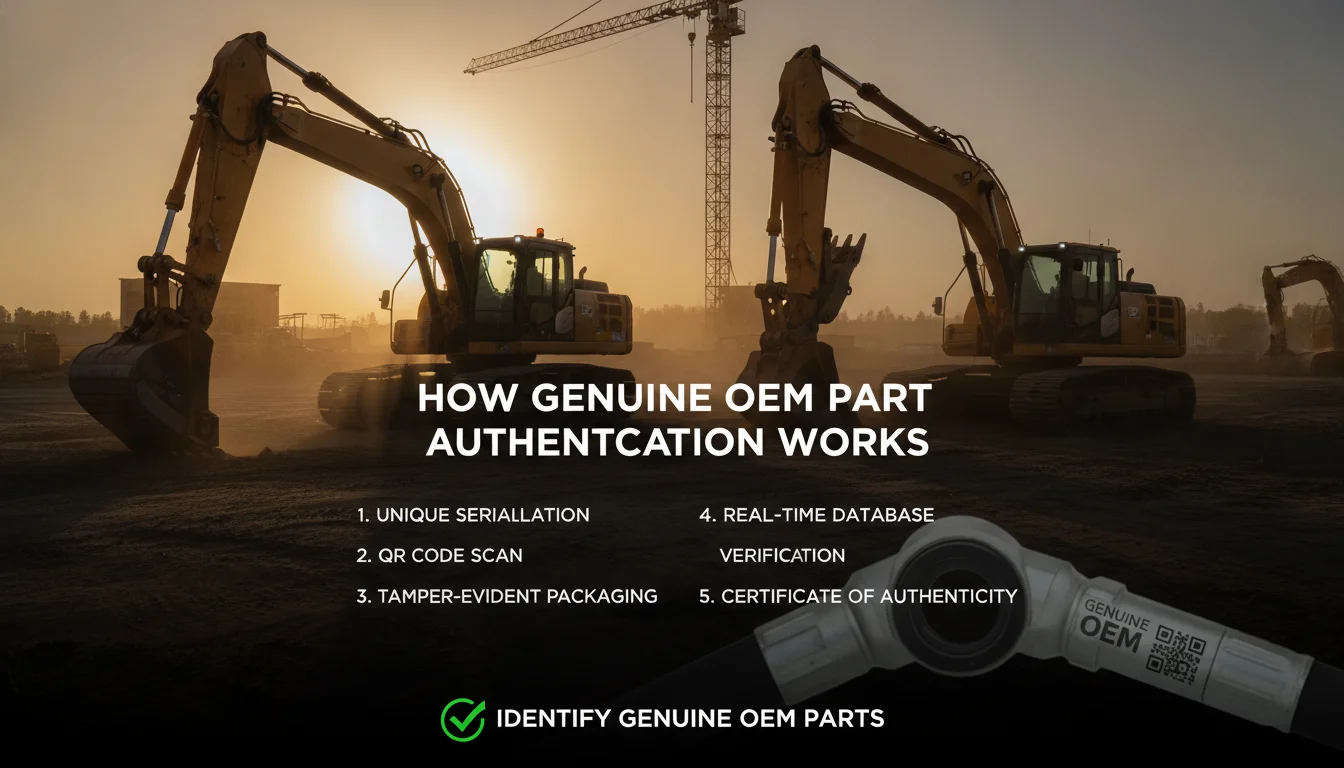
Authentication works by cross-referencing multiple physical and digital identifiers - packaging security features, part numbers, manufacturer markings, and equipment serial data - against verified manufacturer records. No single check is sufficient on its own. Sophisticated counterfeits can pass one or two checks. A genuine part passes all of them consistently.
Here's the underlying logic: OEM manufacturers invest in layered security because counterfeiting their parts damages their brand and creates liability exposure. That investment shows up as holographic labels, laser-etched part numbers, standardized packaging construction, and digital verification tools. Counterfeiters cut costs at every step, so their fakes fail on the details. Your job is to know which details to check.
For heavy equipment specifically, the authentication chain typically runs like this:
- Equipment serial number identifies the exact machine configuration.
- Configuration data maps to specific part numbers in the OEM parts catalog.
- Part numbers appear on both the packaging and the physical component.
- Physical markings on the part (stampings, laser etchings, date codes) confirm the part number.
- Supplier credentials confirm the part came through an authorized distribution channel.
Break any link in that chain and you have a verification failure. That's when you stop and investigate before installing the component.
Common Signs of Genuine OEM Parts
Packaging Characteristics
Genuine OEM parts come in distinctive packaging that includes several security features you can check before opening the box:
- High-Quality Printing: Crisp logos, consistent font weight, and accurate brand colors throughout. Blurring, color shifts, or inconsistent font sizing are immediate red flags.
- Holographic Labels: Many OEM parts feature holographic security labels that are difficult and expensive to replicate. Check that the hologram shifts color correctly when tilted.
- Standardized Part Numbers: OEM parts carry unique part numbers printed directly on the packaging in a standardized format, not applied as a sticker over existing text.
- Clear Country of Origin: Authentic packaging clearly states where the part was manufactured. Vague or missing origin information is a warning sign.
- Professional Package Construction: Seams are clean, adhesive is even, and there are no wrinkles or irregular closures. Counterfeit packaging often shows poor construction quality on close inspection.
- Correct Installation Documentation: Genuine parts typically include installation instructions with accurate grammar, correct part diagrams, and brand-consistent formatting.
Manufacturer Markings on the Part Itself
Packaging can be faked more easily than the part itself. Always inspect the physical component for these markers:
- Logos and Stampings: Look for precise logo impressions or stampings that match the manufacturer's branding exactly. Depth, clarity, and positioning should be consistent with other known-genuine parts.
- Part Numbers: The part number on the component should match the number on the packaging and the number listed in the manufacturer's catalog. Any discrepancy is a serious flag.
- Date Codes: Authentic parts often carry date codes indicating manufacture date. These help verify the part is current production and not a refurbished or repackaged unit.
- Material Quality: Genuine parts use specified materials. A seal that feels too soft, a bracket that flexes where it shouldn't, or a filter housing that seems thinner than expected all indicate substandard materials.
"Modern counterfeit parts often copy logos, packaging, labels, and even serial numbers. To an untrained eye, they can appear authentic. However, what you can't see is the quality of the materials, manufacturing standards, and testing behind the product. This is why experienced mechanics rarely judge a part by its packaging alone." - RightAutoSpares industry analysis, 2026
Using Your Equipment Serial Number to Verify OEM Parts
What Is an Equipment Serial Number?
Your equipment serial number is the heavy machinery equivalent of a vehicle's VIN. It's a unique identifier that encodes the machine's make, model, configuration, production year, and manufacturing plant. For Caterpillar machines, this is the Product Identification Number (PIN). Komatsu uses a similar serial number system. Every major OEM has a structured serial number format that maps directly to parts catalog data.
How to Use Your Serial Number to Identify Genuine OEM Parts
- Locate the Serial Number: On most heavy equipment, the serial number appears on a data plate mounted to the frame, cab, or engine block. Check your operator's manual for the exact location on your specific machine model.
- Access the OEM Parts Catalog: Use your serial number to search the manufacturer's official parts catalog. Caterpillar's SIS (Service Information System), Komatsu's Parts Book system, and Volvo's PROSIS platform all allow serial-number-based parts lookup.
- Confirm the Exact Part Number: The catalog will return the specific part number for your machine's configuration. This is the number that should appear on the packaging and the component you receive.
- Cross-Reference with Your Supplier: Provide this part number to your supplier and ask them to confirm it against their stock. Any hesitation or substitution without explanation warrants further investigation.
- Verify Compatibility Notes: OEM catalogs often include supersession notes where a newer part number replaces an older one. Confirm that any superseded part number is documented in the official catalog, not just claimed verbally by the seller.
How to Apply This in Practice: A Step-by-Step Verification Process
Here's how to identify genuine OEM parts in a real procurement workflow, from initial sourcing through to installation approval.
- Start with the serial number lookup. Before contacting any supplier, pull the exact part number from the official OEM catalog using your machine's serial number. This gives you a verified reference point that no supplier can argue with.
- Request supplier credentials upfront. Ask any new supplier for documentation of their authorized distributor status. Legitimate distributors can provide this. If a supplier deflects or offers vague assurances, that's your answer.
- Inspect packaging on receipt. Before signing off on delivery, check packaging quality, holographic labels, part number printing, and country of origin. Do this before the delivery driver leaves if possible.
- Compare the physical part number to the catalog. The number stamped or etched on the component must match the catalog part number exactly, including any suffix characters that indicate specification variants.
- Check date codes for plausibility. A part with a manufacture date that predates the model it's supposed to fit, or a date code that's clearly inconsistent with the packaging condition, is a red flag.
- Use manufacturer verification tools where available. Some OEMs provide QR codes or online verification portals. Caterpillar's genuine parts program and similar initiatives from Komatsu and Volvo allow you to scan a label and confirm authenticity against a live database.
- Document everything. Keep records of part numbers, supplier invoices, and inspection notes. This documentation protects you if a warranty claim arises later.
Identifying Counterfeit Parts: What to Watch For
Common Characteristics of Counterfeit Parts
Counterfeit parts can closely resemble genuine OEM components, making them difficult to catch without a systematic check. Based on industry experience and reports from procurement professionals, these are the most consistent warning signs:
- Poor Quality Packaging: Counterfeit parts often come in packaging that lacks the security features of genuine products. Look for blurry printing, inconsistent colors, stickered-over part numbers, or packaging that feels flimsy compared to what you'd expect from the brand.
- Inconsistent Branding: Slight variations in logos, color accuracy, or font choice are common in counterfeits. A Caterpillar yellow that's slightly off, or a Komatsu logo with incorrect proportions, should trigger closer inspection.
- Unusual Pricing: If the price is significantly below what authorized dealers or reputable distributors charge, treat it as a warning. Genuine OEM parts have a cost floor set by materials, manufacturing standards, and quality control. Prices well below that floor usually mean corners were cut somewhere.
- Missing or Altered Part Numbers: Counterfeiters sometimes change a single character in the part number, or apply a sticker over the original number. Cross-check every character against the catalog.
- No Documentation: Genuine suppliers provide invoices, certificates of conformity, and traceability documentation. A supplier who can't or won't provide paperwork is a serious risk.
- Incorrect Weight or Feel: Experienced technicians often detect counterfeits by handling the part. A filter housing that's lighter than expected, a seal that feels wrong, or a bearing that spins with unusual resistance can all indicate substandard materials.
"The brand name may be changed slightly by replacing a single letter on the part (not the packaging). The address or manufacturing country details on the part or packaging may not match that of the original brand. Most probably the price at which the part is available is much cheaper than the listed price online or at other retailers." - Hrushit Dave, automotive industry professional, via Quora
Risks of Using Counterfeit Parts
Installing counterfeit parts in heavy equipment carries consequences that go well beyond a failed component:
- Safety Hazards: Counterfeit parts may not meet the load ratings, pressure tolerances, or material specifications required for safe operation. On a mining haul truck or a crane, this can mean catastrophic failure with serious injury risk.
- Accelerated Wear on Adjacent Components: A substandard seal or bearing doesn't just fail itself. It often damages the components around it, turning a minor parts cost into a major repair bill.
- Warranty Voidance: Installing counterfeit parts typically voids the manufacturer's warranty on the affected system, and in some cases on the entire machine.
- Regulatory and Liability Exposure: In regulated industries, using non-certified parts can create compliance failures and expose your organization to liability if an incident occurs.
OEM vs. Aftermarket vs. Counterfeit: A Direct Comparison
| Factor | Genuine OEM | Quality Aftermarket | Counterfeit |
|---|---|---|---|
| Manufacturer | Original equipment maker or certified OEM supplier | Third-party manufacturer to OEM-approximate specs | Unknown, unverified manufacturer |
| Dimensional Fit | Exact factory tolerance | Close, may require minor adjustment | Inconsistent, often incorrect |
| Material Quality | Specified OEM materials | Variable, supplier-dependent | Substandard, cost-reduced materials |
| Packaging | Branded, holographic labels, printed part numbers | Supplier-branded, typically professional | Poor print quality, inconsistent markings |
| Part Number Traceability | Full catalog traceability via serial number | Cross-reference numbers available | Numbers may be copied or altered |
| Warranty Impact | Maintains OEM warranty | May affect warranty depending on manufacturer | Voids warranty |
| Price Range | Full OEM price | Typically lower than OEM | Significantly below market rate |
| Safety Certification | Fully certified to OEM standards | Varies by supplier and certification | No reliable certification |
Verification Methods for Genuine OEM Parts
Online Catalogs
Online catalogs are one of the most effective tools for verifying OEM part authenticity before you place an order. Here's how to use them correctly:
- Choose Reputable Sources: Use catalogs hosted directly by manufacturers or their authorized dealer networks. For Caterpillar parts, that means the official Cat dealer portal. For Komatsu, the official Komatsu parts catalog. Third-party aggregators can be useful for cross-referencing, but always confirm against the primary source.
- Check for Official Logos and Branding: Authentic manufacturer catalogs feature consistent, high-quality branding. If a catalog's logo looks slightly off or the site design feels inconsistent with the brand's official web presence, verify the URL and domain ownership before trusting the data.
- Read Supplier Reviews: For online distributors, look for verified reviews from other procurement professionals. Volume buyers in mining and construction tend to be direct about supplier reliability.
- Verify Part Number Format: Each OEM uses a specific part number format. Caterpillar part numbers follow a defined alphanumeric structure. Komatsu uses a different format. If the part number on a supplier's listing doesn't match the format in the official catalog, that's a discrepancy worth investigating.
Consulting Authorized Dealers
Authorized dealers remain the most reliable source for genuine OEM parts, particularly for critical components in high-stakes applications. When working with dealers:
- Ask for Documentation: Request certificates of authenticity, distributor authorization letters, or manufacturer-issued supplier credentials. Legitimate dealers provide these without hesitation.
- Inquire About Return Policies: Genuine dealers stand behind their parts with clear return and warranty policies. Vague or non-existent return terms are a warning sign.
- Verify Their Authorization Status: Most major OEMs maintain public lists of authorized dealers and distributors. Cross-check any new supplier against the manufacturer's official dealer locator before placing a significant order.
Brand-Specific Verification Tips
Different OEM brands use different authentication systems. Here's what to look for across the brands we supply most frequently:
| Brand | Key Authentication Features | Catalog/Verification Tool |
|---|---|---|
| Caterpillar | Yellow branded packaging, holographic Cat label, PIN-based catalog lookup | Cat SIS (Service Information System) |
| Komatsu | Komatsu-branded box, serial number parts lookup, stamped part numbers on components | Komatsu Parts Book / dealer portal |
| Volvo CE | Volvo-branded packaging, PROSIS catalog, holographic labels on critical parts | Volvo PROSIS |
| Atlas Copco | Atlas Copco branded packaging, serial-number-based parts lookup, QR verification on select parts | Atlas Copco Parts Online |
| JCB | JCB-branded packaging, unique part number format, authorized dealer network verification | JCB Parts portal |
Common Mistakes When Sourcing OEM Parts
Even experienced procurement teams make these errors. Knowing them in advance saves money and prevents equipment damage.
Relying on Price Alone
Price is a useful signal but not a complete verification method. Some counterfeit operations price their products close to genuine OEM levels to avoid suspicion. Conversely, authorized dealers occasionally run promotions that bring prices below typical market rates. Always combine price assessment with physical and documentary verification.
Skipping the Serial Number Check
Ordering by part description or visual match rather than confirmed serial-number-based part numbers is one of the most common and costly mistakes in heavy equipment procurement. Two machines that look identical can have different internal specifications depending on production date or regional configuration. Always start with the serial number.
Trusting Packaging Without Checking the Part
Sophisticated counterfeiters invest in convincing packaging. The packaging check is necessary but not sufficient. Always inspect the physical component for correct markings, material quality, and dimensional accuracy before approving installation.
Using Unverified Online Marketplaces
General-purpose online marketplaces can host both legitimate and counterfeit parts listings side by side. A listing that says "OEM" or "genuine" is not verification. Cross-check every purchase against manufacturer catalogs and supplier authorization documentation, regardless of the platform.
Ignoring Supersession Notices
OEM manufacturers regularly update part numbers when they revise a component. A part number that was correct two years ago may have been superseded. Always check the current catalog, not a saved reference from a previous order. Superseded parts are still genuine if sourced correctly, but the updated part number should be confirmed through official channels.
Failing to Document the Supply Chain
In regulated industries, the ability to trace a part from manufacturer to installation is a compliance requirement. Even in less regulated contexts, documentation protects you in warranty disputes. Keep supplier invoices, part numbers, and inspection records for every critical component you install.
A Realistic Procurement Scenario
Consider a fleet maintenance supervisor managing a fleet of Komatsu PC360 excavators at a large civil construction project. One machine develops a hydraulic pump issue mid-project. The supervisor needs a replacement pump quickly to avoid extended downtime.
A quick online search returns several suppliers offering the required pump at prices ranging from roughly half the authorized dealer price to slightly below it. The supervisor follows the verification process:
- Pulls the exact Komatsu part number from the PROSIS-equivalent Komatsu Parts Book using the machine's serial number.
- Contacts the lowest-price supplier and requests their authorized distributor documentation. The supplier cannot provide it and offers only a verbal guarantee of authenticity.
- Contacts a mid-price supplier who provides a distributor authorization letter from Komatsu's regional distribution network.
- Places the order with the authorized supplier. On receipt, inspects packaging for Komatsu branding, holographic labels, and printed part numbers. All check out.
- Inspects the physical pump for stamped part numbers and date codes. Both match the catalog reference.
- Approves installation. Documents the part number, supplier invoice, and inspection notes in the maintenance record.
The total verification process adds less than two hours to the procurement workflow. The alternative - installing a counterfeit pump - could have meant a second failure within weeks, potential damage to the hydraulic system, voided warranty coverage, and a much larger repair bill. That's the practical value of knowing how to identify genuine OEM parts in a real procurement context.
Where to Source Genuine OEM-Quality Parts Globally
For procurement teams operating across multiple regions, consistent access to verified OEM-quality parts is a logistics challenge as much as a quality challenge. Lead times, customs clearance, and regional distributor availability all affect your ability to keep equipment running.
At 3GEN Export, we supply OEM-standard spare parts for Caterpillar, Komatsu, Volvo, Atlas Copco, and more than 40 additional brands, with global delivery in as few as 5 days. Our parts are sourced through verified supply chains, and we provide full documentation on request. Whether you're maintaining a mining fleet in West Africa, a construction operation in Southeast Asia, or an energy project in the Middle East, we can support your procurement requirements with parts that meet OEM specifications and arrive with the traceability documentation your operation needs.
Explore our parts categories or browse by brand to find the components your fleet needs. For urgent requirements, contact our team directly for expedited sourcing.
Frequently Asked Questions
How do I know if a part is truly OEM?
To verify that a part is genuinely OEM, cross-reference the part number on the component and packaging against the manufacturer's official catalog using your machine's serial number. Check for security features including holographic labels, consistent branding, and printed (not stickered) part numbers. Confirm the supplier holds authorized distributor status from the manufacturer.
Where can I find genuine OEM parts?
Genuine OEM parts are available through authorized dealer networks, manufacturer-direct portals, and verified OEM-standard distributors like 3GEN Export. Always confirm supplier authorization before purchasing, particularly for critical components like hydraulic, engine, or drivetrain parts. Manufacturer websites typically maintain searchable dealer locators for your region.
Are aftermarket parts as good as OEM?
Quality aftermarket parts from reputable manufacturers can meet or approach OEM specifications for many applications. However, quality varies significantly across aftermarket suppliers, and for critical systems - hydraulics, braking, engine management - the risk of specification mismatch is higher. For warranty-sensitive applications, genuine OEM parts are the safer choice.
Can a serial number tell me the original parts for my machine?
Yes. Your equipment's serial number maps directly to the manufacturer's parts catalog, identifying the exact part numbers for your specific machine configuration, production date, and regional specification. This is the most reliable method for confirming correct part fitment and is the starting point we recommend for every procurement decision.
What should I do if I suspect I have counterfeit parts?
Stop installation immediately and quarantine the suspect components. Contact the supplier for documentation and escalate to the manufacturer's anti-counterfeiting team if needed. Most major OEMs including Caterpillar and Komatsu have dedicated channels for reporting suspected counterfeits. Have a qualified technician inspect any components already installed to assess whether they need to be replaced.
How can I avoid counterfeit parts when sourcing internationally?
Work exclusively with suppliers who can provide authorized distributor documentation from the OEM. Use serial-number-based catalog lookups to confirm exact part numbers before ordering. Inspect every shipment on receipt against the verification checklist in this guide. For high-value or safety-critical parts, consider requesting a certificate of conformity from the supplier as a condition of purchase.