Sandvik Parts Catalogue: Complete 2026 Guide
The sandvik parts catalogue is your key to fast, accurate parts sourcing. Explore access methods, part types, ordering steps, and OEM vs aftermarket
Loading article…
Article Not Found
The article you're looking for doesn't exist or may have been removed.
Back to BlogThe sandvik parts catalogue is a structured reference system listing every replacement component for Sandvik mining, drilling, and construction machinery, complete with part numbers, specifications, and ordering details. Use it to cut downtime and keep your fleet running.
Key Takeaways
- The catalogue covers wear parts, hydraulic assemblies, electrical components, and more across the full Sandvik equipment range.
- Access is available online via the My Sandvik portal, as a PDF download, or on mobile for field technicians.
- OEM parts guarantee compatibility; aftermarket options carry quality risk that can cost more in the long run.
- Accurate part numbers are the fastest path to the right component. Part number 88204339, for example, identifies a specific tapered roller bearing used across multiple Sandvik machines.
- Free shipping applies on qualified US orders over $9,999, according to distributor pricing data.
- As of 2026, Sandvik Coromant's catalogue library includes updated ordering information volumes for turning tools, rotating tools, and solid round tools.
What Is the Sandvik Parts Catalogue?
The Sandvik parts catalogue is the definitive reference for sourcing genuine replacement components across Sandvik's full equipment lineup. It covers everything from underground drill rigs and loaders to surface mining equipment, giving procurement teams a single source of truth for part numbers, compatibility data, and technical specifications. Without it, ordering the wrong component is almost inevitable on complex machinery.
Sandvik operates two distinct catalogue systems worth knowing. The Sandvik Mining and Rock Solutions catalogue covers heavy equipment parts: hydraulic systems, drive components, structural assemblies, and wear items for drill rigs, loaders, and tunneling machines. The Sandvik Coromant catalogue focuses on cutting tools, indexable inserts, milling tools, and solid round tools for machining applications. Both are updated regularly. Sandvik Coromant's download page lists updated ordering information volumes dated into 2026, including the latest cutting tools and solutions release and the Indexable Milling Tools 2026 volume.
Using the correct part number is the single most reliable way to eliminate ordering errors and prevent costly machine downtime.
How to Access the Sandvik Parts Catalogue
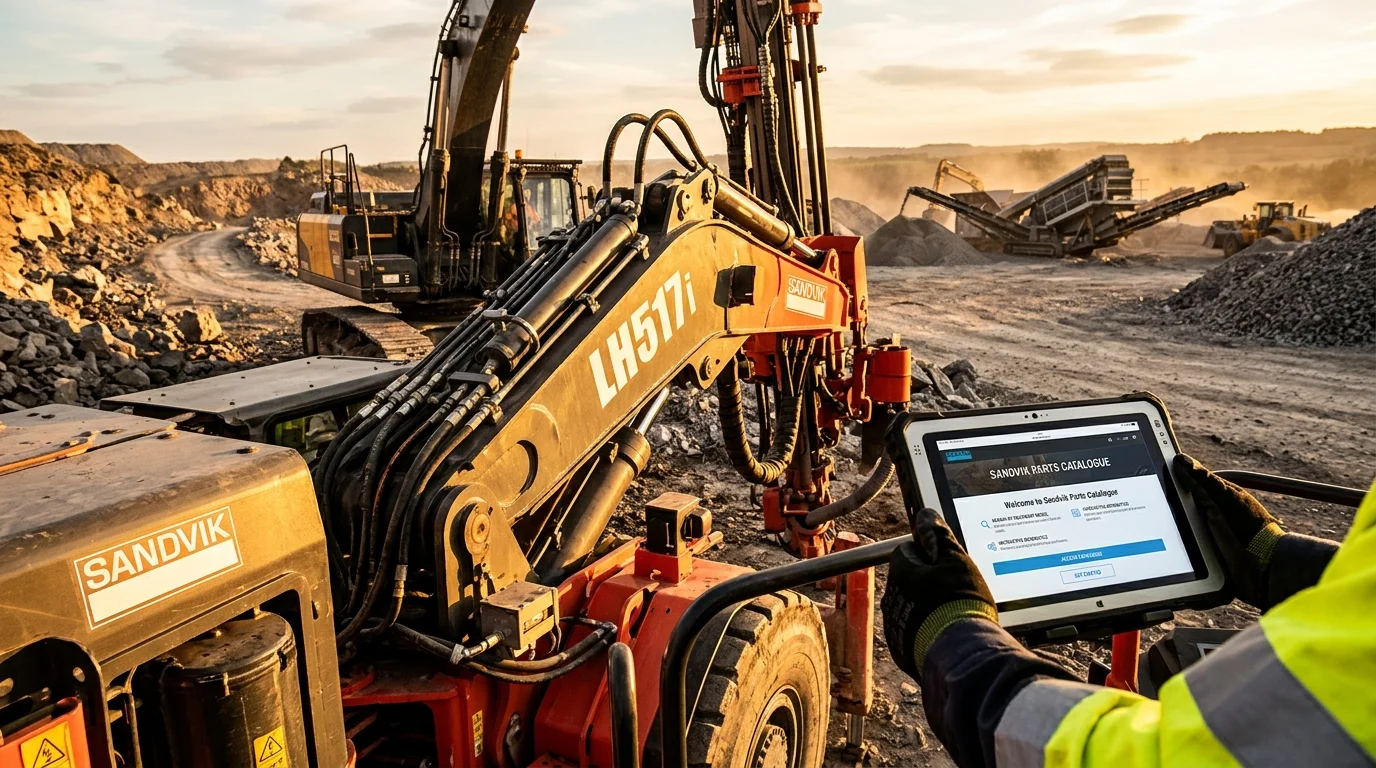
Accessing the catalogue is straightforward once you know which channel fits your workflow. Three primary options exist: the online portal, PDF download, and mobile access.
Online Access via My Sandvik
The My Sandvik customer portal is the primary access point. After registering a business account, users can search by part number or description, view full specifications, check availability, and place orders directly. The portal is the most current version of the catalogue and reflects real-time stock status.
PDF Download for Offline Use
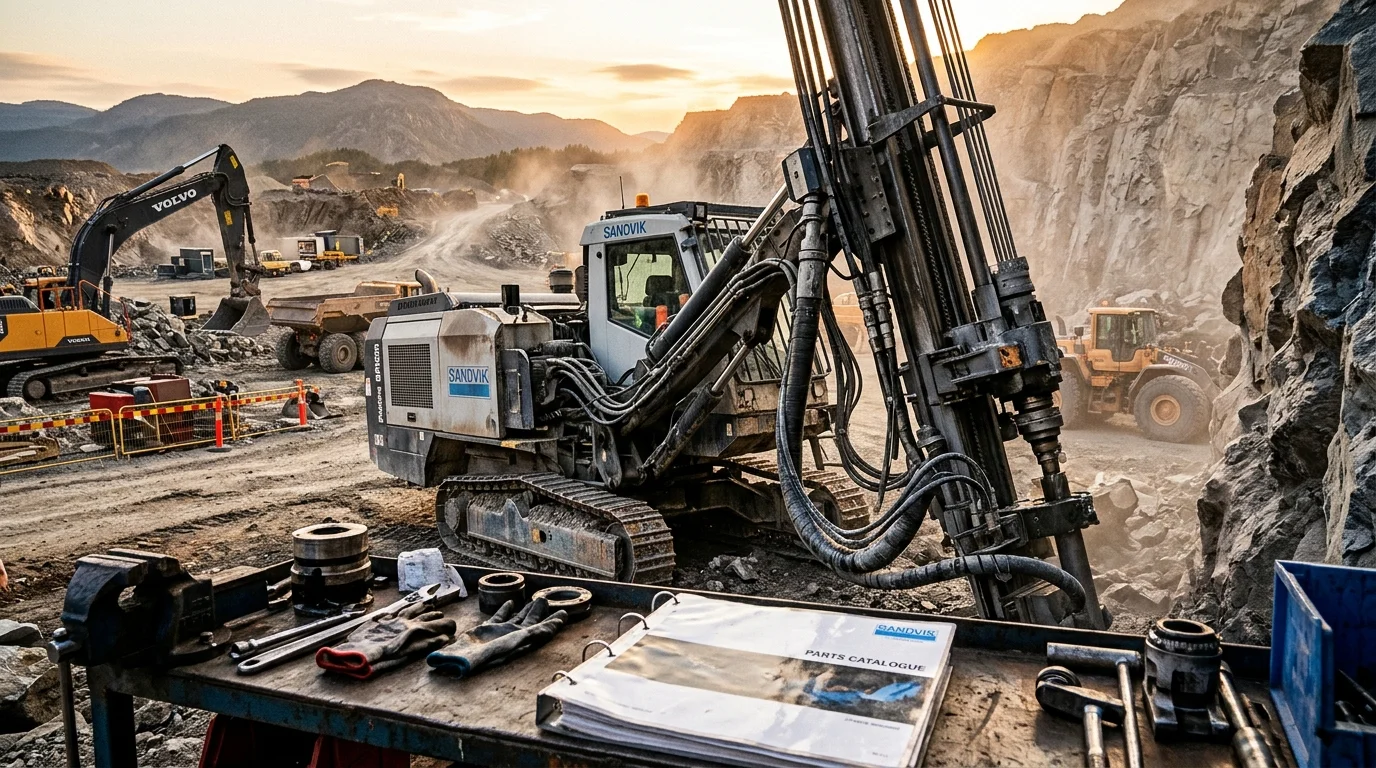
For sites with limited connectivity, PDF versions are available for download. This matters on underground mining sites or remote surface operations where internet access is unreliable. Sandvik Coromant, for instance, publishes its full catalogue library as downloadable PDFs alongside an ePublication app for browsing and sharing. Maintenance Technique, a Sandvik parts specialist, also maintains an active Sandvik parts catalogue section with component-specific PDFs uploaded regularly through 2025 and into 2026, covering items like boom wear parts, feed cradle assemblies, and wheel arch components.
Mobile Access for Field Technicians
Sandvik has optimized its catalogue interfaces for mobile devices. Field technicians can pull up part specifications, cross-reference compatibility, and initiate quote requests directly from a tablet or phone. This removes the lag between identifying a failed component on-site and getting the order moving.
How the Catalogue System Works
The Sandvik parts catalogue operates on a structured part numbering system that ties every component to a specific machine model, serial number range, and assembly position. Understanding this structure saves significant time during procurement.
Each part entry contains several data layers. The part number is the unique identifier. The description names the component and its function. The machine compatibility field lists which models and serial ranges the part fits. The supersession chain shows whether a part number has been replaced by a newer revision. And the assembly diagram (where available) shows exactly where the part sits within the machine.
Take a practical example. Part number 88204339 is a tapered roller bearing. The catalogue entry tells you which Sandvik machines use it, the bearing's dimensional specifications, and whether a superseding part number exists. Without that entry, a technician might order a bearing by dimension alone and receive one that fits physically but lacks the load rating the application demands.
The catalogue also distinguishes between GENUINE Sandvik parts and OEM-equivalent parts. Genuine parts carry Sandvik's full quality certification. OEM-equivalent parts meet original specifications but may come from approved supply chain partners. Both categories appear in distributor listings alongside part numbers like 05962131 (Front Centralizer), 55076646 (Pump Unit), 56013009 (Piston Accumulator), and 32330255 (Manifold Assembly).
The Sandvik parts catalogue system ties every component to a specific machine model and serial number range, making accurate cross-referencing the foundation of reliable procurement.
Types of Parts in the Catalogue
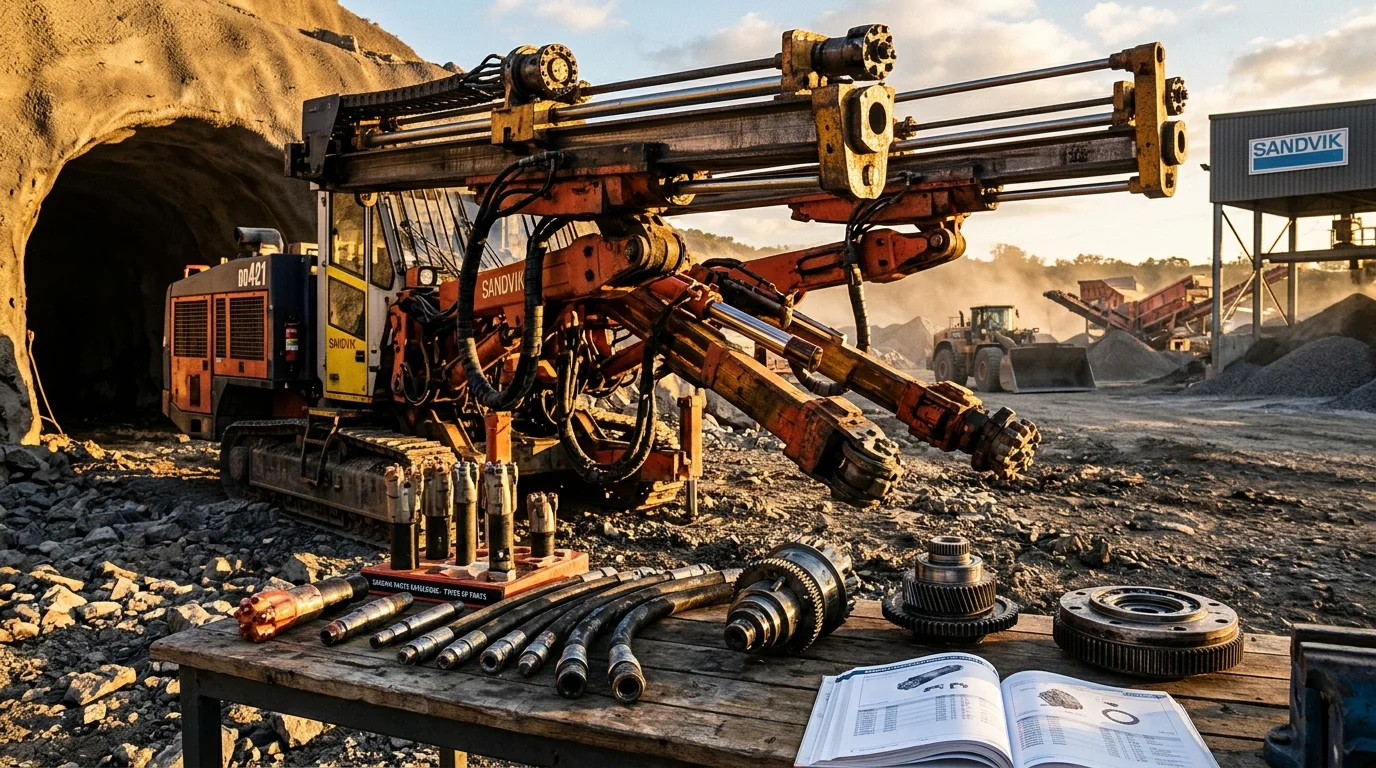
The catalogue covers a broad range of component categories, each critical to a different aspect of machine performance.
Wear Parts
Wear parts experience the highest replacement frequency. Drill bits, cutting tools, cutter unit tool kits (such as part 65673819000K), boom wear components, and shovel assemblies (part 65657706000) all fall into this category. Planning wear part replacements proactively, rather than reactively, is the most direct way to reduce unplanned downtime.
Hydraulic Components
Hydraulic systems are the backbone of most Sandvik heavy equipment. The catalogue lists pumps (part 002764-013, a 7.25 cu in pump), valve assemblies (parts 001479-072 and 003500-001), main control valves (part 902.1112-00), valve spools (part 902.1114-00), piston accumulators, hose groups, and oil coolers. Hydraulic failures are among the most expensive breakdowns on heavy equipment, so having these parts identified and pre-sourced is standard practice for serious maintenance teams.
Drivetrain and Mechanical Components
This category includes gearboxes (part 55197127), driving shafts (part 66809954000), planetary gear assemblies (part 66812052000), coupling connectors (part 7993-3644), and manifold assemblies. These are lower-frequency replacements but high-consequence failures when they occur.
Electrical and Sensor Components
Modern Sandvik equipment relies heavily on electronic control systems. The catalogue covers sensors (part 65656956806), inclination sensors (part BG01312042), timer switches (part 019245-001), instrument panels (part 56027788 area), and control units. Electrical faults are often misdiagnosed as mechanical issues. Having the correct sensor or switch part number on hand accelerates diagnosis and repair.
Structural and Ancillary Parts
The catalogue also covers structural components: wheel arch assemblies, workdeck weldments (part 017336-002), heat exchangers (part 65670945000), sound absorbers (part 65690121000), air ride seat kits (part 64584915), and safety support components (part BE00007984). These parts are often overlooked in maintenance planning but are critical for operator safety and regulatory compliance.
OEM vs. Aftermarket Parts: What the Catalogue Tells You
OEM parts are designed specifically for Sandvik machinery, guaranteeing compatibility and reliability. Aftermarket parts may offer lower upfront cost but carry variable quality risk.
Pros and Cons of OEM Parts
Pros
- Exact fit and dimensional accuracy per original machine specifications.
- Full manufacturer warranty coverage maintained.
- Predictable service life based on Sandvik's own testing and field data.
- Supersession tracking: the catalogue flags when a part number has been updated to a newer, improved revision.
Cons
- Higher unit cost compared to aftermarket alternatives.
- Lead times can extend on slow-moving or specialized components.
- Availability may be limited in certain regions without a local distributor network.
Pros and Cons of Aftermarket Parts
Pros
- Lower purchase price on common wear items.
- Wider availability through general industrial distributors.
- Faster local sourcing in some markets.
Cons
- Quality varies significantly between suppliers. No standardized certification requirement.
- Dimensional tolerances may differ, causing premature wear or fit issues.
- Warranty on the host machine may be affected by non-OEM component use.
- No supersession tracking: you may receive an outdated design revision.
OEM vs. Aftermarket: Side-by-Side Comparison
Use this table to evaluate sourcing options before committing to a purchase decision.
| Factor | OEM / Genuine Sandvik | Aftermarket |
|---|---|---|
| Fit and compatibility | Guaranteed per machine serial range | Variable; verify dimensions independently |
| Quality certification | Sandvik-certified, tested to OEM spec | Supplier-dependent; no universal standard |
| Warranty impact | No impact on machine warranty | May void warranty on affected systems |
| Part number traceability | Full supersession chain in catalogue | No supersession data available |
| Unit cost | Higher | Lower on common items |
| Lead time | Varies; faster with distributor stock | Often faster for generic components |
| Best use case | Critical systems, warranty-active machines | Non-critical wear items, budget-constrained fleets |
How to Order Parts: Step-by-Step
Ordering from the catalogue is a structured process. Follow these steps to avoid errors and delays.
- Identify the machine model and serial number. Every Sandvik machine has a serial number plate. This is your starting point. The catalogue filters parts by machine model and serial range, so without this information you risk ordering a part that fits a different production variant.
- Locate the correct part number. Use the assembly diagram in the catalogue to identify the exact component. Cross-reference the part number against the machine's service manual if available. For bearings, valves, and sensors, even a single digit difference in the part number can mean a completely different specification.
- Log into the My Sandvik portal. Create a business account if you don't already have one. Business accounts unlock pricing, availability data, and invoicing options.
- Search by part number. Enter the exact part number. Avoid searching by description alone as similar components often share generic names but differ in specification.
- Verify the part details. Confirm the description, machine compatibility, and any supersession notes before adding to cart. If the catalogue shows a newer revision, order the current part number.
- Add to cart and review quantities. For wear parts, consider ordering a buffer stock to avoid repeat emergency orders. For hydraulic and electrical components, one spare unit is typically sufficient.
- Select payment method and complete checkout. Sandvik accepts credit cards and invoicing for registered business accounts. Free shipping applies on qualified US orders over $9,999.
- Track your order. Use the My Sandvik portal to monitor shipment status. If delays occur due to supply chain constraints, the portal provides tracking information and customer service contact options.
Common Mistakes When Using the Catalogue
Even experienced procurement teams make avoidable errors. Here are the most common ones and how to prevent them.
Searching by Description Instead of Part Number
Generic descriptions like "pump" or "valve assembly" return dozens of results. Always lead with the part number. If you don't have it, use the machine's assembly diagram to locate the correct item before searching.
Ignoring Supersession Notices
Sandvik regularly updates part numbers when a component is revised. Ordering a superseded part number may result in receiving an older design that no longer meets current specifications. Always check for supersession flags in the catalogue entry before confirming the order.
Ordering Without Confirming Machine Serial Range
Many Sandvik models share similar part names across production variants, but the actual components differ. A hydraulic pump for an early-production unit may not fit a later variant even if the machine model name is identical. Confirm the serial number range compatibility before ordering.
Underestimating Lead Times on Specialized Parts
Common wear parts are typically in distributor stock. Specialized hydraulic assemblies, electronic control units, and structural components may require longer lead times, particularly for machines that are no longer in active production. Build lead time into your maintenance planning cycle.
Mixing OEM and Aftermarket in Critical Systems
Using aftermarket parts in hydraulic or electronic systems alongside OEM components can create compatibility issues that are difficult to diagnose. For critical systems, maintain consistency. Reserve aftermarket sourcing for standalone wear items where the quality risk is lower and the failure consequence is manageable.
A Practical Scenario: Sourcing a Hydraulic Component Under Pressure
Consider a fleet maintenance supervisor at an underground mining operation. A Sandvik loader goes down mid-shift with a hydraulic fault. The on-site technician identifies a failed main control valve as the likely cause.
Without the catalogue, the next step is a phone call to a distributor, a description of the fault, and a wait for someone to identify the part. With the catalogue, the technician pulls up the machine's serial number, navigates to the hydraulic system assembly diagram, and identifies part 902.1112-00 as the main control valve. The part number goes directly into the My Sandvik portal. Availability is confirmed, the order is placed, and tracking begins within minutes of the fault being identified.
That speed difference, between a vague description and a precise part number, is the practical value of knowing how to use the catalogue correctly. On a production site, every hour of machine downtime has a direct cost. Cutting the identification and ordering phase from hours to minutes is not a minor efficiency gain.
2026 Outlook: What's Changing in Parts Sourcing
As of 2026, Sandvik continues to expand its digital parts infrastructure. The Sandvik Coromant catalogue library has been updated with new ordering information volumes this year, including the Indexable Milling Tools 2026 release and the Latest Cutting Tools and Solutions 26.2 update, both available for download or viewing via the ePublication platform.
On the mining and rock solutions side, third-party specialists like Maintenance Technique continue to publish component-specific Sandvik catalogues covering boom wear parts, feed systems, and sensor assemblies, with uploads continuing into 2026. This distributed catalogue ecosystem means procurement teams have more access points than ever, but it also means verifying that you're working from a current document version is more important than ever.
The broader trend in heavy equipment parts sourcing is toward digital-first procurement: portal-based ordering, real-time availability data, and mobile access for field teams. Sandvik's catalogue infrastructure is well-positioned for this shift. Teams that invest time in learning the portal and catalogue structure now will have a clear operational advantage as equipment fleets grow more complex.
For procurement teams sourcing Sandvik parts alongside other major brands, the same discipline applies. Volvo Construction Equipment, for instance, operates a comparable digital parts infrastructure through its Volvo Dealer Network, as described on the Volvo CE login hub, which provides access to parts inventory, technical documentation, and warranty information. The principle is identical: structured part numbers, portal-based ordering, and verified compatibility data are the foundation of efficient fleet maintenance regardless of brand.
How 3GEN Export Supports Your Sandvik Parts Sourcing
We stock OEM-quality parts for Sandvik machinery alongside 40+ other major brands including Caterpillar, Komatsu, Volvo, and Atlas Copco. Our team works with procurement managers and fleet maintenance supervisors across mining, construction, and energy sectors worldwide.
When you need a part fast, we don't make you wait for a distributor to check stock. We carry inventory, we know the part numbers, and we ship globally with 5-day delivery on stocked items. Whether you're sourcing a tapered roller bearing, a hydraulic pump assembly, or a full wear parts kit, we can cross-reference your part number against our inventory and confirm availability before you commit to an order.
Shop OEM-quality spare parts with global 5-day delivery at 3genexport.com.
Frequently Asked Questions
What is the Sandvik parts catalogue?
The Sandvik parts catalogue is a structured reference system listing all replacement components for Sandvik mining, drilling, and construction machinery. Each entry includes a unique part number, technical specifications, machine compatibility data, and ordering information, giving maintenance teams everything they need to source the correct part without guesswork.
How can I access the Sandvik parts catalogue?
You can access it online through the My Sandvik customer portal after registering a business account. PDF versions are available for download for offline use on remote sites. Sandvik Coromant also maintains a dedicated catalogues and handbooks download page with updated volumes for cutting tools and machining applications.
What types of parts are listed in the catalogue?
The catalogue covers wear parts (drill bits, cutting tools, boom wear components), hydraulic assemblies (pumps, valves, hoses, accumulators), drivetrain components (gearboxes, shafts, planetary assemblies), electrical and sensor parts, and structural components. It spans the full range of Sandvik equipment from underground loaders to surface drill rigs.
Can I order parts directly from the catalogue?
Yes. The My Sandvik portal allows registered business users to search by part number, check availability, and place orders directly. Payment options include credit card and invoicing for business accounts. Free shipping applies on qualified US orders over $9,999.
What should I do if I can't find a part in the catalogue?
Start with the exact part number rather than a description search. If the part still doesn't appear, it may have been superseded by a newer part number. Check the machine's service manual for supersession notes, or contact Sandvik customer support directly. Third-party specialists who maintain Sandvik-specific catalogue libraries can also help identify hard-to-find components.
Are OEM parts always better than aftermarket parts for Sandvik machinery?
For critical systems like hydraulics, drivetrain, and electronic controls, OEM parts are the reliable choice. They guarantee fit, maintain warranty coverage, and come with supersession tracking. For standalone wear items on older machines outside warranty, quality aftermarket parts can be a practical option, provided you verify dimensional specifications carefully before ordering.