
What Is OEM Standard Parts in Heavy Equipment?
What is OEM standard parts in heavy equipment? We break down definitions, warranty rules, costs, and verification steps for fleet buyers in 2026.
Loading article…
Article Not Found
The article you're looking for doesn't exist or may have been removed.
Back to BlogWhat is OEM standard parts in heavy equipment? OEM standard parts are replacement components produced by the machine's original manufacturer to the exact engineering specifications, materials, and tolerances used on the factory assembly line.
Key Takeaways
- OEM standard parts in heavy equipment are made by the original equipment manufacturer to the same engineering specifications as the parts installed at the factory.
- Genuine OEM parts protect warranty coverage, reduce fitment risk, and are backed by manufacturer distribution networks and authorized dealers.
- Aftermarket parts often cost less upfront but vary widely in quality, materials, and compatibility, which can lead to downtime and cascading failures.
- Verifying genuine OEM standard parts requires checking packaging, traceability data, part numbers against the equipment manual, and purchasing through authorized channels.
- Total cost of ownership, not initial purchase price, is the most reliable metric for comparing OEM and aftermarket heavy equipment parts.
- As of 2026, fleet managers increasingly evaluate parts sourcing by criticality and warranty exposure rather than a blanket OEM-only or aftermarket-only policy.
What Is OEM Standard Parts in Heavy Equipment?
OEM standard parts in heavy equipment are replacement components manufactured by the same company that built the original machine. The abbreviation OEM stands for original equipment manufacturer. In the heavy equipment world, that manufacturer owns the original engineering drawings, material specifications, and production tolerances for every part in an excavator, wheel loader, dozer, haul truck, or vacuum truck. When you purchase a genuine OEM part, you're buying a component produced to the exact form, fit, and function of the part installed on the assembly line.
This definition matters because heavy equipment operates under extreme loads, vibration, heat, and contamination. A hydraulic pump, final drive, or electronic control module isn't a generic commodity. It's designed to work within a specific system of pressures, clearances, and software parameters. According to EquipmentShare, OEM parts are made to the exact specifications and standards initially installed in the machine, ensuring compatibility and performance identical to its original parts.
The Core Definition of OEM and OE
One common point of confusion is the difference between OEM and OE. OE stands for original equipment. An OE part is the component that was installed when the machine was first assembled. An OEM part, by extension, is the replacement part produced by the same original manufacturer. The two should be functionally identical, but the term OEM gets used more broadly. As Wikipedia notes, the term is ambiguous: an OEM can be the maker of a system that includes other companies' subsystems, an end-product producer, or a value-added reseller. In heavy equipment repair, though, the practical meaning stays consistent: a genuine replacement part from the machine's original manufacturer.
Some industry sources further distinguish OEM from OE by supply chain role. A manufacturer may subcontract part production to a third party that builds components to the manufacturer's design and quality standards. Those parts are often classified as OE or OEM because the equipment manufacturer owns the design and takes responsibility for the part's performance. The key test isn't where the factory sits, but who controls the specification, quality control, and warranty backing.
How OEM Standard Parts Differ from Aftermarket Components
Aftermarket parts are produced by third-party manufacturers who didn't build the original machine. These companies may reverse-engineer a part, create a compatible interpretation, or produce a “will fit” version across multiple equipment brands. According to Titan Machinery, aftermarket parts aren't guaranteed to be fully compatible or meet the safety and performance standards your machine's manufacturer has set. Some aftermarket parts may be high quality, but the absence of manufacturer oversight means quality varies widely from one supplier to the next.
OEM standard parts, in contrast, carry the manufacturer's engineering data, material certifications, and production traceability. They're designed to integrate with adjacent components without modification. This reduces the risk of misalignment, premature wear, and cascading damage. An aftermarket part that looks similar on the outside may use different metallurgy, seal materials, or heat treatment, which can shorten service life and create hidden failure risks.
An Example from Automotive Manufacturing
The concept is easiest to see in the automotive world. When Ford assembled a vehicle, it used Autolite spark plugs, Exide batteries, Bosch fuel injectors, and Ford's own engine blocks and heads. Restorers and collectors consider those to be the OEM parts for that vehicle, according to Wikipedia. Champion spark plugs, DieHard batteries, and Kinsler fuel injectors would be aftermarket alternatives, even if they fit the same vehicle. The same logic applies to heavy equipment: the OEM part is the one specified by the original manufacturer for that machine, regardless of which tier-one supplier actually produced it under contract.
What Is OEM Standard Parts in Heavy Equipment and Why It Matters for Uptime?
OEM standard parts in heavy equipment matter for uptime because they preserve the machine's original performance envelope under the loads and tolerances the manufacturer designed for. Heavy equipment fleets measure success in uptime, cycle times, and cost per hour. A single failed part can stop a 20-ton excavator on a job site, idle a crew, and delay project milestones.
The Relationship Between OEM Parts and Machine Reliability
Reliability is a system property. A final drive, for example, relies on precise gear tooth profiles, bearing preload, seal materials, and oil flow. When an aftermarket part changes any one of those variables, the failure mode may not show up immediately. It can appear as increased heat, accelerated wear on adjacent gears, or seal leakage after hundreds of hours. OEM standard parts are produced to the manufacturer's original engineering drawings and quality control limits, which keeps the system within its designed operating range. According to EquipmentShare, this detailed adherence to the manufacturer's specifications assures consistent quality and reduces the risk of malfunctions caused by ill-fitting parts.
“OEM parts meet the identical specifications established by the equipment's original manufacturer, ensuring exceptional dependability and quality... this detailed adherence to the manufacturer's specifications assures consistent quality,” according to EquipmentShare's guidance on construction equipment parts.
Warranty Compliance and Manufacturer Standards
Heavy equipment manufacturers often condition warranty coverage on the use of OEM or genuine parts. The rationale is simple: the manufacturer can't stand behind a machine's integrity if unknown third-party components are installed. EquipmentShare points out that using OEM parts may be necessary to comply with your machine's warranty. Titan Machinery reinforces this by offering a 12-month parts/service warranty on genuine CNHi parts when a Titan Machinery technician installs them. That kind of coverage is only possible when the part's provenance, engineering, and installation are controlled.
The Ripple Effect of a Single Part Failure
Heavy equipment failures rarely stay isolated. CASE Power & Equipment of Florida provides a vivid example: if a hydraulic hose on an excavator becomes damaged and leaks fluid, it doesn't just affect the hose. It can lead to reduced hydraulic pressure, sluggish performance, and potential damage to the pump. The result is costly repairs and extended downtime. Non-OEM parts that fail prematurely can trigger the same cascade.
“We had a customer who bought a starter from an online seller. That part ended up shorting out, catching the machine on fire and causing a total loss.” - Craig McMicken, district support manager, EquipmentShare and CASE Power & Equipment of Florida
OEM vs. Aftermarket Heavy Equipment Parts: A Side-by-Side Comparison
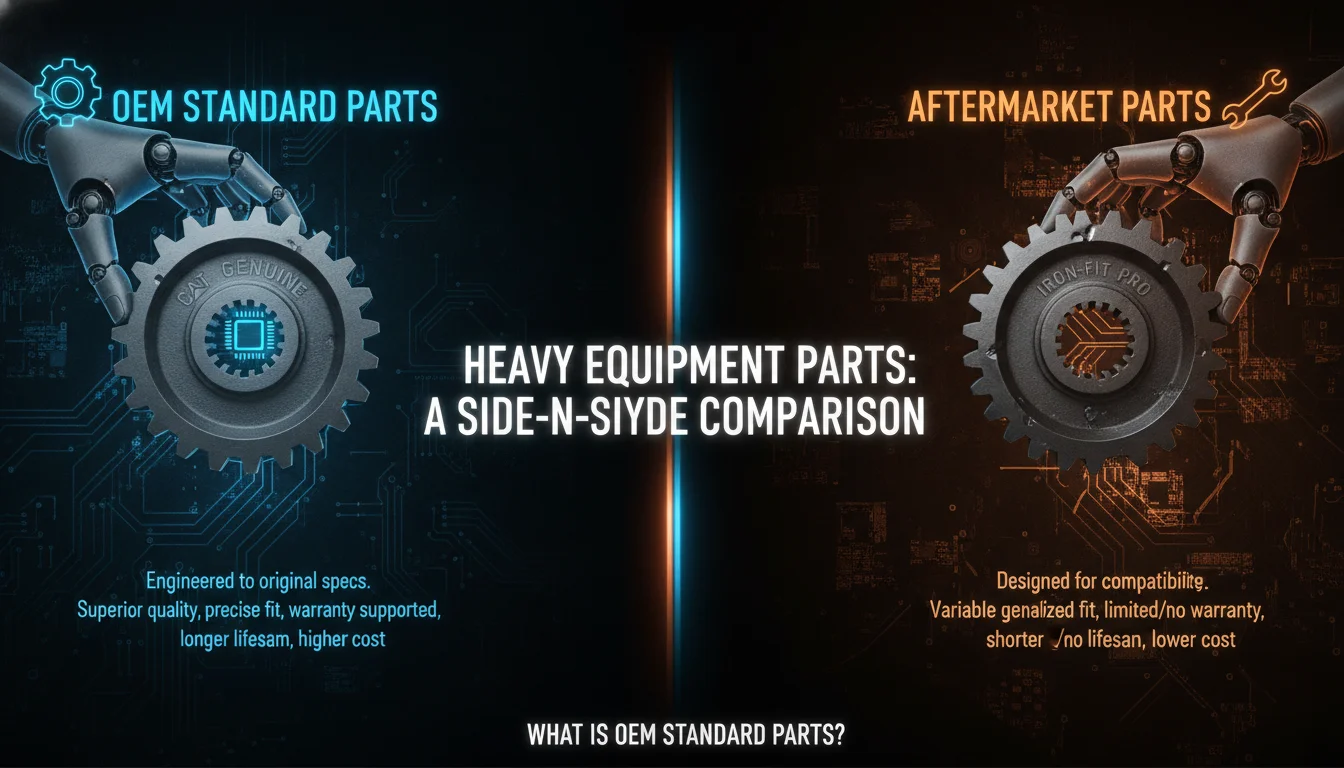
Choosing between OEM and aftermarket parts isn't simply a question of brand loyalty. It's a decision about risk tolerance, budget, warranty exposure, and equipment lifecycle stage. The following comparison table summarizes the key differences that matter for heavy equipment operators.
| Factor | OEM Standard Parts | Aftermarket Parts |
|---|---|---|
| Manufacturer | Produced by the original equipment manufacturer or its contracted supplier to OEM specifications | Produced by third-party manufacturers with no direct link to the original machine builder |
| Fit and compatibility | Guaranteed exact fit and function with no modification required | May require modification; compatibility varies and isn't guaranteed across machine configurations |
| Quality consistency | High; controlled by manufacturer engineering standards and quality systems | Wide variation; some high quality, many low quality, with no uniform oversight |
| Warranty support | Often backed by manufacturer warranty and authorized dealer network | Usually limited to the aftermarket supplier, if offered at all |
| Initial cost | Higher upfront price due to engineering, brand, and quality control | Often cheaper upfront, with lower production standards and materials |
| Long-term cost risk | Lower risk of premature failure, cascading damage, and unplanned downtime | Higher risk of downtime, more frequent replacement, and damage to adjacent parts |
| Availability | Strong for current models through authorized distribution; limited for older or rare machines | Broader range of suppliers, often available from many shops and online sellers |
Quality, Materials, and Manufacturing Standards
The most consistent differentiator is quality control. OEM parts are produced under the manufacturer's material specifications, heat treatment protocols, and tolerance limits. Aftermarket producers may use inferior materials or less strict requirements to lower production cost. Titan Machinery notes that aftermarket manufacturers often utilize inferior materials and less strict requirements, so they tend to be notably cheaper upfront. That lower initial cost isn't always a bargain when the part fails early or damages surrounding components.
Cost Differences and Availability
Cost is the most visible difference. OEM parts carry a heftier price tag because they include engineering amortization, brand value, and rigorous quality assurance. Aftermarket parts are cheaper to produce and therefore cheaper to buy. However, availability cuts both ways. Titan Machinery explains that third-party manufacturers can spring up anywhere around the globe, so buyers have more aftermarket options, but with a much larger share of low-quality parts in that mix. For older or less common equipment models, OEM parts may become difficult to source as manufacturers reduce or cease production. In those cases, aftermarket parts may be the only available option, though sourcing OEM standard parts through a global specialist supplier can often bridge that gap for legacy Caterpillar, Komatsu, and Volvo fleets.
Warranty and Support Ecosystems
OEM parts come with a support structure that aftermarket parts rarely match. Certified dealers and authorized service centers can cross-reference part numbers, verify serial number breaks, and provide installation guidance. If a genuine part fails, the manufacturer has a documented path for warranty resolution. Aftermarket parts, by contrast, depend on the reputation and staying power of the third-party supplier. When a fleet manager chooses an aftermarket part to save money, they often accept that the support ecosystem will be thinner.
Pros and Cons of OEM Standard Parts
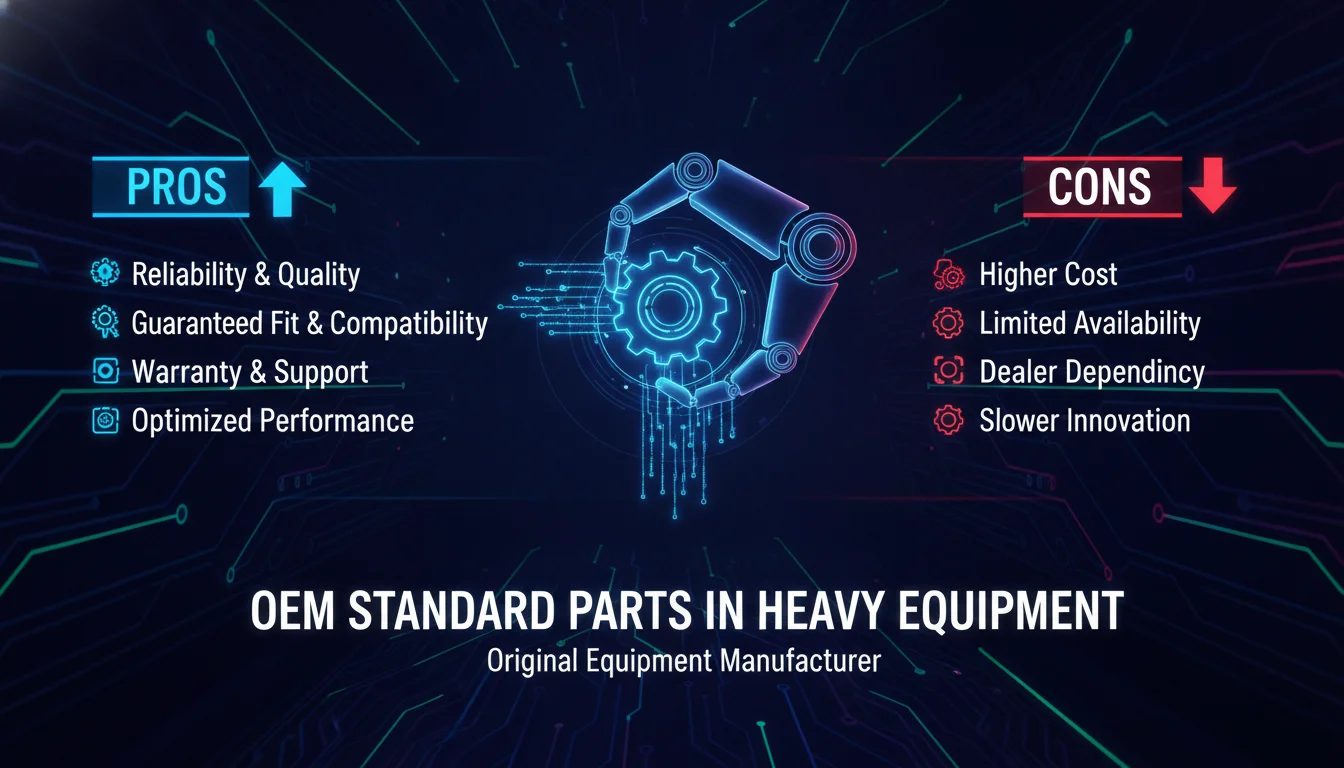
No parts decision is perfect for every situation. OEM standard parts in heavy equipment offer clear advantages, but they also carry drawbacks that fleet managers should weigh before purchasing.
Pros
- Guaranteed fit and function: OEM parts are engineered to the original equipment specifications, eliminating the risk of modification or misalignment.
- Warranty protection: Many manufacturers require OEM parts to keep the machine warranty intact, and genuine parts often carry their own manufacturer-backed warranty.
- Consistent quality: Controlled manufacturing processes and material specifications ensure that each batch of OEM parts performs like the original.
- Access through authorized channels: Well-established distribution networks supported by the original manufacturer include certified dealers and authorized service centers, simplifying procurement and authenticity verification.
- Reduced downtime risk: Because OEM parts fit and perform as designed, they lower the probability of premature failure, cascading damage, and unplanned maintenance.
Cons
- Higher upfront price: OEM parts typically cost more than aftermarket alternatives because of engineering rigor, brand value, and quality assurance.
- Sourcing challenges for older models: As equipment ages or becomes less popular, manufacturers may reduce or stop production of parts for those models, making OEM parts hard to find.
- Fewer customization options: OEM parts are designed to match original specifications, which limits tailoring or enhancing equipment beyond its initial design parameters.
- Supply chain dependency: Relying on OEM parts can create dependency on the manufacturer's supply chain and authorized dealers, potentially leading to less competitive pricing and delays.
When OEM Parts Are the Clear Choice
OEM parts are the clear choice when the equipment is under warranty, when uptime is critical, or when a failure could damage high-cost adjacent systems. Titan Machinery advises that if your machine is under a warranty that could be affected by aftermarket parts, or you want more uptime between part replacements and a guaranteed fit, OEM/genuine parts are the way to go. For high-hour machines operating in demanding conditions, such as mining, heavy civil construction, or municipal vacuum truck fleets, the risk of a non-OEM part failure often outweighs the upfront savings.
How to Verify Genuine OEM Heavy Equipment Parts
Verifying genuine OEM heavy equipment parts requires checking packaging integrity, cross-referencing part numbers against your equipment manual, and buying only through authorized dealers. Counterfeit and mislabeled parts exist in every major equipment market, and a part with a familiar logo or an “OEM quality” label isn't necessarily a genuine OEM part.
Step 1: Inspect Packaging, Labeling, and Traceability Indicators
Genuine OEM parts arrive in packaging that carries consistent manufacturer branding, correct manufacturing address, and intact seals. According to Joe Johnson Equipment's guidance published in MSW Magazine, key indicators of genuine OEM packaging include: the manufacturer brand is correct and consistent on all packaging, there are no broken seals or signs of repackaging, the packaging includes correct OEM information such as manufacturing address and ship-from location, and there is product traceability with date, lot number, and materials used. Bona fide warranty information should also be present.
Step 2: Cross-Check Part Numbers, Serial Numbers, and the Machine Manual
The second layer of verification is documentary. Always verify that the part number on the label matches your OEM heavy equipment manual. EquipmentShare and CASE Power & Equipment of Florida recommend knowing your machine's make, model, and serial number before ordering any part. Different makes, models, and production years of the same type of machine may require different parts. Serial number breaks occur when a manufacturer updates a machine's design during a production run. Understanding your machine's serial number break ensures you get the correct part for your specific unit, reducing the chance of ordering a component that won't work.
Step 3: Work with Authorized Dealers and Certified Service Centers
One of the strongest protections against counterfeit or misapplied parts is sourcing through authorized channels. Authorized dealers have access to the manufacturer's parts databases, technical service bulletins, and warranty systems. They can confirm whether a part fits your exact machine configuration. According to EquipmentShare, certified dealers and authorized service centers provide clear guidelines on compatibility and offer assurances backed by the supplier. This support simplifies the procurement process and provides peace of mind about a part's authenticity and quality. Our brands directory and parts categories pages are built around this same principle: verified compatibility before checkout.
Total Cost of Ownership: The Real Measure of OEM Value
Total cost of ownership, not the sticker price, is the real measure of OEM value because it accounts for installation labor, downtime, cascading damage, and replacement frequency over the life of the machine. Focusing on the initial purchase price of a heavy equipment part is a common mistake.
Initial Price vs. Long-Term Savings
OEM parts are engineered to precise specifications for optimal fit and function. That precision reduces the risk of misalignment and premature wear and tear that lead to high maintenance costs. Aftermarket parts may offer low prices, but inferior quality, fit, and function can create performance, reliability, and useful life issues that often cost more in the long run. Joe Johnson Equipment's guidance states that investing in genuine OEM parts can have a significant impact on machine life, job site performance, maintenance costs, and productivity.
Downtime and Cascading Failure Costs
Unplanned downtime is expensive. When a machine stops, the crew waits, the schedule slips, and project overhead continues. Aftermarket parts designed to fit a wide range of similar heavy machinery brands may appear to meet OEM specifications but often offer varying levels of quality and fit. This variability can lead to unplanned downtime, more frequent preventive maintenance part replacement, and cascading failures that damage other machine parts. Those hidden costs quickly erase any initial savings from choosing a cheaper aftermarket component.
Fleet-Wide Standardization and Inventory Management
For multi-machine fleets, standardizing on OEM standard parts reduces the number of part numbers, suppliers, and failure variables. A fleet running Caterpillar, Komatsu, Volvo, Deere, or Case machines can maintain OEM parts inventories aligned with each manufacturer's recommended replacement intervals. This approach simplifies training for service technicians, ensures consistent warranty documentation, and makes it easier to forecast parts budgets. Aftermarket sourcing across multiple vendors, by contrast, introduces variability that's difficult to control at scale.
Pro Tip: Build a parts criticality matrix ranking components by failure impact. Powertrain, hydraulics, and structural parts should default to OEM standard parts; low-risk wear items like filters or cab accessories may tolerate vetted aftermarket alternatives.
5 Steps for Sourcing the Right OEM Standard Parts
Sourcing the right OEM standard parts in heavy equipment requires five disciplined steps: document machine identity, identify the serial number break, cross-reference the part number, order through authorized channels, and inspect on delivery.
Step 1: Document Machine Identity
Record the equipment make, model, and factory serial number in a central place accessible to every technician and parts clerk.
Step 2: Identify the Serial Number Break
Check whether your machine falls before or after known manufacturer design changes. A part that fits an earlier serial number range may not fit a later one.
Step 3: Cross-Reference the OEM Part Number
Locate the correct part number in the manufacturer's service manual or electronic parts catalog and pay attention to revision codes, date ranges, and configuration options such as auxiliary hydraulics, high-flow systems, or emissions tier.
Step 4: Source Through Authorized Channels
Order from a certified dealer, authorized service center, or a reputable OEM parts supplier that sources direct from the manufacturer. This is exactly where a global supplier network matters. As of 2026, buyers sourcing OEM standard parts internationally should confirm the supplier's traceability documentation before wiring payment, not after.
Step 5: Inspect Upon Delivery
Check the packaging for consistent manufacturer branding, intact seals, no signs of repackaging, correct manufacturing address, product traceability, and warranty information before installation.
Common Misconceptions About OEM Parts
Three misconceptions persist around what OEM standard parts in heavy equipment actually guarantee. First, that OEM parts are always more expensive in the long run: while initial price is higher, total cost of ownership may be lower when reliability and uptime are considered. Second, that all aftermarket parts are inferior: some high-quality aftermarket components exist, especially for low-risk items, but verifying quality before failure is difficult. Third, that any part with the manufacturer's logo is genuine: counterfeit parts exist, and a logo alone isn't proof of authenticity.
Final Recommendation for Heavy Equipment Fleets
For heavy equipment fleets that depend on uptime, safety, and long service life, OEM standard parts are usually the strongest choice, especially for critical powertrain, hydraulic, and structural components. The most effective parts strategy isn't “always OEM” or “always aftermarket,” but a disciplined evaluation of criticality, warranty exposure, and total cost of ownership. By verifying genuine OEM standard parts through packaging, documentation, and authorized channels, fleet managers can make confident decisions that protect both their machines and their bottom line. For deeper maintenance context, see our guides on hydraulic seal kit replacement and excavator undercarriage maintenance.
We supply OEM-standard and OEM-matched spare parts for Caterpillar, Komatsu, Volvo, Atlas Copco, and 40+ heavy equipment brands, with traceability documentation on every shipment. Shop OEM-quality spare parts with global 5-day delivery at 3genexport.com.
Frequently Asked Questions
What does OEM mean in heavy equipment parts?
OEM stands for original equipment manufacturer. In heavy equipment, an OEM part is a replacement component made by the same company that built the original machine, using the same specifications and quality standards.
Are OEM parts better than aftermarket parts for heavy equipment?
OEM parts generally offer better guaranteed fit, quality, and warranty support. Aftermarket parts can be cheaper upfront but carry higher risks of compatibility issues and premature failure, especially in critical systems.
Do OEM parts come with a warranty?
Yes. Many OEM parts include a manufacturer-backed warranty, and using OEM parts may be necessary to maintain the machine's original warranty. For example, Titan Machinery offers a 12-month parts/service warranty on genuine CNHi parts installed by their technicians.
How can I verify that a heavy equipment part is genuine OEM?
Check packaging for consistent manufacturer branding, no broken seals, correct manufacturing address, and product traceability with date and lot number. Always cross-reference the part number in your machine's manual and purchase from authorized dealers.
Why are OEM parts more expensive?
OEM parts cost more because they include engineering development, high-quality materials, stricter production standards, brand value, and manufacturer-backed warranty support. The higher price often translates to lower long-term risk and downtime.
Can I use aftermarket parts without voiding my equipment warranty?
It depends on the manufacturer's warranty terms. Many heavy equipment manufacturers require OEM parts to keep warranty coverage intact. Installing aftermarket parts on a machine under warranty may jeopardize coverage, so check your warranty documentation before purchasing.